
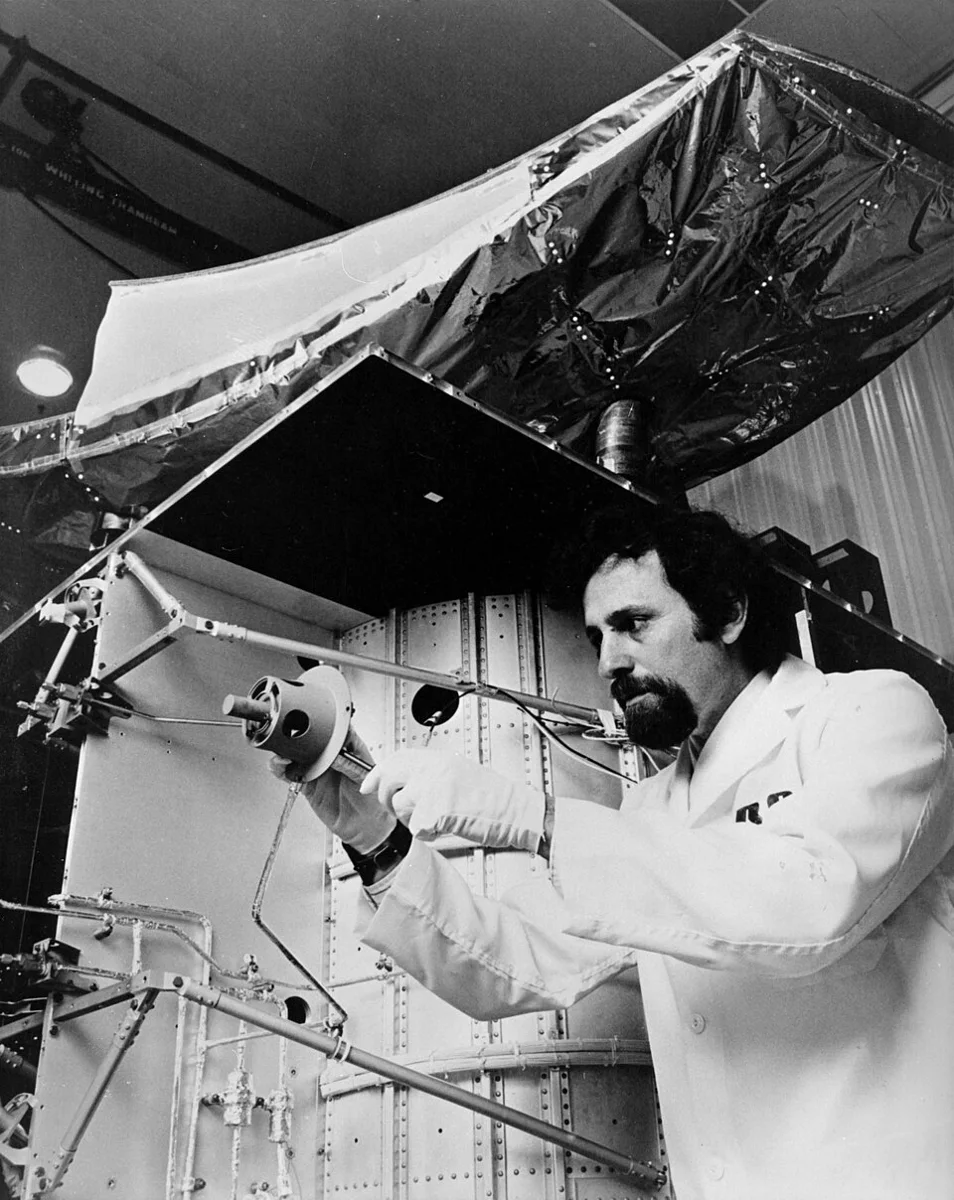
RCA Satcom communications satellite during engineering work; a US example for comparison with Indian systems.
Credit: NASA · Public domain · sourceResized and converted to WebP; uncropped.
1. Working principle and major components
A communication satellite acts as a relay in space. An Earth station sends an uplink carrying voice, video or data. The satellite receives it through an antenna and retransmits it as a downlink towards a selected coverage area, called its footprint. A connection normally includes user terminals, the satellite, gateway Earth stations and terrestrial networks. Unlike a remote-sensing satellite, whose primary task is to observe Earth, a communication satellite primarily transports information between users.
Its communication payload contains antennas and transponders. In a conventional bent-pipe transponder, the received signal is filtered, shifted to another frequency and amplified before retransmission. Frequency separation reduces interference between reception and transmission. Regenerative payloads can additionally demodulate, process or route information on board. Thus, the statement that every communication satellite merely reflects radio waves without processing them is incorrect.
The satellite bus supports the payload through solar arrays, batteries, thermal control, attitude control and propulsion. Telemetry, tracking and command systems monitor its health and control operations. Station-keeping manoeuvres maintain the intended position and orientation. Antennas may provide broad regional coverage or narrow spot beams; the latter concentrate power and permit frequency reuse, increasing capacity.
- Uplink: Earth-to-satellite transmission; downlink: satellite-to-Earth transmission.
- Ground segment: gateways, control centres and user terminals.
- Space segment: satellites and their communication and support systems.
Timeline
1975–76
SITE used ATS-6 for experimental educational television broadcasting in India.
1981
APPLE demonstrated India's experimental communication satellite technology.
1983
INSAT-1B was launched, helping establish operational multipurpose satellite services.
2004
EDUSAT, India's education-focused communication satellite, was launched.
2024
NSIL's GSAT-N2 high-throughput communication satellite was launched.
2. Why orbital choice matters
Geostationary orbit is particularly useful for broadcasting and fixed communication services because an antenna on Earth can continuously point towards the same location in the sky. The satellite's orbital period equals Earth's sidereal rotation period, approximately 23 hours 56 minutes. Geostationary orbit is a special case of geosynchronous orbit: a geosynchronous satellite need not be equatorial or circular and therefore need not appear stationary.
A single geostationary satellite covers a large region. Three suitably spaced satellites can provide extensive coverage across most inhabited latitudes, but not reliable coverage of the entire globe, especially the polar regions. Their great distance also introduces delay: a ground-to-satellite-to-ground journey takes roughly 240 milliseconds from propagation alone, with a corresponding round trip approaching half a second before processing and network delays.
Low Earth orbit constellations operate much closer to Earth and can offer lower latency and smaller path losses. However, each satellite moves rapidly relative to users, requiring tracking, handovers and numerous satellites for continuous wide-area service. Medium Earth orbit systems provide an intermediate trade-off. Highly elliptical orbits can support high-latitude communications. No orbit is universally best: service requirements, cost, coverage and terminal design determine the choice.
- Geostationary advantages: persistent regional coverage and simpler fixed ground antennas.
- LEO challenges: constellation maintenance, collision avoidance, handovers and replacement launches.
A conventional satellite communication link
- 1. User information reaches a transmitting Earth station.
- 2. The Earth station sends a modulated uplink.
- 3. The transponder filters, frequency-shifts and amplifies the signal.
- 4. The satellite antenna sends a downlink within its footprint.
- 5. A receiving terminal decodes the signal and delivers the information.
3. Frequency bands, capacity and limitations
Satellite communication uses several microwave bands. C band is associated with broadcasting and fixed satellite links; Ku band is widely used for direct-to-home television and VSAT networks; Ka band supports many high-capacity broadband systems. L and S bands also support selected mobile and specialised services. A band name covers a range of frequencies, not a single universal uplink or downlink allocation.
Higher-frequency Ku and especially Ka links are more vulnerable to rain attenuation than C-band links. Heavy rainfall can absorb and scatter radio energy, weakening reception. Designers use link margins, adaptive coding and modulation, uplink power control and geographically separated gateways to maintain service. Lower-frequency bands generally offer better resistance to rain, but available spectrum, interference conditions and antenna requirements also influence system design.
High-throughput satellites use multiple spot beams and extensive frequency reuse to deliver much greater aggregate capacity than traditional wide-beam designs. Capacity is not identical to the speed available to each subscriber, which also depends on shared demand and gateway infrastructure. Other constraints include limited spacecraft power, launch costs, solar interference during seasonal sun outages and interference between networks. Satellite access also requires a clear view of the sky; it does not guarantee reliable reception deep inside buildings.
- VSAT means Very Small Aperture Terminal, commonly used for enterprise and remote-area links.
- Latency measures delay; throughput measures the rate of successful data transfer.
| Orbit | Typical altitude | Main advantage | Main limitation |
|---|---|---|---|
| Geostationary | About 35,786 km | Continuous regional coverage with fixed antennas | High latency and poor polar coverage |
| Low Earth orbit | Commonly a few hundred to about 2,000 km | Low propagation delay | Many satellites and frequent handovers |
| Medium Earth orbit | Between LEO and geosynchronous altitude | Coverage–latency compromise | Tracking and constellation management |
| Highly elliptical orbit | Altitude varies substantially | Long dwell time over selected high-latitude regions | Variable distance and periodic satellite handovers |
4. India's communication satellite ecosystem
India's early experiments included the Satellite Instructional Television Experiment of 1975–76, which used the American ATS-6 satellite for educational broadcasting. APPLE, launched in 1981, demonstrated an indigenous experimental communication satellite. INSAT-1B, launched in 1983, helped establish large-scale operational satellite services. The multipurpose INSAT system brought together telecommunications, television broadcasting and meteorological functions, although every individual satellite does not carry all these payloads.
GSAT satellites expanded and diversified India's communication capabilities. EDUSAT, or GSAT-3, launched in 2004, was dedicated to education. GSAT-11, launched in 2018, strengthened high-throughput broadband capacity. GSAT-N2, also called GSAT-20, was launched aboard a Falcon 9 rocket in November 2024. This NSIL-owned Ka-band high-throughput satellite was designed to support broadband and in-flight connectivity, with multiple spot beams covering the Indian region.
Institutional roles must be distinguished. ISRO undertakes space research, technology development and missions. NewSpace India Limited, established in 2019, is a public-sector enterprise responsible for commercial space activities. IN-SPACe, established in 2020, promotes and authorises non-government space activities. The Department of Telecommunications handles relevant telecom and spectrum responsibilities, while the International Telecommunication Union provides the international framework for coordinating radio-frequency use and associated satellite orbit resources.
- Indian Space Policy 2023 enables greater non-government participation across space activities.
- INSAT/GSAT communication services should not be confused with NavIC's primary positioning, navigation and timing functions.
5. Applications, strategic value and governance
Communication satellites deliver DTH television, connect remote bank branches and offshore installations, support telemedicine and distance learning, and provide backhaul for telecom networks. They are particularly useful in islands, mountains and sparsely populated areas where laying fibre is difficult. During disasters, portable satellite terminals can restore essential links when terrestrial infrastructure fails, although terminals still need power, trained users and suitable visibility.
Their strategic importance extends to secure defence communications, maritime connectivity and resilient national infrastructure. Nevertheless, satellite links face cyberattacks, jamming and interception risks. Encryption, authentication, network redundancy and interference monitoring are therefore essential. Large constellations also raise concerns about orbital congestion, debris and effects on astronomical observations.
Good policy must balance affordable access with spectrum coordination, security and sustainable orbital use. End-of-life measures include moving geostationary satellites to disposal orbits above the operational belt and arranging timely deorbiting of lower-orbit spacecraft. Satellite broadband can narrow the digital divide, but equipment costs and subscription charges may constrain adoption. Universal connectivity requires integration with terrestrial infrastructure and public-service delivery systems.
- Exam distinction: communication, Earth observation and navigation are different primary missions, even when their applications overlap.
- Resilience requires diverse communication routes, not dependence on one satellite or constellation.
Communication Satellites: Relay Payloads and Orbital Control
The supplied metadata identifies an RCA Satcom communications satellite undergoing propulsion-related engineering work. This US example illustrates a key distinction: the communications payload relays signals, while the spacecraft bus supplies power, propulsion, thermal regulation and pointing control. A conventional transponder receives an uplink, filters and amplifies it, shifts its frequency and retransmits it as a downlink. Separate uplink and downlink frequencies help prevent interference between reception and transmission.
Geostationary satellites operate in circular equatorial orbits approximately 35,786 km above Earth, matching its rotation and appearing fixed to ground observers. This permits continuous regional coverage with fixed ground antennas, but introduces greater signal delay than lower orbits. Geosynchronous does not automatically mean geostationary: inclination or eccentricity can produce apparent motion across the sky. Thrusters support station-keeping and, depending on spacecraft design, attitude control. The metadata’s reference to “altitude control” should not obscure the distinction between maintaining orbital position and controlling spacecraft orientation.
For India, INSAT and GSAT systems demonstrate comparable applications in broadcasting, telecommunications and connectivity for remote areas. However, this American spacecraft is comparative material, not evidence of Indian satellite hardware or capabilities. Metadata alone cannot establish its detailed payload configuration or operating performance.
- Station-keeping maintains the intended orbit; attitude control directs antennas and solar arrays appropriately.
- Higher-frequency Ku/Ka links can support substantial capacity, but rain attenuation matters in India’s monsoon conditions.
- Satellite communication requires a complete ground–space network; spacecraft coverage alone does not guarantee affordable, reliable last-mile access.
Real-world case studies
SITE: communication technology for development
During 1975–76, SITE broadcast educational programmes to about 2,400 villages in six Indian states using ATS-6. It demonstrated how satellite broadcasting could reach dispersed rural audiences and provided experience relevant to India's subsequent operational satellite services.
EDUSAT: connecting educational institutions
Launched in September 2004, GSAT-3 supported satellite-based education through broadcasting and interactive classroom networks. It illustrated the public-service value of dedicated communication capacity, while also showing that connectivity must be supported by teaching content, local equipment and trained personnel.
Previous year questions
No source-linked PYQ is available here yet. Use the practice questions below.
Practice questions
Practice MCQ 1
Consider the following statements: 1. Every geosynchronous satellite appears stationary to an observer on Earth. 2. A geostationary satellite must orbit in Earth's equatorial plane. 3. A geostationary satellite's orbital period equals Earth's sidereal rotation period. Which statements are correct?
- A. 1 and 2 only
- B. 2 and 3 only
- C. 1 and 3 only
- D. 1, 2 and 3
Practice MCQ 2
With reference to satellite communication, consider the following statements: 1. Spot beams can enable frequency reuse. 2. Ka-band links are generally less susceptible to rain attenuation than C-band links. 3. A conventional transponder can change a received signal's frequency before retransmission. Which statements are correct?
- A. 1 only
- B. 2 and 3 only
- C. 1 and 3 only
- D. 1, 2 and 3
Practice MCQ 3
Which pair is correctly matched?
- A. APPLE — India's first operational navigation constellation
- B. EDUSAT — Communication satellite dedicated to education
- C. IN-SPACe — International allocator of satellite radio frequencies
- D. GSAT-N2 — Low Earth orbit optical imaging satellite
Mains practice · Communication satellites can strengthen digital inclusion and disaster resilience, but cannot substitute for all terrestrial infrastructure. Discuss with reference to India. (150 words)
- Explain wide-area connectivity, broadcasting and telecom backhaul.
- Use examples from islands, mountain settlements, education and emergency communication.
- Mention INSAT/GSAT and emerging high-throughput services.
- Assess latency, affordability, rain attenuation, terminal requirements and capacity sharing.
- Conclude with integrated satellite–terrestrial networks, redundancy and sustainable spectrum and orbital management.
Further reading
- ISRO official website: Communication Satellites, INSAT, GSAT, APPLE and EDUSAT mission pages.
- NewSpace India Limited official website: GSAT-N2 mission information.
- Department of Space: Indian Space Policy 2023 and annual reports.
- International Telecommunication Union: Radio Regulations and satellite network coordination resources.
- NCERT, Fundamentals of Human Geography: Transport and Communication.
- https://commons.wikimedia.org/wiki/File:Satcom,_Communication_Satellite_-_GPN-2003-00010.jpg
Preparing for UPSC Civil Services? Get classroom teaching, answer-writing evaluation and mentorship at Pragnya IAS Academy, Ashok Nagar — see why aspirants choose us for IAS coaching in Hyderabad.