
Falkland Islands (Malvinas)
South Atlantic Ocean
Falkland Islands (Malvinas): Tribunal rejects bid to halt Sea Lion oil project
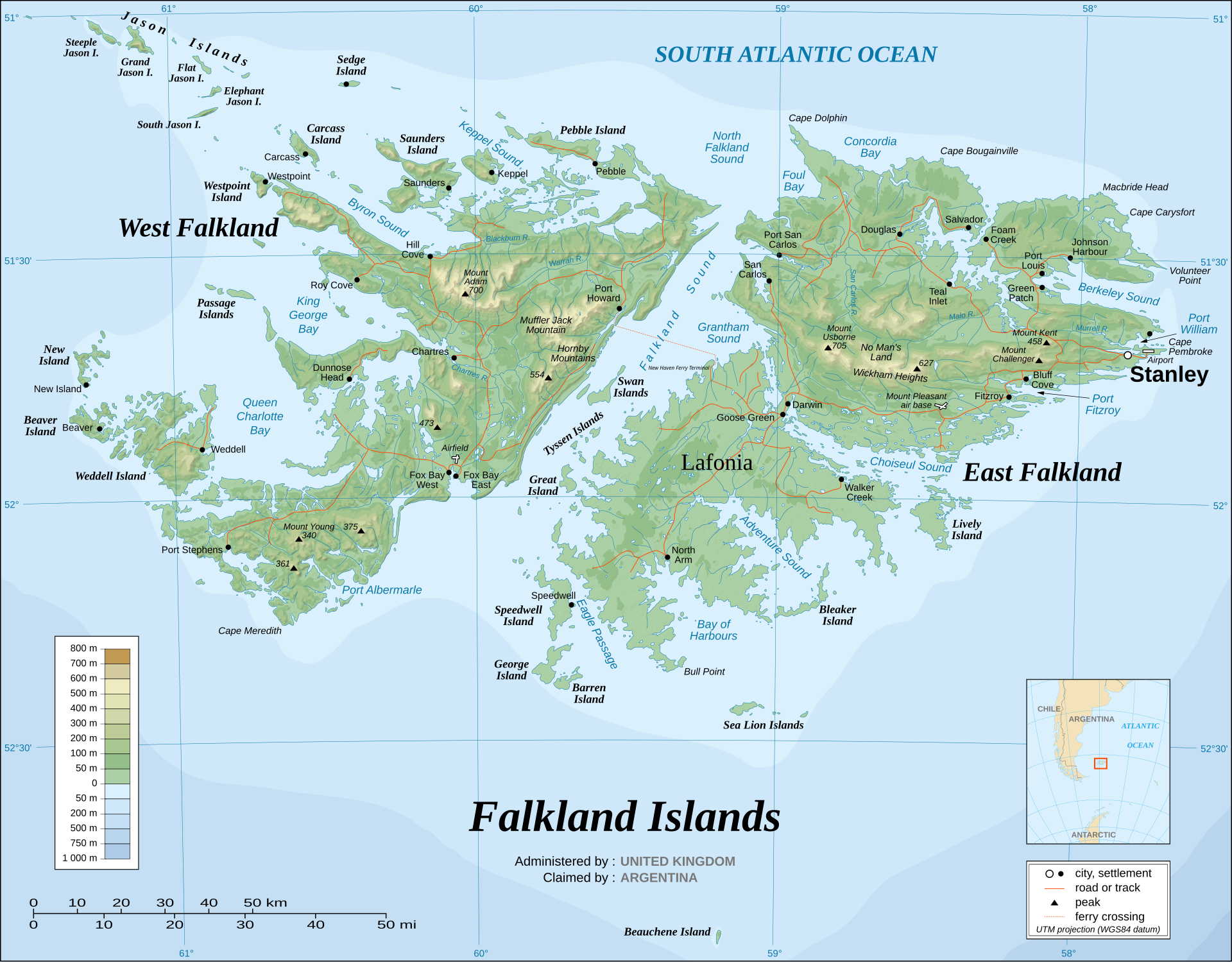
The Falkland Islands (Malvinas) are an archipelago in the South Atlantic Ocean, comprising East Falkland, West Falkland and numerous smaller islands. They are administered by the United Kingdom as a British Overseas Territory and claimed by Argentina.
Position matched with OpenStreetMap; the dashed outline shows its mapped extent. Other numbered pins are the day's other places — tap one to open it.
Why in the news
The International Tribunal for the Law of the Sea rejected Argentina’s request to halt the Sea Lion oil project north of the islands. The tribunal said the case could not be separated from the dispute over sovereignty over the islands.
Ocean
South Atlantic Ocean
Capital
Stanley
Main islands
East Falkland and West Falkland
Highest point
Mount Usborne
Separating channel
Falkland Sound
Political status
British Overseas Territory; sovereignty claimed by Argentina
Location
- Lie east of southern Patagonia, off the southern part of South America.
- Located northeast of Cape Horn and west of South Georgia.
- East Falkland and West Falkland are separated by Falkland Sound.
- Stanley, the capital, lies on the eastern side of East Falkland.
Nearby mainland and islands
- Argentina’s Patagonian coast to the west
- Tierra del Fuego to the southwest
- South Georgia to the east
Key features
- Archipelago
- Two principal islands, East Falkland and West Falkland, dominate the island group.
- Falkland Sound
- The marine channel separating the two main islands.
- Relief
- Low hills and upland ridges alternate with broad plains; Mount Usborne on East Falkland is the highest point.
- Coastline
- Deeply indented shores contain numerous bays, inlets and natural harbours.
- Stone runs
- Extensive accumulations of angular rock blocks are distinctive landforms associated with past cold-climate weathering.
- Offshore basin
- The North Falkland Basin lies north of the islands and contains the Sea Lion oil field.
Flora, fauna & ecology
- Climate
- Cool, windy maritime conditions prevail, with limited seasonal temperature variation.
- Vegetation
- Largely treeless landscapes support grasslands, dwarf-shrub heath and peatlands; tussac grass is important along coasts and on smaller islands.
- Wildlife
- The islands support breeding penguins, black-browed albatrosses and other seabirds, alongside seals and sea lions.
History & significance
- The islands are the subject of a long-standing sovereignty dispute between Argentina and the United Kingdom.
- Argentina and the United Kingdom fought a war over the islands in 1982; British administration was restored after the conflict.
UPSC angle
- Prelims mapping: locate the archipelago relative to Patagonia, Tierra del Fuego, Cape Horn and South Georgia.
- GS I: island physiography, maritime climate, coastal ecosystems and cold-climate landforms.
- GS II: territorial disputes, the law of the sea and the relationship between maritime jurisdiction and land sovereignty.
- GS III: offshore hydrocarbon development and environmental concerns in ecologically sensitive marine regions.
Also locate on your map
- Patagonia
- Tierra del Fuego
- Cape Horn
- Strait of Magellan
- Drake Passage
- South Georgia
- South Sandwich Islands
- North Falkland Basin
Test yourself
Q1. Which of the following correctly describes the location of the Falkland Islands (Malvinas)?
Q2. Consider the following statements about the Falkland Islands (Malvinas): 1. Falkland Sound separates East Falkland from West Falkland. 2. Stanley is located on East Falkland. 3. Mount Usborne is the highest point of the archipelago. Which of the statements given above are correct?
Sources
Background maps and imagery © Esri and partners (English labels); place positions checked with OpenStreetMap (ODbL). Boundaries are for study reference only. Prepared by Pragnya IAS Academy for exam revision.