
AI-Enabled Warfare: UNIDIR Warns of Eroding Human Control and Escalation Risks
Revise the static topic: UPSC Internal Security notes
In short: The United Nations Institute for Disarmament Research has warned that expanding military use of artificial intelligence is rapidly reducing the role of human judgement, including in the nuclear domain. Faster targeting and opaque systems heighten the risks of error and unintended escalation, making meaningful human control, legal accountability and international safeguards critical.

Reference image: A Shark Raybird 3 military drone on its launcher. Military drones provide context for debates over targeting and human control; the image does not establish whether this aircraft uses AI or autonomous targeting.
Image: UN News
Why in news
UNIDIR Director Robin Geiss warned at a UN Headquarters briefing that AI is increasingly crowding out human decision-making in warfare. He also outlined an upcoming multi-stakeholder forum addressing responsible industry behaviour, shared terminology and misuse by non-State armed groups.
Background
UNIDIR is an autonomous institution within the United Nations that conducts research on disarmament and security. Military AI encompasses intelligence analysis, decision support, cyber operations and weapons applications; it is not synonymous with autonomous weapons. Discussions on lethal autonomous weapon systems take place under the Convention on Certain Conventional Weapons. International humanitarian law governs the conduct of hostilities regardless of the technology employed, including through the principles of distinction, proportionality and precautions in attack.
What UNIDIR has warned about
According to the briefing, AI is already used for intelligence analysis, target identification, drone operations and the orchestration of cyber-attacks. Its growing responsibilities compress the interval between identifying and striking targets, while expanding the number of targets forces can engage.
The central concern is not speed alone, but speed combined with opacity and declining human judgement. When operators cannot adequately understand or question an output before acting, errors can propagate into military decisions and unintended escalation.
- UNIDIR specifically flagged the erosion of human judgement in the nuclear domain.
- Easier access to AI tools could enable non-State actors to conduct more sophisticated military operations.
- Geopolitical competition remains a major obstacle to common safeguards.

Reference image: Hiroshima Peace Memorial Park, with the Genbaku Dome in the background. The memorial underscores the consequences of nuclear warfare, relevant to UNIDIR’s warning about AI-related error and escalation in the nuclear domain.
Image: UN News
Infographic
Human control
Preserve informed judgement and effective authority over force.
Legal compliance
Apply distinction, proportionality and precautions.
Technical assurance
Test reliability and constrain operational behaviour.
Accountability
Record decisions and enable investigation.
Global cooperation
Combine binding rules, shared terms and incident communication.
AI-assisted infographic by Pragnya IAS Academy, based on the cited sources.
Meaningful human control: substance, not a nominal approval
Meaningful human control is a governance concept rather than a universally settled legal formula. Its central requirement is that humans retain informed and effective authority over decisions involving force, rather than merely approving machine-generated recommendations.
An operator's presence does not itself establish meaningful control. Control depends on understanding system limitations, having sufficient time and contextual information to assess an action, and possessing the practical ability to intervene. Design restrictions and operational boundaries also matter, especially where real-time intervention is difficult.
- Human judgement should shape mission objectives, target restrictions and conditions of deployment.
- Systems should operate within defined limits on location, duration and permitted target categories.
- Operators should be able to withhold, suspend or terminate actions where required and feasible.
- Testing should establish behaviour under uncertainty, adversarial interference and communications failure.
International humanitarian law and accountability
AI does not displace international humanitarian law. Distinction requires attacks to be directed at lawful military targets rather than civilians or civilian objects. Proportionality prohibits attacks expected to cause incidental civilian harm excessive in relation to the concrete and direct military advantage anticipated. Precautions require feasible measures to avoid or minimise civilian harm.
These duties involve contextual assessment, not merely technical classification. A system's ability to recognise an object does not establish that attacking it is lawful in the circumstances. Machine recommendations therefore cannot substitute for the legal assessment required of those planning or deciding upon attacks.
There is no automatic legal vacuum: States remain responsible for internationally wrongful conduct attributable to them, and individuals may incur criminal responsibility where the relevant legal requirements are met. However, opaque models and dispersed development and deployment chains can make evidence, causation and individual responsibility harder to establish.
- Article 36 of Additional Protocol I requires States party to that Protocol to review the legality of new weapons, means or methods of warfare.
- Command responsibility is not automatic liability for every machine-caused harm; its applicable legal conditions must be established.
- System logs, documented authorisations and traceable updates can support investigation and accountability.
Global governance: binding rules and practical confidence-building
The UN Secretary-General has repeatedly called for stronger regulation of military AI and a legally binding treaty on lethal autonomous weapon systems. This is a call for further rule-making, not evidence that such a treaty has already been adopted.
UNIDIR announced an upcoming forum through its Centre of Excellence on AI, Peace and Security. Its priorities include voluntary guidance for responsible industry behaviour, an AI security lexicon and measures addressing misuse by non-State armed groups.
The source also reports a United States proposal in September for an AI notification mechanism with China covering incidents that could threaten national security. It should be understood as a proposal, not an established bilateral arrangement. Such confidence-building measures could complement, but not replace, substantive legal safeguards.
- Shared terminology can reduce ambiguity over autonomy, safety and security.
- Industry guidance can embed safeguards at the design and development stage.
- Incident notification can help prevent technical failures from being misread as deliberate hostile acts.
- Binding rules, technical standards and operational restraint should be pursued together.
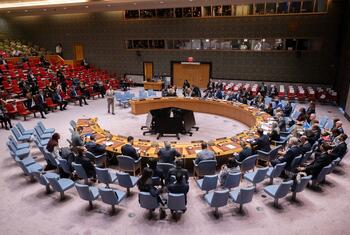
Reference image: Delegates around the UN Security Council table in New York. This illustrates a setting for international security diplomacy, not a meeting on the UNIDIR warning, and accompanies discussion of international safeguards for military AI.
Image: UN News
| Application | Principal concern | Priority safeguard |
|---|---|---|
| AI-assisted intelligence and targeting | Incorrect recommendations and automation bias | Independent verification and sufficient human review time |
| Autonomous target selection and engagement | Loss of contextual judgement over the use of force | Predictable behaviour, operational limits and effective human control |
| AI-enabled cyber operations | Rapid propagation and unintended effects | Bounded authorisations, testing and termination mechanisms |
| AI support in the nuclear domain | Compressed decision time and unintended escalation | Preserved human decision authority and robust verification |
- 1. Incomplete, manipulated or ambiguous data enter an AI system.
- 2. The system generates an incorrect assessment or target recommendation.
- 3. Operational speed and automation bias weaken human scrutiny.
- 4. A harmful action is authorised or executed.
- 5. An adversary interprets the action as deliberate escalation.
- 6. Retaliation compounds the original error.
Significance, challenges & way forward
Significance
- Preserving human judgement protects civilian life and maintains responsibility for decisions involving force.
- Controlling military AI risks is a strategic-stability concern, particularly where nuclear decision-making is involved.
- Clear standards can guide procurement and innovation without treating every military AI application as equally risky.
- For India, the issue connects defence modernisation with cyber security, counter-terrorism and multilateral technology governance.
Challenges
- Machine-speed operations can leave humans with formal authority but insufficient time for meaningful scrutiny.
- Opaque systems can obstruct validation, legal review and post-incident investigation.
- Geopolitical rivalry and military secrecy make transparency and verification difficult.
- Different understandings of autonomy and safety impede agreement on common rules.
- Dual-use tools and wider accessibility complicate efforts to prevent misuse by non-State armed groups.
- Software updates and changing operational environments can invalidate earlier safety assumptions.
Way forward
- Adopt risk-based safeguards, with the strongest restrictions where civilian harm, unpredictability or escalation risks are greatest.
- Specify human authority, operational boundaries and intervention requirements before deploying AI-enabled systems.
- Integrate legal scrutiny, adversarial testing and civilian-harm assessment into development, procurement and deployment.
- Maintain auditable records of system versions, recommendations, authorisations and operational outcomes.
- Preserve human decision authority in nuclear matters and avoid dependence on unverified AI assessments.
- Pursue binding international rules alongside incident-notification channels, shared terminology and practical industry standards.
- India should connect defence AI development with legal expertise, operator training and active participation in multilateral discussions.
Key terms
- Meaningful human control
- Informed and effective human authority over the use of force, rather than nominal approval of automated decisions.
- Autonomous weapon system
- A weapon system that, once activated, can select and engage targets without further human intervention; definitions remain contested.
- Automation bias
- The tendency to over-rely on automated outputs despite conflicting evidence or uncertainty.
- Distinction
- The obligation to distinguish civilians and civilian objects from lawful military targets.
- Proportionality in attack
- The prohibition of attacks expected to cause incidental civilian harm excessive relative to the concrete and direct military advantage anticipated.
- Weapons review
- Legal assessment of whether a new weapon, means or method of warfare would be prohibited in some or all circumstances.
- Strategic stability
- A condition in which incentives for initiating conflict or escalating it are restrained.
Link with static syllabus
Prelims practice MCQs
Q1. With reference to military artificial intelligence, consider the following statements: 1. Its applications extend beyond weapon systems to intelligence analysis and cyber operations. 2. Every AI-assisted targeting system is necessarily an autonomous weapon. 3. A human operator's formal approval alone guarantees meaningful human control. Which of the statements given above is/are correct?
Q2. Consider the following pairs concerning international humanitarian law: 1. Distinction — Differentiating lawful military targets from civilians and civilian objects 2. Proportionality — Ensuring equal military losses on opposing sides 3. Precautions in attack — Taking feasible measures to avoid or minimise civilian harm Which of the pairs given above are correctly matched?
Q3. With reference to UNIDIR and military AI governance, consider the following statements: 1. UNIDIR is an autonomous research institution within the United Nations. 2. The announced forum's priorities include an AI security lexicon and responsible industry behaviour. 3. The reported United States proposal establishes that an AI incident-notification mechanism with China is already operational. Which of the statements given above are correct?
Q4. Article 36 of Additional Protocol I to the Geneva Conventions concerns which of the following?
Mains practice questions
GS 3 · 15 marks · 250 words
Meaningful human control, rather than the mere presence of a human operator, should guide the governance of AI-enabled warfare. Discuss with reference to international humanitarian law and accountability.
Frequently asked questions
Is all military AI an autonomous weapon?
No. Military AI also supports intelligence analysis, logistics, decision-making and cyber operations; autonomy in selecting and engaging targets is a distinct issue.
Does existing international humanitarian law apply to AI-enabled warfare?
Yes. Distinction, proportionality and precautions apply irrespective of the technology used, although AI can complicate compliance and investigation.
Why is human approval alone insufficient?
Approval may be merely nominal when an operator lacks time, contextual information or the ability to challenge the system. Meaningful control requires informed judgement and effective authority.
Has the reported US–China AI notification mechanism been established?
The supplied source reports a United States proposal. It does not establish that China accepted it or that the mechanism became operational.
Sources
Analysis prepared by the Pragnya IAS Academy current-affairs desk with AI assistance from the cited reports. Verify figures with the original sources.
Turn current affairs into marks
Join Pragnya IAS Academy's mentorship for daily answer-writing evaluation on stories like this — classroom programmes from a trusted name in IAS coaching in Hyderabad.