
MP High Court Strikes Down 27% OBC Quota: Reservation Ceiling and Evidence Test
Revise the static topic: UPSC Polity notes · UPSC Governance notes
In short: The Madhya Pradesh High Court has struck down the State’s 2019 law increasing OBC reservation from 14% to 27%, finding no extraordinary circumstances to justify breaching the judicially prescribed 50% ceiling. The ruling distinguishes entitlement to reservation from its permissible extent and highlights the need for evidence of inadequate representation when expanding public-employment quotas.
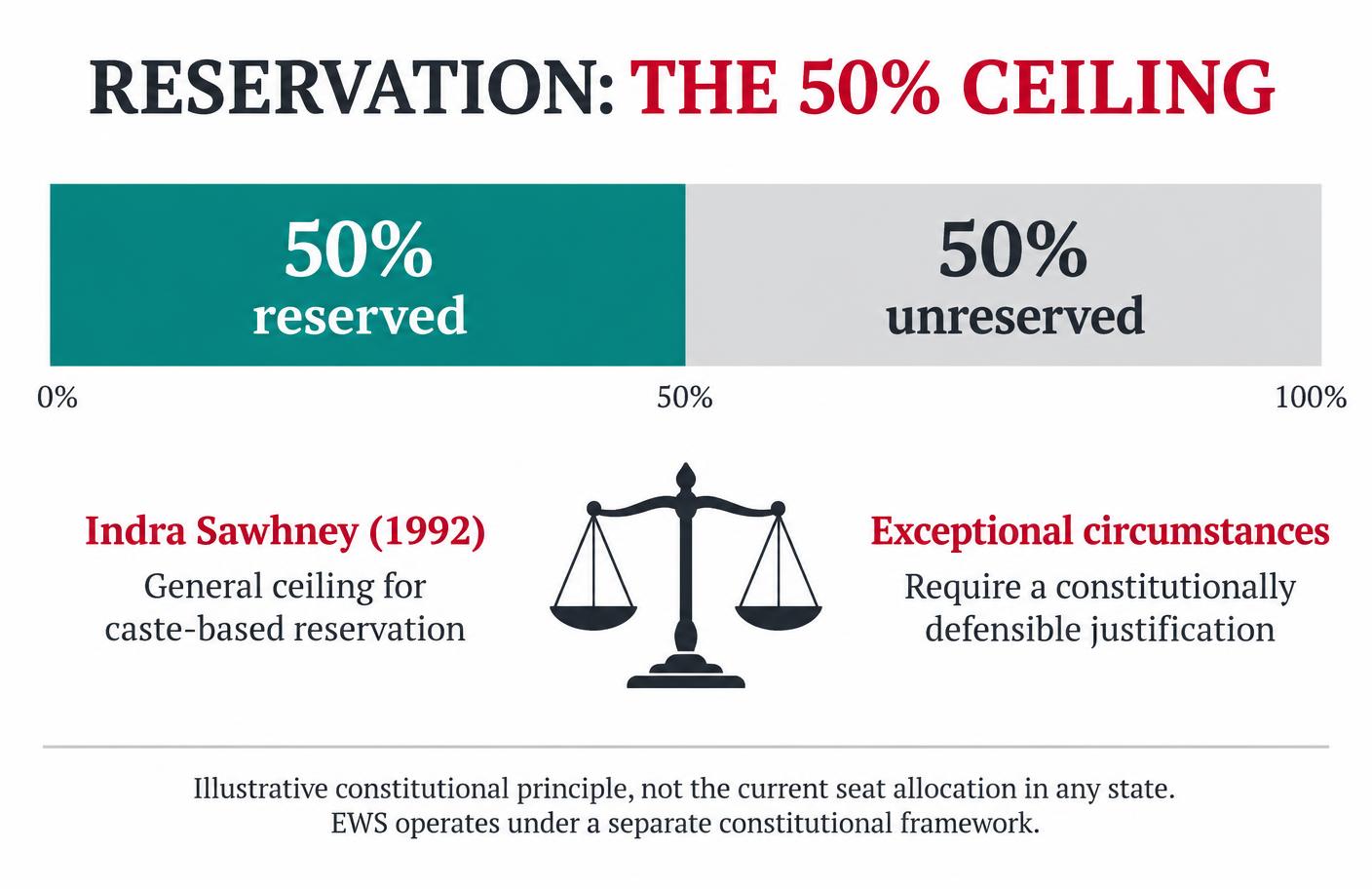
The general 50% ceiling for caste-based reservation from Indra Sawhney (1992). This illustrates a constitutional principle, not actual seat allocations; EWS has a separate constitutional framework.
Image: Pragnya IAS Academy · AI-assisted educational diagram
Why in news
The High Court invalidated the Madhya Pradesh Public Service (Reservation for Scheduled Castes, Scheduled Tribes and Other Backward Classes) Amendment Act, 2019. It also directed recruitment authorities to fill the withheld 13% posts from existing unreserved selection lists within three months, while protecting appointments made under the enhanced quota between March 2019 and September 2022.
27%
Enhanced OBC quota struck down
14%
OBC quota retained by the ruling
50%
Judicial ceiling at issue
87:13
Interim recruitment formula
13%
Posts withheld pending adjudication
Three months
Deadline to fill withheld posts
Background
Reservation is an instrument of substantive equality within India’s constitutional framework. Article 15 enables special provisions for disadvantaged groups in specified contexts, including education, while Article 16 governs equality of opportunity in public employment. Article 16(4) permits reservation for a backward class that, in the State’s opinion, is inadequately represented in its services. In Indra Sawhney, the Supreme Court established the general 50% ceiling for backward-class reservations, allowing departure only in exceptional circumstances; Jaishri Laxmanrao Patil reaffirmed this discipline. The ceiling is judicially evolved, not an express numerical limit written into Article 16(4).
What the High Court decided
A Division Bench of Justices Anand Pathak and Vinay Saraf at Jabalpur declared the 2019 amendment unconstitutional. The Court held that the State had not established extraordinary conditions or emergent situations warranting an increase in OBC reservation from 14% to 27% beyond the applicable ceiling.
The ruling concerns the extent of reservation, not the abolition of OBC reservation. It stated that OBC reservation would remain at 14% in public services and higher education, and protected appointments made under the enhanced quota between March 2019 and September 2022.
- Students from unreserved categories had challenged the amendment.
- The interim 87:13 arrangement allowed recruitment against 87% of vacancies while withholding the remaining 13%.
- Separate unreserved and OBC selection lists had been maintained for the withheld posts.
- The Court directed the withheld posts to be filled from the existing unreserved selection lists within three months.
Infographic
Entitlement
OBC reservation continues; the dispute concerns its extent.
Evidence
Assess disadvantage and actual representation under the applicable provision.
Ceiling
A breach requires exceptional circumstances, not population share alone.
Open merit
Unreserved seats are accessible to all eligible communities.
Implementation
Protect specified past appointments and resolve withheld vacancies.
AI-assisted infographic by Pragnya IAS Academy, based on the cited sources.
Constitutional framework: education and employment are distinct
Article 15(4) enables special provisions for socially and educationally backward classes and for Scheduled Castes and Scheduled Tribes. Article 15(5) concerns admission-related special provisions in educational institutions, including private aided and unaided institutions, while excluding minority educational institutions protected by Article 30(1).
Article 16(4) specifically concerns public employment and inadequate representation in State services. These are enabling provisions: they authorise constitutionally justified affirmative action but do not create an automatic entitlement to any particular quota percentage.
The legal tests should not be conflated. Inadequate representation is expressly part of Article 16(4); education-related measures must be assessed under their applicable Article 15 framework. Article 46 provides an additional Directive Principle supporting the educational and economic advancement of weaker sections.
- Article 14 supplies the overarching guarantee of equality before the law and equal protection of the laws.
- Article 16(1) guarantees equality of opportunity in public employment.
- Article 226 empowers High Courts to exercise judicial review over unconstitutional State action.
The 50% ceiling and the separate position of EWS reservation
The High Court relied on Indra Sawhney and Jaishri Laxmanrao Patil to reject the State’s justification for exceeding the ceiling. A large backward-class population does not, by itself, establish the exceptional circumstances necessary for such a departure.
The report also quotes the Court as describing an existing reservation total of 60% when EWS reservation is included. This must not be read as contradicting the ceiling applied to the OBC increase: EWS reservation operates under the separate constitutional provisions of Articles 15(6) and 16(6).
In Janhit Abhiyan, the Supreme Court upheld the EWS constitutional framework, including reservation additional to existing reservations. That ruling does not provide blanket permission to increase backward-class quotas beyond the ceiling applicable to them.
- The 50% rule is a general judicial limit, not an absolute prohibition without any exceptions.
- Exceptional circumstances must be demonstrated rather than merely asserted.
- Different constitutional bases of reservation require separate legal analysis.
Evidence: what the ruling establishes and what requires caution
The Court relied on government datasets concerning higher education and public services. According to the judgment as reported, OBC candidates secured their reserved share and approximately half of open-competition seats; the Court treated this as evidence of adequate representation.
Open-category seats are not reserved exclusively for persons outside reserved communities. Eligible SC, ST and OBC candidates may secure them on merit, subject to applicable selection rules. Such selections are distinct from appointments against reserved vacancies and can be relevant to assessing actual representation.
The Court also referred to OBC political representation. Analytically, however, political prominence cannot substitute for the service-related inquiry required by Article 16(4). Aggregate success may also conceal differences across backward communities, departments and levels of employment; these distinctions deserve attention in future policy design.
- Population share is not identical to inadequate representation in State services.
- Evidence supporting a quota increase must be distinguished from evidence justifying an exceptional breach of the ceiling.
- The petitioners’ allegation of electoral opportunism should be understood as a litigating party’s argument, not treated as an independently established fact.
| Provision or doctrine | Scope | Key distinction |
|---|---|---|
| Article 15(4) | Special provisions for socially and educationally backward classes, SCs and STs | Supports advancement measures; not the public-employment provision |
| Article 15(5) | Admission-related special provisions in educational institutions | Excludes minority educational institutions protected by Article 30(1) |
| Article 16(4) | Reservation for backward classes inadequately represented in State services | Requires a reasoned assessment of inadequate representation |
| Indra Sawhney ceiling | General 50% limit on backward-class reservations | Departure requires exceptional circumstances |
| Articles 15(6) and 16(6) | Separate constitutional basis for EWS reservation | Does not automatically relax the ceiling for OBC reservation |
- 1. Identify whether the measure concerns education or public employment.
- 2. Establish eligibility under the relevant constitutional provision.
- 3. Compile reliable evidence of disadvantage and, for Article 16(4), inadequate representation in State services.
- 4. Explain how the evidence supports the proposed extent of reservation.
- 5. Assess compliance with the ceiling and establish exceptional circumstances if a breach is proposed.
- 6. Adopt clear implementation rules and subject the measure to judicial review.
March 2019
The State government introduced an ordinance enhancing OBC reservation from 14% to 27%.
August 2019
The amendment Act followed the ordinance and was challenged by students from unreserved categories.
September 2022
The State introduced the High Court-approved 87:13 recruitment arrangement, withholding 13% of posts pending resolution.
Judgment reported in the supplied source
The High Court struck down the enhancement, protected specified past appointments and ordered the withheld posts to be filled within three months.
Significance, challenges & way forward
Significance
- The ruling reinforces that reservation policy is subject to constitutional scrutiny even when it enjoys broad political support.
- It separates the continued legitimacy of OBC reservation from the justification for increasing its extent.
- It highlights actual representation, including open-merit selections, as relevant evidence in assessing public-employment reservation.
- Protecting past appointments while resolving withheld vacancies seeks to limit disruption for recruits and public administration.
Challenges
- Aggregate OBC data may obscure disadvantage among particular communities and across different services or employment levels.
- Prolonged litigation and withheld recruitment lists create uncertainty for candidates and impede timely staffing.
- Political representation and educational participation cannot automatically establish adequate representation in every State service.
- Confusion between open-category seats and seats exclusively for non-reserved communities can distort public understanding.
- The separate legal position of EWS reservation can be overlooked when discussing the overall reservation ceiling.
Way forward
- The State should comply with the operative directions unless they are modified or stayed by a competent court.
- Any fresh quota proposal should publish its legal basis, data sources, methodology and reasons for the proposed extent of reservation.
- Representation studies should distinguish reserved selections from open-merit selections and examine relevant services and employment levels.
- Disaggregated evidence should guide constitutionally permissible measures for communities whose disadvantage is masked by aggregate indicators.
- Scholarships, hostels, quality schooling, skill development and recruitment support should complement reservation rather than leave social justice dependent on quota expansion alone.
- Recruitment authorities should communicate selection rules and the treatment of pending vacancies clearly to all candidates.
Key terms
- Substantive equality
- An approach to equality that addresses structural disadvantage rather than relying only on identical treatment.
- Inadequate representation
- Insufficient representation of a backward class in State services, assessed under Article 16(4), rather than an automatic shortfall against population share.
- 50% ceiling
- The general judicial limit on backward-class reservations, with narrowly recognised exceptional departures.
- Open competition
- Selection against unreserved seats for which eligible candidates from all communities may compete.
- Judicial review
- The power of constitutional courts to test legislation and executive action against the Constitution.
- Enabling provision
- A constitutional provision permitting State action without automatically mandating a particular policy or quota.
Link with static syllabus
Prelims practice MCQs
Q1. With reference to Article 16(4), consider the following statements: 1. It enables reservation for a backward class inadequately represented in State services. 2. It expressly prescribes a 50% numerical ceiling. 3. It guarantees reservation in proportion to a backward class’s population. Which of the statements given above is/are correct?
Q2. Consider the following pairs: 1. Indra Sawhney — General reservation ceiling with exceptional departures 2. Jaishri Laxmanrao Patil — Reaffirmation of the reservation ceiling 3. Janhit Abhiyan — Upholding the constitutional framework for EWS reservation Which of the pairs given above are correctly matched?
Q3. With reference to open-category seats in recruitment, consider the following statements: 1. They are exclusively reserved for candidates who do not belong to SC, ST or OBC communities. 2. Eligible candidates belonging to reserved communities may secure them through open competition. Which of the statements given above is/are correct?
Q4. With reference to constitutional provisions on reservation, consider the following statements: 1. Article 15(5) covers admission-related special provisions in private aided and unaided educational institutions. 2. Minority educational institutions protected by Article 30(1) are excluded from Article 15(5). 3. Article 16(4) primarily governs admission to educational institutions. Which of the statements given above are correct?
Mains practice questions
GS 2 · 15 marks · 250 words
Reservation policy must reconcile substantive equality with constitutional limits and reliable evidence. Discuss in the context of the Madhya Pradesh High Court’s ruling on enhanced OBC reservation.
Frequently asked questions
Has the High Court abolished OBC reservation in Madhya Pradesh?
No. It struck down the increase from 14% to 27% and stated that OBC reservation would remain at 14% in public services and higher education.
Is the 50% reservation ceiling written into the Constitution?
No. It is a judicially evolved general limit associated with decisions such as Indra Sawhney, with exceptional departures requiring justification.
Does the ruling cancel appointments already made under the enhanced quota?
The Court protected appointments made with 27% reservation between March 2019 and September 2022. It separately directed the withheld 13% posts to be filled from existing unreserved selection lists within three months.
Why does EWS reservation not automatically justify a higher OBC quota?
EWS reservation operates under Articles 15(6) and 16(6), whose constitutional framework was upheld in Janhit Abhiyan. This does not remove the limits governing backward-class reservation.
Sources
Analysis prepared by the Pragnya IAS Academy current-affairs desk with AI assistance from the cited reports. Verify figures with the original sources.
Turn current affairs into marks
Join Pragnya IAS Academy's mentorship for daily answer-writing evaluation on stories like this.