
Agniveer Retention Review: Readiness, Training Costs and Rehabilitation
Revise the static topic: UPSC Internal Security notes
In short: The Armed Forces are likely to assess the initial Agniveer exit and regular absorption cycles before discussing higher retention under Agnipath. The current policy remains merit-based absorption of 25 per cent from each service after a four-year tenure; any revision would require balancing operational experience, personnel expenditure and rehabilitation of those leaving.
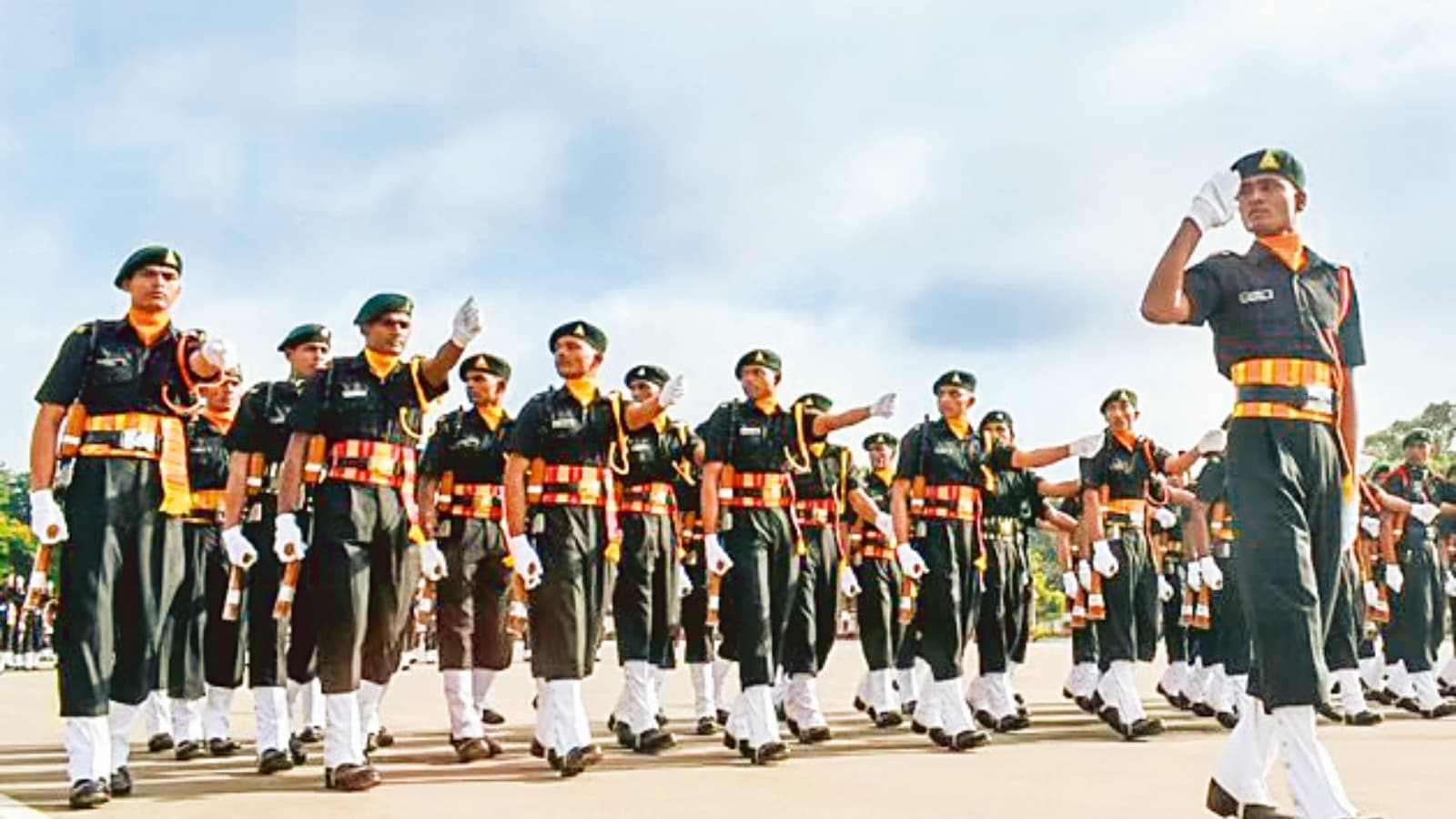
Why in news
The Indian Express reports that the services and the Department of Military Affairs have been discussing retention options, with the first Navy batch approaching completion of its tenure. No higher retention percentage has been approved in the supplied report.
25%
Current regular absorption share in each service
4 years
Agniveer tenure before regular absorption or exit
Background
Agnipath is a recruitment framework for personnel below officer rank in the Army, Navy and Air Force. Recruits designated as Agniveers serve for a fixed tenure, after which a selected share enters the regular cadre through a merit-based process. Military personnel policy must reconcile a suitable age profile, professional competence, continuity in operational units and sustainable expenditure. The Department of Military Affairs functions within the Ministry of Defence, while coordination with the Ministry of Home Affairs is relevant to exploring subsequent employment avenues.
What is being considered, and what remains unchanged?
The services are seeking greater retention, but the agreed policy remains regular absorption of 25 per cent of Agniveers from each service after completion of their four-year tenure. Higher retention is a proposal for further examination, not an announced entitlement.
According to the report, the Armed Forces are likely to observe the first few exit cycles, examine selection and resettlement outcomes, and then revisit the retention percentage. Discussions between the services and the Department of Military Affairs are already underway.
- Completion of the initial tenure does not automatically confer regular service status.
- The current absorption process is merit-based.
- Employment avenues are being explored with the Ministry of Home Affairs; exploration does not establish a guaranteed placement.
Infographic
Current rule
Four-year tenure; 25 per cent merit-based regular absorption
Readiness
Preserve relevant operational and technical experience
Training
Assess proficiency and returns on training investment
Expenditure
Weigh lifecycle liabilities against capability gains
Rehabilitation
Convert military skills into credible post-service pathways
Evidence
Study initial exit outcomes before revisiting retention
AI-assisted infographic by Pragnya IAS Academy, based on the cited sources.
Operational readiness and returns on training
The stated case for higher retention is the need for a larger pool of trained and experienced personnel who have participated in operations and can handle new technologies and weapons. Retaining suitable personnel could preserve accumulated expertise and continuity within operational teams.
Military competence extends beyond initial instruction to platform familiarity, collective training and judgement acquired through deployment. Higher retention could spread training investment over a longer service period and reduce repeated replacement demands. However, the report provides no quantified evidence on training costs or readiness gains.
- Assess retention against role-specific proficiency and operational requirements, rather than treating a higher percentage as an end in itself.
- Examine the time required to achieve proficiency in different trades and technical specialisations.
- Maintain selection standards so that retention supports capability rather than merely increasing regular cadre strength.
Personnel expenditure: evaluate the full lifecycle
Absorbing more Agniveers into regular service would expand longer-term personnel commitments relative to retaining a smaller share, other conditions remaining unchanged. The fiscal assessment should include pay, career progression and retirement liabilities applicable to the regular cadre.
The countervailing consideration is that retaining experienced personnel may improve the return on recruitment and training expenditure. Neither net savings nor the optimal retention share can be inferred from the report: these require service-specific staffing plans, cost data and capability assessments.
- Distinguish immediate budget expenditure from future personnel liabilities.
- Compare staffing alternatives that deliver similar operational capability.
- Protect the balance between personnel expenditure, equipment modernisation and operational maintenance.
Rehabilitation is part of the scheme's performance
The source identifies resettlement of exiting Agniveers as an issue to be studied alongside regular absorption. Higher retention could reduce the number exiting a given cohort, but it would not remove the need for a credible transition system.
Military skills do not automatically translate into civilian qualifications or job offers. Transition support should therefore connect skills certification, career counselling and employer requirements, while respecting the eligibility and recruitment rules of receiving organisations.
- Separate announced employment avenues from actual recruitment and sustained employment outcomes.
- Begin transition preparation before the end of tenure.
- Use transparent selection criteria and accessible grievance channels to sustain confidence in the absorption process.
| Dimension | Current position or reported concern | Implication to assess |
|---|---|---|
| Regular absorption | 25 per cent from each service after four years, through merit-based selection | Any increase requires a policy decision; none is reported as approved |
| Operational experience | Services seek a larger pool of trained and experienced personnel | Continuity, technical proficiency and deployment readiness |
| Training | Recruits began training in early 2023 | Training capacity and returns from retaining acquired expertise |
| Personnel expenditure | The source provides no fiscal estimates | Longer-term liabilities weighed against possible reductions in replacement training demands |
| Post-service transition | Resettlement will be studied; employment avenues are being explored with MHA | Verified placements, qualification recognition and quality of employment |
- 1. Initial cohorts complete their four-year tenure
- 2. Apply the existing merit-based regular absorption policy
- 3. Track resettlement and employment outcomes of exiting personnel
- 4. Assess experience requirements, training demands and lifecycle expenditure
- 5. Use findings in discussions between the services and the Department of Military Affairs
- 6. Consider whether the retention policy requires revision
Early 2023
Agniveers recruited under Agnipath began training, according to the report.
Ahead of the first Navy batch's exit
Selection and exit formalities are reported to be underway and nearly complete.
After the initial exit cycles, as proposed
The services are likely to study regular absorption and resettlement outcomes before discussing retention again.
Significance, challenges & way forward
Significance
- Higher retention could preserve operational experience and technical competence that take time to develop.
- Studying actual exit cycles can replace assumptions with evidence on selection, staffing and rehabilitation.
- The review links recruitment design with combat capability rather than treating personnel policy solely as a cost issue.
- Credible post-service pathways can support confidence among recruits and improve the transfer of military skills to other employment.
Challenges
- The report offers no quantified evidence on the optimal retention share, training costs or net fiscal effects.
- Skill requirements and training periods can differ across services and trades, complicating a uniform assessment.
- Greater regular absorption could constrain expenditure flexibility unless supported by sustainable manpower planning.
- Early cohort outcomes may not capture long-term effects on cadre structure, career progression and readiness.
- Employment avenues being explored with MHA cannot be equated with assured absorption of all exiting Agniveers.
Way forward
- Undertake a service-wise and trade-wise assessment of proficiency, deployment experience and replacement training requirements.
- Compare retention options using lifecycle personnel costs and equivalent operational capability, not headcount alone.
- Publish clear selection criteria and provide review mechanisms without compromising operational confidentiality.
- Link military training with recognised qualifications and begin career counselling before personnel exit.
- Track actual employment, further education and livelihood outcomes rather than relying only on announced opportunities.
- Review the framework periodically while preserving predictable terms for serving and prospective recruits.
Key terms
- Agniveer
- A recruit serving under the Agnipath framework for a fixed initial tenure.
- Regular absorption
- Selection into the regular military cadre after completion of the Agniveer tenure.
- Operational readiness
- The ability of a military force to perform assigned missions with suitable personnel, training and equipment.
- Lifecycle personnel cost
- The expenditure associated with recruiting, training, employing and meeting applicable post-service obligations for personnel.
- Resettlement
- Support for the transition from military service to subsequent employment, education or other livelihoods.
- Department of Military Affairs
- A department within the Ministry of Defence involved in military affairs and the reported discussions on retention.
Link with static syllabus
Prelims practice MCQs
Q1. With reference to the Agniveer retention framework described in the report, consider the following statements: 1. Agniveers complete a four-year tenure before regular absorption or exit. 2. The current policy provides for merit-based regular absorption of 25 per cent from each service. 3. A higher retention percentage has already been approved. Which of the statements given above are correct?
Q2. The Department of Military Affairs, involved in discussions on Agniveer retention, is part of which institution?
Q3. Consider the following statements regarding the assessment of higher Agniveer retention: 1. Retaining experienced personnel may preserve technical proficiency and operational continuity. 2. Higher retention necessarily reduces total personnel expenditure. 3. Post-service rehabilitation remains relevant even if retention increases. Which of the statements given above are correct?
Q4. Which of the following most accurately describes the reported approach to a further retention review?
Mains practice questions
GS 3 · 15 marks · 250 words
Higher retention under Agnipath must be assessed as a question of military capability, fiscal sustainability and personnel welfare. Discuss.
Frequently asked questions
Has Agniveer retention been increased?
The supplied report does not announce an increase. The current policy remains merit-based absorption of 25 per cent from each service after the four-year tenure.
Why are the services seeking higher retention?
The report cites the need for a larger pool of trained and experienced personnel who have operational exposure and can handle new technologies and weapons.
Would higher retention necessarily save money?
No. Possible improvements in training efficiency must be weighed against longer-term regular personnel commitments; the report contains no estimates establishing net savings.
Are jobs with organisations under MHA guaranteed for exiting Agniveers?
The report says employment avenues are being explored with MHA. It does not establish guaranteed employment for all exiting Agniveers.
Sources
Analysis prepared by the Pragnya IAS Academy current-affairs desk with AI assistance from the cited reports. Verify figures with the original sources.
Turn current affairs into marks
Join Pragnya IAS Academy's mentorship for daily answer-writing evaluation on stories like this.