
MP High Court Strikes Down 27% OBC Quota: Reservation Ceiling and Evidence
Revise the static topic: UPSC Social Justice notes
In short: The Madhya Pradesh High Court has struck down the law increasing OBC reservation from 14% to 27%, holding that the state failed to establish exceptional circumstances for breaching the 50% reservation ceiling. The ruling concerns the extent of reservation, not the entitlement of OBCs to reservation, and highlights the importance of reliable evidence. Congress leaders have announced a Supreme Court challenge, but the supplied reports do not establish that an appeal has been filed or a stay granted.
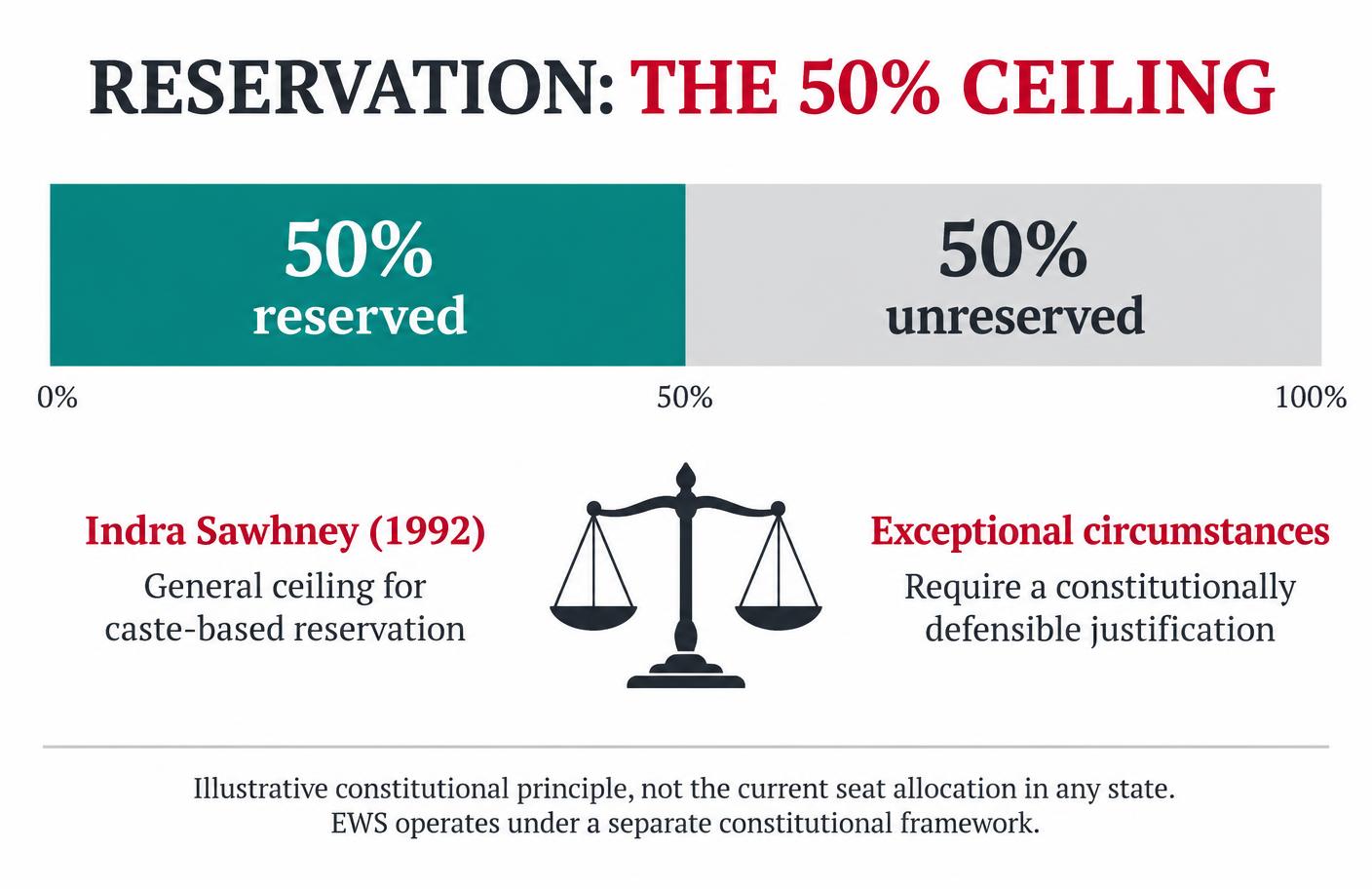
The general 50% ceiling for caste-based reservation from Indra Sawhney (1992). This illustrates a constitutional principle, not actual seat allocations; EWS has a separate constitutional framework.
Image: Pragnya IAS Academy · AI-assisted educational diagram
Why in news
The High Court invalidated the quota enhancement enacted in 2019 and issued directions concerning affected appointments. On 10 October 2026, Congress leaders announced their intention to challenge the verdict in the Supreme Court, while the state government said it would examine further legal proceedings.
27%
OBC quota struck down
14%
Earlier OBC quota
50%
Reservation ceiling at issue
33.87%
OBC higher-education enrolment cited
28.16%
OBC government employment cited
3 months
Appointment-completion deadline
Background
Reservation is an instrument of substantive equality, intended to address structural disadvantage rather than guarantee population-proportionate allocation. Article 15(4) enables special provisions for socially and educationally backward classes and Scheduled Castes and Scheduled Tribes; Article 15(5) addresses admission-related provisions in educational institutions, subject to its constitutional exceptions. Article 16(4) enables reservation in public employment for a backward class inadequately represented in state services. In Indra Sawhney, the Supreme Court affirmed the general reservation ceiling and the exclusion of the creamy layer among OBCs. These enabling powers remain subject to constitutional equality and judicial review.
What the High Court decided
A division bench of Justices Anand Pathak and Vinay Saraf struck down the law raising Madhya Pradesh's OBC reservation from 14% to 27%. According to the report, the bench held that the state had not demonstrated exceptional circumstances justifying departure from the 50% ceiling.
The court expressly distinguished entitlement from quantum: it did not invalidate OBC reservation as a category, but rejected the justification for the enhancement. It also protected certain completed appointments while directing how subsequent recruitment should be handled.
- OBC candidates appointed against the additional quota between March 2019 and 29 September 2022 would not be removed; their appointments would be adjusted against the next three recruitment drives.
- For appointments after 29 September 2022, the report describes directions for recruitment on an 87% basis, with the remaining 13% of posts filled from the unreserved category.
- The Madhya Pradesh Public Service Commission, Madhya Pradesh Employees Selection Board and other recruitment agencies were directed to complete the relevant appointments within three months.
- Unreserved posts are open-competition posts, not a quota exclusively for candidates outside reserved communities.
Infographic
Decision
Enhancement from 14% to 27% struck down; OBC reservation itself was not abolished.
Ceiling
Exceptional circumstances were not established for breaching the ordinary 50% limit.
Evidence
Enrolment, employment and recruitment data informed the bench's assessment.
Equality
Open seats remain available to all communities; aggregates need careful interpretation.
Legal status
A Supreme Court challenge was announced; no stay or reversal is established by the reports.
AI-assisted infographic by Pragnya IAS Academy, based on the cited sources.
Constitutional framework: distinct enabling powers and a qualified ceiling
Articles 14, 15 and 16 must be read together: equality permits affirmative action, but the design and extent of that action require constitutional justification. Educational reservation under Article 15 and public-employment reservation under Article 16 have distinct textual foundations; inadequacy of representation in state services is specifically central to Article 16(4).
The 50% ceiling is a judicially developed rule, not a percentage expressly written into Articles 15(4) or 16(4). Indra Sawhney permits departure only in exceptional circumstances, and the Supreme Court's Maratha reservation judgment reaffirmed the need for a convincing justification. Population share alone does not create an entitlement to proportionate reservation.
The ceiling should not be presented as an undifferentiated limit covering every constitutional reservation arrangement. In Janhit Abhiyan, the Supreme Court upheld the separate EWS framework under Articles 15(6) and 16(6), including its operation beyond the existing ceiling. That ruling does not automatically authorise an OBC quota enhancement beyond the ordinary ceiling.
- Article 46 directs the state to promote the educational and economic interests of weaker sections, particularly Scheduled Castes and Scheduled Tribes.
- Creamy-layer exclusion remains an important feature of OBC reservation policy.
- Article 335 specifically concerns the claims of Scheduled Castes and Scheduled Tribes in services alongside administrative efficiency; it should not be described as an OBC-specific provision.
Evidence: what the bench relied on and what requires scrutiny
The bench relied on a study by Dr BR Ambedkar University of Social Sciences, AISHE data, government employment figures and recruitment results. It cited OBC shares of 33.87% in higher-education enrolment and 28.16% in government employment, and questioned the study's description of educational conditions as extremely weak. These are figures cited in the reported judgment, not an independent assessment undertaken here.
The court also referred to successive OBC chief ministers and representation among ministers and legislators. Analytically, political leadership is not a substitute for evidence of educational disadvantage or representation across public services. Statewide aggregates can conceal disparities between communities, districts, institutions and service levels.
The report records the court's observation that precise category-wise population estimates remained tentative in the absence of a post-Independence state caste census. Consequently, the source's broad population estimate should not be treated as an established census finding. Evidence must be assessed for its sampling, coverage, comparability and relevance to the constitutional question.
- A quota percentage and a community's total employment share measure different things; direct comparison alone cannot settle adequacy.
- Success through open competition must be distinguished from appointments obtained against reserved vacancies.
- Reserved-category candidates selected on the applicable open-merit standard do not thereby convert open seats into reserved seats.
- The court held that failure to fill existing OBC vacancies did not itself justify raising reservation beyond the ceiling.
- Enrolment growth should be examined alongside completion, institutional access and the distribution of benefits within OBC communities.
High Court ruling versus a prospective Supreme Court challenge
Congress leaders have announced a challenge, and Chief Minister Mohan Yadav has said that the government would study the judgment and ensure further legal proceedings. These statements establish political and legal intent; they do not establish that the Supreme Court has admitted a case, stayed the ruling or approved the enhanced quota.
Article 136 enables the Supreme Court, in its discretion, to grant special leave to appeal. Filing a petition does not automatically suspend a High Court judgment: interim protection requires a judicial order. Any eventual Supreme Court examination must therefore be distinguished from the High Court's presently reported conclusions.
A prospective challenge could question the application of the ceiling, the sufficiency and interpretation of the evidence, the relevance of political representation, and the treatment of affected appointments. These are possible issues for review, not confirmed grounds of a filed petition. Allegations of weak advocacy remain political claims rather than established judicial findings.
- The full judgment and operative directions should guide implementation, rather than political summaries.
- No Supreme Court outcome should be inferred from the announcement of a challenge.
- Any subsequent stay, modification or final ruling would need separate verification.
| Issue | Relevant test or distinction |
|---|---|
| Educational affirmative action | Article 15 permits special provisions for constitutionally specified disadvantaged groups; the educational basis of the measure requires justification. |
| Public-employment reservation | Article 16(4) concerns a backward class inadequately represented in state services. |
| Breach of the ordinary ceiling | The state must establish exceptional circumstances; population share alone is insufficient. |
| Open-category selection | Eligible candidates from every community may compete; open seats are not exclusive to non-reserved communities. |
| Political representation | Political office-holding is distinct from educational disadvantage and representation in public services. |
| Supreme Court challenge | An announced or filed challenge is not equivalent to admission, interim stay or reversal. |
- 1. Identify the constitutional basis: educational advancement or public-employment representation.
- 2. Collect reliable and disaggregated evidence of the relevant disadvantage or inadequacy.
- 3. Justify the extent of reservation and apply relevant safeguards, including creamy-layer exclusion.
- 4. Test compliance with the ordinary ceiling and establish exceptional circumstances if departure is proposed.
- 5. Implement transparently, monitor outcomes and remain subject to judicial review.
2019
The Kamal Nath-led government enacted the law increasing OBC reservation from 14% to 27%.
2020
The succeeding BJP government supported the enhancement while legal challenges were before the High Court.
2023
The university study later examined by the High Court assessed OBC socio-economic and representation indicators.
October 2026
The High Court struck down the enhancement and issued appointment-related directions.
10 October 2026
Congress leaders announced an intended Supreme Court challenge; the state government indicated further legal examination.
Significance, challenges & way forward
Significance
- The ruling separates the legitimacy of OBC reservation from the constitutional justification for increasing its extent.
- It reinforces the need for evidence-based affirmative action rather than reliance on demographic assertions alone.
- Protection of specified completed appointments recognises the consequences of policy litigation for candidates.
- The dispute illustrates how judicial review mediates between social-justice objectives and constitutional limits.
- It highlights that open competition and reservation can operate together without making open seats community-exclusive.
Challenges
- Aggregate OBC indicators may conceal unequal access among constituent communities and across service levels.
- Tentative population estimates complicate comparisons, but population enumeration alone cannot establish educational disadvantage or service inadequacy.
- Comparing enrolment, survey attainment and employment figures without compatible denominators can produce misleading conclusions.
- Unfilled reserved vacancies reveal implementation failures that quota enhancement alone may not address.
- Political claims and announcements of litigation can obscure the distinction between an operative ruling and a possible future outcome.
Way forward
- Publish a clear implementation note based on the full judgment, covering protected appointments, recruitment adjustments and applicable deadlines.
- Strengthen backward-class commission research through transparent methods and community-wise, regional and service-level analysis.
- Audit reserved vacancies and recruitment bottlenecks before treating a higher quota as the primary remedy.
- Apply creamy-layer rules consistently and examine whether benefits reach the most disadvantaged OBC communities.
- Complement reservation with scholarships, hostels, quality schooling, academic support and measures against discrimination.
- If a challenge is pursued, ground it in constitutional doctrine and a rigorous evidentiary record, while seeking explicit interim directions where needed.
Key terms
- Substantive equality
- An approach to equality that recognises structural disadvantage and permits measures to improve real access to opportunities.
- Enabling provision
- A constitutional provision authorising state action without itself mandating a particular quota.
- Reservation ceiling
- The judicially developed ordinary limit on reservation, subject to relevant constitutional distinctions and narrowly justified exceptions.
- Inadequate representation
- The condition concerning representation of a backward class in state services that is central to Article 16(4).
- Creamy layer
- The socially advanced sections among OBCs excluded from OBC reservation benefits under applicable criteria.
- Open or unreserved category
- Seats or posts available through open competition to eligible candidates from all communities.
- Special leave to appeal
- Discretionary permission granted by the Supreme Court under Article 136 to pursue an appeal.
- Stay
- An interim judicial order suspending the operation of a decision or specified proceedings.
Link with static syllabus
Prelims practice MCQs
Q1. With reference to backward-class reservation, consider the following statements: 1. Article 16(4) concerns a backward class inadequately represented in state services. 2. The 50% reservation ceiling is expressly written into Article 16(4). 3. Article 15(4) enables special provisions for socially and educationally backward classes and Scheduled Castes and Scheduled Tribes. Which of the statements given above are correct?
Q2. Which of the following best describes an unreserved post in public recruitment?
Q3. Regarding the reported Madhya Pradesh High Court ruling on OBC reservation, consider the following statements: 1. It invalidated the entire entitlement of OBCs to reservation in the state. 2. It held that the state failed to establish exceptional circumstances for the quota enhancement beyond the ceiling. 3. An announcement of a Supreme Court challenge automatically stays the High Court ruling. Which of the statements given above is/are correct?
Q4. Consider the following pairs: 1. Article 46 — Promotion of educational and economic interests of weaker sections 2. Article 136 — Supreme Court's power to grant special leave to appeal 3. Article 335 — Claims of OBCs alone in state services Which of the pairs given above are correctly matched?
Mains practice questions
GS 2 · 15 marks · 250 words
Reservation policy requires both a commitment to substantive equality and a constitutionally defensible evidentiary foundation. Discuss in the context of the Madhya Pradesh High Court ruling on OBC reservation.
Frequently asked questions
Did the High Court abolish OBC reservation in Madhya Pradesh?
No. The reported ruling struck down the increase from 14% to 27% and expressly distinguished the extent of reservation from the underlying OBC entitlement.
Is the 50% ceiling an absolute rule for every kind of reservation?
No. It is the ordinary judicially developed ceiling relevant to this dispute, with narrowly recognised exceptions; the Supreme Court has separately upheld the constitutional EWS framework.
Has the Supreme Court restored the 27% OBC quota?
The supplied reports do not establish any Supreme Court restoration or stay. They report an intended challenge by Congress leaders and the state government's statement about further legal proceedings.
Can OBC candidates be selected against unreserved posts?
Yes. Unreserved posts are open to eligible candidates from every community under the applicable open-competition rules.
Sources
- Indian Express: India News Highlights, 10 October 2026: Congress to challenge MP High Court verdict scrapping 27% OBC quota in SC
- Indian Express: Striking down 27% quota, Madhya Pradesh High Court cites OBC chief ministers, quotes Rousseau
Analysis prepared by the Pragnya IAS Academy current-affairs desk with AI assistance from the cited reports. Verify figures with the original sources.
Turn current affairs into marks
Join Pragnya IAS Academy's mentorship for daily answer-writing evaluation on stories like this.