
RBI’s Oil Dollar Window and Forex Curbs: Rupee Defence, Reserve Costs and Hedging Risks
Revise the static topic: UPSC Economy notes
In short: The RBI has announced a special dollar-sale window for three public sector oil marketing companies, effective October 12, 2026, alongside tighter rules for rupee-linked foreign exchange derivatives. The measures seek to ease pressure on the rupee by managing large dollar purchases and discouraging speculative or duplicate hedging, but may consume reserves and raise legitimate hedging costs.
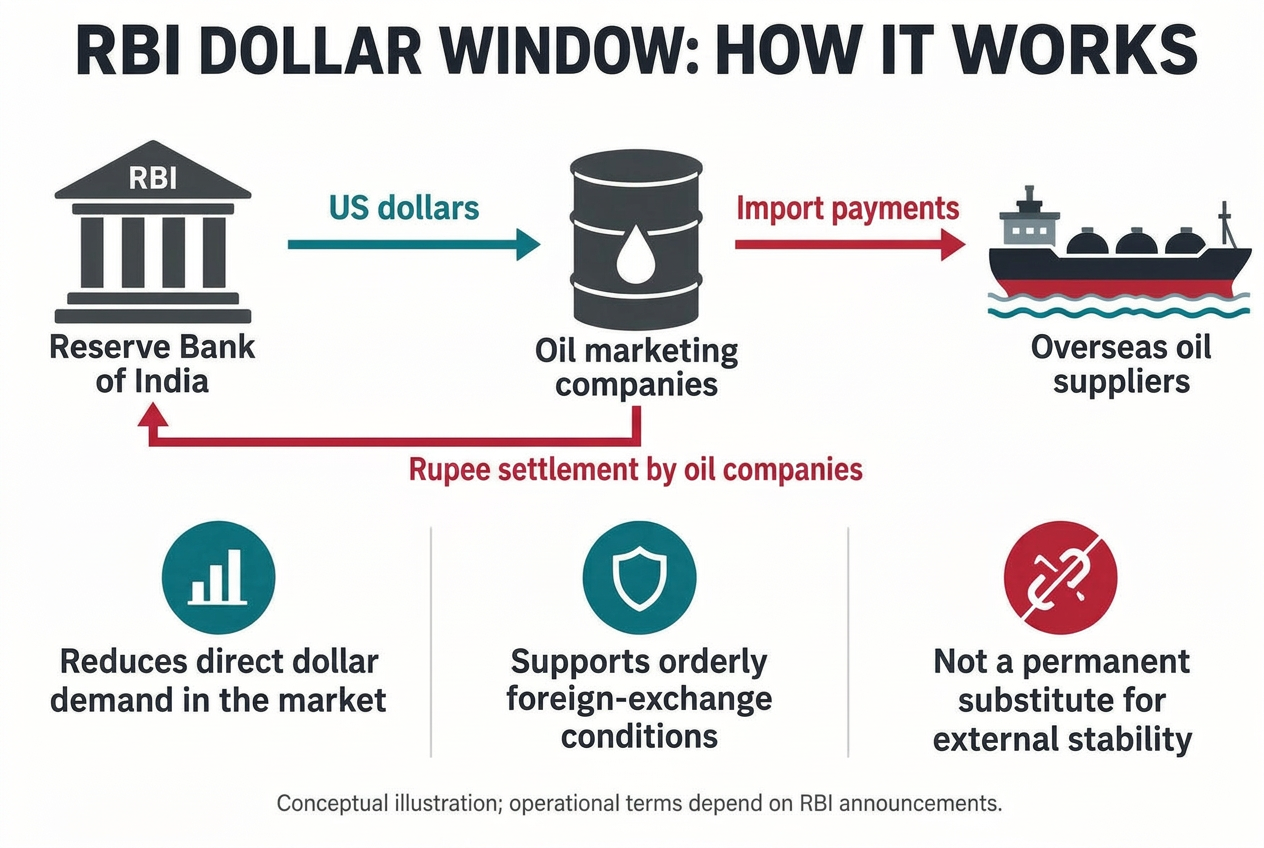
Conceptual dollar-window mechanism: RBI supplies US dollars to oil marketing companies for import payments, with rupee settlement by the companies. Exact operational terms depend on the RBI announcement.
Image: Pragnya IAS Academy · AI-assisted educational diagram
Why in news
The RBI has announced targeted dollar supply and regulatory restrictions amid renewed rupee weakness. The supplied Indian Express report notes that the rupee weakened despite the October 7 policy rate increase, highlighting the limits of interest-rate action alone.
20%
FERR cash requirement
Above USD 2 million
Notional threshold for applicable FERR contracts
USD 5 million
Revised underlying-exposure verification threshold
USD 100 million
Previous verification threshold
3
Public sector OMCs covered
October 12, 2026
Dollar window becomes operational
Background
India has a market-determined exchange rate, with the RBI intervening to contain excessive volatility and maintain orderly market conditions rather than mechanically fixing the rupee at a particular level. Import payments create demand for foreign currency, while export receipts and capital inflows contribute to its supply. A trade deficit does not by itself determine the exchange rate: capital flows, expectations and global financial conditions also matter. Currency derivatives allow firms to manage exchange-rate exposure, while the Foreign Exchange Management Act, 1999 provides the principal statutory framework for foreign exchange regulation in India.
What the RBI has announced
The special window will meet the entire daily dollar requirements of Indian Oil Corporation, Hindustan Petroleum Corporation and Bharat Petroleum Corporation. The RBI will sell US dollars to these public sector OMCs through designated banks from October 12, 2026, until further notice.
Separately, the RBI has tightened rules on cancellation and rebooking, verification of underlying exposures and duplicate hedging. It has also introduced a Foreign Exchange Risk Reserve, or FERR, for specified rupee-linked derivative transactions.
- Cancelled foreign exchange derivative contracts involving INR cannot be rebooked, whether they are deliverable or non-deliverable, when the cancellation occurs after issuance of the Directions.
- Rollover of derivative contracts at maturity remains permitted, subject to existing regulatory provisions.
- The threshold for transactions without establishing the underlying contracted exposure falls from USD 100 million to USD 5 million equivalent across all Authorised Dealers.
- The corresponding threshold for exchange-traded INR currency derivatives also falls to USD 5 million equivalent across recognised stock exchanges taken together.
- Authorised Dealers must retain an undertaking confirming that the same underlying exposure has not been hedged with another Authorised Dealer.
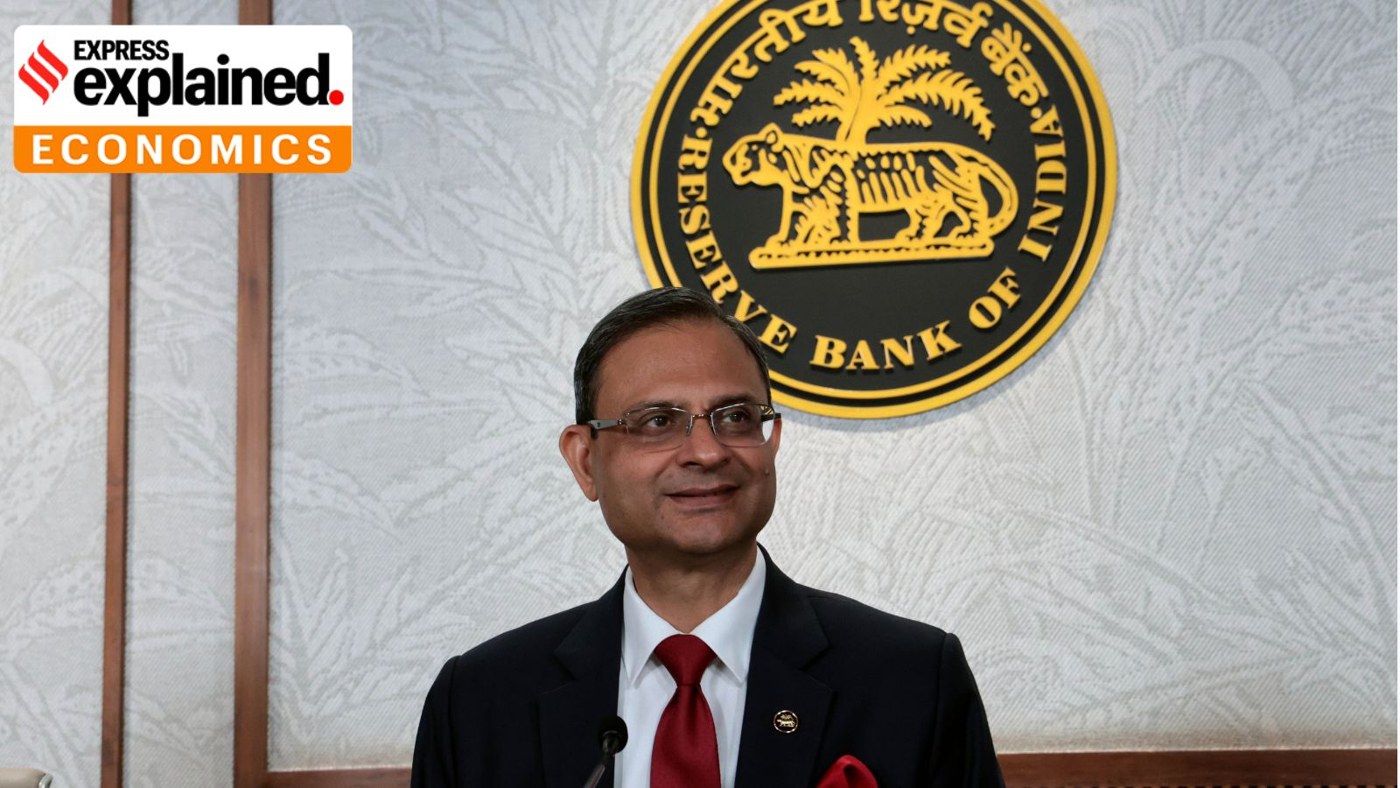
Reference photograph of RBI Governor Sanjay Malhotra, accompanying the source analysis of foreign-exchange measures; this is not a photograph of the transaction mechanism.
Image: Indian Express
Infographic
Targeted dollar supply
RBI meets covered OMCs’ daily dollar requirements.
Cost of positioning
FERR ties up dealer cash against applicable derivatives.
Exposure discipline
Lower verification thresholds and anti-duplication undertakings.
Reserve constraint
Dollar supply can draw on the external buffer.
Market-functioning test
Contain volatility without undermining genuine hedging.
AI-assisted infographic by Pragnya IAS Academy, based on the cited sources.
How targeted dollar supply can stabilise the rupee
Oil companies require foreign currency to pay for imports. Routing their daily dollar requirements through an RBI window reduces the need for these large purchases to compete directly with other demand in the ordinary foreign exchange market. It can therefore ease immediate order-flow pressure and reduce disorderly exchange-rate movements.
The facility changes how dollar demand is met; it does not eliminate the oil import bill. To the extent that the RBI supplies dollars from its reserves, the intervention draws on the external buffer. Reserve adequacy and the duration of intervention consequently become important.
Dollar sales against rupees ordinarily absorb rupee liquidity, other things remaining unchanged. This can interact with domestic liquidity management, although the net effect depends on the RBI’s other operations.
- The window targets a concentrated source of structural dollar demand rather than restricting oil imports.
- Its stabilising impact depends on the scale of other demand, capital flows and exchange-rate expectations.
- The official announcement describes a dollar-sale facility; it does not specify an oil-company swap or concessional exchange rate.
FERR and derivative restrictions: discipline versus hedging costs
FERR applies to foreign exchange derivatives involving INR that hedge current account exposures where the user purchases foreign currency against rupees, and whose notional value exceeds USD 2 million equivalent. Authorised Dealers must maintain cash with the RBI equal to 20% of the INR equivalent of each applicable transaction’s notional amount.
This is a cash reserve requirement on the dealer, not a stated 20% tax on the importer. Nevertheless, tying up funds imposes a funding or opportunity cost that dealers may pass on through derivative pricing. It can temper one-sided demand for protection against rupee depreciation, but can also make genuine import hedging more expensive.
Lower verification thresholds and anti-duplication undertakings strengthen the connection between derivatives and real exposures. The trade-off is greater documentation and reduced flexibility, especially when genuine commercial exposures change after a hedge has been cancelled.
- The USD 5 million threshold concerns establishing the underlying exposure; it is not a general prohibition on larger hedges.
- Transactions below the verification threshold are not thereby authorised to lack a genuine underlying contracted exposure.
- FERR is a domestic cash requirement and should not be confused with the RBI’s stock of foreign currency reserves.
Why the package offers breathing space rather than a complete solution
According to the supplied report, the October 7 increase in the repo rate did not prevent renewed rupee weakness. Higher interest rates can support a currency through interest differentials and expectations, but exchange rates also respond to oil prices, foreign investor behaviour and anticipated depreciation.
The Indian Express compares FERR with China’s exchange-rate toolkit. The relevant policy principle is that reserve requirements can change the cost of derivative positions and influence currency-market demand without relying solely on spot intervention or policy rates.
Persistent restrictions can impair price discovery, widen trading spreads or encourage activity to move towards less accessible market segments. The policy test is therefore not merely whether the rupee strengthens immediately, but whether volatility subsides without excessive reserve depletion or damage to legitimate risk management.
- Crude oil prices influence the underlying import-related demand for dollars.
- Foreign capital inflows or outflows can reinforce or offset the benefits of targeted intervention.
- Predictable communication and periodic review are essential to prevent temporary stabilisation tools from becoming lasting market distortions.
| Measure | Operating channel | Principal trade-off |
|---|---|---|
| Dollar window for public sector OMCs | RBI meets daily dollar requirements through designated banks | Eases market pressure but can draw on reserves |
| FERR | Cash requirement raises the cost of applicable foreign-currency purchase hedges | Discourages one-sided demand but can increase genuine hedging costs |
| Ban on rebooking cancelled contracts | Restricts cancellation followed by renewed positioning | Limits tactical churn but reduces commercial flexibility |
| Lower exposure-verification threshold | Requires establishment of underlying exposure at a lower threshold | Improves discipline but increases compliance work |
| Anti-duplication undertaking | Requires confirmation that another dealer has not hedged the same exposure | Discourages duplicate hedging but depends on effective verification |
- 1. Oil import payments and expectations of rupee weakness create demand for foreign currency.
- 2. The RBI window routes public sector OMC dollar purchases through designated banks.
- 3. FERR raises the funding cost of applicable foreign-currency purchase derivatives.
- 4. Verification and rebooking restrictions seek to curb unsupported, duplicate or tactical positioning.
- 5. Reduced market pressure may moderate volatility, subject to oil prices, capital flows and reserve capacity.
2013
The taper tantrum episode illustrated how shifts in US monetary-policy expectations can generate exchange-rate and capital-flow stress in emerging economies.
May 2026
According to the supplied Indian Express report, the rupee reached a record low of 96.96 per US dollar.
June 2026
The report states that the RBI opened a concessional swap window for Foreign Currency Non-Resident (Bank) deposits to support reserves and the exchange rate.
October 7, 2026
The policy repo rate was raised by 25 basis points to 5.5%, but the rupee weakened, according to the report.
October 12, 2026
The special dollar-sale window for the three public sector OMCs is scheduled to take effect and remain operational until further notice.
Significance, challenges & way forward
Significance
- The package combines direct dollar supply with regulation of derivative demand rather than relying only on interest rates.
- Containing disorderly depreciation can reduce uncertainty over import costs and imported inflation.
- Stronger exposure verification can improve market discipline and the integrity of hedging activity.
- The measures demonstrate the interaction between external-sector management and domestic banking liquidity.
Challenges
- Sustained reserve-backed dollar sales cannot permanently offset adverse external fundamentals.
- Higher derivative costs may discourage legitimate hedging and leave firms more exposed to depreciation.
- Frequent regulatory changes can weaken confidence in the predictability of market rules.
- Stricter documentation and rebooking restrictions may impede management of changing commercial exposures.
- Reduced market liquidity or migration of activity can weaken domestic price discovery.
Way forward
- Review the dollar window against exchange-rate volatility, reserve adequacy and normalisation of market conditions.
- Communicate that intervention aims at orderly market functioning rather than an unconditional defence of a particular exchange rate.
- Clarify operational aspects of FERR, including holding arrangements and release conditions, to reduce uncertainty.
- Monitor hedging costs and trading spreads to identify disproportionate effects on genuine importers.
- Improve exposure verification while avoiding unnecessary duplication of documentation across market channels.
- Combine short-term stabilisation with export competitiveness, energy diversification and prudent management of foreign-currency liabilities.
Key terms
- Foreign Exchange Risk Reserve
- A cash reserve that Authorised Dealers must place with the RBI against specified foreign-currency purchase derivative transactions involving INR.
- Underlying exposure
- The actual foreign-currency payment, receipt or other eligible risk that a derivative is intended to hedge.
- Notional amount
- The reference amount used to determine a derivative contract’s obligations, not necessarily the cash exchanged upfront.
- Authorised Dealer
- An entity authorised by the RBI under FEMA to undertake specified foreign exchange transactions.
- Non-deliverable derivative
- A derivative settled through a net payment rather than delivery of the underlying currencies.
- Rollover
- Renewal or extension of a hedge at maturity, subject to applicable rules.
- Rebooking
- Booking a derivative again after cancellation of an earlier contract.
- Sterilisation
- Central bank operations that offset the domestic liquidity impact of foreign exchange intervention.
Link with static syllabus
Prelims practice MCQs
Q1. With reference to the RBI’s special dollar window for public sector oil marketing companies, consider the following statements: 1. It covers Indian Oil Corporation, Hindustan Petroleum Corporation and Bharat Petroleum Corporation. 2. Dollars will be sold through designated banks. 3. The announcement guarantees a subsidised exchange rate. Which of the statements given above are correct?
Q2. With reference to the announced Foreign Exchange Risk Reserve, consider the following statements: 1. Authorised Dealers must maintain the reserve in cash with the RBI. 2. The requirement is 20% of the INR equivalent of the applicable transaction’s notional amount. 3. It applies universally to every INR derivative, irrespective of transaction size, exposure category or direction of currency purchase. Which of the statements given above are correct?
Q3. Consider the following statements about the RBI’s revised foreign exchange derivative rules: 1. Rollover at maturity remains permitted subject to existing regulatory provisions. 2. The USD 5 million verification threshold applies separately to every Authorised Dealer, allowing independent limits at multiple dealers. 3. Users must provide an undertaking that the same underlying exposure has not been hedged with another Authorised Dealer. Which of the statements given above are correct?
Q4. Other things remaining unchanged, an RBI sale of US dollars from its reserves against rupees is most likely to have which immediate effects?
Mains practice questions
GS 3 · 15 marks · 250 words
Targeted foreign exchange intervention can buy time, but cannot substitute for external-sector resilience. Examine with reference to the RBI’s dollar window for oil companies and restrictions on currency derivatives.
Frequently asked questions
Does the oil-company dollar window eliminate demand for dollars?
No. It changes how the covered OMCs obtain dollars by routing supply through the RBI and designated banks; the foreign-currency requirement for imports remains.
Does FERR apply to every rupee-linked derivative?
No. The announced requirement covers specified current account hedges where users purchase foreign currency against INR and the notional value exceeds USD 2 million equivalent.
Does the USD 5 million threshold ban larger hedging transactions?
No. It lowers the threshold for establishing the underlying exposure, rather than imposing a general ceiling on hedging.
Can firms still roll over their currency hedges?
Yes. Rollover at maturity remains permitted subject to existing rules, while rebooking contracts cancelled after issuance of the Directions is restricted.
Sources
- Indian Express: How RBI is borrowing from China playbook to defend rupee
- RBI: RBI announces special window for Public Sector Oil Marketing Companies to meet dollar requirements
- RBI: RBI Announces Regulatory Measures for the Foreign Exchange Market
Analysis prepared by the Pragnya IAS Academy current-affairs desk with AI assistance from the cited reports. Verify figures with the original sources.
Turn current affairs into marks
Join Pragnya IAS Academy's mentorship for daily answer-writing evaluation on stories like this.