
UNCTAD: Record $35 Trillion Trade and Barriers to Developing-Country Participation
Revise the static topic: UPSC Economy notes · UPSC International Relations notes
In short: World trade reached a record $35 trillion in 2025, according to UNCTAD, but new technological and policy barriers constrained greater developing-country participation. For India, the central policy challenge is to diversify exports while strengthening firms’ technological capabilities and ability to meet overseas market requirements.
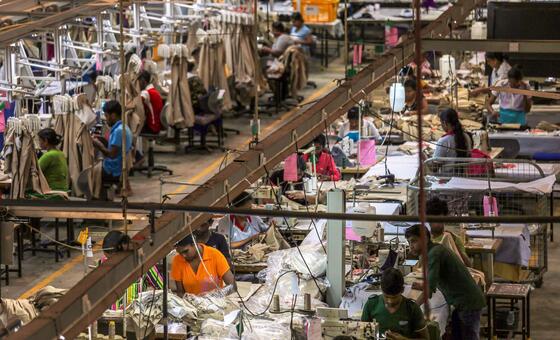
Image: UN News
Why in news
UN News reported UNCTAD’s assessment that global trade reached a record in 2025 despite conflicts. The assessment highlights the gap between expanding aggregate trade and developing countries’ ability to participate more fully.
$35 trillion
Record world trade in 2025
Background
UN Trade and Development, known as UNCTAD, is a United Nations body concerned with trade, investment and development, particularly the integration of developing economies into the world economy. Unlike the World Trade Organization, it is not the institution administering multilateral trade agreements and their dispute-settlement framework. International trade participation depends not only on tariff access but also on productive capacity, infrastructure, technology, finance and compliance with importing-market requirements.
What the record establishes—and what it does not
The supplied report establishes that world trade reached $35 trillion in 2025 despite conflicts. It also records UNCTAD’s concern that new technological and policy barriers held developing countries back from greater participation.
A record dollar value is not, by itself, evidence of equally distributed gains or higher physical trade volumes. The excerpt provides no country shares, sectoral breakdown, price adjustment or measure of the participation gap; it therefore cannot establish whether developing-country exports declined or which economies gained most.
- Aggregate trade expansion and constrained participation can coexist.
- A record trade value does not automatically imply higher domestic value addition in exporting economies.
- India-specific conclusions must be treated as policy implications, not as findings reported in the excerpt.
Infographic
Record scale
World trade reached $35 trillion in 2025.
Participation constraint
UNCTAD flags technological and policy barriers.
Capability response
Build technology, skills and quality infrastructure.
Market-access response
Improve transparency and reduce avoidable compliance costs.
India’s objective
Diversify exports and strengthen domestic value addition.
AI-assisted infographic by Pragnya IAS Academy, based on the cited sources.
How technological barriers can restrict entry
The excerpt does not identify particular technologies. Analytically, technological barriers can arise when exporters lack the capabilities needed to satisfy buyers’ requirements for digital documentation, traceability, quality assurance or integration with production networks.
Such requirements can impose substantial initial costs. Smaller firms may find it harder to finance equipment, acquire skills or access reliable testing and digital infrastructure, even when their products face low tariffs.
- Technology can facilitate trade while also raising the capability threshold for entry.
- Access to digital systems is insufficient without the skills and organisational capacity to use them.
- Limited technological capability can restrict movement into higher-value activities such as design and specialised production.
Policy barriers: distinguish regulation from protectionism
The report flags policy barriers without specifying individual measures. In trade analysis, market access may be affected by tariffs, licensing, technical regulations, product standards and rules governing origin or data. Their effects depend on their design and implementation.
Not every non-tariff measure is protectionist. Health, safety and environmental requirements can serve legitimate objectives; the concern arises when measures are discriminatory, unnecessarily trade-restrictive, opaque or disproportionately costly to comply with.
- Different requirements across markets can multiply exporters’ testing and documentation costs.
- A preferential tariff may remain commercially unusable if an exporter cannot meet the applicable rules of origin.
- Predictability, transparency and accessible compliance systems matter alongside formal market opening.
India’s export diversification: access must match capability
For India, diversification should cover products, destinations, exporting firms and positions within value chains. Merely redirecting existing exports to new markets may not overcome dependence on a narrow range of capabilities or buyers.
The policy implication is to combine trade negotiations with domestic competitiveness measures. Affordable certification, technology adoption, skills, logistics and trade finance can help firms convert market access into actual exports. These are analytical recommendations rather than measures announced in the supplied report.
- Develop shared testing and certification facilities to reduce the fixed costs faced by smaller exporters.
- Use market intelligence to identify product-specific requirements before firms enter new destinations.
- Support both goods and services diversification without assuming that either is unaffected by regulatory barriers.
- Assess export performance through domestic value addition and sustained exporter participation, not gross export value alone.
| Constraint | Participation effect | Potential Indian response |
|---|---|---|
| Technology and skills gaps | Firms may struggle to meet buyer requirements or enter sophisticated production networks. | Support technology adoption, workforce skills and shared technical services. |
| Testing and certification costs | Fixed compliance costs can make entry uneconomic for smaller exporters. | Expand accredited laboratories and affordable conformity-assessment services. |
| Fragmented market requirements | Exporters must adapt products and documentation separately for different destinations. | Provide regulatory intelligence and pursue recognition arrangements where feasible. |
| Complex rules of origin | Firms may be unable to use preferential tariffs despite a trade agreement. | Improve origin documentation support and exporter awareness. |
| Limited trade finance | Firms may lack working capital for production, shipment and payment delays. | Improve access to trade credit and appropriate risk-cover instruments. |
- 1. An overseas market or buyer requires technical capability and regulatory compliance.
- 2. The exporter must invest in technology, skills, testing and documentation.
- 3. High fixed costs or limited finance make compliance difficult.
- 4. The firm cannot enter the market or remains confined to less demanding activities.
- 5. Aggregate trade can expand without similarly broadening participation.
2025
World trade reached a record $35 trillion, according to the UNCTAD assessment reported by UN News.
Significance, challenges & way forward
Significance
- UNCTAD’s assessment shifts attention from the size of global trade to the conditions under which developing economies can participate.
- The record demonstrates continued trade activity despite conflicts, but does not establish that trade is unaffected by geopolitical disruption.
- Export diversification can reduce dependence on particular products and destinations while creating opportunities for industrial upgrading.
- Broader firm participation can connect export growth more closely with employment and domestic productive capacity.
Challenges
- The supplied excerpt lacks disaggregated evidence needed to identify the most affected countries, sectors and types of firms.
- Smaller exporters may face compliance costs that are high relative to their sales.
- Rapid technological change can make market-entry capabilities costly to acquire and maintain.
- Divergent regulations can fragment markets even when tariffs are reduced.
- Export expansion may deliver limited domestic gains if firms remain concentrated in activities with low domestic value addition.
Way forward
- Diagnose barriers at the product and destination level rather than treating all weak export performance as a tariff problem.
- Combine market-access negotiations with investment in logistics, skills, quality infrastructure and technology adoption.
- Provide accessible standards guidance, certification support and trade finance for smaller firms.
- Pursue transparent, non-discriminatory trade rules while preserving legitimate health, safety and environmental regulation.
- Encourage partnerships that build local supplier capability and support movement into higher-value activities.
- Track destination concentration, product diversity, exporter retention and domestic value addition alongside headline export values.
Key terms
- UNCTAD
- The United Nations trade and development body focusing on the development dimensions of trade, investment and related economic issues.
- Trade value versus trade volume
- Trade value measures trade in monetary terms, while trade volume measures changes after accounting for price effects.
- Non-tariff measures
- Policy measures other than ordinary customs tariffs that can affect international trade, including technical and health requirements.
- Conformity assessment
- Processes such as testing, inspection and certification used to demonstrate that specified requirements are met.
- Rules of origin
- Criteria used to determine a product’s country of origin, including its eligibility for preferential tariff treatment.
- Global value chains
- Production arrangements in which different stages of creating a good or service are distributed across countries.
- Domestic value addition
- The value generated within the domestic economy through production, rather than the value embodied in imported inputs.
Link with static syllabus
Prelims practice MCQs
Q1. With reference to the supplied UNCTAD assessment, consider the following statements: 1. World trade reached $35 trillion in 2025. 2. The record establishes that developing countries increased their share of global trade. 3. New technological and policy barriers constrained greater developing-country participation. Which of the statements given above are correct?
Q2. Consider the following statements about international trade measures: 1. Every non-tariff measure is necessarily protectionist. 2. Technical regulations can pursue legitimate health, safety or environmental objectives. 3. Conformity assessment can include testing and certification. Which of the statements given above are correct?
Q3. Which of the following best describes the function of rules of origin in a preferential trade agreement?
Q4. With reference to international economic institutions, consider the following statements: 1. UNCTAD addresses trade and investment issues from a development perspective. 2. The World Trade Organization administers a multilateral trade dispute-settlement framework. 3. UNCTAD is the institution responsible for adjudicating disputes under WTO agreements. Which of the statements given above are correct?
Mains practice questions
GS 3 · 15 marks · 250 words
Record global trade does not necessarily imply inclusive trade participation. Examine how technological and policy barriers constrain developing economies, and suggest a strategy for India’s export diversification.
Frequently asked questions
What did UNCTAD say about global trade in 2025?
World trade reached a record $35 trillion despite conflicts. UNCTAD also said new technological and policy barriers held developing countries back from greater participation.
Does the record mean developing-country exports declined?
No such conclusion follows from the supplied excerpt. Constrained participation does not necessarily mean an absolute decline in exports.
Why are lower tariffs insufficient for export diversification?
Exporters must also meet technical, regulatory and buyer requirements. Technology, skills, certification, logistics and finance determine whether formal market access becomes commercially usable.
What is the main policy lesson for India?
India should combine market-access efforts with stronger domestic export capabilities. Diversification should broaden products, destinations and firm participation while increasing domestic value addition.
Sources
Analysis prepared by the Pragnya IAS Academy current-affairs desk with AI assistance from the cited reports. Verify figures with the original sources.
Turn current affairs into marks
Join Pragnya IAS Academy's mentorship for daily answer-writing evaluation on stories like this.