
RBI Bulletin Flags Broad-Based Food Inflation: Rural Stress and Policy Choices
Revise the static topic: UPSC Economy notes
In short: The October RBI Bulletin, as reported by The Hindu, flagged increasingly broad-based food-price increases, alongside rising fuel and core inflation. Headline CPI inflation reached 5.5% in September, with rural inflation exceeding urban inflation, highlighting the need to combine inflation-expectation management with targeted supply-side interventions.
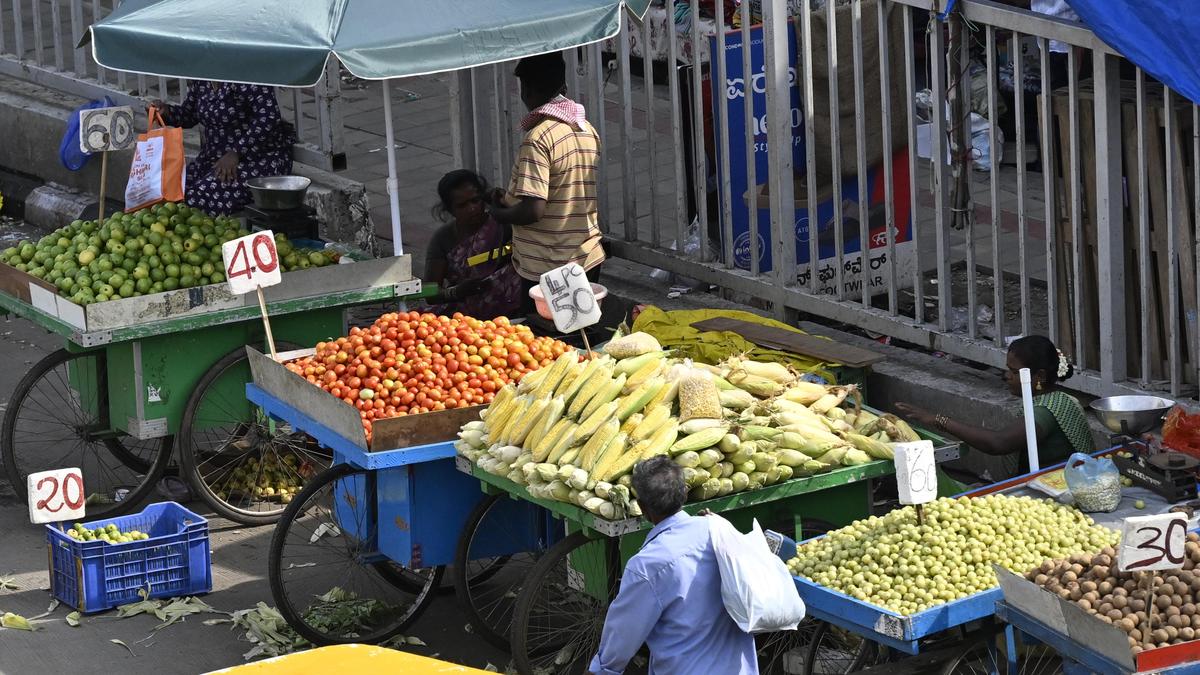
The October RBI Bulletin flagged broadening food-price pressures as September headline CPI inflation reached 5.5%, with rural inflation exceeding urban inflation.
Image: The Hindu
Why in news
The RBI Bulletin released on October 23, 2026 reported widespread price pressures, drawing on September inflation readings and high-frequency food-price data up to October 19. Its State of the Economy article argued that greater generalisation of inflation called for a commensurate monetary policy response.
5.5%
September headline CPI inflation
4.8%
August headline CPI inflation
6.1%
September rural inflation
4.9%
September urban inflation
11.4%
September WPI inflation
11 out of 12
CPI divisions with sequential inflation increases
Background
Inflation is a sustained increase in the general price level, which reduces purchasing power. The Consumer Price Index measures changes in retail prices faced by consumers, while the Wholesale Price Index tracks prices of goods at the wholesale level. India's flexible inflation-targeting framework uses headline CPI inflation as its nominal anchor, with the Monetary Policy Committee determining the policy rate. Food prices are particularly sensitive to harvest conditions, seasonality, storage, transport and trade conditions; monetary policy influences them mainly indirectly through demand, financing conditions and inflation expectations.
What the Bulletin signals: inflation is becoming more generalised
According to the supplied report, headline CPI inflation rose from 4.8% in August to 5.5% in September, reaching a 23-month high. Food, fuel and core components contributed to the increase, while eleven of the twelve CPI divisions witnessed a sequential increase in inflation.
High-frequency observations up to October 19 showed rising prices across cereals, major pulses and edible oils. The pattern matters because widespread increases are less readily explained by a temporary shortage of a single commodity.
However, broad-based does not mean universal: potato prices declined, onion price increases slowed and tomato prices picked up. These October observations are early price signals, not a completed October CPI inflation estimate.
- Rice and wheat prices continued to increase.
- Major pulse prices rose sequentially.
- Edible oil increases were led by mustard and palm oil.
- The report placed September WPI inflation at 11.4%, indicating pressure at the wholesale stage as well.
Infographic
Breadth
Food, fuel and core pressures contributed to rising headline inflation.
Rural exposure
September rural inflation exceeded urban inflation.
Monetary role
Anchor expectations and contain second-round effects.
Supply response
Ease commodity bottlenecks through stocks, trade and logistics.
Welfare balance
Protect vulnerable consumers while preserving producer incentives.
AI-assisted infographic by Pragnya IAS Academy, based on the cited sources.
Why rural inflation is higher: composition, markets and vulnerability
Rural inflation rose from 5.2% in August to 6.1% in September, while urban inflation increased from 4.3% to 4.9%. These are rural and urban headline inflation readings, not separate food-inflation rates.
Differences in consumption baskets and expenditure weights can make rural and urban inflation diverge. Local availability, transport costs, storage facilities and market competition can also affect retail prices. The supplied report establishes the gap but does not quantify the contribution of these possible explanations.
Higher food prices do not benefit every rural household. Net food buyers, landless workers and households with weak income growth can lose purchasing power; even cultivators may face higher input costs or fail to receive proportionate increases in farm-gate prices.
- Household welfare depends on income growth and net purchases of food, not simply on rural or urban residence.
- The report identified Telangana, Tamil Nadu and Puducherry as recording inflation above 6% in both rural and urban areas.
- State-level variation supports geographically differentiated supply and welfare responses.
Monetary policy: contain persistence without treating every shortage as excess demand
Interest-rate policy cannot directly produce cereals, restore a damaged crop or create cold-storage capacity. Reacting mechanically to every temporary food-price spike can weaken investment and demand without quickly correcting the underlying shortage.
Nevertheless, persistent food inflation can influence wage demands, business pricing and household expectations. When food pressures coincide with rising fuel and core inflation, the risk of second-round effects becomes more relevant, requiring close attention to inflation persistence and demand conditions.
The Bulletin article's call for a commensurate change in monetary policy stance is an analytical assessment, not itself an MPC decision. Any policy response should be based on the inflation outlook, expectations, growth conditions and the transmission of earlier measures.
- A temporary relative-price shock and a persistent increase in general inflation require different assessments.
- Core inflation helps identify underlying pressures, but headline CPI remains the policy anchor.
- Credible communication can help prevent temporary price shocks from becoming embedded in expectations.
Supply-side policy: address commodity bottlenecks and cost transmission
The appropriate supply response varies by commodity. Where public stocks and operational arrangements permit, calibrated releases can improve cereal availability. For perishables, faster transport, better market arrivals, storage and cold-chain facilities are more directly relevant.
Trade policy can supplement domestic supplies of commodities such as pulses and edible oils, subject to global availability, landed costs and delivery lags. Predictable decisions are preferable to abrupt restrictions that may weaken farmer incentives and private investment.
Elevated industrial and farm input costs create a risk of further pass-through into retail prices, although WPI and CPI do not move mechanically together. The report also links elevated energy prices and constrained supply chains to the West Asia conflict, reinforcing the importance of monitoring imported costs.
- Use commodity-level information on stocks, arrivals and retail margins before selecting interventions.
- Protect vulnerable consumers through targeted food-security support rather than indiscriminate demand stimulus.
- Improve irrigation, warehousing, market connectivity and climate resilience to reduce recurring supply shocks.
- Coordinate Union and State action while preserving the institutional role of the MPC.
| Indicator | August 2026 | September 2026 |
|---|---|---|
| Combined CPI inflation | 4.8% | 5.5% |
| Rural inflation | 5.2% | 6.1% |
| Urban inflation | 4.3% | 4.9% |
| WPI inflation | 9.9% | 11.4% |
- 1. Supply disruptions or higher input costs raise food prices.
- 2. Repeated increases lift household living costs and business expenses.
- 3. If households and firms expect inflation to persist, wage demands and pricing behaviour may adjust.
- 4. Second-round effects can spread beyond the initially affected commodities.
- 5. Supply measures address shortages while monetary policy limits demand spillovers and anchors expectations.
August 2026
Headline CPI inflation stood at 4.8%, with rural inflation already above urban inflation.
September 2026
Headline CPI inflation rose to 5.5%, accompanied by increases in food, fuel and core components.
October 2026, up to October 19
High-frequency observations indicated broad-based food-price increases, including cereals, pulses and edible oils.
October 23, 2026
The October RBI Bulletin was released, highlighting increasingly generalised inflation pressures.
Significance, challenges & way forward
Significance
- Simultaneous pressure across food, fuel and core components makes the persistence of inflation more important than any single commodity movement.
- Higher rural inflation can erode real incomes and consumption among households that are net buyers of food.
- Elevated wholesale and input prices warrant monitoring for subsequent retail-price transmission.
- Regional differences show why national inflation readings must be supplemented with State-level and commodity-level evidence.
Challenges
- Partial-month food-price observations cannot establish the final monthly inflation outcome.
- The reported rural–urban gap does not by itself identify whether expenditure weights, local prices or distribution costs are the dominant cause.
- Monetary tightening has transmission lags and cannot directly eliminate physical supply shortages.
- Indiscriminate price suppression can weaken producer incentives, while delayed intervention can hurt vulnerable consumers.
- External energy and supply-chain shocks can complicate domestic stabilisation even when domestic demand remains resilient.
Way forward
- Track inflation breadth, persistence, expectations and commodity contributions rather than reacting to the headline rate alone.
- Deploy stock releases, import facilitation and logistics support selectively, based on verified availability and market conditions.
- Strengthen targeted food-security delivery for vulnerable households while avoiding broad fiscal stimulus that could add to price pressure.
- Invest in irrigation, storage, cold chains and competitive agricultural markets to reduce structural volatility.
- Make trade and market interventions predictable, time-bound and transparent to protect both consumers and producer incentives.
- Maintain clear communication between monetary and fiscal authorities without treating a Bulletin assessment as an MPC policy announcement.
Key terms
- Headline inflation
- Inflation measured using the full consumer-price basket, including food and fuel.
- Core inflation
- In the supplied report, CPI inflation excluding food and fuel.
- Broad-based inflation
- Price increases spread across several commodities or expenditure categories rather than concentrated in a few items.
- Second-round effects
- The spread of an initial price shock into wages, expectations and prices of other goods and services.
- Inflation expectations
- Household and business beliefs about future inflation that can influence spending, wages and pricing.
- Cost pass-through
- The transmission of higher input or wholesale costs into prices charged to consumers.
- Net food buyer
- A household whose purchases of food exceed its sales of food.
- Sequential price increase
- An increase relative to the preceding observation period, distinct from a year-on-year comparison.
Link with static syllabus
Prelims practice MCQs
Q1. With reference to the inflation readings in the supplied report, consider the following statements: 1. Rural headline inflation exceeded urban headline inflation in both August and September. 2. Every vegetable mentioned in the October observations recorded rising prices. 3. The October high-frequency observations covered only part of the month. Which of the statements given above are correct?
Q2. Consider the following statements about monetary policy and food inflation: 1. Monetary policy can influence inflation expectations even when the initial shock originates in food supply. 2. An increase in the policy interest rate directly expands the physical supply of vegetables. 3. Persistent food inflation can generate second-round effects through wages and business pricing. Which of the statements given above are correct?
Q3. Consider the following pairs: 1. Headline CPI inflation — Inflation across the full consumer-price basket 2. Core inflation in the supplied report — CPI inflation excluding food and fuel 3. WPI — An index of retail prices covering all consumer services Which of the pairs given above are correctly matched?
Q4. Which of the following best describes the institutional significance of a State of the Economy article in the RBI Bulletin?
Mains practice questions
GS 3 · 15 marks · 250 words
Broad-based food inflation requires a coordinated response rather than reliance on monetary policy alone. Discuss with reference to rural–urban inflation differences in India.
Frequently asked questions
Does broad-based food inflation mean every food item became costlier?
No. It means increases were spread across several categories; the supplied report also noted declining potato prices and a slower pace of onion price increases.
Why can rural households suffer even when agricultural prices rise?
Many rural households are net food buyers rather than surplus producers. Higher retail prices can reduce their real incomes, while cultivators may also face higher production costs.
Can the RBI control food inflation?
The RBI cannot directly remove physical shortages, but monetary policy can influence demand and prevent persistent food-price shocks from destabilising inflation expectations. Supply interventions remain essential.
Did the Bulletin announce a change in the policy rate?
The supplied report describes an article calling for a commensurate monetary policy response; it does not report an MPC policy-rate decision.
Sources
Analysis prepared by the Pragnya IAS Academy current-affairs desk with AI assistance from the cited reports. Verify figures with the original sources.
Turn current affairs into marks
Join Pragnya IAS Academy's mentorship for daily answer-writing evaluation on stories like this — classroom programmes from a trusted name in IAS coaching in Hyderabad.