
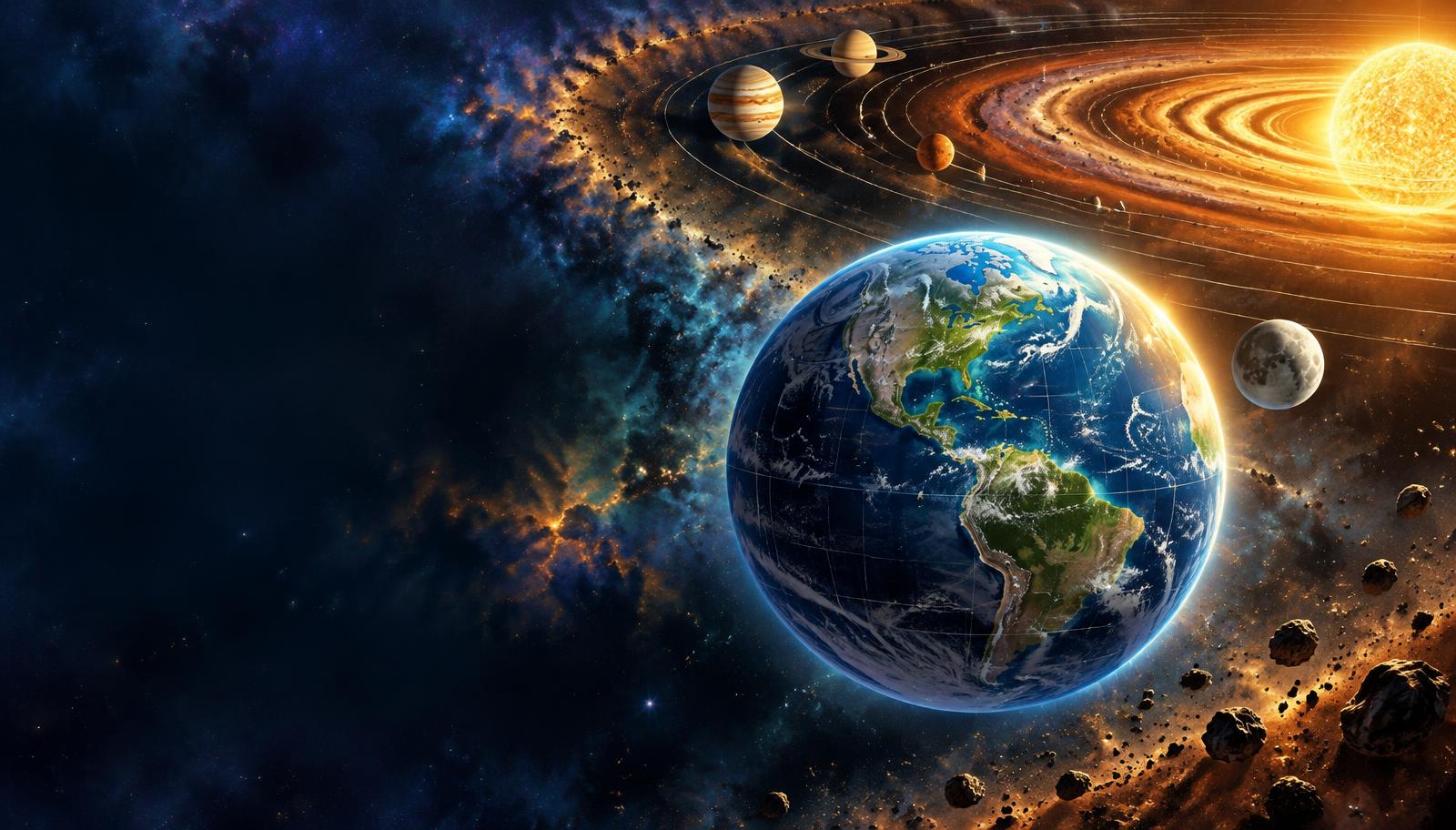
InfoGraphix by Pragnya · Geography · Chapter 1
Origin and Evolution of the Earth
How the universe, the Solar System and the Earth formed; how rock, oceans, air and life evolved; and how the Earth's shape and motions create latitudes, time zones, seasons and eclipses.
- 18 visual topics
- 54 practice MCQs
- 54 flip cards
Three parts of the chapter
Topics 1–7
Cosmos
Theories of origin, the Big Bang, how stars and planets form, the planets, small bodies and the Moon.
Topics 8–9
Young Earth
How rock, oceans, air and life evolved together over four billion years.
Topics 10–17
Earth's grid & motions
Latitude, longitude, time, the Date Line, rotation, seasons and eclipses.
From the Big Bang to today's calendar
Scroll the ribbon and tap any milestone to open its infographic.
13.8 bn
Big Bang
The universe begins expanding.
Open topic →4.6 bn
Solar System
Sun and planets form from a nebula.
Open topic →≈ 4.5 bn
Moon forms
Giant impact on the young Earth.
Open topic →4.0 bn
Oceans
Rain fills the basins.
Open topic →3.8 bn
First life
Single cells in the sea.
Open topic →1755
Kant
Nebular hypothesis.
Open topic →1884
Prime Meridian
Greenwich fixed as 0°.
Open topic →1929
Hubble
Galaxies are receding.
Open topic →2006
Pluto
Reclassified as a dwarf planet.
Open topic →2023
Chandrayaan-3
Landing near the lunar south pole.
Open topic →
Topic index
Follow the numbers in order, or jump to what you need.
0 of 18 revised on this device
- 11755–1940s
Early Theories: Nebular to Revised Nebular
Kant, Laplace, Chamberlin–Moulton, Jeans, Schmidt
Before the Big Bang, scientists tried to explain only how the Sun and planets formed. Kant and Laplace imagined a spinning gas cloud, Chamberlin and Moulton a passing star, and Schmidt and Weizsäcker a dusty disc around the young Sun.
Open infographic - 2Cosmology
The Big Bang & the Expanding Universe
13.8 billion years, Hubble and the CMB
The universe began about 13.8 billion years ago from an extremely hot, dense state and has been expanding ever since. Hubble's receding galaxies and the cosmic microwave background are the two strongest pieces of evidence.
Open infographic - 3Formation
How Stars and Planets Form
Nebula → disc → planetesimals → planets
Stars are born when gravity collapses dense clumps of gas in a nebula. The leftover gas and dust flatten into a spinning disc where grains stick together into planetesimals, which collide and grow into planets.
Open infographic - 4Planets
Terrestrial vs Jovian Planets
Rocky inner worlds, giant outer worlds
The four inner planets are small, rocky and dense; the four outer giants are huge, gassy or icy and light. The difference comes from where they formed — inside or outside the 'frost line' around the young Sun.
Open infographic - 5Planets
The Eight Planets: Fact File
Hottest, densest, retrograde, rings
One distinctive fact per planet answers most Prelims statements: Venus is the hottest and spins backwards, Earth is the densest, Saturn is the least dense, Uranus rolls on its side and Neptune was found by mathematics.
Open infographic - 6Small bodies
Dwarf Planets, Asteroids & Comets
IAU test, Pluto and the leftovers
A planet must orbit the Sun, be round and clear its orbital path. Pluto fails the third test and became a dwarf planet in 2006. Asteroids, comets and meteoroids are the Solar System's leftover building blocks.
Open infographic - 7Satellite
The Moon
Giant impact, tidal locking, Chandrayaan
The Moon most likely formed when a Mars-sized body struck the young Earth about 4.5 billion years ago. It is tidally locked, shows phases as it orbits, and its 5° tilted orbit explains why eclipses are not monthly.
Open infographic - 8Young Earth
Evolution of the Lithosphere & Oceans
Differentiation, degassing and rain
The early Earth was hot and molten. Heavy iron sank to form the core while lighter rock rose to form the mantle and crust. Water vapour released by volcanoes condensed into rain that filled basins and made the oceans about 4 billion years ago.
Open infographic - 9Young Earth
Atmosphere in Three Stages & the Origin of Life
Solar wind, volcanoes, photosynthesis
The atmosphere evolved in three stages: the first hydrogen–helium envelope was stripped by the solar wind; volcanoes then released water vapour, carbon dioxide and nitrogen; finally photosynthesising life filled the air with oxygen.
Open infographic - 10Earth's grid
Shape of the Earth & Latitudes
Geoid, parallels and the 111 km degree
The Earth is a geoid — slightly flattened at the poles and bulging at the Equator. Latitude measures a place's angle north or south of the Equator; parallels are full circles that shrink towards the poles.
Open infographic - 11Earth's grid
Key Parallels & Heat Zones
Who lies on the Equator and the Tropics
Five parallels divide the globe into the torrid, temperate and frigid zones. The Tropic of Cancer crosses eight Indian states, and the countries on the Equator, the Tropics and the Prime Meridian are favourite Prelims material.
Open infographic - 12Earth's grid
Longitudes & the Prime Meridian
Greenwich 1884 and India's 30° spread
Meridians run from pole to pole. The Prime Meridian through Greenwich was chosen in 1884 as 0°, and the 180° meridian opposite it roughly follows the International Date Line. India stretches across about 29° of longitude.
Open infographic - 13Time
Local Time & Indian Standard Time
1° = 4 minutes; IST at 82°30′E
The Earth turns 360° in 24 hours, so every degree of longitude equals four minutes of time. Places to the east are ahead. India's Standard Time is set at 82°30′E, near Mirzapur, which is 5 hours 30 minutes ahead of Greenwich.
Open infographic - 14Time
Date Line & India's Time-Zone Debate
Gain or lose a day; one zone or two
The International Date Line roughly follows the 180° meridian but bends around islands and the Bering Strait. Crossing it eastward repeats a date; crossing it westward skips one. India debates whether it needs a second time zone for the North-East.
Open infographic - 15Motions
Rotation: Day, Night & the Coriolis Effect
West to east at 1,670 km/h
The Earth spins from west to east once in about 24 hours. Rotation causes day and night, the apparent motion of the Sun, and the Coriolis effect that deflects winds and ocean currents to the right in the Northern Hemisphere and to the left in the Southern.
Open infographic - 16Motions
Revolution, Tilt & the Seasons
Solstices, equinoxes, perihelion
The Earth orbits the Sun in about 365¼ days with its axis tilted 23½° from the vertical and always pointing the same way. The tilt — not the distance from the Sun — produces the seasons, solstices, equinoxes and changing day length.
Open infographic - 17Eclipses
Eclipses: Solar vs Lunar
New moon, full moon and the 5° tilt
An eclipse occurs when the Sun, Earth and Moon line up. A solar eclipse happens only at new moon, when the Moon blocks the Sun; a lunar eclipse happens only at full moon, when the Moon enters the Earth's shadow.
Open infographic - 18Revision
Chapter Quick Revision
Numbers, scientists, traps and an answer frame
The whole chapter on one sheet: theories and their authors, planet facts, the three-stage atmosphere, key parallels, the time formula, seasons and eclipses — with the traps examiners love.
Open infographic
Full reading notes in the Study Library
All Geography notes →Previous year questions