
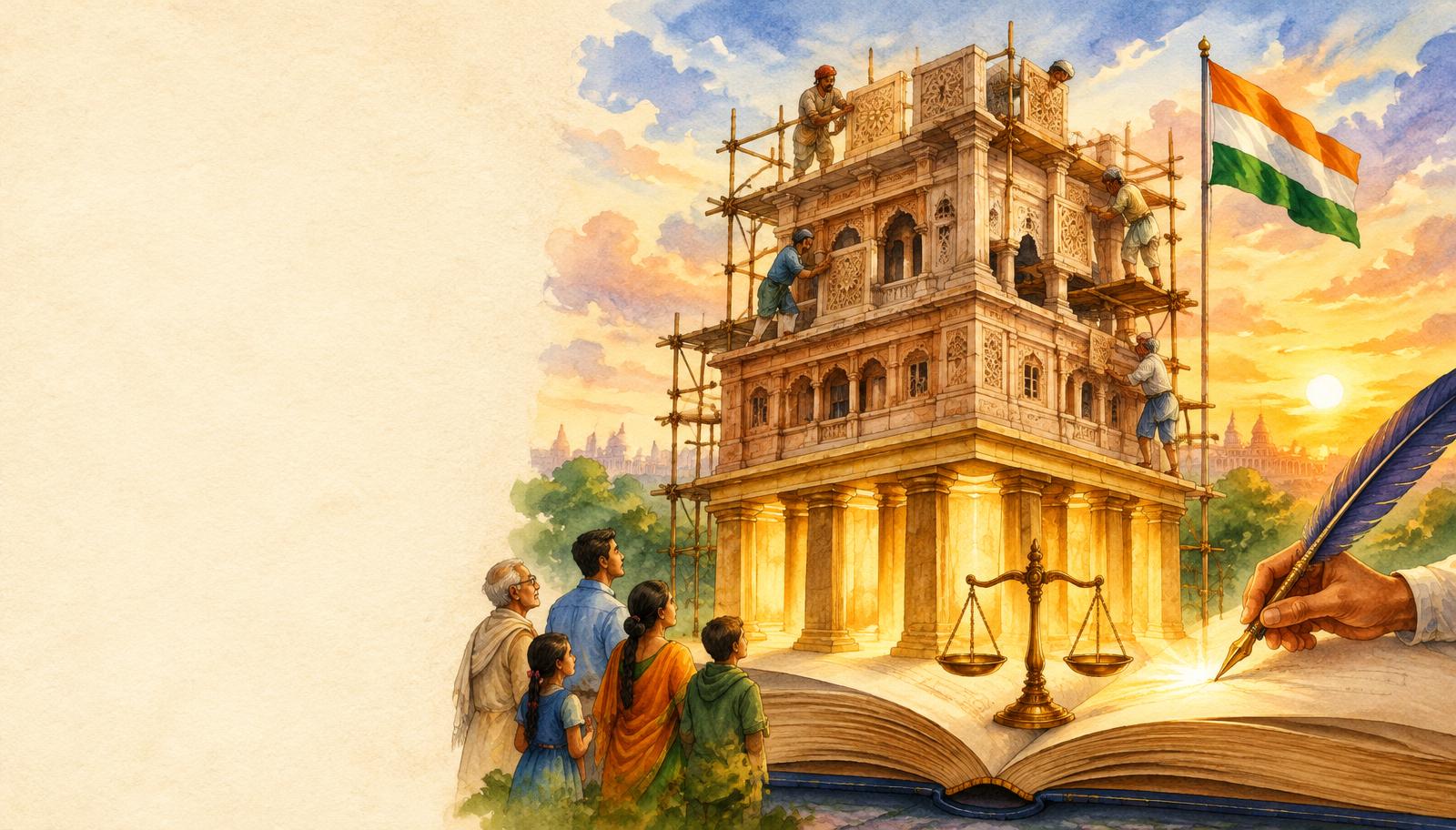
InfoGraphix by Pragnya · Indian Polity · Chapter 5
Amendment of the Constitution & Basic Structure
How the Constitution changes and what it can never lose — Article 368 and its three modes, the step-by-step procedure, the case battle from Shankari Prasad to Kesavananda Bharati and beyond, the features of the basic structure and the landmark amendments from 1951 to 2023.
- 18 visual topics
- 54 practice MCQs
- 54 flip cards
Three pillars of the chapter
Article 368
The power
Constituent power of Parliament — three modes, five steps, obligatory assent.
1951–1980
The battle
From Shankari Prasad and Golaknath to Kesavananda and Minerva Mills.
Basic structure
The limit
What no amendment can destroy — and the amendments that shaped India.
Chapter mind-map: 1950 → 2023
Scroll the ribbon and tap any milestone to open its infographic.
1950
Article 368
Procedure for amendment.
Open topic →1951
1st Amendment
Ninth Schedule; Shankari Prasad.
Open topic →1965
Sajjan Singh
'Basic features' doubt.
Open topic →1967
Golaknath
FRs unamendable.
Open topic →1971
24th Amendment
Constituent power; assent obligatory.
Open topic →1973
Kesavananda Bharati
Basic structure, 7:6.
Open topic →1975
Raj Narain
Free and fair elections.
Open topic →1976
42nd Amendment
Mini Constitution.
Open topic →1980
Minerva Mills
Limited amending power.
Open topic →1992
Kihoto Hollohan
Ratification matters.
Open topic →1994
S.R. Bommai
Secularism, federalism.
Open topic →2007
I.R. Coelho
Ninth Schedule review.
Open topic →2015
NJAC case
99th struck down.
Open topic →2016
101st Amendment
GST.
Open topic →2023
106th Amendment
Women's reservation.
Open topic →
Topic index
Follow the numbers in order, or jump to what you need.
0 of 18 revised on this device
- 1Part XX
Why Amend a Constitution?
Flexibility, stability and the middle path
Why a Constitution must be able to change, why India's framers chose a middle path between rigidity and flexibility, and how Article 368 and the basic structure doctrine together keep change disciplined.
Open infographic - 2Comparison
Rigid vs Flexible: USA, UK & India
Who amends, how hard, and the States' role
A side-by-side look at the rigid US model, the flexible British model and India's blend — who can amend, how hard it is, and what role the States play.
Open infographic - 3Art 368
Article 368: Text & Scope
Constituent power, clause by clause
What Article 368 actually says — constituent power, 'addition, variation or repeal', the special majority, obligatory assent and the exclusion of Article 13 — and how the 24th Amendment rewrote it.
Open infographic - 4Modes
Three Modes of Amendment
Simple, special, special + States
The three ways India's Constitution changes — simple majority outside Article 368, special majority of Parliament, and special majority plus ratification by half of the States — with the exact meaning of each majority.
Open infographic - 5Arts 2–4, 169
Changes by Simple Majority
Outside Article 368 — and 'not deemed' amendments
The provisions Parliament can change by an ordinary law — States, Legislative Councils, schedules on Scheduled and Tribal Areas, salaries, quorum and more — and why such laws are 'not deemed' Article 368 amendments.
Open infographic - 6Art 368(2)
Special Majority & State Ratification
The federal list and the Kihoto lesson
What needs a special majority of Parliament, what additionally needs ratification by half of the States, and why the second list protects the federal bargain.
Open infographic - 7Procedure
Amendment Procedure, Step by Step
Five steps; no joint sitting; obligatory assent
The journey of a constitutional amendment Bill — introduction in either House, special majority, State ratification where needed and the President's obligatory assent — with the rules that make it different from an ordinary Bill.
Open infographic - 8Evaluation
Criticism of the Amendment Procedure
Too easy, too central — or well balanced?
Why critics call India's amendment procedure too easy, too centralised and too vague — and why its defenders still call it one of the best-designed parts of the Constitution.
Open infographic - 91951–1971
Shankari Prasad to Golaknath
Can Parliament amend Fundamental Rights? 1951–1971
The first round of the amendment battle, 1951–1967: whether Parliament could amend Fundamental Rights — yes in Shankari Prasad and Sajjan Singh, no in Golaknath — and how Parliament hit back.
Open infographic - 101973
Kesavananda Bharati, 1973
Thirteen judges, 7:6 and the basic structure
The thirteen-judge case that gave India the basic structure doctrine — who brought it, what was decided by 7:6, what was upheld and struck down, and why it still governs every amendment.
Open infographic - 111975–1981
After Kesavananda: Raj Narain to Waman Rao
39th and 42nd Amendments meet the courts
How the doctrine was tested in the Emergency years — the 39th Amendment and Indira Gandhi v Raj Narain, the 42nd Amendment's attempt to shut out courts, Minerva Mills and the Ninth Schedule cut-off in Waman Rao.
Open infographic - 12Doctrine
Elements of the Basic Structure
The features no amendment can destroy
The features courts have recognised as part of the basic structure — from supremacy of the Constitution to free and fair elections — grouped for easy recall, with the cases that named them.
Open infographic - 131992–2022
Basic Structure in Later Cases
Kihoto, Bommai, Coelho, NJAC, EWS
How the Supreme Court applied the basic structure test from 1992 to 2022 — anti-defection, secularism, tribunals, reservations, the Ninth Schedule, the NJAC, cooperatives and EWS quotas.
Open infographic - 14Limits
What Parliament Can & Cannot Do
Amend — yes; destroy the identity — no
A clear map of the amending power: what Parliament may change by amendment, what it can never destroy, and the common exam errors about 'unamendable' Fundamental Rights.
Open infographic - 151951–1978
Landmark Amendments, 1951–1978
1st, 7th, 24th, 25th, 26th, 42nd, 44th
The amendments of the first three decades that every aspirant must know — 1st, 7th, 24th, 25th, 26th, 42nd and 44th — what each changed and why it mattered.
Open infographic - 161985–2023
Landmark Amendments, 1985–2023
Anti-defection to women's reservation
From the anti-defection law to women's reservation — the amendments of 1985–2023 most likely in the exam, with the correct numbers and contents.
Open infographic - 17Evaluation
The Basic Structure Debate
Judicial overreach or democracy's insurance?
Is the basic structure doctrine judicial overreach or democracy's insurance policy? The criticisms, the defences, its intellectual roots and its influence beyond India.
Open infographic - 18Revision
Chapter Quick Revision
Article 368, cases, features and amendments
Article 368, the three modes, the procedure, the case ladder from Shankari Prasad to Janhit Abhiyan, the basic features and the high-yield amendments — on one revision sheet.
Open infographic
Full reading notes in the Study Library
- Important amendments →
- Constitution Amendment Bill →
- Basic structure →
- Judicial review →
- 73rd Amendment →
- 74th Amendment →
Previous year questions