
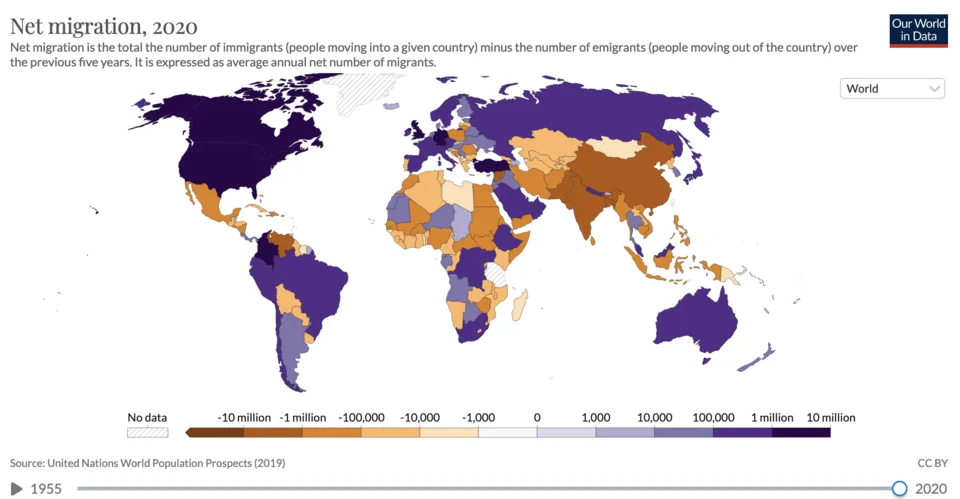
World net migration map for 2020; comparative context for studying migration in India.
Credit: Esteban Ortiz-Ospina, Max Roser, Hannah Ritchie, Fiona Spooner and Marcel Gerber · CC BY-SA 3.0 · sourceResized and converted to WebP; uncropped.
1. Meaning, classification and measurement
Migration differs from births and deaths because it redistributes people between places rather than directly adding to or subtracting from the global population. A migrant's departure is out-migration for the origin and arrival is in-migration for the destination. Immigration and emigration generally refer to international movements. Net migration equals in-migration minus out-migration; gross migration is their sum.
Internal migration takes place within national boundaries and may be intra-district, inter-district within a state, or interstate. Its four settlement streams are rural–rural, rural–urban, urban–urban and urban–rural. International migration crosses national borders. Duration provides another classification: permanent, temporary, seasonal and circular. Seasonal migration follows recurring agricultural or climatic calendars; circular migration involves repeated movement between origins and destinations.
The Census of India identifies migrants using place of birth and place of last residence. A person born elsewhere is a lifetime migrant under the birthplace approach. Last residence helps identify the most recent residential move, but does not reveal every move made during a lifetime. Daily commuters and tourists are not ordinarily residential migrants. Short-duration and highly mobile workers can be difficult to capture, making definitions and reference periods crucial.
- Migration stock counts migrants present at a specified time; migration flow counts movements during a period.
- Return migration means moving back to a previous place of residence, commonly the place of origin.
- Displacement is movement compelled by circumstances such as conflict, disasters or development projects; not all migration is displacement.
2. Drivers and geographical patterns in India
Migration results from interacting push and pull factors. Push factors include limited employment, low agricultural earnings, land fragmentation, indebtedness, environmental stress and insecurity. Pull factors include higher wages, industrial and service-sector jobs, education, healthcare and family networks. Distance, transport costs, language, social restrictions and information influence whether people can move. The poorest may lack the resources required to migrate.
Rural–rural movement is the largest stream in India's Census migration stock, substantially reflecting marriage-related relocation and movement between nearby settlements. Rural–urban labour migration is economically prominent but should not be mistaken for the majority of all migration. Urban–urban moves accompany job changes and the growth of metropolitan economies. Urban–rural movement includes retirement, return migration and movement during economic shocks.
Uttar Pradesh and Bihar are major origins of interstate labour migration. Maharashtra, the National Capital Region and Gujarat are important destinations, while Karnataka, Tamil Nadu and Kerala also attract workers. Corridors link eastern Uttar Pradesh and Bihar with Delhi and Mumbai, Odisha with Surat, and eastern and northeastern India with southern construction and service centres. These are broad patterns: individual states can simultaneously send and receive migrants.
International labour migration connects India with the Gulf countries, while skilled employment, education and family migration link it with North America, Europe and other destinations. Migration is selective by age, skills and household resources. Social networks reduce travel and job-search costs, explaining why particular villages develop durable connections with particular cities or overseas destinations.
How a labour-migration corridor develops
- 1. Regional differences create livelihood incentives
- 2. Households assess costs, risks and expected earnings
- 3. Recruiters or social networks facilitate movement
- 4. Workers enter destination labour and housing markets
- 5. Remittances and information connect destination with origin
- 6. Repeated movement, return or settlement shapes later migration
3. Reading migration data correctly
Census 2011 recorded approximately 45.6 crore migrants by place of last residence, or 37.6% of the population. This figure includes people who moved many years earlier, movements within districts, marriage migration and people whose previous residence was outside India. It is therefore incorrect to interpret it as the number of interstate labour migrants or people who migrated during 2011.
The NSO report Migration in India, 2020–21, based on the Periodic Labour Force Survey, estimated that migrants comprised 28.9% of the population. The estimated rate was 47.9% among females and 10.7% among males. Marriage was the leading reported reason among women, while employment-related reasons were important among men. Recording a single main reason can conceal multiple motivations: a woman moving for marriage may subsequently enter paid work.
Census and survey estimates are not automatically comparable. Differences in definitions, residence criteria, sampling, coverage and reference periods affect the results. The 2020–21 survey also overlapped the COVID-19 disruption. Students should distinguish absolute migrant numbers from migration rates, and total migration from net migration. A large state may have many migrants without having the highest migrant share.
| Stream | Common drivers | Illustrative movement |
|---|---|---|
| Rural–rural | Marriage, agricultural work, family relocation | Movement between villages |
| Rural–urban | Employment, education, access to services | Village workers moving to Surat |
| Urban–urban | Job mobility, professional education, business | Movement from a smaller city to Hyderabad |
| Urban–rural | Return migration, retirement, livelihood shocks | City workers returning to home villages |
| International | Employment, education, family reunification | Indian workers moving to Gulf countries |
4. Population, economic and environmental consequences
Migration changes the size, age structure, sex composition and occupational profile of origin and destination populations. Out-migration of working-age adults may increase the relative share of children and older persons in source areas. Male-dominated labour migration can increase women's agricultural and household responsibilities. At destinations, young workers expand labour supply and support construction, manufacturing, domestic services, hospitality and transport.
Remittances finance food, housing, education, healthcare and debt repayment. Return migrants can bring savings, skills and business connections. However, departure may create local labour shortages, separate families and transfer care burdens to those left behind. Benefits are uneven: recruitment debt, uncertain employment and high living costs can reduce migrants' gains.
Rapid inflows can increase demand for rental housing, water, sanitation, schools and public transport. Informal settlements often reflect insufficient affordable housing and urban planning rather than migration alone. Migrants also face wage theft, hazardous work, overcrowding and language barriers. Droughts, floods, cyclones and erosion may encourage temporary or lasting movement, but environmental pressures usually interact with livelihoods, infrastructure and household choices.
- Population change equals births minus deaths plus net migration.
- Urban population growth has three major sources: natural increase, net migration and reclassification or boundary expansion.
- International emigration may create skill shortages in some sectors, while return migration and diaspora networks can support knowledge transfer.
5. Rights, welfare portability and planning
Articles 19(1)(d) and 19(1)(e) of the Constitution protect citizens' rights to move freely and reside and settle throughout India, subject to constitutionally permitted reasonable restrictions. Migrant welfare therefore requires inclusion in destination areas, rather than treating mobility itself as a problem. Affordable housing, accessible public services, safe transport and enforceable employment standards are central priorities.
The Inter-State Migrant Workmen Act, 1979 was designed around interstate workers recruited through contractors, including provisions on registration, licensing and allowances. Its recruitment-based scope did not cover every form of migration. The Occupational Safety, Health and Working Conditions Code, 2020 provides a broader framework, including certain self-migrated interstate workers subject to statutory conditions. Examination answers should distinguish legislative provisions from notified implementation and operational coverage.
One Nation One Ration Card enables eligible National Food Security Act beneficiaries to access foodgrain entitlements through portability across participating fair-price shops. The e-Shram portal, launched in 2021, creates a national database of unorganised workers; registration is not itself a guarantee of every welfare benefit. Better migration statistics, multilingual information, grievance redress, childcare and coordination between origin and destination governments are essential for effective protection.
Net migration: interpreting population redistribution
A world map described as showing net migration in 2020 offers comparative context for migration, but is not evidence of movement within India. Net migration is the difference between people entering and leaving a defined territory during a specified period. A positive balance indicates more arrivals than departures; a negative balance indicates the reverse. Neither reveals the total volume of movement: substantial immigration and emigration can coexist with a small net balance. Migration also differs from commuting, which generally does not involve changing residence.
For India, distinguish international migration from internal movements across villages, towns, districts and states. Internal migration redistributes population without directly changing the national population total. Employment, education, marriage and family movement are important reasons, while seasonal and circular mobility complicate measurement. Census measures based on birthplace or place of last residence answer different questions from surveys using particular reference periods. The supplied metadata does not identify the map’s underlying dataset, units or estimation method; therefore, it cannot establish India’s migration balance or explain causes. Analysis requires checking whether values are counts or rates and what period they cover.
- Population change combines natural increase, meaning births minus deaths, with net migration; population growth alone does not demonstrate inward migration.
- National net migration cannot reveal interstate flows, rural–urban streams or migrants’ characteristics; use appropriately disaggregated Indian evidence.
- For Mains, connect mobility with labour demand, remittances, housing and portability of entitlements, rather than treating migration solely as urban pressure.
Real-world case studies
COVID-19 and return migration, 2020
The nationwide lockdown beginning on 25 March 2020 disrupted employment, transport and housing security for many migrant workers. Large-scale return movement exposed gaps in welfare portability and worker records. Shramik Special trains began on 1 May 2020. The episode demonstrated how sudden livelihood shocks can reverse migration flows and why destination-based support is essential.
Kerala's two-way migration economy
Kerala combines substantial overseas emigration, especially to Gulf countries, with inward migration from other Indian states. Overseas remittances support household consumption and investment, while incoming workers support construction, manufacturing and services. It illustrates why a region cannot always be classified simply as either a source or a destination.
Previous year questions
UPSC Mains 2015 · GS-I
Discuss the changes in the trends of labour migration within and outside India in the last four decades.
- Explain the expansion of interstate and circular labour migration.
- Connect destination changes with industrialisation, construction and service-sector growth.
- Trace Gulf labour migration and skilled migration to advanced economies.
- Assess remittances, recruitment systems and worker vulnerability.
Practice questions
Practice MCQ 1
Consider the following statements: 1. Internal migration directly changes India's total population. 2. Net migration can change a district's population even when births equal deaths. 3. Daily commuting necessarily makes a person a residential migrant. Which statement is correct?
- A. 1 only
- B. 2 only
- C. 2 and 3 only
- D. 1 and 3 only
Practice MCQ 2
Which statement best describes India's recorded internal migration?
- A. All migrants are interstate workers.
- B. Rural–urban movement is the only significant migration stream.
- C. Marriage-related relocation contributes substantially to female migration.
- D. Migration stock measures only movements during the latest year.
Practice MCQ 3
Consider the following pairs: 1. One Nation One Ration Card — portability of eligible foodgrain entitlements. 2. e-Shram — database of unorganised workers. 3. Place-of-last-residence data — complete lifetime sequence of residential moves. Which pairs are correctly matched?
- A. 1 and 2 only
- B. 2 and 3 only
- C. 1 and 3 only
- D. 1, 2 and 3
Mains practice · Migration is both a livelihood strategy and a source of vulnerability. Examine with reference to internal migration in India. Suggest measures for migrant-inclusive development. Answer in 250 words.
- Distinguish migration generally from labour migration.
- Explain push–pull factors, networks and seasonal mobility.
- Discuss remittances, labour supply and demographic effects.
- Assess insecure work, housing shortages and service-access barriers.
- Suggest portable welfare, rental housing, worker protection and interstate coordination.
Further reading
- NCERT, India: People and Economy, Class XII, chapter Migration: Types, Causes and Consequences in editions containing the chapter.
- Office of the Registrar General and Census Commissioner, India: Census 2011 D-Series migration tables, censusindia.gov.in.
- National Statistical Office: Migration in India, 2020–21, mospi.gov.in.
- Department of Food and Public Distribution: One Nation One Ration Card, dfpd.gov.in.
- Ministry of Labour and Employment: e-Shram and labour legislation; India Code for statutory texts.
- https://commons.wikimedia.org/wiki/File:Net_Migration_2020.png
Preparing for UPSC Civil Services? Get classroom teaching, answer-writing evaluation and mentorship at Pragnya IAS Academy, Ashok Nagar — see why aspirants choose us for IAS coaching in Hyderabad.