
Manila Summits: Balancing ASEAN Centrality, Quad Cooperation and Strategic Autonomy
Revise the static topic: UPSC International Relations notes
In short: According to the supplied report, Prime Minister Narendra Modi participated in the ASEAN-India, East Asia and Quad leaders’ meetings in Manila, signalling a broadening of India’s Act East and Indo-Pacific engagement. The strategic task is to combine ASEAN-led regional diplomacy with practical Quad cooperation while preserving independent decision-making; the supplied extract does not specify the announced outcomes.
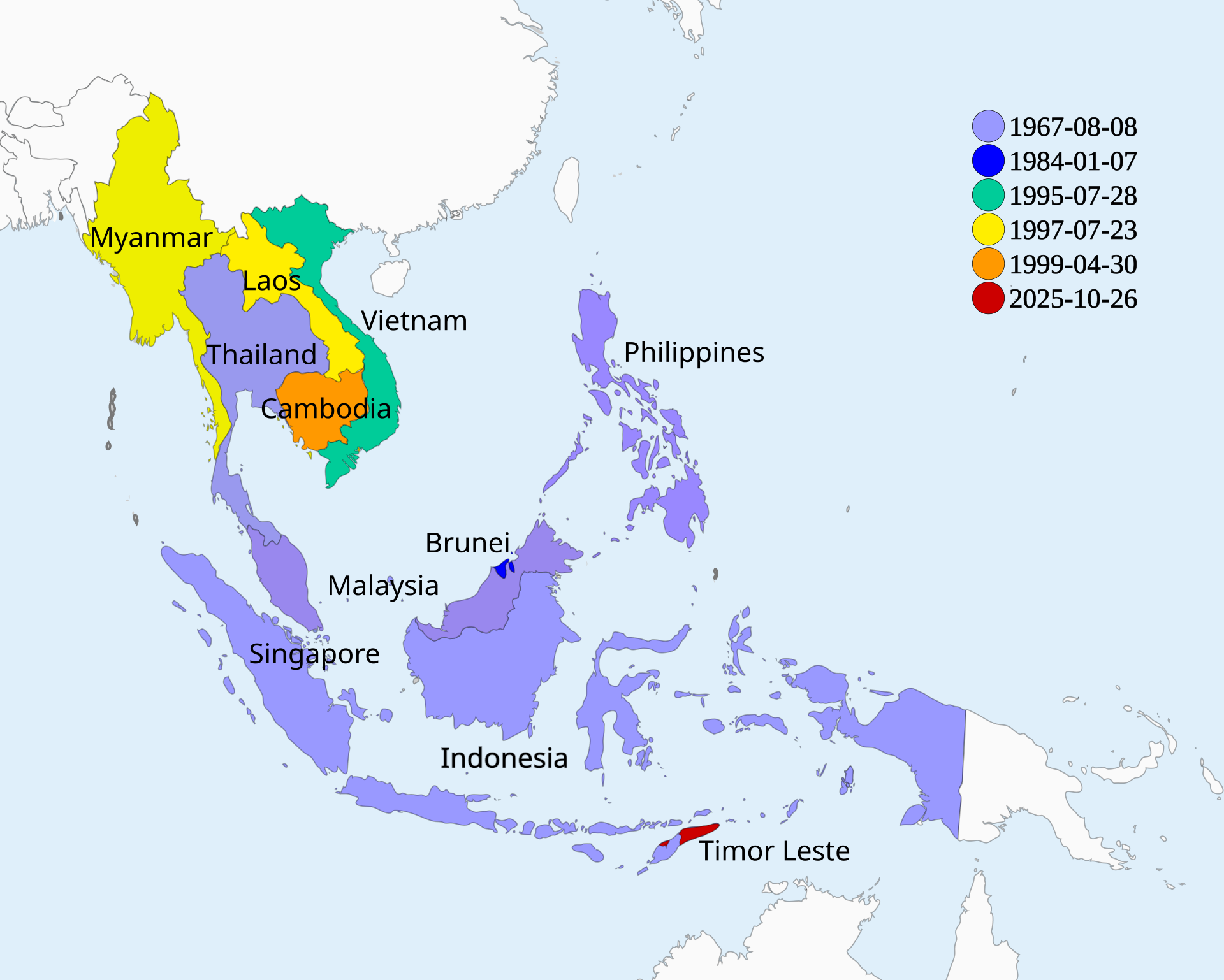
Map of ASEAN member states, providing geographic context for India’s Act East policy and ASEAN-led regional diplomacy.
Image: File:Asie.svg : historicair 20:31, 20 November 2006 (UTC) derivative work: Hariboneagle927 · Public domain
Why in news
The Hindu reports India’s participation in successive multilateral meetings in Manila after Modi skipped the ASEAN summits in Kuala Lumpur in 2025. These engagements invite scrutiny of how India reconciles ASEAN centrality with smaller, issue-based partnerships such as the Quad.
Background
India’s Act East policy links engagement with Southeast Asia to wider economic, diplomatic and strategic interests in the Indo-Pacific. ASEAN provides an institutional centre for regional dialogue through ASEAN-led mechanisms, including the East Asia Summit. The Quad brings together India, Australia, Japan and the United States as a diplomatic partnership rather than a collective-defence alliance. India’s strategic autonomy means retaining the freedom to make issue-specific choices based on national interests, not maintaining equal distance from every major power.
What the Manila report establishes—and what it does not
The report places Modi at the ASEAN-India Summit, East Asia Summit and Quad leaders’ meeting in Manila. It identifies US President Donald Trump, Japanese Prime Minister Sanae Takaichi and Australian Prime Minister Anthony Albanese as the other Quad participants.
The extract says the meetings produced concrete announcements but does not provide their content. Therefore, specific agreements, financial commitments, project deadlines or joint-statement language cannot be attributed to these meetings on the supplied evidence.
The defensible analytical takeaway is the breadth of India’s engagement: an ASEAN-focused partnership, an inclusive ASEAN-led regional forum and a smaller strategic grouping were pursued alongside one another.
- Summit participation is evidence of diplomatic engagement, not by itself evidence of implementation.
- The report presents domestic commitments around Deepavali and trade friction with the United States as perceived reasons for Modi’s absence in 2025, not as conclusively established official explanations.
Infographic
ASEAN centrality
Anchor cooperation in regional consultation and inclusive institutions.
Quad cooperation
Build focused partnerships that deliver useful regional public goods.
East Asia dialogue
Maintain engagement across a wider spectrum of regional powers.
Strategic autonomy
Preserve independent choices through diversified ties and stronger capabilities.
Act East delivery
Translate diplomacy into connectivity, trade and local benefits.
AI-assisted infographic by Pragnya IAS Academy, based on the cited sources.
ASEAN centrality and the Quad: complementary, but not automatically
ASEAN centrality refers to ASEAN’s convening and agenda-shaping role in the regional architecture. For India, supporting it helps prevent the Indo-Pacific from being framed solely as a contest between major powers and gives Southeast Asian states institutional space to shape regional choices.
The Quad can complement this architecture through focused cooperation in areas such as maritime domain awareness, disaster response, infrastructure resilience and technology. These are established areas of Quad cooperation, not verified new Manila announcements.
The tension arises when smaller groupings appear to bypass ASEAN or impose an exclusive strategic agenda. Complementarity therefore depends on consultation, demand-driven projects and respect for the different preferences of ASEAN members.
- ASEAN-led forums provide broad participation and political legitimacy.
- The Quad offers a smaller format for coordination among partners with overlapping interests.
- ASEAN centrality does not mean that every regional initiative must be negotiated within ASEAN.
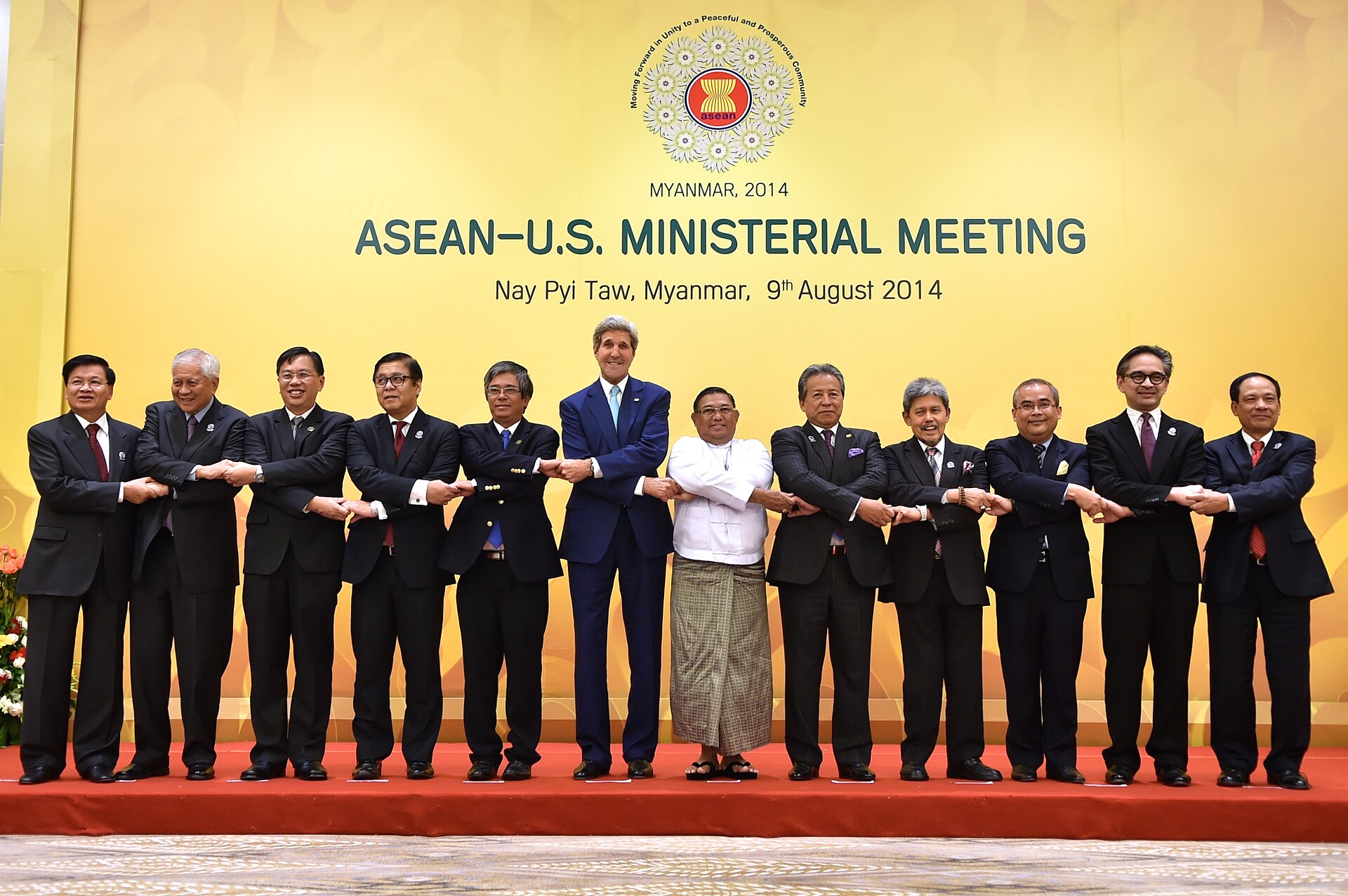
Historical reference view: U.S. Secretary of State John Kerry and ASEAN ministerial colleagues perform the “ASEAN handshake” in Naypyitaw, Myanmar, on August 9, 2014—not at the reported Manila meetings. ASEAN-led forums provide a platform for engagement with external partners.
Image: U.S. Department of State · Public domain
Strategic autonomy through overlapping partnerships
India’s simultaneous participation in these forums illustrates how strategic autonomy can operate through multiple partnerships rather than diplomatic isolation. Cooperation with the United States, Japan and Australia need not require India to accept automatic alignment on every security or economic question.
The East Asia Summit provides a wider setting involving ASEAN and major regional partners, including China and Russia. It allows India to pursue dialogue in a forum broader than the Quad, helping retain channels across competing strategic camps.
However, autonomy must be backed by capability. Economic competitiveness, defence preparedness, diversified supply chains and credible regional delivery determine how much practical freedom India can exercise.
- Strategic autonomy is independent judgement, not permanent neutrality.
- The Quad is not a collective-defence treaty and does not create automatic mutual-defence obligations.
- Issue-based convergence should be assessed against India’s interests rather than treated as unconditional geopolitical alignment.
Act East must connect summit diplomacy with delivery
Act East will gain credibility when diplomatic engagement produces stronger trade links, reliable connectivity, maritime cooperation and people-to-people exchanges. India’s Northeast is geographically important to overland connectivity with Southeast Asia, while maritime routes connect India to regional production and trading networks.
The India–Myanmar–Thailand Trilateral Highway illustrates the link between connectivity and regional integration. Conflict and instability in Myanmar complicate the wider environment for cross-border cooperation; this is a standing policy challenge, not a newly reported Manila outcome.
India should treat ASEAN as a region of diverse partners rather than merely as an arena of major-power competition. Cooperation in skills, digital capacity, resilient infrastructure and disaster preparedness can connect India’s strategic objectives with local development priorities.
- Connectivity requires customs coordination, maintenance and border facilitation alongside physical infrastructure.
- Maritime engagement should support international law, including the United Nations Convention on the Law of the Sea.
- Official outcome documents are necessary before assessing whether the reported Manila announcements materially advance these priorities.
| Forum | Institutional character | Value for India | Key limitation |
|---|---|---|---|
| ASEAN-India Summit | Dialogue between India and ASEAN | Deepens engagement with Southeast Asia across economic, political and functional areas | Progress requires sustained implementation and accommodation of diverse member interests |
| East Asia Summit | ASEAN-led leaders’ forum involving major regional partners | Supports inclusive dialogue on strategic, political and economic issues | Divergent interests can constrain common positions |
| Quad | Diplomatic partnership of India, Australia, Japan and the United States | Enables focused cooperation on shared Indo-Pacific priorities | Must address regional concerns about exclusivity and strategic polarisation |
2025
According to the report, Modi skipped the ASEAN summits in Kuala Lumpur; the reasons discussed in the extract are presented as perceptions rather than confirmed official explanations.
2026
The supplied report describes Modi’s participation in the ASEAN-India, East Asia and Quad leaders’ meetings in Manila, signalling wider engagement across regional forums.
Significance, challenges & way forward
Significance
- Engagement across overlapping forums allows India to combine Southeast Asian partnerships with wider Indo-Pacific cooperation.
- Support for ASEAN-led institutions can strengthen the voice of regional states amid major-power competition.
- Quad cooperation can help translate shared interests into practical regional public goods without creating a formal military alliance.
- Inclusive dialogue and issue-based partnerships together preserve diplomatic options for India.
- Effective Act East implementation can connect India’s Northeast more closely with Southeast Asian economic networks.
Challenges
- ASEAN members have differing security concerns and economic relationships, making a uniform regional position difficult.
- Quad initiatives may generate unease if they are perceived as replacing ASEAN-led mechanisms or demanding exclusive alignment.
- Major-power rivalry can narrow the space for inclusive dialogue and complicate issue-based cooperation.
- Instability in Myanmar and implementation bottlenecks complicate overland connectivity with Southeast Asia.
- Summit visibility can exceed policy delivery when announcements lack clear responsibilities, financing or follow-up.
- The supplied extract is insufficient to evaluate the substance or implementation prospects of the reported Manila announcements.
Way forward
- Assess the Manila meetings against official statements and implementation documents before drawing conclusions about specific policy gains.
- Align Quad-supported regional initiatives with priorities identified through consultation with ASEAN and its members.
- Combine inclusive regional dialogue with focused partnerships rather than presenting them as mutually exclusive choices.
- Prioritise connectivity, trade facilitation and local economic participation in India’s Northeast within Act East implementation.
- Build strategic autonomy through stronger domestic capabilities and diversified economic and technological partnerships.
- Evaluate regional projects through transparent milestones, local benefits and sustained institutional follow-up.
Key terms
- ASEAN centrality
- ASEAN’s role as a principal convenor and agenda-shaper in the regional institutional architecture.
- Strategic autonomy
- The capacity to make independent foreign-policy choices according to national interests.
- Minilateralism
- Cooperation among a limited group of countries around selected shared interests or tasks.
- Act East policy
- India’s policy of deepening economic, political, cultural and strategic engagement with Southeast Asia and the wider eastern neighbourhood.
- Maritime domain awareness
- Understanding activities and conditions in the maritime domain relevant to security, safety, the economy and the environment.
- Regional public goods
- Shared benefits, such as disaster-response capacity and maritime safety, that can serve countries beyond the immediate providers.
Link with static syllabus
Prelims practice MCQs
Q1. With reference to regional groupings in the Indo-Pacific, consider the following statements: 1. The East Asia Summit is an ASEAN-led forum. 2. The Quad creates automatic collective-defence obligations for its members. 3. ASEAN centrality necessarily excludes cooperation through smaller regional groupings. Which of the statements given above is/are correct?
Q2. Which of the following sets consists entirely of Quad members?
Q3. Consider the following pairs: 1. ASEAN-India Summit — Engagement between India and ASEAN 2. East Asia Summit — ASEAN-led regional leaders’ forum 3. Quad — ASEAN’s collective-defence institution Which of the pairs given above are correctly matched?
Q4. In the context of India’s foreign policy, strategic autonomy most appropriately refers to:
Mains practice questions
GS 2 · 15 marks · 250 words
ASEAN centrality and Quad cooperation can be complementary instruments of India’s Act East policy. Examine this proposition with reference to strategic autonomy and India’s Indo-Pacific interests.
Frequently asked questions
Does participation in the Quad contradict ASEAN centrality?
Not inherently. Quad cooperation can complement ASEAN-led diplomacy when it responds to regional priorities and does not seek to displace ASEAN’s institutional role.
How does strategic autonomy differ from neutrality?
Strategic autonomy concerns independent decision-making and permits active partnerships. It does not require India to remain neutral on every issue or maintain equal distance from all powers.
What concrete outcomes were announced in Manila?
The supplied extract says concrete announcements were made but does not identify them. Specific agreements, funding commitments or deadlines cannot therefore be verified from this material.
Why is the East Asia Summit important alongside the Quad?
The East Asia Summit offers an ASEAN-led setting for dialogue involving a broader range of regional powers, including China and Russia. It complements the Quad’s narrower partnership by keeping inclusive diplomatic channels available.
Sources
Analysis prepared by the Pragnya IAS Academy current-affairs desk with AI assistance from the cited reports. Verify figures with the original sources.
Turn current affairs into marks
Join Pragnya IAS Academy's mentorship for daily answer-writing evaluation on stories like this — classroom programmes from a trusted name in IAS coaching in Hyderabad.