
Judicial Appointments: Supreme Court Notice Revives MoP and Collegium Reform Debate
Revise the static topic: UPSC Polity notes · UPSC Governance notes
In short: The Supreme Court has sought responses from the Union government and its own administrative side on a petition seeking finalisation of the revised Memorandum of Procedure for judicial appointments. The case concerns procedural reform of the collegium system, bringing judicial independence, transparency and executive accountability into focus; the notice itself does not change the appointments framework.
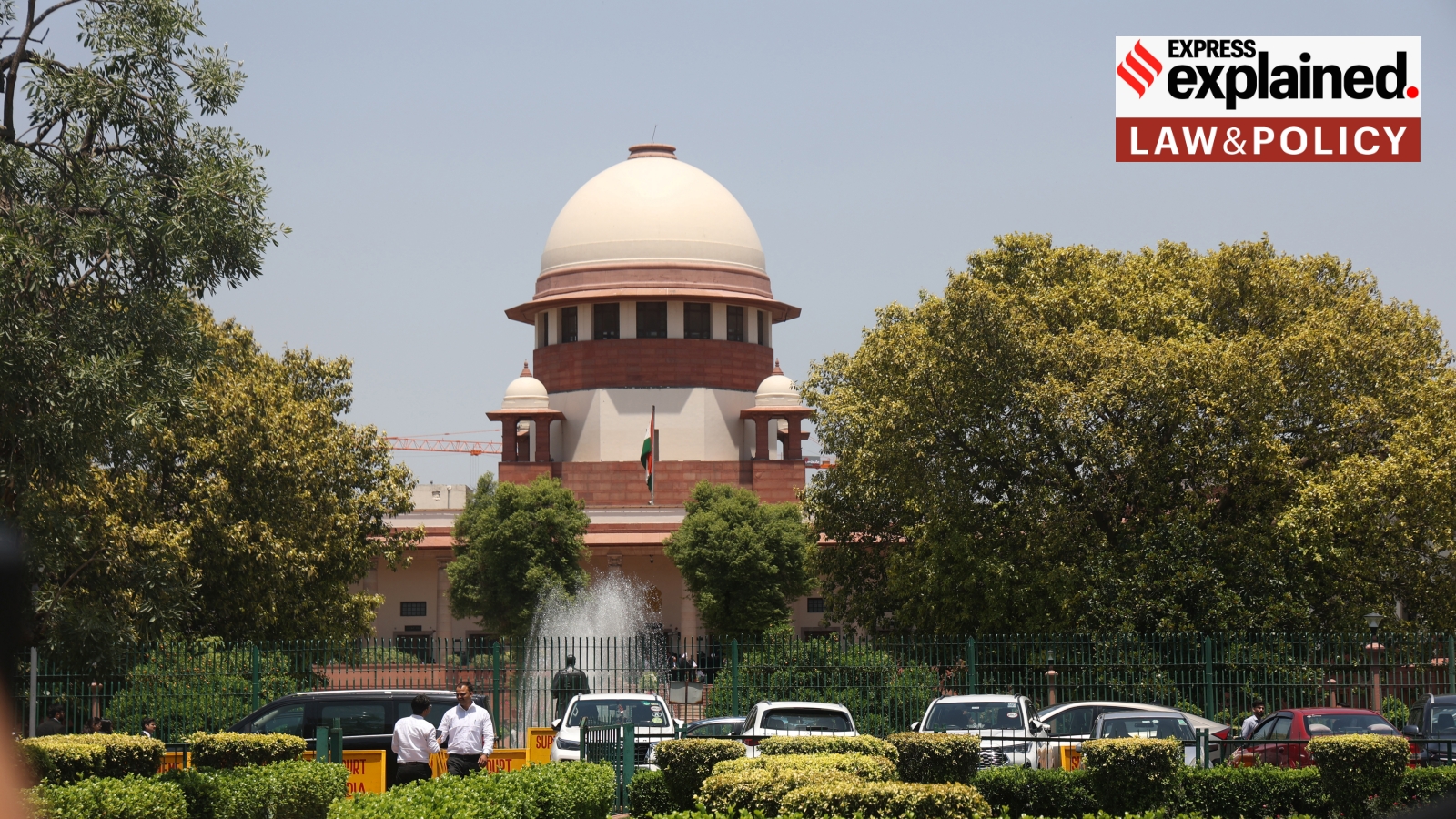
Reference view of the Supreme Court of India. The Court has sought responses on a petition seeking finalisation of the revised Memorandum of Procedure for judicial appointments; the notice does not itself change the appointments framework.
Image: Indian Express
Why in news
A public interest litigation by NGO Lok Prahari challenges the continuing delay in finalising the revised Memorandum of Procedure following the Supreme Court’s December 2015 directions. The petition also seeks to bring collegium decisions within the Right to Information framework.
1999
Year of the operative MoP
December 2015
Revision entrusted to Centre in consultation with CJI
6 members
Composition of the invalidated NJAC
About 11,500 pages
Suggestions received during reform proceedings
Background
The Constitution provides for the appointment of Supreme Court judges by the President under Article 124 and High Court judges under Article 217. Article 222 governs the transfer of judges between High Courts. The collegium is not expressly mentioned in the Constitution: it evolved through judicial interpretation of the consultation required in appointments. The Second Judges Case established judicial primacy, while the Third Judges Case clarified collective consultation within the judiciary. The Memorandum of Procedure operationalises this framework through agreed procedures; it is neither a constitutional amendment nor a parliamentary enactment.
What the Supreme Court notice means
A Bench of Justices M M Sundresh and P B Varale issued notice on Lok Prahari’s petition. Although the story is framed as notice to the Centre and the CJI, the source clarifies that responses have been sought from the Centre and the Supreme Court’s Secretary General, representing the Court’s administrative side.
The distinction matters: the Supreme Court is adjudicating a challenge concerning its own administrative arrangements for judicial appointments. Issuing notice seeks a response; it is not a finding of illegality, an order finalising the MoP or a direction requiring blanket disclosure of collegium records.
- The petition seeks completion of the revised MoP and greater transparency through RTI.
- Justice P S Narasimha earlier recused himself because he had appeared as Additional Solicitor General in the NJAC proceedings.
- Justice Sundresh disclosed his collegium membership and asked whether counsel objected to his hearing the matter, highlighting the institutional sensitivity of the litigation.
Infographic
Independence
Protect selection from political control.
Clear criteria
Publish standards for competence and integrity.
Reasoned transparency
Explain outcomes while protecting lawful confidentiality.
Institutional support
Use a professional secretariat and verified candidate information.
Shared accountability
Track delays and require reasons across the appointment chain.
AI-assisted infographic by Pragnya IAS Academy, based on the cited sources.
Constitutional framework and the collegium’s role
Under Article 124, the President formally appoints Supreme Court judges. Under Article 217, appointments to a High Court involve consultation with the CJI, the Governor concerned and, for judges other than the Chief Justice, the Chief Justice of that High Court. These provisions operate as interpreted by the Judges Cases, which require collective judicial consultation rather than the CJI’s individual preference.
For Supreme Court appointments, the collegium comprises the CJI and the four senior-most Supreme Court judges. Proposals for High Court appointments originate with the High Court Chief Justice in consultation with the two senior-most puisne judges and subsequently undergo scrutiny at the Supreme Court level. The executive processes proposals and provides relevant inputs, while the President makes the formal appointment.
- Judicial independence is part of the Constitution’s basic structure.
- Judicial primacy does not eliminate the executive’s constitutionally recognised role.
- Article 222 concerns transfers between High Courts, not transfers of Supreme Court judges.
- The collegium is a judicially evolved mechanism, while the MoP provides its operational procedure.
Why the revised MoP remains contested
After invalidating the constitutional amendment establishing the NJAC in October 2015, the Supreme Court separately considered improvements to the restored collegium system. Its December 2015 order entrusted supplementation of the existing MoP to the government in consultation with the CJI, who was to act on the unanimous view of the collegium. The Court outlined broad suggestions but did not prescribe a deadline.
The source identifies reported disagreements over a proposed national-security ground for rejecting candidates and a permanent collegium secretariat. The draft’s fine print was not publicly available. While the judiciary subsequently developed arrangements for tracking judicial performance, the source reports that appointments continue under the 1999 MoP.
In 2023, the Union Law Minister proposed government nominees in search-cum-evaluation committees. The government subsequently clarified that these bodies were intended to facilitate evaluation and that the collegium would retain the final decision on recommendations. This proposal should not be confused with an enacted replacement for the collegium.
- Publish eligibility criteria and the appointments procedure.
- Provide for minutes of deliberations, including dissenting opinions.
- Develop secretarial support for the Supreme Court and High Courts.
- Create a mechanism for handling complaints against candidates.
Independence, transparency and accountability must reinforce one another
The central constitutional concern is preventing political control over adjudication. However, opaque selection criteria, unexplained departures and prolonged non-action can weaken confidence in appointments. Protecting judicial independence therefore requires safeguards against both executive interference and unaccountable internal discretion.
Transparency should be calibrated rather than absolute. Published criteria, procedural timelines and reasoned outcomes can improve accountability, while raw complaints, personal information and sensitive inputs may require lawful protection. The CJI’s office falls within the RTI framework, but this does not make every collegium record automatically disclosable; statutory exemptions and public-interest considerations remain relevant.
The source reports instances of non-appointment even after collegium recommendations were reiterated. This raises a distinct accountability issue: executive inaction can frustrate an appointment without an openly reasoned rejection. Any national-security objection should therefore be specific, supported by material and institutionally reviewable, rather than an undefined veto.
- Public criteria can make discretion more consistent without making appointments mechanical.
- Recording dissent preserves institutional reasoning and need not imply publication of every confidential detail.
- Accountability must cover the entire appointment chain, not only the collegium.
| Instrument or mechanism | Role and status |
|---|---|
| Articles 124 and 217 | Constitutional provisions governing appointments to the Supreme Court and High Courts. |
| Article 222 | Constitutional provision for transfers of judges between High Courts. |
| Collegium | Judicially evolved system giving collective judicial opinion primacy in recommendations. |
| Memorandum of Procedure | Operational framework for appointments and High Court transfers; the source identifies the 1999 MoP as continuing to govern appointments. |
| NJAC | Proposed appointments commission comprising the CJI, two senior judges, the Law Minister and two eminent persons; its constitutional foundation was struck down. |
| Search-cum-evaluation committees | Proposed facilitative bodies discussed in 2023, not an enacted replacement for the collegium. |
- 1. The High Court Chief Justice initiates a proposal in consultation with the two senior-most puisne judges.
- 2. The proposal passes through governmental consultation and input-gathering under the MoP.
- 3. The Supreme Court collegium evaluates the proposal and relevant judicial and executive inputs.
- 4. The Union executive processes the recommendation; reconsideration may be sought within the governing framework.
- 5. The President makes the formal appointment under Article 217.
1993
The Second Judges Case established judicial primacy in appointments through the collegium framework.
1998
The Third Judges Case clarified the requirements of collective judicial consultation.
30 June 1999
The MoP was drawn up to operationalise the appointments framework.
16 October 2015
A Constitution Bench struck down the 99th Constitutional Amendment establishing the NJAC and restored the collegium system.
16 December 2015
The Supreme Court asked the government to supplement the existing MoP in consultation with the CJI.
2016–2017
Consultations continued, but disagreements prevented finalisation of the revised MoP.
2023
The government proposed nominees in search-cum-evaluation committees, subsequently describing their intended role as facilitative.
Latest reported proceedings
The Supreme Court sought responses from the Centre and its administrative side on Lok Prahari’s petition.
Significance, challenges & way forward
Significance
- Finalising the MoP can reduce procedural uncertainty without requiring replacement of the collegium.
- Transparent criteria and recorded reasons can strengthen public confidence in judicial selection.
- Clear responsibilities across judicial and executive institutions can make delays easier to identify and address.
- Structured evaluation can support merit, integrity and broader representation without compromising judicial independence.
Challenges
- The executive and judiciary have not resolved disagreements over the scope of governmental objections and institutional support arrangements.
- The absence of a deadline in the December 2015 order left procedural reform without a firm completion schedule.
- Unverified complaints and sensitive personal information make unrestricted disclosure potentially harmful to candidates.
- Executive non-action can obstruct appointments even without a formally asserted veto.
- Judicial scrutiny of the judiciary’s own administrative practices requires careful management of conflicts and perceptions of impartiality.
Way forward
- Finalise a publicly accessible MoP through structured consultation between the Centre and the CJI, consistent with binding constitutional judgments.
- Publish selection criteria covering professional competence, integrity and relevant experience, while explaining how representation is considered.
- Create a professionally staffed secretariat under safeguards that prevent either political capture or unchecked internal discretion.
- Record deliberations and dissent, and publish reasoned outcomes with necessary redactions under the applicable legal framework.
- Adopt stage-wise timelines and track pending proposals so that responsibility for delay is visible.
- Require specific reasons and supporting material for adverse executive inputs, with a defined procedure for reconsideration.
- Establish a fair complaints process that verifies allegations and allows an appropriate response before adverse material determines a recommendation.
Key terms
- Memorandum of Procedure
- The procedural framework governing higher judicial appointments and transfers between High Courts.
- Collegium
- A body of senior judges whose collective opinion has primacy in higher judicial appointment recommendations.
- Judicial primacy
- The precedence accorded to the judiciary’s institutional opinion in the appointments process under the Judges Cases.
- Puisne judge
- A judge of a court other than its Chief Justice.
- Recusal
- A judge’s withdrawal from a case to avoid an actual or reasonably apprehended conflict affecting impartiality.
- Basic structure doctrine
- The principle that Parliament’s constitutional amendment power cannot destroy the Constitution’s essential features.
- Reiteration
- The collegium’s reaffirmation of a recommendation after reconsidering objections or a returned proposal.
Link with static syllabus
Prelims practice MCQs
Q1. With reference to judicial appointments in India, consider the following statements: 1. The Constitution expressly establishes the collegium system. 2. The President formally appoints judges of the Supreme Court. 3. Article 222 concerns transfers of judges between High Courts. Which of the statements given above are correct?
Q2. Consider the following statements about the Memorandum of Procedure for judicial appointments: 1. It is a parliamentary enactment. 2. The December 2015 order envisaged its supplementation by the government in consultation with the CJI. 3. That order prescribed a fixed deadline for completing the revision. Which of the statements given above is/are correct?
Q3. Which of the following correctly describes the composition envisaged for the National Judicial Appointments Commission?
Q4. Consider the following pairs: 1. Second Judges Case — Judicial primacy in appointments. 2. Third Judges Case — Clarification of collective judicial consultation. 3. Article 217 — Transfer of judges between High Courts. How many of the pairs given above are correctly matched?
Mains practice questions
GS 2 · 15 marks · 250 words
Judicial independence and transparency in judicial appointments are complementary constitutional objectives. Discuss with reference to the pending revision of the Memorandum of Procedure.
Frequently asked questions
Has the Supreme Court changed the judicial appointments system through this notice?
No. The notice seeks responses to the petition; it does not replace the collegium or finalise a revised MoP.
What is the difference between the collegium and the MoP?
The collegium is the judicial body responsible for appointment recommendations. The MoP sets out the procedures through which proposals, consultations and appointments are processed.
Why is the notice described as being issued to the CJI?
The dispute concerns the judiciary’s administrative role in appointments. The source specifies that the Supreme Court’s Secretary General has been asked to respond on its administrative side.
Does RTI coverage mean all collegium discussions must be disclosed?
No. Although the CJI’s office falls within the RTI framework, disclosure of particular records remains subject to statutory exemptions and applicable public-interest considerations.
Sources
Analysis prepared by the Pragnya IAS Academy current-affairs desk with AI assistance from the cited reports. Verify figures with the original sources.
Turn current affairs into marks
Join Pragnya IAS Academy's mentorship for daily answer-writing evaluation on stories like this — classroom programmes from a trusted name in IAS coaching in Hyderabad.