
Pallikaranai Construction Restrictions: Ramsar Protection and Urban Flood Resilience
Revise the static topic: UPSC Environment notes
In short: CREDAI Chennai has announced plans to approach the Supreme Court for relief from an NGT-imposed one-kilometre construction restriction around Pallikaranai marshland, following the Madras High Court’s reported decision to refer the matter to the apex court. The dispute highlights how wetland boundaries, hydrological connectivity and development rights should be reconciled without weakening Chennai’s natural flood protection.
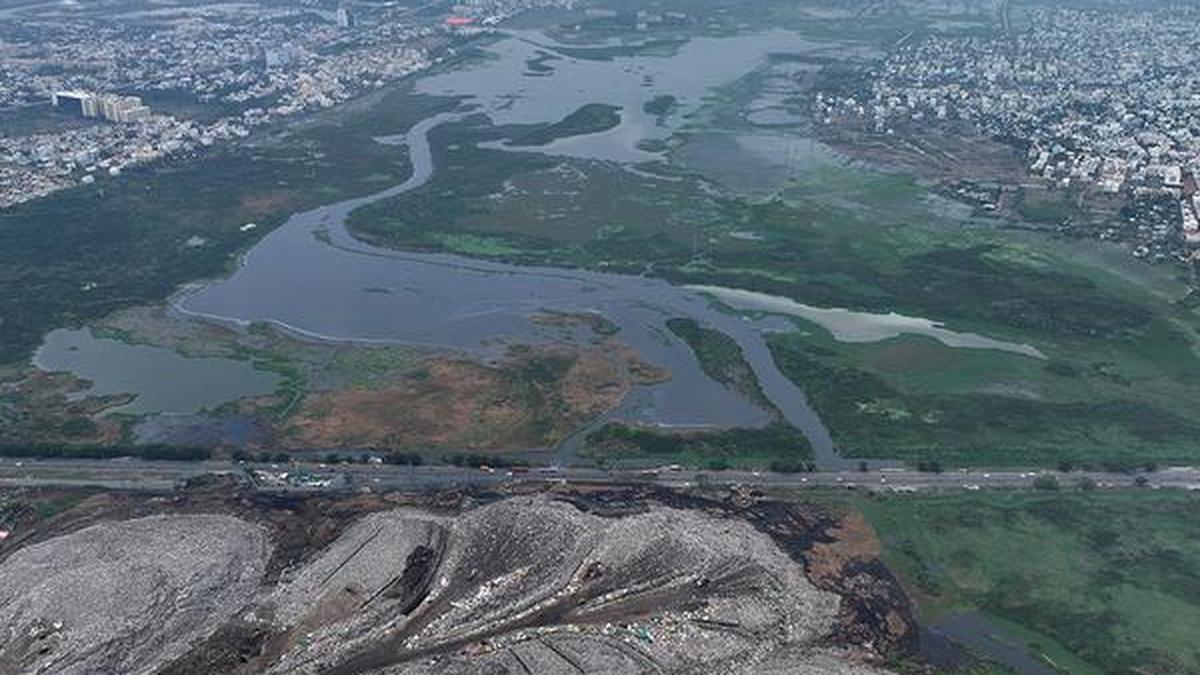
Photo from the source report: Pallikaranai Construction Restrictions: Ramsar Protection and Urban Flood Resilience
Image: The Hindu
Why in news
The Hindu reports that CREDAI Chennai will challenge the construction restriction around the Pallikaranai Ramsar wetland. The association argues that an interim Zone of Influence assessment by the Tamil Nadu State Wetland Authority provides a scientific basis for regulating surrounding development.
1 km
Reported NGT construction restriction
Over 8,400 acres
Area affected, according to CREDAI
Over one lakh
Patta holders affected, according to CREDAI
Background
Pallikaranai is a marshland in Chennai and a Ramsar wetland of international importance. Urban wetlands store and slow runoff, support biodiversity and help maintain water quality through ecological processes. Their functioning depends not only on the land within their boundaries but also on connected drains, surrounding catchments and water-exchange pathways. The Ramsar Convention promotes conservation and wise use of wetlands, while enforceable development controls in India arise through domestic environmental law, planning regulation and judicial orders.
What the dispute concerns
According to the report, CREDAI Chennai seeks relief from the NGT’s construction restriction around Pallikaranai after the Madras High Court’s reported decision to refer the matter to the Supreme Court. The association links this development to an ongoing Supreme Court matter concerning identification, demarcation and ground-truthing of wetland boundaries.
CREDAI argues that the restriction affects a large developed urban area and numerous patta holders. It also says that the Wetland Authority’s interim assessment leaves the Ramsar wetland area unchanged while proposing safeguards for development in its Zone of Influence. These are the association’s reported submissions; the supplied material does not reproduce the judicial orders or the complete technical report.
- An announced approach to the Supreme Court is not evidence that relief has been granted.
- The affected-area and landholder estimates should be attributed to CREDAI, not treated as judicial findings.
- A claim based on an old land title does not by itself establish an unrestricted right to build.
Infographic
Protect the wetland
Safeguard ecological character, not only mapped extent.
Secure connectivity
Keep drains, inlets, outlets and linked storage areas functional.
Apply the law
Distinguish Ramsar commitments, domestic rules and judicial orders.
Regulate scientifically
Use verified hydrology and cumulative-impact assessment.
Ensure fairness
Combine transparent decisions with protection against transferred flood risk.
AI-assisted infographic by Pragnya IAS Academy, based on the cited sources.
The legal framework: Ramsar status and domestic regulation
Ramsar designation establishes international conservation significance and engages the Convention’s conservation and wise-use framework. It does not, by itself, prescribe a universal one-kilometre construction buffer around every Ramsar site. The restriction reported here arises from an NGT order.
India’s Wetlands (Conservation and Management) Rules, framed under the Environment (Protection) Act, cover Ramsar-listed wetlands and wetlands notified under the Rules, subject to their scope and exclusions. They prohibit specified harmful activities, including conversion for non-wetland use, encroachment, dumping of solid waste and discharge of untreated wastes and effluents. They also restrict permanent construction near wetlands, subject to the terms and exceptions of the Rules.
State Wetland Authorities support identification, delineation, management and regulation of wetlands. The constitutional commitment to environmental protection, the public trust doctrine, the precautionary principle and sustainable development guide conservation decisions. Technical recommendations do not automatically override a subsisting judicial restriction.
- Wetland regulation and judicial directions must be read together before development permissions are issued.
- Ownership records and environmental permissions answer different legal questions.
- A wetland Zone of Influence and an eco-sensitive zone around a protected area are not interchangeable regulatory categories.
Why construction buffers matter ecologically
A wetland can be degraded without direct construction inside its mapped boundary. Filling adjacent low-lying land, obstructing inlet channels or expanding impermeable surfaces can alter runoff, reduce flood storage and interrupt water exchange. Untreated sewage entering connected drains can damage the wetland even when the discharge point lies outside it.
A uniform-distance restriction can provide an administratively clear precautionary safeguard, especially where boundaries or ecological risks remain uncertain. However, distance alone is an incomplete measure of ecological impact: a connected upstream parcel may matter more than a nearby parcel separated from the wetland’s drainage system.
The source reports that the interim Zone of Influence assessment considered hydrological connectivity, drainage pathways, satellite wetlands, land use and the urban interface. Its ecological adequacy would need to be assessed against transparent evidence, seasonal conditions and cumulative development pressures.
- Flood resilience requires protection of both storage spaces and the routes through which water reaches and leaves them.
- Wetlands have finite capacity and cannot substitute for sewage treatment or functioning urban drainage.
- Hydrology-based zoning should supplement, not become a pretext for weakening, enforceable ecological safeguards.
Balancing urban development with flood resilience
The central policy question is not simply conservation versus construction. It is whether development can be located and designed without transferring flood risk, pollution and ecological costs to other residents. A blanket restriction can impose substantial uncertainty, while poorly designed exemptions can create irreversible cumulative damage.
CREDAI cites Guindy National Park and East Kolkata Wetlands as precedents for a zero-distance Zone of Influence. The supplied source does not establish the legal or ecological comparability of these examples. Differences in regulatory categories, catchments, site conditions and judicial directions must be examined before any precedent is applied.
A defensible approach combines precaution during uncertainty with publicly accessible mapping, reasoned parcel-level decisions and catchment-wide safeguards. Retaining the wetland’s mapped area is necessary, but it does not alone demonstrate protection of its ecological character.
- Existing approvals and legitimate landholder concerns require due process rather than automatic exemption.
- Assessment should consider the combined impact of projects, not only the footprint of each building.
- Flood-risk reduction should be treated as a core urban planning objective rather than a residual environmental condition.
| Concept | Purpose | Key caution |
|---|---|---|
| Wetland boundary | Identifies the spatial extent of the wetland requiring protection | A mapped boundary does not capture every external ecological pressure |
| Uniform-distance construction restriction | Limits construction within a specified distance; the reported NGT restriction is one kilometre | Its scope and any modification depend on the applicable judicial order |
| Zone of Influence | Identifies surrounding areas whose activities can affect wetland ecological character | It should reflect connectivity and pressures, not merely geometric distance |
| Catchment | Describes the area contributing runoff to the wetland | It may extend beyond an immediate construction-restriction belt |
- 1. Construction replaces permeable surfaces or fills low-lying land.
- 2. Runoff increases while local water-storage capacity declines.
- 3. Blocked or narrowed channels interrupt inflows and outflows.
- 4. The wetland–drainage network loses its ability to accommodate floodwater effectively.
- 5. Flood exposure can increase in connected urban neighbourhoods.
February 2026
According to CREDAI’s account, the petition was filed before the Madras High Court.
September 7, 2026
The source reports a court direction following which the Wetland Authority re-examined the Zone of Influence.
Following the court direction
An interim assessment was reportedly prepared with technical agencies, examining hydrology, drainage, land use and connected wetlands.
Latest reported development
CREDAI Chennai announced its decision to approach the Supreme Court after examining the Madras High Court order.
Significance, challenges & way forward
Significance
- The dispute brings attention to urban wetlands as natural infrastructure for flood moderation and biodiversity conservation.
- It demonstrates that protecting a Ramsar site requires attention to ecological connections beyond its mapped boundary.
- It tests how scientific assessments can inform legally enforceable and proportionate land-use controls.
- It highlights the need to align wetland governance, drainage planning, sewage management and building permissions.
Challenges
- Disputed boundaries and incomplete ground verification can generate uncertainty for conservation authorities and landholders.
- Dense urban development makes restoration of obstructed channels and lost flood-storage areas difficult.
- A narrow focus on individual projects can overlook cumulative changes to catchment runoff and wetland ecology.
- Fragmented institutional responsibilities can leave gaps between technical recommendations and enforcement.
- Stakeholder claims and references to other sites cannot substitute for examination of the actual orders and site-specific evidence.
Way forward
- Publish verified wetland boundaries, drainage networks and the proposed Zone of Influence with their technical rationale.
- Subject the interim assessment to independent scientific scrutiny and meaningful consultation with affected communities and landholders.
- Retain applicable judicial safeguards unless they are lawfully modified by the competent court or tribunal.
- Use hydrological risk to differentiate land-use controls while preserving non-negotiable protection for the wetland and essential water pathways.
- Integrate catchment-wide cumulative-impact assessment into master plans, drainage projects and development permissions.
- Prevent untreated sewage inflows, restore obstructed channels and monitor compliance through coordinated institutional responsibility.
Key terms
- Ramsar site
- A wetland designated as internationally important under the Ramsar Convention.
- Wise use
- Maintenance of wetland ecological character through ecosystem approaches within the context of sustainable development.
- Zone of Influence
- The surrounding area where developmental activities can induce adverse changes in a wetland’s ecosystem structure or functioning.
- Hydrological connectivity
- The movement and exchange of water between connected landscape elements, including drains, wetlands and catchments.
- Ground-truthing
- Field verification of information derived from maps, satellite imagery or other assessments.
- Precautionary principle
- The principle that lack of full scientific certainty should not justify postponing measures against serious environmental harm.
- Patta
- A land-revenue record relevant to recorded land rights, not a substitute for environmental or building permission.
Link with static syllabus
Prelims practice MCQs
Q1. With reference to Ramsar wetlands, consider the following statements: Statement I: Ramsar designation automatically imposes an identical one-kilometre construction prohibition around every listed wetland. Statement II: Activities outside a wetland’s boundary can affect its ecological character. Which of the statements given above is/are correct?
Q2. Which of the following best describes the Zone of Influence of a wetland?
Q3. Consider the following statements about wetland conservation in India: Statement I: The Wetlands (Conservation and Management) Rules are framed under the Environment (Protection) Act. Statement II: A land-revenue record automatically exempts its holder from applicable environmental restrictions. Which of the statements given above is/are correct?
Q4. With reference to urban wetlands, consider the following statements: Statement I: Filling connected low-lying areas can reduce flood-storage capacity even without construction inside the wetland boundary. Statement II: Protecting inlet and outlet channels is important for maintaining wetland hydrology. Which of the statements given above is/are correct?
Mains practice questions
GS 3 · 15 marks · 250 words
Urban wetland conservation requires protection of ecological connectivity, not merely mapped boundaries. Discuss in the context of the Pallikaranai construction-restriction dispute.
Frequently asked questions
Does Ramsar status automatically create a one-kilometre construction ban?
No. The reported Pallikaranai restriction arises from an NGT order; Ramsar designation itself does not prescribe an identical one-kilometre buffer for every listed wetland.
Why regulate construction outside the wetland boundary?
Surrounding construction can alter runoff, block drainage, reduce flood storage and introduce pollutants. Protecting the wetland therefore requires attention to its connected landscape.
Has the Supreme Court lifted the Pallikaranai restriction?
The supplied report does not establish that any relief has been granted. It reports CREDAI Chennai’s decision to approach the Supreme Court.
Does the interim Zone of Influence assessment settle the dispute?
No. It is a reported technical input whose adequacy and legal effect must be evaluated; it does not automatically replace an applicable judicial restriction.
Sources
Analysis prepared by the Pragnya IAS Academy current-affairs desk with AI assistance from the cited reports. Verify figures with the original sources.
Turn current affairs into marks
Join Pragnya IAS Academy's mentorship for daily answer-writing evaluation on stories like this — classroom programmes from a trusted name in IAS coaching in Hyderabad.