
UGC Campus Equity Rules: Review Proposal, Equality and Procedural Fairness
Revise the static topic: UPSC Social Justice notes
In short: The Centre told the Supreme Court on November 5, 2026 that it was considering a special committee to review the UGC’s 2026 campus equity regulations. The regulations remain stayed, with the 2012 framework continuing in force; the central challenge is to tackle caste discrimination through clearly defined protections and fair, effective grievance procedures.
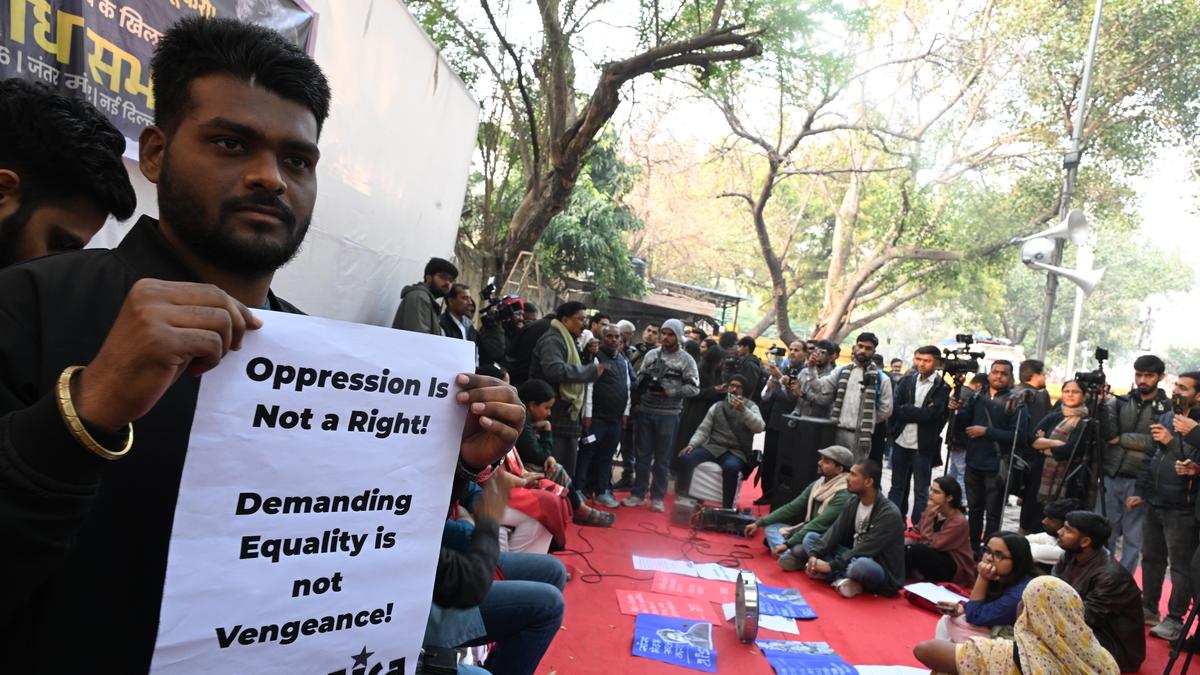
Reference image for coverage of the Supreme Court proceedings on UGC campus equity rules, not a view of the hearing. The Centre is considering a review committee; the 2026 regulations remain stayed while the 2012 framework continues in force.
Image: The Hindu
Why in news
The Centre sought more time to submit a comprehensive response to criticism of the University Grants Commission (Promotion of Equity in Higher Education Institutions) Regulations, 2026. It indicated that a review committee was under consideration, not that one had already been constituted.
Background
The University Grants Commission is a statutory body established under the University Grants Commission Act, 1956, with responsibilities relating to the coordination, determination and maintenance of standards in university education. Campus equity connects educational access with the conditions necessary for meaningful participation: dignity, non-discrimination and institutional support. The constitutional framework combines equality before law under Article 14, prohibition of specified forms of discrimination under Article 15, abolition of untouchability under Article 17 and protection of dignity under Article 21. Article 46 directs the State to promote the educational and economic interests of weaker sections, particularly Scheduled Castes and Scheduled Tribes, and protect them from social injustice and exploitation.
What the Centre has proposed and what remains in force
The Union government informed the Supreme Court that it was contemplating a special committee to re-examine the 2026 equity regulations. It was examining criticism of the framework and sought additional time for a comprehensive response. This is a proposal for review, not a confirmed withdrawal, amendment or restoration of the regulations.
The UGC notified the 2026 regulations in January after consultations, superseding the 2012 framework. Later that month, the Supreme Court stayed the new regulations, describing them as too sweeping and vague, and directed that the 2012 regulations continue in force.
- The operative position reported in the source is continuation of the 2012 framework.
- The January stay is an interim judicial measure, not a final declaration that the 2026 regulations are unconstitutional.
- A possible executive review and the pending judicial challenge are distinct processes.
Infographic
Clear scope
Define prohibited conduct and explain who is protected.
Substantive equality
Address historical and structural disadvantage.
Safe reporting
Provide accessible channels and protection from retaliation.
Fair inquiry
Ensure impartiality, a hearing and reasoned findings.
Accountable remedies
Provide proportionate action, review and compliance monitoring.
AI-assisted infographic by Pragnya IAS Academy, based on the cited sources.
The dispute over the definition of caste-based discrimination
The Court issued notices to the government and the UGC on petitions challenging Regulation 3(c). According to the petitioners, its definition of caste-based discrimination was too narrow because it covered prejudice against members of Scheduled Castes, Scheduled Tribes and Other Backward Classes. Upper-caste student groups also protested, alleging that the rules were one-sided.
The impetus for the new framework came from a joint petition by the mothers of Rohith Vemula and Payal Tadvi concerning caste discrimination in higher education. Their representatives opposed the stay, arguing that the regulations addressed discrimination against Dalit and historically oppressed students. The dispute therefore involves both the reach of protection and the need to recognise entrenched social disadvantage.
- The petitioners’ description of Regulation 3(c) is a contested legal argument, not a final judicial finding.
- A revised framework should clarify prohibited conduct, coverage and the relationship between general protection and targeted safeguards.
- Allegations that a rule is one-sided do not, by themselves, establish either its invalidity or the absence of discrimination.
Constitutional balance: substantive equality with legal certainty
Formal equality requires equal treatment under law; substantive equality also examines whether historical and structural barriers prevent people from enjoying rights in practice. Article 14 permits reasonable classification, while Articles 15(4) and 15(5) enable specified special provisions for socially and educationally backward classes and Scheduled Castes and Scheduled Tribes. Targeted protection is therefore not inherently inconsistent with equality.
However, a legitimate objective does not remove the need for precise drafting and fair administration. Rules should identify what conduct is prohibited and guide consistent institutional action. Ambiguity can discourage genuine complaints, enable arbitrary enforcement and weaken confidence in the framework.
The constitutional task is not to choose between equality and fairness. It is to design proportionate protections that address demonstrated disadvantage while providing an impartial process for determining individual responsibility.
- Article 17 specifically abolishes untouchability; it should not be treated as an exhaustive definition of every form of caste discrimination.
- Article 46 is a Directive Principle of State Policy, not a directly enforceable fundamental right.
- Regulatory provisions must remain consistent with the Constitution and the authority granted by the parent statute.
Effective grievance redress: protection without prejudgment
A revised mechanism should make complaints accessible, protect complainants and witnesses from retaliation, and provide counselling and appropriate interim support. These measures should facilitate participation in the process without treating an allegation as an established finding.
Natural justice requires an unbiased decision-maker and a meaningful opportunity to respond. A sound framework should provide adequate notice, disclosure of relevant material subject to lawful safeguards, reasoned decisions and a review or appeal mechanism. Privacy must be protected without preventing a fair defence.
These are recommended design principles, not claims about provisions contained in the supplied account of the 2026 regulations. Campus procedures should also clarify their relationship with applicable criminal law: institutional grievance redress cannot substitute for statutory investigation where an offence is alleged.
- Define discrimination, harassment, retaliation and institutional responsibility with suitable illustrations.
- Establish conflict-of-interest rules and train inquiry personnel in both caste sensitivity and procedural fairness.
- Prescribe clear timelines while allowing justified extensions in complex cases.
- Do not equate an unsubstantiated complaint with a deliberately false complaint.
- Publish anonymised information on complaint handling without exposing identities.
| Issue | Position supported by the source | UPSC takeaway |
|---|---|---|
| 2012 framework | The Supreme Court directed that it continue in force. | The stay did not leave campuses without the earlier regulatory framework. |
| 2026 regulations | Notified in January after consultations; subsequently stayed. | Notification and present enforceability are different questions. |
| Regulation 3(c) | Petitions challenge the scope of its definition of caste-based discrimination. | Distinguish a petitioner’s contention from a final judicial ruling. |
| Review committee | The Centre said it was contemplating a special committee. | A proposed committee must not be reported as already constituted. |
| Future safeguards | The supplied report does not detail a revised grievance mechanism. | Treat recommendations on procedure as proposals, not existing provisions. |
- 1. Receive a complaint through accessible and confidential channels.
- 2. Assess immediate safety and support needs without prejudging responsibility.
- 3. Check jurisdiction and conflicts of interest, and notify the respondent.
- 4. Conduct an impartial inquiry with a meaningful hearing for both sides.
- 5. Issue a reasoned decision and proportionate remedial or disciplinary measures.
- 6. Provide review or appeal and monitor compliance and retaliation risks.
2012
The earlier UGC Promotion of Equity in Higher Education Institutions regulatory framework was introduced.
January 2016
Rohith Vemula died by suicide; his mother later jointly petitioned the Supreme Court over campus caste discrimination.
May 2019
Payal Tadvi died by suicide; her mother later joined the petition concerning caste discrimination in higher education.
January 2026
The UGC notified the 2026 equity regulations after consultations, superseding the 2012 framework.
January 2026
The Supreme Court stayed the new regulations and directed continuation of the 2012 framework.
November 5, 2026
The Centre told the Supreme Court that it was contemplating a special committee to review the regulations.
Significance, challenges & way forward
Significance
- Campus equity makes access to higher education meaningful by addressing barriers to dignity, participation and academic progress.
- Targeted safeguards can advance substantive equality where historical disadvantage persists despite formally equal rules.
- Clear definitions help students understand their rights and institutions apply rules consistently.
- Fair procedures strengthen the credibility of genuine findings and the durability of regulatory action.
- Effective redress links institutional autonomy with accountability for a safe and non-discriminatory learning environment.
Challenges
- Reconciling protection against caste prejudice with focused safeguards for historically disadvantaged groups requires careful drafting.
- Academic hierarchies and dependence on supervisors can make complainants fear retaliation.
- Conflicts of interest may compromise inquiries conducted within the same institution.
- Vague provisions risk inconsistent interpretation, while excessively rigid definitions may miss contextual discrimination.
- Polarised debate can displace attention from institutional capacity, evidence assessment and remedies.
- Confidentiality must be balanced with the disclosure necessary for a meaningful defence.
Way forward
- If constituted, the review committee should consult affected students, universities, constitutional experts and practitioners experienced in grievance redress.
- Publish a clear explanation of the revised framework’s coverage, prohibited conduct and justification for targeted protections.
- Preserve substantive protection against caste discrimination while removing ambiguity and procedural gaps.
- Create impartial, trained grievance bodies with conflict-of-interest safeguards and accessible review mechanisms.
- Separate immediate welfare support from final findings of misconduct and disciplinary consequences.
- Monitor implementation through anonymised reporting and feedback, without treating low complaint counts as proof of an equitable campus.
- Ensure institutions communicate and implement the framework currently in force while the review and litigation continue.
Key terms
- Substantive equality
- An approach that addresses structural disadvantage so that people can meaningfully exercise equal rights.
- Formal equality
- Equal treatment under the same legal rules, without necessarily correcting unequal starting conditions.
- Natural justice
- Principles of fair decision-making, especially an unbiased authority and a meaningful opportunity to be heard.
- Reasonable classification
- A classification based on an intelligible differentia that has a rational connection with the law’s objective.
- Delegated legislation
- Rules or regulations made by an authorised body under powers granted by a parent statute.
- Interim stay
- A temporary judicial suspension of operation that does not itself finally determine legal validity.
- Retaliation
- Adverse treatment linked to making a complaint, supporting a complainant or participating in an inquiry.
Link with static syllabus
Prelims practice MCQs
Q1. With reference to the reported position on UGC campus equity regulations as of November 5, 2026, consider the following statements: 1. The Centre had already constituted a special review committee. 2. The Supreme Court had directed that the 2012 framework continue in force. 3. The stay conclusively established that the 2026 regulations were unconstitutional. Which of the statements given above is/are correct?
Q2. Consider the following pairs: 1. Article 14 — Equality before law and equal protection of laws 2. Article 17 — Abolition of untouchability 3. Article 46 — A directly enforceable fundamental right to educational advancement Which of the pairs given above are correctly matched?
Q3. Which of the following best describes substantive equality in the context of higher education?
Q4. With reference to fair institutional grievance procedures, consider the following statements: 1. An inquiry authority should be free from conflicts of interest. 2. Interim welfare support necessarily amounts to a finding against the respondent. 3. Failure to substantiate a complaint does not, by itself, establish deliberate falsity. Which of the statements given above are correct?
Mains practice questions
GS 2 · 15 marks · 250 words
Campus anti-discrimination regulations must advance substantive equality without compromising procedural fairness. Discuss in the context of the proposed review of UGC equity regulations.
Frequently asked questions
Has the Centre constituted a committee to review the UGC equity regulations?
The supplied report confirms only that the Centre was contemplating a special committee as of November 5, 2026. It does not confirm constitution of the committee.
Which campus equity regulations currently apply according to the report?
The Supreme Court stayed the 2026 regulations in January and directed that the 2012 framework continue in force.
What is the controversy over Regulation 3(c)?
Petitioners argue that its definition of caste-based discrimination is too narrow because it limits protection to Scheduled Castes, Scheduled Tribes and Other Backward Classes. This is a contested contention, not a final judicial determination.
Can targeted safeguards coexist with equal protection?
Yes. Constitutionally justified measures can address historical disadvantage, provided their design is clear and their implementation respects impartial decision-making and fair procedures.
Sources
- The Hindu: Centre tells Supreme Court it may set up a panel to review UGC equity on campus regulations
- Times of India: Mulling panel to review UGC equity norms: Government
- Times of India: Government buys time on UGC rules without committing to withdrawal or retention
Analysis prepared by the Pragnya IAS Academy current-affairs desk with AI assistance from the cited reports. Verify figures with the original sources.
Turn current affairs into marks
Join Pragnya IAS Academy's mentorship for daily answer-writing evaluation on stories like this — classroom programmes from a trusted name in IAS coaching in Hyderabad.