
Unauthorised GM Cotton: Study Flags Adoption and Gaps in Biosafety Regulation
Revise the static topic: UPSC Agriculture notes · UPSC Economy notes
In short: An industry-commissioned study estimates that cotton hybrids carrying unapproved GM traits occupied up to 30% of India’s cotton area in 2025-26. It links adoption to cheaper weed management and demand for better bollworm control, highlighting the need to reconcile farmer livelihoods with biosafety and seed-market accountability. Its hotspot-based sampling and inconsistencies in the reported area figures warrant caution in interpreting the national estimate.
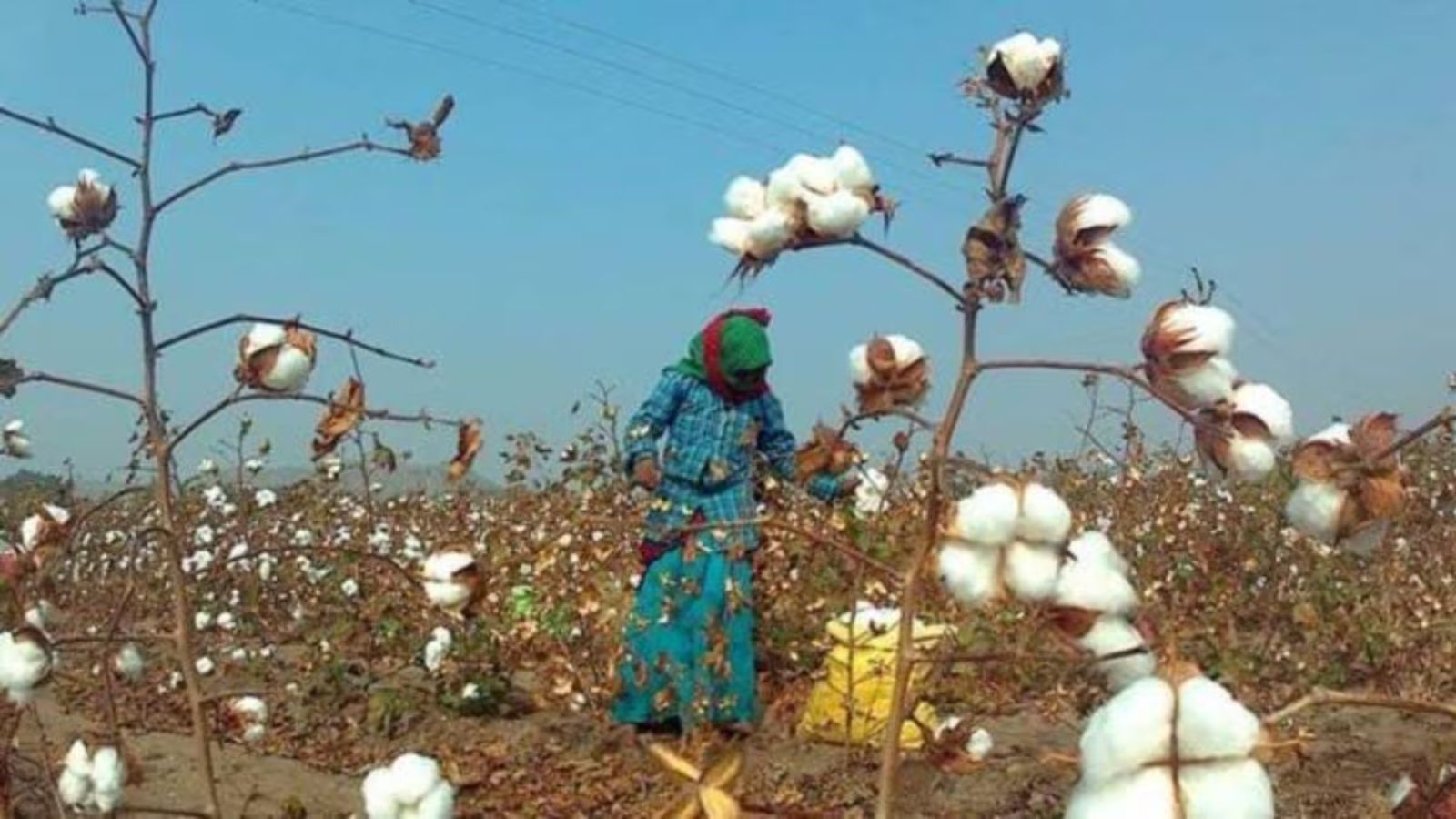
Why in news
The Indian Express reported a field-based study commissioned by the Federation of Seed Industry of India and National Seed Association of India on unauthorised herbicide-tolerant and insect-resistant cotton hybrids.
Up to 30%
Reported unauthorised cotton-area estimate
114.8 lakh hectares
Cotton area in 2025-26
227
Geo-tagged seed and leaf samples
16
Hotspot districts surveyed
72.69%
Samples positive for HT trait marker
53.74%
Samples positive for Vip3 trait marker
Background
Genetic modification introduces selected genetic material to confer particular traits; hybridisation, by contrast, involves crossing genetically distinct parents and does not necessarily involve genetic engineering. Bt cotton expresses insecticidal proteins derived from Bacillus thuringiensis, a soil bacterium. India regulates genetically engineered organisms under the Environment (Protection) Act, 1986 and the Rules, 1989 governing hazardous microorganisms and genetically engineered organisms or cells. Approval is specific to the genetic modification and its intended use: permission for Bt cotton does not authorise every insect-resistant or herbicide-tolerant cotton hybrid.
What the study found—and what it cannot establish
The study, undertaken by the South Asia Biotechnology Centre, covered 984 farmers across Maharashtra, Telangana, Andhra Pradesh and Rajasthan and tested 227 geo-tagged seed or leaf samples. Districts were selected as hotspots using glyphosate sales trends, farmer interactions and seed-market intelligence. Testing used dipstick or lateral flow assays and ELISA.
The findings indicate substantial unauthorised trait presence within the sampled hotspots. However, targeted hotspot sampling is not equivalent to a nationally representative survey; sample positivity cannot be directly interpreted as the share of India’s cotton acreage.
The report pairs an estimated 26.2–29 lakh hectares of unauthorised cotton with a 24–30% share of 114.8 lakh hectares. These reported ranges do not arithmetically reconcile. The national estimate therefore requires clarification of its denominator, extrapolation method and uncertainty.
- Industry commissioning should be disclosed, but does not by itself invalidate the findings; independent replication is essential.
- Protein-based screening provides evidence of trait expression, while enforcement-grade identification may require confirmatory molecular testing.
- Declining legal seed sales and rising glyphosate imports are corroborative signals, not standalone proof of unauthorised cotton acreage.
Infographic
Verify
Representative surveys and confirmatory trait testing
Assess
Transparent, event-specific biosafety appraisal
Enforce
Trace seed lots and hold unauthorised suppliers accountable
Support
Affordable weed and pest-management alternatives
Steward
Refuges, resistance monitoring and safe-use extension
AI-assisted infographic by Pragnya IAS Academy, based on the cited sources.
India’s GM-crop approval framework
The Genetic Engineering Appraisal Committee, under the Ministry of Environment, Forest and Climate Change, is the central body for appraisal of proposals involving environmental release of genetically engineered organisms, including experimental field trials. The Review Committee on Genetic Manipulation, under the Department of Biotechnology, oversees safety aspects of ongoing research involving genetically engineered organisms.
Institutional Biosafety Committees provide institution-level oversight, while State Biotechnology Coordination Committees and District Level Committees form part of the monitoring framework under the Rules, 1989. Biosafety permission and compliance with applicable seed-quality and marketing requirements are distinct obligations.
According to the source, permitted GM cotton hybrids or varieties contain cry1Ac and cry2Ab. Cotton carrying cp4-epsps or Vip3A lacks the reported government authorisation. An existing approval for Bt cotton cannot be treated as permission to add another gene or combine unapproved traits.
- A GM event refers to a particular genetic insertion, not merely the presence of a broadly named trait.
- Approval of an insect-resistance trait does not imply approval of herbicide tolerance.
- Widespread cultivation cannot substitute for biosafety appraisal.
Why farmers adopt unauthorised seeds
The study attributes herbicide-tolerant cotton adoption to labour shortages and high manual weeding costs. It reports seasonal glyphosate-based weed-management costs of Rs 750–850 per acre against Rs 12,000–15,000 for manual weeding. These are reported comparisons, not universally established farm budgets or estimates of total cultivation costs.
Demand for Vip3A-containing hybrids is linked in the report to pink bollworm pressure and declining effectiveness of existing Bt technology. Its claimed pest-control advantage should be distinguished from independently demonstrated local performance and regulatory approval.
An established supplier network appears to be meeting unmet demand outside authorised channels. This creates a governance problem: farmers may perceive immediate private benefits, while the seed’s identity, quality, traceability and longer-term stewardship remain uncertain.
- Farmer adoption reflects labour, cost and pest-management constraints, not proof of safety.
- Unauthorised seed purchases may weaken practical access to quality assurance and grievance redress.
- Enforcement without viable alternatives may displace sales into more concealed channels.
Biosafety, livelihoods and regulatory trade-offs
Herbicide tolerance and insect resistance create different management challenges. Repeated dependence on the same herbicide can select resistant weeds, while inadequate insect-resistance management can accelerate pest resistance to Bt proteins. These are established risk pathways, not field outcomes demonstrated by this study.
Unassessed releases complicate evaluation of environmental effects, gene flow and appropriate cultivation conditions. Herbicide use also requires attention to spray drift, occupational exposure and effects on neighbouring vegetation; crop tolerance does not mean that the herbicide is environmentally harmless.
The policy choice is not simply between prohibition and deregulation. A credible approach combines transparent scientific appraisal, action against organised unauthorised supply, affordable agronomic alternatives and farmer-centred extension.
- Do not equate absence of approval with demonstrated harm, or widespread adoption with demonstrated safety.
- Preserve the effectiveness of existing insect-resistance technology through appropriate refuge and pest-management practices.
- Separate assessment of the crop trait from compliance with applicable pesticide-use requirements.
| Gene or trait | Primary function | Reported status in India |
|---|---|---|
| cry1Ac and cry2Ab | Bt proteins toxic to certain bollworm pests | Permitted in approved GM cotton hybrids or varieties |
| cp4-epsps | Enables cotton to tolerate glyphosate | Unapproved |
| Vip3A | Bt-derived insect-resistance trait with a different mode of action | Unapproved |
- 1. Identify suspect seed lots and fields through risk-based surveillance.
- 2. Collect traceable samples with documented chain of custody.
- 3. Screen for trait proteins and undertake appropriate confirmatory molecular testing.
- 4. Verify the identified event and use against regulatory permissions.
- 5. Trace suppliers and take proportionate action with farmer guidance.
- 6. Monitor affected areas and strengthen resistance-management extension.
1986
The Environment (Protection) Act established the umbrella environmental law underpinning India’s biosafety framework.
1989
Rules governing hazardous microorganisms and genetically engineered organisms or cells established the specialised regulatory framework.
2017-18
The study places the unauthorised HTBt seed market at around 35 lakh packets.
2022-23
The source reports legal Bt cotton hybrid seed sales of 596 lakh packets.
2025-26
The study estimates unauthorised HTBt seed sales at 82–88 lakh packets; the source reports legal Bt cotton seed sales of 463 lakh packets.
Significance, challenges & way forward
Significance
- The study flags a gap between formal biotechnology regulation and actual cultivation practices in sampled cotton-growing hotspots.
- Farmer demand highlights the importance of labour-saving weed control and effective bollworm management.
- Unauthorised dissemination can undermine traceability, biosafety monitoring and accountability across the seed supply chain.
- Resistance management is a collective agricultural interest because misuse can reduce the future effectiveness of valuable technologies.
Challenges
- Hotspot selection and unclear national extrapolation limit confidence in the headline acreage estimate.
- Uncertain seed provenance makes it difficult to identify responsible suppliers and verify genetic events.
- Labour scarcity and reported cost differences weaken the effectiveness of enforcement-only responses.
- Fragmented responsibilities across biosafety, agriculture, seed inspection and pesticide administration complicate coordinated action.
- Farmers may face livelihood losses if enforcement removes an adopted practice without accessible alternatives.
Way forward
- Commission an independent, representative survey and publish sampling methods, laboratory protocols and the basis of acreage estimates.
- Strengthen accredited testing, event identification, seed-lot traceability and evidence-based action against organised unauthorised suppliers.
- Make biosafety appraisal transparent and predictable without presuming either approval or rejection of a technology.
- Expand access to integrated weed management, mechanical weeding and locally suitable labour-saving practices.
- Support pest surveillance, appropriate refuge compliance and integrated pest management to slow resistance.
- Provide farmers with clear information on approved traits, seed authenticity, safe pesticide use and grievance channels.
Key terms
- Bt cotton
- Genetically engineered cotton expressing insecticidal proteins derived from Bacillus thuringiensis.
- Herbicide tolerance
- A crop’s ability to withstand a particular herbicide that would otherwise damage it.
- GM event
- A specific genetic modification characterised by the inserted DNA and its location in the organism’s genome.
- Trait stacking
- Combining multiple introduced traits or genetic events within a crop.
- Refuge
- A designated planting of non-Bt host plants that helps maintain susceptible insects and delay resistance.
- ELISA
- An antibody-based laboratory assay used to detect target substances, including proteins associated with GM traits.
- Biosafety
- Assessment and management of potential risks arising from biological organisms and biotechnology applications.
Link with static syllabus
Prelims practice MCQs
Q1. With reference to GM cotton traits, consider the following statements: 1. cry1Ac and cry2Ab encode proteins toxic to certain insect pests. 2. cp4-epsps confers tolerance to glyphosate. 3. Approval of a Bt cotton event automatically permits addition of any other Bt-derived gene. Which of the statements given above are correct?
Q2. Consider the following pairs: 1. Genetic Engineering Appraisal Committee — Ministry of Environment, Forest and Climate Change 2. Review Committee on Genetic Manipulation — Department of Biotechnology 3. Rules governing genetically engineered organisms, 1989 — Environment (Protection) Act, 1986 Which of the pairs given above are correctly matched?
Q3. A study deliberately selects districts with suspected high adoption of an unauthorised crop trait. Which inference is most appropriate?
Q4. With reference to resistance management in agriculture, consider the following statements: 1. Repeated use of the same herbicide can select resistant weed populations. 2. Refuges can help delay insect resistance to Bt crops. 3. Herbicide tolerance in cotton means that the crop kills bollworms. Which of the statements given above are correct?
Mains practice questions
GS 3 · 15 marks · 250 words
Unauthorised GM cotton adoption reflects both unmet farmer demand and weaknesses in regulatory governance. Discuss and suggest a balanced policy response.
Frequently asked questions
Is all Bt cotton cultivation in India unauthorised?
No. The source states that approved cotton hybrids or varieties containing cry1Ac and cry2Ab are permitted; the concern is cultivation of hybrids containing unapproved traits such as cp4-epsps and Vip3A.
Does herbicide-tolerant cotton also resist bollworms?
Not by virtue of herbicide tolerance alone. A hybrid may combine herbicide-tolerance and insect-resistance traits, but they perform different functions and require appropriate regulatory assessment.
Has the study conclusively established that 30% of cotton acreage is unauthorised?
No. It reports an estimate of up to 30%, but hotspot sampling, unclear extrapolation and inconsistencies between the reported area and percentage ranges require clarification.
Why is farmer adoption not sufficient grounds for approval?
Adoption can reveal demand and perceived benefits, but cannot replace evaluation of environmental risks, trait identity and management requirements. Policy must address these risks alongside farmers’ production constraints.
Sources
- Indian Express: Up to 30% of cotton area under ‘illegal’ GM hybrids, finds study
Analysis prepared by the Pragnya IAS Academy current-affairs desk with AI assistance from the cited reports. Verify figures with the original sources.
Turn current affairs into marks
Join Pragnya IAS Academy's mentorship for daily answer-writing evaluation on stories like this.