
US Russia-Sanctions Waiver: India’s Oil Security, Tariff Relief and Continuing Risks
Revise the static topic: UPSC International Relations notes
In short: US President Donald Trump’s October 16, 2026 executive order waived sanctions, restrictions and duties under a new Russia-sanctions law, easing the threat of tariffs on goods from major buyers of Russian energy, including India. The move supports continuity in India’s discounted crude purchases and creates negotiating space with Washington, but it is reconsiderable and does not remove separate sanctions or trade-policy risks.
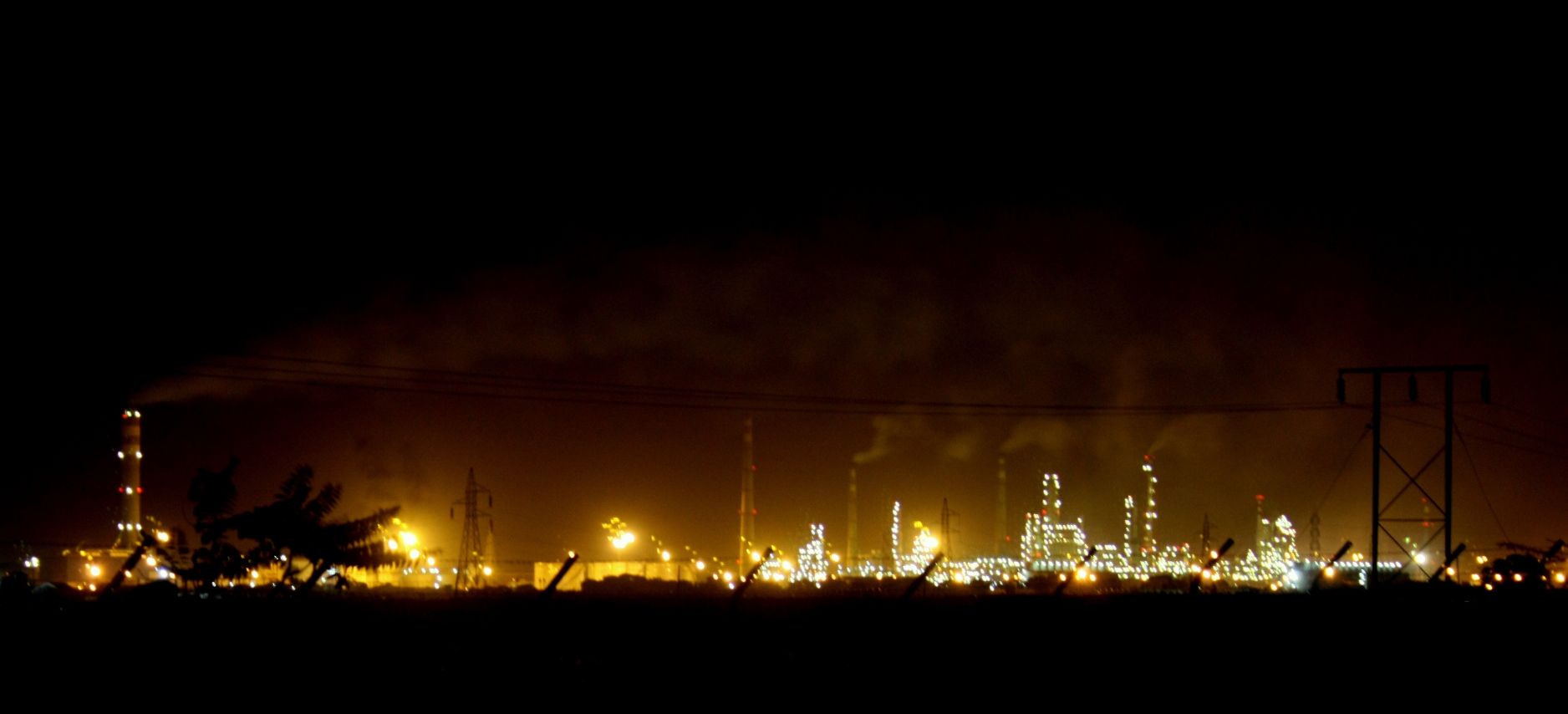
Reference view of the Essar Oil Refinery at Vadinar, near Jamnagar. Refining infrastructure provides context for India’s need to maintain affordable crude supplies while diversifying sources.
Image: Abhisek Sarda · CC BY 2.0
Why in news
The Hindu reports that the executive order waived measures under the Lindsey O. Graham Sanctioning Russia and Iran Act shortly before its enforcement deadline. Indian refiners are consequently expected to maintain Russian crude purchases close to current levels, while Ukraine has criticised the easing of pressure on Moscow.
Up to 100%
Tariffs authorised under the waived law
Five
Largest Russian crude and gas importers targeted
Over 88%
India’s crude requirement met through imports, per Indian Express
1.8 million bpd
India’s average Russian seaborne crude imports in 2026, per The Hindu
$23 per barrel
September Urals discount to Brent, per The Hindu
Background
Following Russia’s invasion of Ukraine in February 2022, Western restrictions and the withdrawal of traditional buyers redirected Russian oil towards Asian markets. The European Union banned seaborne imports of Russian crude, while the G7 introduced a price-cap mechanism intended to constrain Russian revenues without removing its oil entirely from global supply. Discounted cargoes helped Russia become India’s largest crude supplier. For India, energy security involves affordable access, reliable supply, diversified suppliers and resilient transport and payment arrangements; strategic autonomy means retaining independent policy choices rather than aligning automatically with any external power.
What the waiver changes—and what it does not
According to The Hindu, the law signed on September 18 authorised tariffs of up to 100% on goods from the five largest importers of Russian crude and gas, alongside sanctions on Russia’s shadow fleet. The October 16 executive order waived the law’s sanctions, restrictions and duties. This eases a prospective penalty on exporting countries; it is not simply a reduction in a tariff charged on Russian crude entering India.
The waiver is not India-specific and may also benefit China. The order permits the US administration to reconsider the decision. It should therefore be understood as reversible relief, not repeal of the underlying law or a permanent exemption for Indian buyers.
A separate October 9 US Treasury decision allowed the sale and import of Russian diesel into the global market, including the US, until April 7, 2027. That stated end date applies to the diesel permission; the supplied reports do not establish it as the expiry date of the broader October 16 waiver.
- The waived tariff threat concerned goods from targeted energy-importing countries, potentially exposing sectors unrelated to oil.
- A US executive waiver does not automatically alter European Union restrictions.
- The supplied material does not establish that every Russian entity, vessel or transaction is now free of sanctions.
Infographic
Immediate relief
The prospective tariff threat under the waived law has eased.
Energy advantage
Discounted Russian crude supports supply continuity and refinery economics.
Diplomatic space
India gains room for independent sourcing and trade negotiations.
Residual exposure
Reconsideration and separate restrictions preserve uncertainty.
Durable response
Diversification, legal clarity and transaction screening build resilience.
AI-assisted infographic by Pragnya IAS Academy, based on the cited sources.
Energy security: preserving affordable supply without creating dependence
The Indian Express reports that imports meet over 88% of India’s crude oil needs. Continued access to discounted Russian supplies can support refinery economics and moderate the imported-energy bill, especially when alternative supply routes face disruption. The Hindu reports an average Urals discount to Brent of $23 per barrel in September 2026.
These benefits are conditional. The effective saving depends on freight, insurance, financing, payment arrangements and the crude’s suitability for a refinery. Lower acquisition costs do not automatically translate into equivalent reductions in retail fuel prices.
The sources differ on some monthly import volumes and peak levels. They nevertheless agree on the central trend: Russia has become India’s largest crude supplier, and the waiver supports near-term continuity in purchases. A precise monthly series should not be constructed by combining their inconsistent estimates.
- Diversification should be assessed across suppliers, shipping routes, insurers and payment channels, not merely the number of exporting countries.
- Commercial decisions should compare risk-adjusted landed costs rather than headline discounts alone.
- Strategic petroleum reserves and alternative supply contracts can help cushion sudden interruptions.
Strategic autonomy: greater room for manoeuvre, not immunity
India’s stated position, quoted in the supplied reporting, is to secure energy through diversified sourcing and evolving market dynamics. The waiver gives New Delhi additional space to pursue that approach while maintaining engagement with both Washington and Moscow.
Washington’s permission for Russian diesel trade strengthens India’s negotiating argument that energy-market stability matters to all major consumers. However, an argument about policy consistency is not a legal guarantee against future penalties. The ability to reverse the waiver preserves US leverage.
Ukraine’s criticism highlights the wider diplomatic cost: purchases that improve an importer’s energy security also sustain revenues for an exporting state at war. India must therefore distinguish its commercial energy choices from political endorsement of the conflict, while continuing to support dialogue and the principles of sovereignty and territorial integrity.
- Strategic autonomy requires credible alternatives, not exclusive dependence on a discounted supplier.
- Energy diplomacy should combine bilateral engagement with wider efforts towards de-escalation.
- Policy predictability is best pursued through clear arrangements rather than reliance on discretionary relief.
Trade negotiations: a reduced obstacle, not a concluded bargain
The reduced tariff threat removes an immediate source of uncertainty for Indian exporters and may improve the environment for India-US trade negotiations. It also creates room to discuss energy procurement on its own merits rather than under the shadow of punitive duties on unrelated goods.
However, the waiver is neither a bilateral trade agreement nor a general exemption from US trade law. Section 301 of the US Trade Act of 1974 provides a separate mechanism for investigating and responding to certain foreign trade practices. The Indian Express suggests that policy convergence on issues such as structural overcapacity could help India, but the supplied material does not establish a final Section 301 exemption.
India should use the negotiating window to seek clarity on the waiver’s scope and conditions for reconsideration, while continuing work on other market-access issues. Reduced pressure strengthens the case for a balanced agreement; it does not justify assuming that all trade differences have disappeared.
- Negotiating leverage should be assessed separately from legal protection.
- Energy-related relief should not be mistaken for cancellation of unrelated tariffs or investigations.
- Exporters need contingency planning because sanctions-related measures can affect goods outside the energy sector.
Continuing exposure: jurisdictions, counterparties and logistics
The Indian Express highlights concerns about European Union measures involving companies in third countries. Such restrictions must be assessed independently: a transaction permitted under one jurisdiction may still encounter restrictions under another.
Compliance also extends beyond the nationality of the crude. Buyers must examine the seller, vessel, ownership and control, financing bank, insurer and applicable service restrictions. Existing designations or restrictions outside the waived law cannot be presumed to have disappeared.
The sources describe a political decision and its expected market effects, but do not reproduce the executive order’s complete operative provisions. Firms should therefore verify the governing legal text and implementing guidance before treating a particular transaction as covered.
- Waiver reconsideration creates contractual and delivery risks for future cargoes.
- Banks and insurers may remain cautious even where a transaction is legally permitted.
- Refined-product exports require separate checks against destination-market rules.
| Measure or issue | Reported position | Implication for India |
|---|---|---|
| Tariffs under the new sanctions law | The October 16 order waived the law’s sanctions, restrictions and duties. | The immediate threat to goods from major Russian-energy buyers has eased. |
| Durability of the broad waiver | The administration can reconsider the decision. | Relief is reversible and should not be treated as permanent immunity. |
| Russian diesel permission | The separate October 9 decision allows sales and imports until April 7, 2027. | Its stated duration must not be applied automatically to the broader waiver. |
| European Union measures | The reporting flags restrictions involving third-country companies. | US relief does not establish compliance with EU rules. |
| Section 301 trade action | It operates under a separate US trade-law mechanism. | No blanket exemption follows from the Russia-sanctions waiver. |
- 1. The executive waiver reduces the immediate sanctions-linked tariff threat.
- 2. Lower policy risk supports continuity in Russian crude procurement.
- 3. Discounted purchases can reduce refiners’ acquisition costs, subject to freight and compliance expenses.
- 4. Lower energy-import costs can support the external balance and moderate cost pressures.
- 5. Reconsideration of the waiver or separate restrictions can interrupt these benefits.
February 2022 onwards
Russia’s invasion of Ukraine and subsequent Western restrictions encouraged discounted Russian oil flows towards Asian buyers, including India.
September 18, 2026
According to the supplied reporting, Trump signed the Lindsey O. Graham Sanctioning Russia and Iran Act.
October 9, 2026
The US Treasury permitted Russian diesel sales and imports into the global market, including the US, until April 7, 2027.
October 16, 2026
Trump issued an executive order waiving sanctions, restrictions and duties under the new law.
October 17, 2026
Ukrainian President Volodymyr Zelenskyy criticised the easing of sanctions and warned against further concessions to Russia.
Significance, challenges & way forward
Significance
- The waiver supports continuity in supplies from India’s largest crude supplier without requiring an abrupt change in procurement.
- It reduces a prospective tariff threat to Indian goods that extends beyond the oil sector.
- Discounted crude can improve refinery economics and help contain the energy-import bill.
- The decision creates diplomatic space for India to defend diversified sourcing while advancing trade discussions with the US.
- The episode illustrates the tension between sanctions enforcement, global supply stability and domestic fuel affordability.
Challenges
- The US administration’s ability to reconsider the waiver leaves buyers and exporters exposed to renewed uncertainty.
- Separate restrictions on entities, vessels, financial services or destination markets may continue to constrain transactions.
- Concentrated procurement can exchange immediate price advantages for greater supplier and logistics vulnerability.
- Headline discounts may overstate savings if shipping, insurance and financing costs rise.
- Continued Russian energy purchases attract diplomatic scrutiny because of their contribution to Moscow’s revenues.
- Differing source estimates and the absence of the complete legal text require caution in quantitative and legal conclusions.
Way forward
- Seek authoritative clarification of the waiver’s coverage, conditions for reconsideration and treatment of existing contracts.
- Maintain transaction-level screening of suppliers, vessels, beneficial owners, banks and insurers across applicable jurisdictions.
- Diversify procurement and logistics while evaluating cargoes on risk-adjusted landed cost.
- Strengthen strategic petroleum reserves, contingency supply arrangements and contractual protections against sanctions disruption.
- Use the negotiating window to seek predictable trade treatment rather than depend on discretionary exemptions.
- Reduce structural oil vulnerability through energy efficiency, electrification and cleaner transport alternatives.
- Pair independent energy procurement with consistent diplomatic support for dialogue and respect for sovereignty.
Key terms
- Sanctions waiver
- An authorised relaxation of specified restrictions whose scope and durability depend on the governing legal instrument.
- Secondary sanctions
- Measures seeking to deter third-country actors from dealings with a sanctioned target, distinct from ordinary import tariffs.
- Punitive tariff
- An import duty used to exert pressure over another country’s conduct or policies.
- Shadow fleet
- Tankers using opaque ownership or operating arrangements to transport oil while circumventing sanctions-related constraints.
- Oil price cap
- A mechanism linking access to specified services for Russian oil trade to compliance with a prescribed price ceiling.
- Strategic autonomy
- The capacity to make independent policy choices based on national interests while engaging multiple partners.
- Risk-adjusted landed cost
- The delivered cost of a cargo assessed alongside financing, logistics, compliance and disruption risks.
- Section 301
- A provision of the US Trade Act of 1974 enabling investigation and action against specified foreign trade practices affecting US commerce.
Link with static syllabus
Prelims practice MCQs
Q1. With reference to the October 16, 2026 US Russia-sanctions waiver, consider the following statements: 1. It is an exemption granted exclusively to India. 2. The US administration can reconsider the waiver. 3. It automatically suspends European Union restrictions on Russian energy-related transactions. Which of the statements given above is/are correct?
Q2. According to the supplied reporting, the new US sanctions law authorised tariffs of up to 100% on which of the following?
Q3. Consider the following statements about energy security: 1. A crude-oil discount alone establishes the final economic saving to an importing refinery. 2. Diversification of shipping and payment arrangements can strengthen energy security. 3. Strategic petroleum reserves can cushion temporary supply disruptions. Which of the statements given above are correct?
Q4. With reference to the measures discussed in the supplied reports, consider the following pairs: 1. Section 301: US Trade Act of 1974 2. April 7, 2027: Stated end date of the separate Russian diesel permission 3. October 16 waiver: Permanent repeal of the underlying sanctions law Which of the pairs given above are correctly matched?
Mains practice questions
GS 2 · 15 marks · 250 words
The US waiver of Russia-related sanctions offers India breathing space, not lasting immunity. Evaluate its implications for India’s energy security, strategic autonomy and trade negotiations.
Frequently asked questions
Has the US permanently exempted India from Russia-related sanctions?
No. The reported waiver is not India-specific, can be reconsidered and does not establish that all Russia-related restrictions have been removed.
Will the waiver necessarily reduce petrol and diesel prices in India?
No. It supports access to discounted crude, but retail prices also depend on logistics, refining and marketing costs, exchange rates, taxes and pricing decisions.
Does April 7, 2027 mark the expiry of the broader sanctions waiver?
The supplied reporting assigns that date to the separate Russian diesel permission. It does not establish the same expiry date for the October 16 waiver.
Why do Indian firms still need sanctions compliance checks?
Separate jurisdictional, entity, vessel and service restrictions may remain relevant. Firms must verify whether their specific counterparties and transactions fall within the relief.
Sources
- The Hindu: Zelenskyy says Trump could lift more Russia sanctions
- The Hindu: India’s Russian crude binge to continue after Trump waives new sanctions law
- Indian Express: Trump eases duty threat; penalising India hard to defend for US now
- Indian Express: Trump’s Russia sanctions waiver: Relief for India’s oil imports, but US still wields the stick
Analysis prepared by the Pragnya IAS Academy current-affairs desk with AI assistance from the cited reports. Verify figures with the original sources.
Turn current affairs into marks
Join Pragnya IAS Academy's mentorship for daily answer-writing evaluation on stories like this — classroom programmes from a trusted name in IAS coaching in Hyderabad.