
Yamuna Pollution: Supreme Court Demands Outcome-Based Accountability
Revise the static topic: UPSC Environment notes
In short: The Supreme Court has observed that Yamuna pollution has increased despite substantial cleanup expenditure and directed the CPCB to monitor water quality at administrative boundaries. Its directions shift attention from constructing treatment infrastructure to preventing pollution at source, verifying treatment performance and holding jurisdictions accountable for deteriorating water quality.
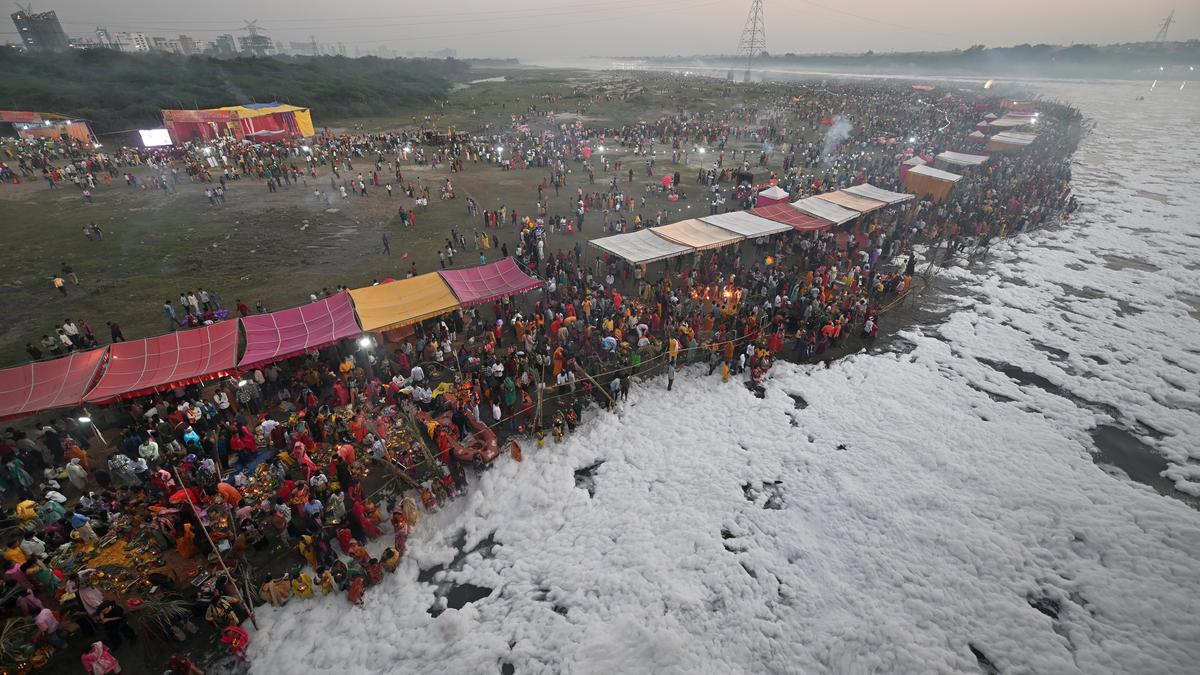
Photo from the source report: Yamuna Pollution: Supreme Court Demands Outcome-Based Accountability
Image: The Hindu
Why in news
In its November 4 order, the Supreme Court directed boundary-level monitoring, unhindered inspections and investigation of pollution incidents in the Yamuna. It also asked the CPCB to suggest a formula for compensation payable when water quality deteriorates within a jurisdiction.
520
Drains discharging wastewater into the Yamuna, as cited by the Court
Background
The Yamuna originates from the Yamunotri glacier in Uttarakhand and joins the Ganga at Prayagraj. River pollution control requires coordination among urban local bodies, sewerage utilities, pollution control boards and governments across the basin. The Water (Prevention and Control of Pollution) Act, 1974 provides the institutional framework for preventing and controlling water pollution, including Central and State Pollution Control Boards. A sewage treatment plant is only one component of sanitation: wastewater must also be collected, conveyed, treated to the required standard and safely discharged or reused.
What the Supreme Court directed
The Court directed the CPCB to monitor water quality where the Yamuna and its major drains enter and exit states, Union territories and districts. Where water quality deteriorates on any parameter within a jurisdiction, the concerned authorities are to be held accountable and penalised.
The CPCB must suggest a formula for calculating compensation, which the order says is to be deposited with the Supreme Court registry. The supplied report does not specify an expenditure total, a compensation rate or a completed assessment of liability.
- The CPCB must investigate incidents such as fish deaths, white foam, eutrophication, algal blooms and increases in BOD, COD or TSS, identifying causes and remedial measures.
- Central and state bodies must provide administrative, logistical, technical, operational and infrastructural assistance to the CPCB.
- Public and private infrastructure operators must allow immediate, unhindered access to premises, installations and records for unannounced inspections and technical assessments.
- Operators must provide unrestricted data access and cooperate with integration into the CPCB's centralised monitoring architecture.
Infographic
Prevent
Control industrial pollutants and untreated sewage at source.
Connect
Ensure wastewater reaches suitable treatment infrastructure.
Verify
Audit actual flows, treatment quality and operational performance.
Attribute
Use boundary monitoring and source investigation to establish responsibility.
Restore
Track sustained water-quality gains alongside ecological recovery.
AI-assisted infographic by Pragnya IAS Academy, based on the cited sources.
Why more treatment plants may not deliver a cleaner river
The Court emphasised stopping industrial pollutants and untreated sewage at source. Where prevention is not possible, sewage must be intercepted and treated. Installed treatment capacity cannot improve river health if sewage never reaches the plant or if treatment fails to meet discharge requirements.
The Court identified weak sewerage networks and the joining of stormwater and sewage drains as obstacles to interception. It also noted that irregular layouts and limited space in unauthorised settlements make sewer installation difficult. These observations underline the need to assess the entire sanitation chain rather than plant construction alone.
- Collection gaps can leave households and establishments outside functioning sewer networks.
- Mixed drainage complicates the interception and management of sewage flows.
- Treatment performance depends on operation, maintenance, reliable utilities and the characteristics of incoming wastewater.
- Industrial effluent requires source-specific control and appropriate treatment; municipal sewage infrastructure is not a substitute for industrial compliance.
From expenditure accounting to ecological accountability
Expenditure records measure financial inputs, while completed plants and laid sewers measure infrastructure outputs. Restoration must ultimately be judged by outcomes: reduced pollutant discharge, improved water quality and healthier aquatic ecosystems. The Court's directions create a basis for connecting public spending with these outcomes.
Boundary monitoring can reveal where water quality worsens, but credible attribution requires more than comparing isolated concentration readings. River flow, seasonal variation, upstream pollution, tributary inputs and sampling conditions must inform the technical assessment. Pollutant-load accounting can complement concentration data because dilution alone does not establish that less pollution has entered the river.
- BOD, COD and TSS help diagnose different dimensions of pollution and should not be treated as interchangeable measures.
- Dissolved oxygen and ecological indicators can supplement the parameters mentioned in the order.
- Independent sampling, volumetric audits and sensor verification can test whether reported treatment performance is reliable.
- The proposed compensation methodology should make attribution transparent without weakening the obligation to prevent pollution.
Legal foundations, shared responsibility and rehabilitation
Environmental protection is supported by Article 21 jurisprudence, the State's duty under Article 48A and the citizen's duty under Article 51A(g). Article 243W, read with the Twelfth Schedule, provides a framework for assigning municipalities functions including sanitation and public health, subject to state legislation. Effective river governance therefore requires a clear division of operational and regulatory responsibilities.
The Court stated that settlements on drains and the river bed would continue to contribute sewage unless removed with rehabilitation of occupants. This must not be reduced to an eviction-only approach: implementation should respect applicable law, due process, rehabilitation and access to sanitation. Pollution control must also address industrial and other municipal sources rather than placing the burden only on vulnerable residents.
The polluter-pays principle supports requiring polluters to bear prevention and remediation costs. Jurisdiction-level compensation, however, raises an additional governance question: how to identify the responsible utility, department, operator or polluter so that accountability does not end with a payment from the public exchequer.
- Judicial monitoring should reinforce, not substitute for, durable administrative and regulatory capacity.
- A basin-wide approach is necessary because pollution crosses municipal, district and state boundaries.
- Rehabilitation and sanitation provision should be integrated into restoration planning.
| Dimension | Expenditure-led assessment | Outcome-oriented assessment |
|---|---|---|
| Public spending | Funds released or utilised | Verified pollution reduction linked to spending |
| Infrastructure | Treatment plants and sewer networks constructed | Wastewater actually collected and treated to standards |
| Plant operations | Reported capacity and operating status | Independently verified flows, uptime and effluent quality |
| River condition | Completion of cleanup activities | Sustained water-quality and ecological improvement |
| Accountability | Department-wise project completion | Identifiable responsibility for pollution and corrective action |
- 1. Map drains, discharge sources, sewer coverage and responsible agencies.
- 2. Prevent industrial pollution and intercept untreated sewage.
- 3. Convey wastewater to suitable treatment and verify operational performance.
- 4. Monitor river and drain quality at entry and exit points using validated sampling and flow data.
- 5. Investigate deterioration and establish causes and institutional responsibility.
- 6. Apply corrective measures and compensation under the Court's framework, then verify ecological improvement.
1974
The Water (Prevention and Control of Pollution) Act established the statutory framework for water-pollution control through Central and State Pollution Control Boards.
November 4, 2026
The Supreme Court ordered boundary-level Yamuna monitoring, pollution-incident investigations and access for inspections, and sought a compensation formula from the CPCB.
Significance, challenges & way forward
Significance
- The directions make river health, rather than expenditure alone, central to evaluating restoration.
- Boundary monitoring can strengthen accountability for pollution transferred downstream.
- Unannounced inspections and unrestricted data access can expose gaps between reported and actual treatment performance.
- Incident-specific investigations can connect visible symptoms such as fish deaths or foam with scientifically established causes.
- Cleaner water can support public health, aquatic biodiversity and safer cultural and livelihood uses of the river.
Challenges
- Fragmented responsibilities can allow municipalities, utilities, regulators and contractors to shift blame.
- Treatment assets may deliver limited benefits where collection networks and household connections remain inadequate.
- Seasonal flows and upstream pollution complicate the attribution of water-quality deterioration to a particular jurisdiction.
- Monitoring requires calibrated sensors, representative sampling, credible laboratories and sufficient technical staff.
- Compensation paid from public funds may fail to change behaviour unless responsibility is traced to the relevant institutions and operators.
- Settlement-related interventions risk social harm if rehabilitation, due process and sanitation access are neglected.
Way forward
- Publish drain-wise source inventories and responsibility maps covering sewage, industrial effluent and solid-waste interfaces.
- Prioritise sewer connectivity, interception and rehabilitation of existing systems alongside justified treatment-capacity additions.
- Link utility and operator performance to verified treatment quality, actual flows handled and sustained compliance.
- Develop a transparent compensation methodology using reliable boundary measurements, flow conditions and source attribution.
- Publish comparable monitoring results and corrective-action reports, supported by independent technical audits.
- Integrate rehabilitation and inclusive sanitation with measures to protect drains and the river bed.
- Coordinate pollution control with environmental flows and floodplain protection because treatment alone cannot restore river ecology.
Key terms
- Biochemical Oxygen Demand
- The oxygen required by microorganisms to biologically break down degradable organic matter under specified test conditions.
- Chemical Oxygen Demand
- The oxygen equivalent required to chemically oxidise susceptible substances in a water sample under specified test conditions.
- Total Suspended Solids
- The concentration of suspended particulate matter measured through a prescribed filtration method.
- Dissolved oxygen
- Oxygen present in water and available to aquatic organisms.
- Eutrophication
- Nutrient enrichment of a water body that can promote excessive algal growth and subsequent oxygen depletion.
- Pollutant load
- The quantity of a pollutant transported or discharged over time, assessed using concentration and flow.
- Polluter-pays principle
- The principle that the polluter should bear the costs of preventing, controlling and remedying pollution.
- Environmental flows
- The quantity, timing and quality of water flows needed to sustain aquatic ecosystems and associated human benefits.
Link with static syllabus
Prelims practice MCQs
Q1. With reference to the Supreme Court's reported directions on Yamuna pollution, consider the following statements: 1. The CPCB is to monitor water quality where the river and its major drains enter and exit administrative jurisdictions. 2. Construction of additional sewage treatment plants was considered sufficient by itself to clean the river. 3. The CPCB was asked to suggest a formula for calculating compensation. Which of the statements given above are correct?
Q2. Consider the following pairs: 1. BOD: Oxygen required for biological degradation of degradable organic matter 2. COD: Concentration of dissolved oxygen available to fish 3. TSS: Suspended particulate matter in water Which of the pairs given above are correctly matched?
Q3. Which of the following most directly expresses the polluter-pays principle?
Q4. With reference to river-water monitoring, consider the following statements: 1. A decline in pollutant concentration necessarily proves a decline in the quantity of pollutant discharged. 2. Flow data can help estimate pollutant loads. 3. Seasonal conditions and upstream inputs are relevant when attributing downstream deterioration. Which of the statements given above are correct?
Mains practice questions
GS 3 · 15 marks · 250 words
River restoration cannot be assessed through expenditure and installed treatment capacity alone. Discuss with reference to the Supreme Court's directions on Yamuna pollution.
Frequently asked questions
Why can the Yamuna remain polluted despite spending on sewage treatment?
Treatment infrastructure cannot deliver results if wastewater is not collected and conveyed to it or if treatment performance is inadequate. The Court highlighted weak sewerage systems, mixed drains and the need to stop pollution at source.
What is the CPCB's role under the reported directions?
The CPCB must undertake boundary-level monitoring, investigate pollution incidents and suggest a compensation formula. Operators must provide access for inspections, sampling, technical assessments and data integration.
Has the Supreme Court specified a fixed compensation amount?
The supplied report does not specify a fixed amount or rate. It says the CPCB has been directed to suggest a formula and that compensation is to be deposited with the Court registry.
Do foam or fish deaths establish the precise pollution source?
No; these are warning signs requiring investigation rather than conclusive source attribution. The Court directed the CPCB to identify causes and recommend remedial measures.
Sources
- The Hindu: Pollution in Yamuna increased despite huge expenditure on cleaning: Supreme Court
- Times of India: '520 drains discharge wastewater in the Yamuna': SC raps admin over rising pollution despite huge spending
Analysis prepared by the Pragnya IAS Academy current-affairs desk with AI assistance from the cited reports. Verify figures with the original sources.
Turn current affairs into marks
Join Pragnya IAS Academy's mentorship for daily answer-writing evaluation on stories like this — classroom programmes from a trusted name in IAS coaching in Hyderabad.