
InfoGraphix by Pragnya · Indian Polity · Chapter 3
Fundamental Rights
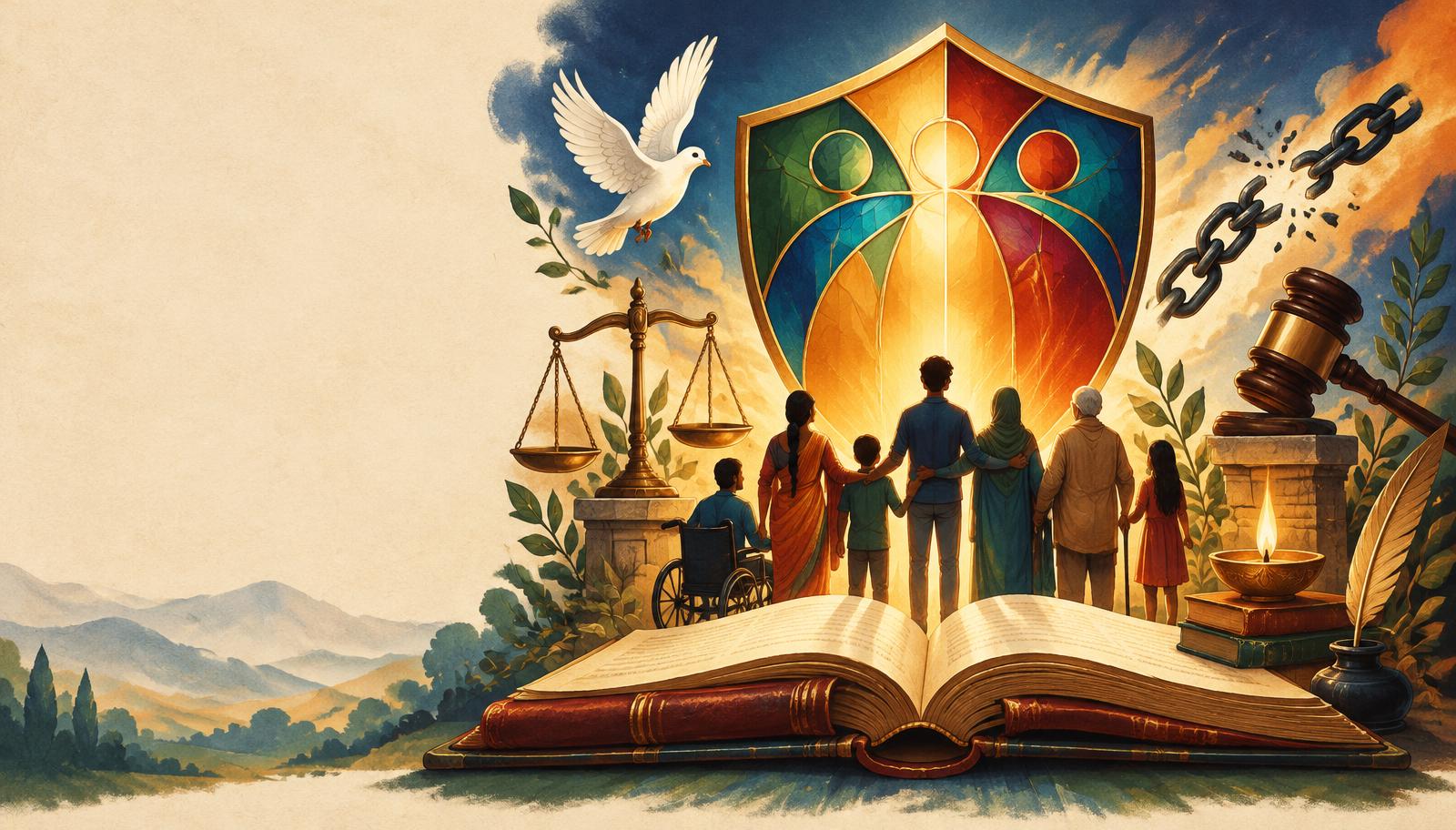
The six Fundamental Rights, article by article — equality, freedom, protection against exploitation, religion, culture and education, and the writs that enforce them — with emergency rules, landmark cases and the amendments that reshaped Part III.
- 18 visual topics
- 54 practice MCQs
- 54 flip cards
Three pillars of Part III
Articles 12–13
The framework
Against whom rights apply, and why laws that violate them are void.
Articles 14–30
The six rights
Equality, freedom, protection from exploitation, religion, and culture and education.
Articles 31A–35
Protection and limits
Writs and Article 32, emergency suspension, saving clauses and Parliament's powers.
Chapter mind-map: 1950 → 2024
Scroll the ribbon and tap any milestone to open its infographic.
1950
A.K. Gopalan
Narrow reading of Article 21.
Open topic →1951
1st Amendment
15(4), 31A, 31B, Ninth Schedule.
Open topic →1959
Basheshar Nath
Rights cannot be waived.
Open topic →1967
Golak Nath
Rights cannot be amended.
Open topic →1973
Kesavananda Bharati
Basic structure doctrine.
Open topic →1976
ADM Jabalpur
No habeas corpus in Emergency.
Open topic →1978
Maneka Gandhi; 44th Amendment
Fair procedure; property out; Arts 20–21 safe.
Open topic →1980
Minerva Mills
FR–DPSP balance.
Open topic →1992
Indra Sawhney
Creamy layer; 50% ceiling.
Open topic →2002
Article 21A
Education for children 6–14.
Open topic →2015
Shreya Singhal
Section 66A struck down.
Open topic →2017
Puttaswamy
Privacy a Fundamental Right.
Open topic →2019
103rd Amendment
EWS reservation.
Open topic →2024
Davinder Singh
SC sub-classification allowed.
Open topic →
Topic index
Follow the numbers in order, or jump to what you need.
0 of 18 revised on this device
- 1Part III
Fundamental Rights: An Introduction
Six categories, who can claim them, key features
What Fundamental Rights are, why Part III is called the Magna Carta of India, who can claim which right, and the features that set these rights apart from ordinary legal rights.
Open infographic - 2Arts 12–13
Articles 12–13: 'State' & Void Laws
Against whom — and severability, eclipse, waiver
Article 12 defines the 'State' against which Fundamental Rights are enforced; Article 13 makes laws that violate them void — the textual base of judicial review and the doctrines of severability and eclipse.
Open infographic - 3Art 14
Article 14: Equality Before Law
Reasonable classification, never arbitrariness
Article 14 guarantees equality before law and equal protection of the laws to every person — and permits reasonable classification, but never arbitrariness.
Open infographic - 4Arts 15–16
Articles 15–16: Non-discrimination & Reservation
From 15(3) to EWS and SC sub-classification
Article 15 bans discrimination and Article 16 guarantees equal opportunity in public jobs — while enabling reservation for backward classes, SCs, STs and the economically weaker sections.
Open infographic - 5Arts 17–18
Articles 17–18: Untouchability & Titles
Abolished — and what still counts
Article 17 abolishes untouchability in every form and makes its practice an offence; Article 18 abolishes titles, except military and academic distinctions.
Open infographic - 6Art 19
Article 19: Six Freedoms
Each freedom and its permitted limits
Article 19 gives every citizen six freedoms — speech, assembly, association, movement, residence and profession — each limited only by the grounds listed in clauses (2) to (6).
Open infographic - 7Arts 20–21A
Articles 20, 21 & 21A: Life, Liberty, Education
From Gopalan to Puttaswamy
Article 20 protects the accused, Article 21 protects life and personal liberty — the most expanded right in the Constitution — and Article 21A guarantees free education to children aged 6–14.
Open infographic - 8Art 22
Article 22: Arrest & Preventive Detention
Four safeguards and the three-month rule
Article 22 gives an arrested person four safeguards and sets the limits of preventive detention — detention without trial to stop a feared act, reviewed by an Advisory Board after three months.
Open infographic - 9Arts 23–24
Right against Exploitation
Trafficking, begar, forced and child labour
Article 23 bans trafficking, begar and forced labour; Article 24 bans employing children under 14 in factories, mines and hazardous work — both enforceable against private persons too.
Open infographic - 10Arts 25–28
Freedom of Religion
Individuals, denominations, taxes, instruction
Articles 25–28 protect freedom of conscience and religion for individuals and denominations, bar taxes for any one religion and limit religious instruction in State institutions.
Open infographic - 11Arts 29–30
Cultural & Educational Rights
Any section's culture; minority institutions
Article 29 protects the distinct language, script and culture of any section of citizens; Article 30 lets religious and linguistic minorities establish and administer educational institutions of their choice.
Open infographic - 12Art 32
Article 32, Writs & PIL
The heart and soul of the Constitution
Article 32 — 'the heart and soul of the Constitution' — lets any person move the Supreme Court for Fundamental Rights; the five writs and public interest litigation make that remedy real.
Open infographic - 131951–2007
Amending Fundamental Rights
Shankari Prasad to Kesavananda and beyond
Can Parliament amend Fundamental Rights? The tug-of-war from Shankari Prasad (1951) through Golak Nath (1967) to Kesavananda Bharati (1973) — and the basic structure that settled it.
Open infographic - 14Arts 358–359
Fundamental Rights in an Emergency
Articles 358 and 359 after the 44th Amendment
How Fundamental Rights are affected during a National Emergency — automatic suspension of Article 19 under Article 358, Presidential orders under Article 359, and the 44th Amendment's safeguards.
Open infographic - 15Arts 31A–35
Saving Clauses & Articles 33–35
31A, 31B, 31C, armed forces, martial law
Articles 31A, 31B and 31C protect certain laws from Fundamental Rights challenges; Articles 33–35 let Parliament modify rights for the armed forces, during martial law, and legislate on specified rights.
Open infographic - 161950–2024
Landmark Judgments
Case, year and the line that matters
The Supreme Court cases every aspirant must know on Fundamental Rights — what each was about and the one line that matters in the exam.
Open infographic - 17Parts III–IV
FR vs DPSP & Key Amendments
Means and goals — and nine amendments
How Fundamental Rights differ from Directive Principles, how courts have reconciled them, and the constitutional amendments that reshaped Part III.
Open infographic - 18Revision
Chapter Quick Revision
Articles 12–35, writs, cases and traps on one sheet
Fundamental Rights on one sheet — Articles 12–35, writs, emergency rules, cases and the traps that cost marks.
Open infographic
Full reading notes in the Study Library
- Equality →
- Freedom →
- Article 12 →
- Article 13 →
- Judicial review →
- Reasonable restrictions →
- Life and personal liberty →
- Protection against exploitation →
- Freedom of religion →
- Cultural and educational rights →
- Constitutional remedies →
- Writs →
- Writ jurisdiction →
- PIL →
- Basic structure →
- Doctrine of severability →
- Doctrine of eclipse →
- Emergency provisions →
- FR-DPSP relationship →
- Important amendments →
Previous year questions