
Electoral Roll Revision: Form 7 Safeguards and Barriers to Voter Appeals
Revise the static topic: UPSC Polity notes · UPSC Governance notes
In short: A Supreme Court petition alleges fabricated Form 7 objections seeking voter deletions in Delhi’s Mustafabad constituency, while reporting from West Bengal highlights voters stranded with their eligibility still under adjudication. The cases expose distinct risks to electoral integrity: exclusion through unverified objections and exclusion through unresolved proceedings that obstruct effective appeals.
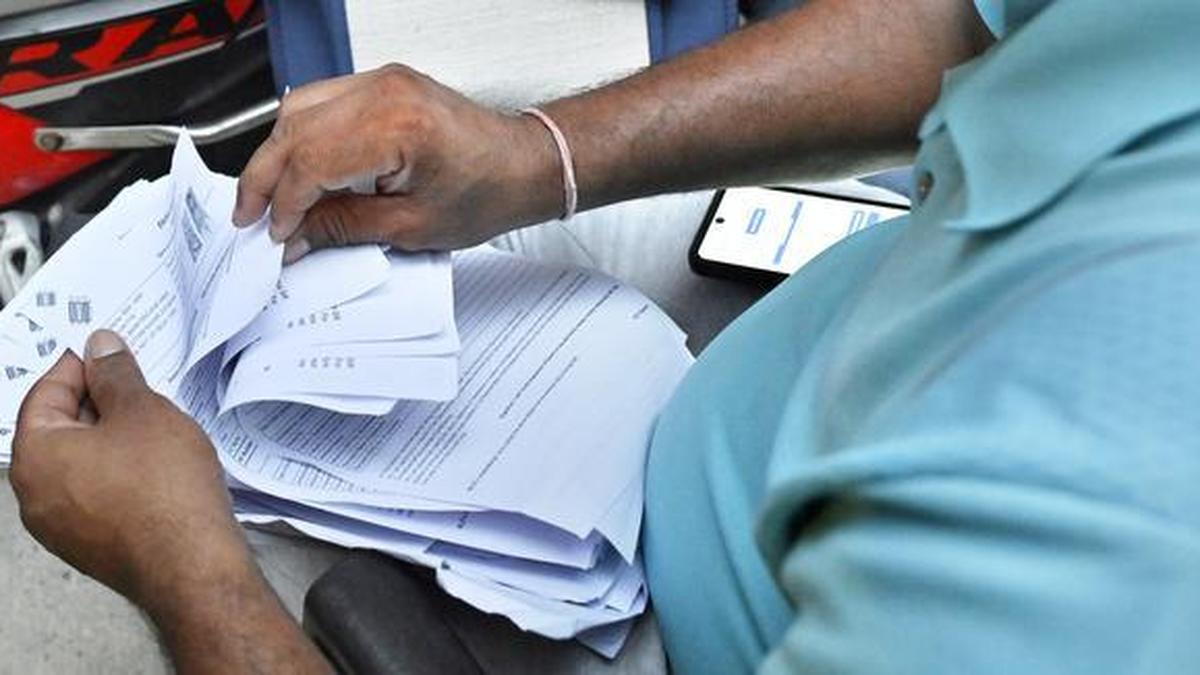
Photo from the source report: Electoral Roll Revision: Form 7 Safeguards and Barriers to Voter Appeals
Image: The Hindu
Why in news
The Hindu reports a petition seeking safeguards before Delhi’s revised electoral roll is finalised. Separately, The Indian Express reports that unresolved adjudication and pending decisions have left some West Bengal voters unable to secure an effective remedy.
37
Applications found false or fabricated, according to the Delhi petition
28
Electors traced at their enrolled addresses in the cited investigation
1,021
Mustafabad Form 7 applications analysed by The Hindu
787
Applications recorded in the names of 20 BJP-appointed Booth Level Agents
38.31 lakh
Bengal tribunal appeals filed, as reported to the Supreme Court
1.26 lakh
Bengal tribunal appeals disposed of by the September 18 submission
Background
Article 324 places the preparation of electoral rolls under the superintendence, direction and control of the Election Commission of India. Article 325 provides for one general electoral roll for each territorial constituency and prohibits ineligibility for inclusion on grounds only of religion, race, caste or sex; Article 326 establishes adult suffrage for elections to the Lok Sabha and State Legislative Assemblies, subject to constitutional and statutory qualifications. The Representation of the People Act, 1950 and the Registration of Electors Rules, 1960 govern electoral registration, revision, correction and deletion. Electoral Registration Officers exercise statutory decision-making powers, while Booth Level Officers assist field verification. Political parties’ Booth Level Agents are distinct from these election officials.
Two different routes to wrongful exclusion
In Mustafabad, the petition alleges that deletion applications cite death or permanent shifting even where electors are alive and remain at their recorded addresses. It also alleges that persons identified as applicants deny submitting or signing the Form 7 objections. According to the petition, authorities examined and found 37 applications false or fabricated.
The Hindu’s analysis, cited in the petition, found that 787 of 1,021 applications stood in the names of 20 persons recorded as BJP-appointed Booth Level Agents. This concentration warrants verification of authorship and evidence; it does not, by itself, establish individual or party responsibility, particularly where purported applicants deny filing the forms.
West Bengal presents a different problem: some voters remain under adjudication without completed decisions. The report identifies pending decisions and e-signing as obstacles and records officials saying that the applicable court orders reserve action in these cases to judicial officers. These are reported allegations and administrative accounts, not findings supplied from a final judicial judgment.
- Delhi raises questions about the authenticity of objections and the factual basis for proposed deletions.
- West Bengal raises questions about delayed decisions, institutional responsibility and access to appellate remedies.
- A deletion request is not equivalent to an approved deletion, and a pending case is not equivalent to an established disqualification.
Infographic
Authentic objection
Verify who filed Form 7 and whether the submission is genuine.
Verified ground
Establish facts; do not equate temporary absence with shifting.
Fair procedure
Provide applicable notice, hearing and a reasoned decision.
Completed adjudication
Resolve pending decisions, signatures and communication.
Usable remedy
Make the appropriate appeal accessible and timely.
AI-assisted infographic by Pragnya IAS Academy, based on the cited sources.
Form 7: An objection initiates scrutiny, not automatic deletion
Rule 13(2) of the Registration of Electors Rules, 1960 provides for Form 7 objections to proposed inclusion or applications for deletion, preferred by a person whose own name is included in the electoral roll. The form identifies the applicant, the elector concerned, the ground of objection and a declaration about the truth of the particulars. Its accompanying guidelines place the onus of substantiating the ground on the applicant.
Section 22 of the Representation of the People Act, 1950 requires the Electoral Registration Officer to be satisfied after proper verification before correcting or deleting an entry. For deletion on grounds such as ceasing to be ordinarily resident or otherwise not being entitled to registration, the statutory safeguard includes a reasonable opportunity of being heard. An allegation of death also requires proper verification; merely selecting that ground on a form cannot establish it.
Section 20 makes clear that temporary absence does not, by itself, terminate ordinary residence. Consequently, an unsuccessful household visit cannot automatically establish permanent shifting. Section 31 addresses knowingly false written statements or declarations connected with electoral rolls, providing a legal basis for action where its requirements are established.
- Authenticate the objection: establish that an identifiable applicant actually submitted it.
- Verify the ground: distinguish death, permanent shifting and temporary absence through appropriate evidence.
- Ensure procedural fairness: serve applicable notice, consider the elector’s response and record reasons.
- Keep responsibility clear: the Electoral Registration Officer decides; a Booth Level Officer’s field report assists that decision.
Why an appeal on paper may not be an effective remedy
A workable appeal ordinarily requires an identifiable decision, communicated reasons and a known forum. Where a voter’s case remains indefinitely pending, the practical barrier arises before the appellate stage: there may be no completed adverse order to challenge through the envisaged appeal mechanism.
Section 24 of the Representation of the People Act, 1950 provides appeals against specified orders under Sections 22 and 23 to designated district-level authorities, followed by an appeal to the Chief Electoral Officer, subject to prescribed requirements. The Registration of Electors Rules also contain procedures governing claims, objections and appeals. The court-directed judicial adjudication and appellate tribunals reported in West Bengal must not be confused with this ordinary statutory framework.
The Indian Express reports that the Election Commission told the Supreme Court on September 18 that 1.26 lakh of 38.31 lakh tribunal appeals had been disposed of. These appeals included both challenges by deleted voters and objections against inclusion. The total therefore cannot be presented as the number of deleted voters awaiting restoration.
- An unsigned or uncommunicated decision can prevent a voter from using the appropriate remedy effectively.
- Court-imposed allocation of responsibility requires judicial clarification where administrative officials cannot act.
- Delay has an electoral consequence: a remedy delivered after polling cannot restore participation in that completed poll.
Constitutional balance: Accurate rolls with procedural legitimacy
Electoral integrity requires both removing ineligible entries and retaining eligible electors. Treating deletions as the sole indicator of a successful revision creates a distorted incentive: an apparently cleaner roll may conceal wrongful exclusion.
The statutory right to vote operates within the constitutional framework of adult suffrage, equality and free and fair elections. Article 14 and principles of natural justice reinforce the need for non-arbitrary procedures. Electoral authorities must therefore connect each adverse decision to verified facts rather than presume that an objection or data discrepancy proves ineligibility.
Reports of concentrated pendency in minority-dominated constituencies justify scrutiny of unequal impacts and procedural access. They do not, without further evidence, establish discriminatory intent. The appropriate response is transparent auditing of grounds, verification quality, notice service and case outcomes.
- Roll accuracy and electoral inclusion are complementary objectives, not opposing choices.
- Digital tools should support verification and case tracking, not convert unresolved flags into presumed disqualification.
- Transparency must enable scrutiny without exposing unnecessary personal information.
| Stage | Principal risk | Required safeguard or corrective approach |
|---|---|---|
| Receipt of Form 7 | Fabricated applicant or unsupported allegation | Check applicant eligibility, authorship, declaration and supporting grounds |
| Field verification | Temporary absence treated as permanent shifting | Assess ordinary residence and corroborate the alleged ground |
| Notice and hearing | Elector remains unaware of proposed adverse action | Provide applicable notice and a meaningful opportunity to respond |
| Decision | Mechanical deletion or indefinite pendency | Complete a reasoned determination through the competent authority |
| Communication and appeal | Missing order or unclear appellate forum | Communicate the decision and the applicable appeal procedure |
| Publication and monitoring | Errors persist despite verification or correction | Reconcile decisions with the roll and audit unresolved cases |
- 1. Receive and register the objection with applicant details and the stated ground.
- 2. Check applicant eligibility and authenticate the submission.
- 3. Verify the alleged facts through field enquiries and appropriate records.
- 4. Provide applicable notice and a reasonable opportunity for the elector to respond.
- 5. Have the Electoral Registration Officer issue a reasoned decision.
- 6. Communicate the outcome, enable the applicable appeal and reconcile the decision with the electoral roll.
October 27, 2025
West Bengal’s SIR began, according to The Indian Express.
February 2026
The Supreme Court ordered judicial officers to adjudicate the eligibility of Bengal voters flagged for logical discrepancies, according to the report.
March 20, 2026
The Supreme Court ordered appellate tribunals to provide deleted Bengal voters an opportunity to appeal.
September 18, 2026
The Election Commission reported to the Supreme Court that 1.26 lakh of 38.31 lakh Bengal tribunal appeals had been disposed of.
October 29, 2026
West Bengal’s Additional Chief Electoral Officer wrote to District Election Officers about reactivating judicial officers’ logins for pending decisions and e-signing.
November 5, 2026
The Hindu’s analysis of Mustafabad Form 7 applications, subsequently cited in the petition, highlighted their concentration in the names of recorded Booth Level Agents.
November 25, 2026
Claims and objections are scheduled to close under the revised Delhi timetable quoted in the petition.
December 2026
The petition quotes December 15 for completion of disposal and December 22 for final publication of Delhi’s revised roll.
Significance, challenges & way forward
Significance
- Accurate and inclusive rolls underpin the legitimacy of representative government.
- Authenticating objections protects eligible voters while preserving legitimate scrutiny of ineligible entries.
- Time-bound decisions make appellate safeguards practically usable rather than merely formal.
- Clear separation between election officials and party agents protects administrative neutrality.
- Auditable procedures strengthen public confidence without prejudging disputed political allegations.
Challenges
- Fabricated objections can misuse a lawful correction mechanism to create wrongful-exclusion risks.
- Temporary migration and absence during verification can be mistaken for loss of ordinary residence.
- Incomplete decisions and pending e-signatures can leave voters without a usable appellate starting point.
- Large appeal workloads can delay relief beyond the electoral event for which it matters.
- Court-directed allocation of functions can require judicial clarification before administrators address bottlenecks.
- Litigation costs and limited procedural awareness can make remedies harder to access for vulnerable voters.
Way forward
- Authenticate disputed applicants and examine unusual filing patterns without presuming that every concentrated set of objections is unlawful.
- Use corroborated verification and recorded findings rather than treating one failed household visit as proof of permanent shifting.
- Provide accessible notices, acknowledgment of responses and reasoned decisions through both offline and digital channels.
- Create a pending-case register distinguishing cases awaiting hearing, decision, signature, communication and appeal.
- Seek appropriate judicial directions to resolve the Bengal bottleneck where existing court orders constrain administrative action.
- Provide assisted filing, clear forum guidance and legal-aid referrals so that cost and digital exclusion do not defeat remedies.
- Investigate demonstrably false declarations under the applicable law while preserving bona fide objections.
- Publish privacy-protecting disposal data and audit samples of both deletions and retained entries.
Key terms
- Special Intensive Revision
- An intensive exercise to revise electoral rolls through verification of existing entries and consideration of eligible inclusions and deletions.
- Form 7
- The prescribed form for objecting to proposed inclusion or seeking deletion of an electoral-roll entry.
- Electoral Registration Officer
- The statutory authority responsible for electoral-roll preparation and decisions on registration, correction and deletion.
- Booth Level Officer
- A field-level election functionary who assists electoral registration and verification.
- Booth Level Agent
- A political party’s representative assisting its participation in electoral-roll scrutiny, distinct from an election official.
- Ordinary residence
- The statutory residential connection relevant to constituency registration, which is not lost merely through temporary absence.
- Reasoned order
- A decision recording the relevant facts and reasons so that the affected person can understand and challenge it.
- Under adjudication
- A pending decision status, not by itself a finding that an elector is ineligible.
Link with static syllabus
Prelims practice MCQs
Q1. With reference to Form 7 objections, consider the following statements: 1. An objection under Rule 13(2) must be preferred by a person whose own name is included in the electoral roll. 2. Filing Form 7 automatically authorises deletion of the challenged entry. 3. The accompanying guidelines place the onus of substantiating the ground on the applicant. Which of the statements given above are correct?
Q2. Consider the following pairs: 1. Article 324: Superintendence, direction and control over preparation of electoral rolls 2. Article 325: One general electoral roll for each territorial constituency 3. Article 326: Adult suffrage for Lok Sabha and State Legislative Assembly elections How many of the above pairs are correctly matched?
Q3. With reference to electoral registration, consider the following statements: 1. Temporary absence does not, by itself, terminate ordinary residence. 2. A Booth Level Agent is the statutory authority empowered to order deletion of an electoral-roll entry. Which of the statements given above is/are correct?
Q4. Which of the following best describes Section 24 of the Representation of the People Act, 1950?
Mains practice questions
GS 2 · 15 marks · 250 words
Electoral-roll integrity requires protection against both ineligible inclusion and wrongful exclusion. Examine the safeguards governing deletion of entries and suggest measures to make voter remedies effective.
Frequently asked questions
Does filing Form 7 automatically remove a voter’s name?
No. It initiates an objection or deletion request that requires verification and a decision by the competent electoral-registration authority, with applicable procedural safeguards.
Can a voter be deleted merely because a verification officer did not find them at home?
Temporary absence does not, by itself, end ordinary residence. A failed visit cannot automatically establish permanent shifting.
Why can an under-adjudication status obstruct an appeal?
Without a completed and communicated decision, a voter may lack the order needed to invoke the relevant appeal procedure. The Bengal report describes this practical difficulty; it does not establish that all other legal remedies are unavailable.
Have the allegations against Mustafabad objectors been finally established by the Supreme Court?
The supplied material reports a petition and the evidence it cites, including allegedly fabricated applications. It does not provide a final Supreme Court finding on responsibility.
Sources
- The Hindu: Plea in SC says ghost Form 7s haunt Mustafabad constituency during Delhi SIR
- Indian Express: ‘Can’t appeal, can’t vote’: The forgotten voters of Bengal SIR
Analysis prepared by the Pragnya IAS Academy current-affairs desk with AI assistance from the cited reports. Verify figures with the original sources.
Turn current affairs into marks
Join Pragnya IAS Academy's mentorship for daily answer-writing evaluation on stories like this — classroom programmes from a trusted name in IAS coaching in Hyderabad.