
ICJ Myanmar Genocide Ruling: Rohingya Accountability and Conditions for Safe Return
Revise the static topic: UPSC International Relations notes
In short: According to the supplied reports, the International Court of Justice ruled on 19 November 2026 that Myanmar committed genocide against the Rohingya and ordered safe return, reparations and prosecution of suspected perpetrators. The central challenge is translating binding state responsibility into actual protection: a judgment neither enforces itself nor makes refugee return automatically safe.
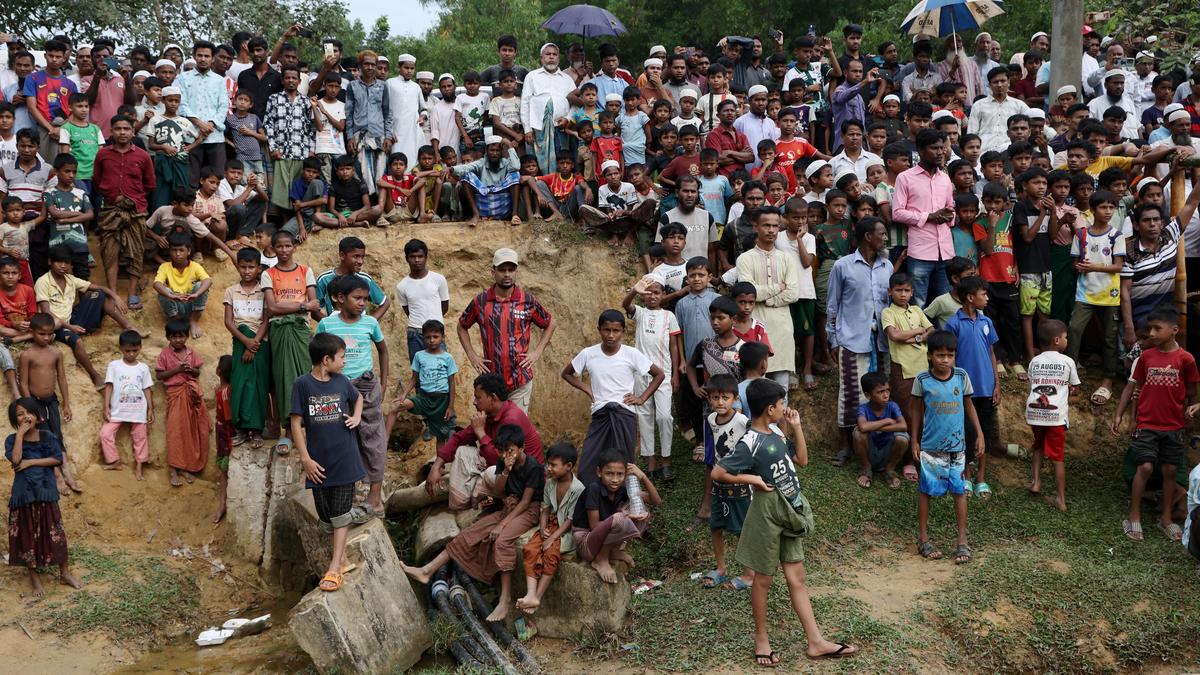
Rohingya refugees in Bangladesh, whose protection and conditions for safe return to Myanmar are central to accountability. Reference view, not a photograph of the reported ICJ ruling.
Image: The Hindu
Why in news
Myanmar rejected the reported ICJ judgment as unfair, while Rohingya refugees in Bangladesh welcomed recognition of their suffering but sought a credible route home. Malaysia separately announced a proposal to resettle 10,000 Rohingya in Turkiye through a skills-training programme, raising questions about consent and lasting protection.
About 1.2 million
Rohingya refugees in Bangladesh
10,000
Proposed Malaysia–Turkiye resettlement
190,000
Myanmar refugees and asylum seekers in Malaysia
Two-thirds
Rohingya share of Malaysia’s Myanmar refugee and asylum-seeker population
Three to six months
Proposed vocational training in Turkiye
Background
The Rohingya are a predominantly Muslim minority associated with Myanmar’s Rakhine State, bordering Bangladesh. Long-standing exclusion, restrictions on rights and widespread statelessness underpin their displacement. The Genocide Convention requires states to prevent and punish genocide, while the International Court of Justice, the principal judicial organ of the United Nations, adjudicates disputes between states within its jurisdiction. Refugee protection addresses a distinct but connected question: how displaced people can remain safe until a genuinely durable solution becomes available.
What the reported judgment establishes
The supplied reports state that the ICJ found Myanmar responsible for genocide during the military operation against the Rohingya in 2017. They describe findings of mass executions, widespread rape and sexual violence, and destruction of villages. The reported remedies include safe return, reparations and prosecution of suspected perpetrators.
Myanmar’s spokesperson disputed the judgment and cited its lack of unanimity. However, an ICJ judgment does not require unanimity to be binding. Political rejection does not extinguish the respondent state’s legal obligations.
The reports do not reproduce the operative judgment or specify compensation amounts, implementation deadlines or detailed monitoring arrangements. These should not be inferred from news summaries.
- Recognition of genocide establishes legal responsibility; implementation determines whether that recognition changes survivors’ lives.
- An order requiring prosecution is not itself a criminal conviction of any individual.
- The wish to return home must be distinguished from consent to return under existing conditions.
Infographic
State responsibility
ICJ adjudicates treaty breaches by states.
Individual accountability
Competent criminal courts determine personal guilt.
Implementation
Binding obligations need diplomacy, monitoring and compliance.
Voluntary choice
No return or transfer through coercion.
Restored rights
Legal status, safety, property and livelihoods sustain return.
Shared protection
Support host communities and credible durable solutions.
AI-assisted infographic by Pragnya IAS Academy, based on the cited sources.
Genocide Convention: state responsibility versus individual guilt
Genocide requires a prohibited act accompanied by the specific intent to destroy, in whole or in part, a national, ethnical, racial or religious group as such. Large-scale violence alone does not dispense with this intent requirement. Prohibited acts include killing, serious bodily or mental harm, deliberately imposing destructive conditions of life, preventing births and forcibly transferring children.
State responsibility concerns conduct attributable to the state and breaches of its international obligations. Military conduct can engage state responsibility because armed forces are state organs. Responsibility for committing genocide must be distinguished from separate breaches of duties to prevent and punish it.
Article IX of the Genocide Convention provides for ICJ adjudication of disputes concerning its interpretation, application or fulfilment, including state responsibility. The Gambia’s case illustrates the common interest of Convention parties in compliance: a state need not be the territorial victim to invoke responsibility for obligations owed to all parties.
- The ICJ determines responsibility between states; it does not sentence individuals to imprisonment.
- Individual criminal accountability requires proceedings before a competent domestic or international criminal court.
- Reparation may include compensation and other appropriate measures; accountability is not reducible to a monetary award.
Binding judgment, limited enforcement machinery
ICJ judgments in contentious cases are final and binding between the parties in the particular case. Under Article 94 of the UN Charter, UN members undertake to comply with judgments in cases to which they are parties. If a party fails to comply, the other party may approach the Security Council, which may make recommendations or decide measures to give effect to the judgment.
The Court has no independent police force or standing coercive machinery. Security Council action is discretionary and can encounter permanent-member veto politics. Domestic resistance, conflict and restrictions on humanitarian access can further obstruct implementation.
These constraints do not make the judgment legally meaningless. It can provide an authoritative basis for diplomatic pressure, evidence preservation, advocacy for reparations and coordinated demands for compliance. Such measures must nevertheless be designed to avoid worsening civilian deprivation.
- Security Council enforcement is a possible route, not an automatic consequence of non-compliance.
- A legally binding obligation and an effectively enforced obligation are different propositions.
- Regional diplomacy and humanitarian support should complement, not replace, accountability.
Return and third-country resettlement: protection before movement
Safe, voluntary and dignified return requires more than transport across a border. Refugees need reliable protection from persecution, recognition of identity and legal status, freedom of movement, access to livelihoods and services, and remedies for dispossession. Consent must be informed and free from detention threats, aid withdrawal or other coercive pressures.
The reported Malaysia–Turkiye proposal concerns third-country resettlement, not repatriation to Myanmar. Malaysia’s announcement envisages vocational training and possible employment subject to Turkish rules. The sources do not establish whether participation will be voluntary or provide full details of legal status and long-term protection; training alone does not demonstrate a durable solution.
For India, the issue connects neighbourhood stability with humanitarian protection and border management. India is not a party to the Refugee Convention or its Protocol, but Articles 14 and 21 of the Constitution protect persons, not only citizens. Security screening, lawful procedures and individual protection assessments should therefore be considered together rather than treated as mutually exclusive.
- Non-refoulement prohibits return to specified serious threats; its precise scope depends on the applicable legal framework.
- UNHCR’s traditional durable solutions are voluntary repatriation, local integration and third-country resettlement.
- Refugee participation and independent monitoring are essential safeguards against premature return.
| Pathway | Central purpose | Key limitation or safeguard |
|---|---|---|
| ICJ proceedings | Determine state responsibility and appropriate remedies | Binding judgments depend on implementation; the Court has no independent enforcement force |
| Criminal proceedings | Determine individual guilt and impose criminal penalties | Require competent jurisdiction, evidence and fair trial safeguards |
| Voluntary repatriation | Enable refugees to return to their country of origin | Requires free and informed consent, safety and dignified conditions |
| Third-country resettlement | Transfer refugees to another state offering admission and protection | Requires secure status and protection; employment training alone is insufficient |
| Local integration | Establish a lasting legal, economic and social place in the host country | Depends on host-state policy and meaningful access to rights |
- 1. Translate the judgment into clearly identified compliance obligations.
- 2. Establish protection guarantees, humanitarian access and independent monitoring.
- 3. Address legal identity, citizenship exclusion, movement restrictions and property claims.
- 4. Provide refugees with reliable information and obtain free, individual and informed consent.
- 5. Facilitate return only where safety and dignity can be verified.
- 6. Monitor reintegration and ensure access to remedies, livelihoods and services.
1948
The Genocide Convention was adopted, establishing obligations to prevent and punish genocide.
2017
Myanmar’s military operation against the Rohingya became the central factual background to the genocide case described in the reports.
2019
The Gambia instituted proceedings against Myanmar at the ICJ under the Genocide Convention.
Late September 2026
According to the supplied reporting, Malaysia repatriated Myanmar nationals under a programme described by authorities as voluntary; rights groups warned of risks.
October 2026
Malaysia said it would seek clarification about reports that some recently returned migrants were detained in Myanmar.
19 November 2026
The supplied reports describe an ICJ genocide judgment against Myanmar, with orders concerning safe return, reparations and prosecution.
20 November 2026
Myanmar criticised the ruling, Rohingya refugees in Bangladesh welcomed it, and Malaysia announced its proposed resettlement initiative with Turkiye.
Significance, challenges & way forward
Significance
- The reported judgment places the Rohingya crisis within a framework of enforceable legal obligations rather than discretionary humanitarian concern alone.
- Recognition of state responsibility can strengthen demands for reparations, protection and institutional reform.
- The case demonstrates how treaty obligations of common concern can be invoked by a state not directly injured by the alleged conduct.
- Separating accountability from return prevents a court verdict from being misused as evidence that conditions are already safe.
- A durable response can reduce prolonged displacement and support stability across South and Southeast Asia.
Challenges
- Myanmar’s rejection of the judgment signals political resistance to implementation.
- Security Council divisions can obstruct collective enforcement despite the binding nature of the judgment.
- Statelessness, exclusion and insecure property rights can reproduce persecution even after physical return.
- Crowded camps, health hazards and work restrictions can create pressure to accept return without genuine choice.
- Unclear consent procedures and legal status weaken confidence in the proposed Malaysia–Turkiye arrangement.
- Disinformation and xenophobia can erode public support for refugee protection in host societies.
Way forward
- Anchor diplomatic engagement in the judgment’s actual operative provisions, without inventing deadlines or remedies absent from the text.
- Seek independently verifiable safeguards against persecution, arbitrary detention and renewed displacement before facilitating return.
- Address citizenship exclusion, documentation, freedom of movement and housing, land and property claims as core protection issues.
- Ensure individual consent, family unity, accessible information and independent oversight in both repatriation and resettlement programmes.
- Expand support for host communities and refugees through education, healthcare, lawful livelihood opportunities and predictable humanitarian assistance.
- Preserve evidence and support credible criminal accountability alongside victim-centred reparations.
- India should combine regional engagement and border management with lawful procedures and individualised assessment of protection risks.
Key terms
- Genocide
- Specified acts committed with intent to destroy, in whole or in part, a national, ethnical, racial or religious group as such.
- Specific intent
- The particular intention to destroy a protected group that distinguishes genocide from other grave international crimes.
- State responsibility
- International legal responsibility arising when conduct attributable to a state breaches its international obligations.
- Erga omnes partes obligations
- Treaty obligations owed to all parties collectively, in whose observance every party has a legal interest.
- Non-refoulement
- The prohibition on returning a person to specified serious threats, including persecution or torture, under applicable international law.
- Reparations
- Measures addressing injury caused by an internationally wrongful act, potentially including restitution, compensation and satisfaction.
- Voluntary repatriation
- Return to the country of origin based on a refugee’s free and informed choice, in safety and dignity.
- Third-country resettlement
- Transfer of refugees from a country of asylum to another state that admits them and offers protection and a durable solution.
Link with static syllabus
Prelims practice MCQs
Q1. With reference to the International Court of Justice, consider the following statements: 1. In contentious cases, it adjudicates disputes between states within its jurisdiction. 2. It can sentence individuals convicted of genocide to imprisonment. 3. Its judgments are binding between the parties in the particular case. Which of the statements given above are correct?
Q2. Under the Genocide Convention, which of the following is essential for prohibited acts to constitute genocide?
Q3. Consider the following pairs: 1. Voluntary repatriation: Return to the country of origin 2. Third-country resettlement: Admission and protection in a state other than the current country of asylum 3. Local integration: Establishment of a lasting legal, economic and social place in the host country How many of the above pairs are correctly matched?
Q4. With reference to Article 94 of the United Nations Charter, consider the following statements: 1. UN members undertake to comply with ICJ judgments in cases to which they are parties. 2. If a party fails to comply, the other party may have recourse to the Security Council. 3. The Security Council must automatically impose sanctions whenever non-compliance is alleged. Which of the statements given above are correct?
Mains practice questions
GS 2 · 15 marks · 250 words
An international judgment can establish accountability without securing a durable solution for displaced people. Discuss with reference to the reported ICJ genocide ruling against Myanmar and the conditions for Rohingya return.
Frequently asked questions
Does the ICJ judgment automatically punish Myanmar’s military leaders?
No. The ICJ determines state responsibility; individual punishment requires proceedings before a competent criminal court with jurisdiction and fair trial safeguards.
Can Myanmar’s disagreement make the judgment non-binding?
No. Political rejection or the absence of unanimity does not remove a judgment’s binding effect between the parties.
Does an order permitting safe return mean refugees should return immediately?
No. Return requires verified safety, free and informed consent, and conditions supporting dignity and sustainable reintegration.
How does Malaysia’s Turkiye proposal differ from repatriation?
It proposes movement to a third country rather than return to Myanmar. Its durability depends on consent, secure legal status and continuing protection, not merely completion of vocational training.
Sources
- The Hindu: Malaysia plans to resettle 10,000 Rohingya in Turkiye
- The Hindu: Rohingya in Bangladesh welcome UN court’s genocide verdict but say they want to go home to Myanmar
- The Hindu: Myanmar calls ICJ ruling on genocide 'unfair'
- The Hindu: The Rohingya question: International solidarity, accountability and the missing road home
Analysis prepared by the Pragnya IAS Academy current-affairs desk with AI assistance from the cited reports. Verify figures with the original sources.
Turn current affairs into marks
Join Pragnya IAS Academy's mentorship for daily answer-writing evaluation on stories like this — classroom programmes from a trusted name in IAS coaching in Hyderabad.