
India–Netherlands Strategic Partnership: Chips, Water and Clean Energy
Revise the static topic: UPSC International Relations notes
In short: India and the Netherlands elevated bilateral ties to a Strategic Partnership during Prime Minister Narendra Modi’s visit on May 16–17, 2026, signing 17 agreements and MoUs. Cooperation in semiconductors, water, renewable energy and critical minerals could strengthen India’s technological capabilities and resource security, but its impact will depend on implementation rather than diplomatic announcements alone.
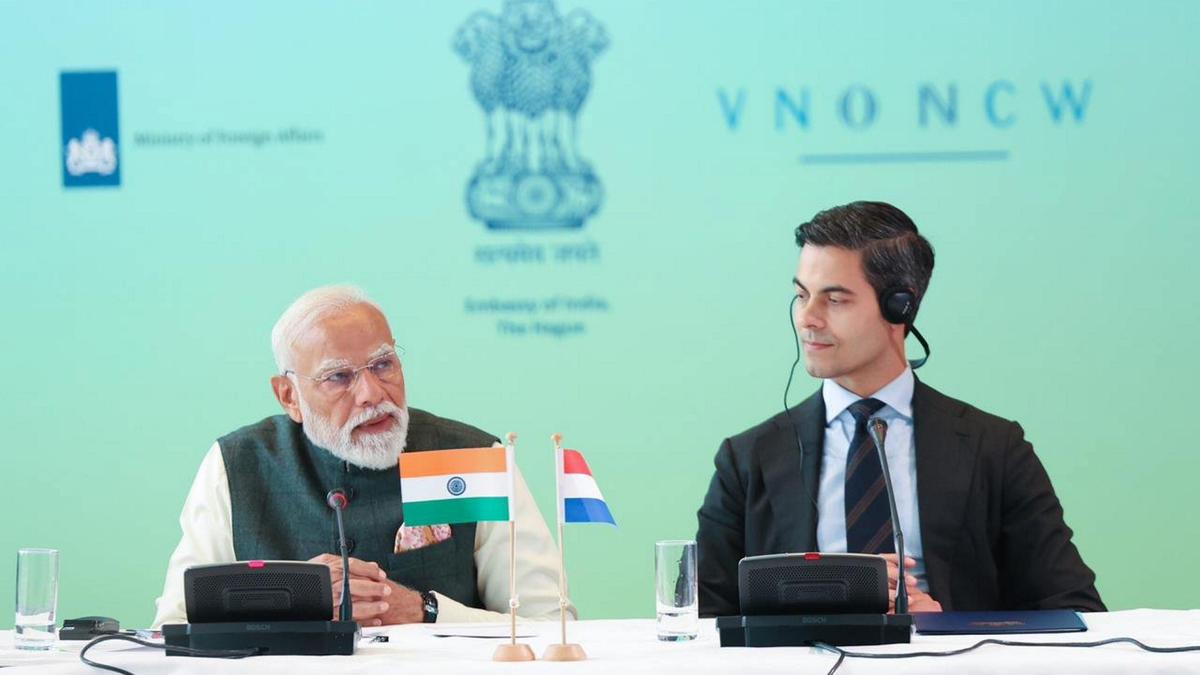
India and the Netherlands elevated ties to a Strategic Partnership, with 17 agreements and MoUs covering cooperation including semiconductors, water and renewable energy.
Image: The Hindu
Why in news
The partnership upgrade included an agreement concerning a semiconductor fabrication project between TATA Electronics and ASML. The visit also brought diplomatic sensitivities into focus, with Dutch media reporting concerns over press freedom and minority rights that India’s Ministry of External Affairs pushed back on.
17
Agreements and MoUs signed
Background
The Netherlands is a member of the European Union and an important centre of water-management expertise and semiconductor-equipment manufacturing. Its low-lying delta geography has shaped its capabilities in flood protection and water governance, while Dutch company ASML supplies lithography systems used in chip manufacturing. For India, cooperation with such a specialised technology partner connects foreign policy with domestic priorities: industrial capability, climate resilience, agricultural productivity and energy security. A Strategic Partnership provides a political framework for deeper cooperation; the designation does not by itself create a military alliance or guarantee technology transfer.
What was agreed, and what remains unspecified
During the May 16–17 visit, India and the Netherlands elevated relations to a Strategic Partnership and signed agreements and MoUs covering water, agriculture and health, described as WAH, alongside renewable energy, critical minerals and semiconductors.
The reported semiconductor agreement concerns a fabrication project involving TATA Electronics and ASML. The supplied report does not specify the project’s location, investment, production capacity, technology node, equipment configuration or completion schedule. It therefore supports an assessment of strategic potential, not a claim that production or technology transfer has already begun.
- The partnership combines advanced industrial cooperation with development-oriented sectors.
- The label MoU alone does not establish whether an instrument is legally binding; its text and the parties’ intentions matter.
- An agreement concerning a fabrication project is not evidence of an operational semiconductor plant.
Infographic
Semiconductors
Specialised equipment cooperation must translate into manufacturing capability.
Water
Adapt expertise to local resilience, efficiency and maintenance needs.
Clean energy
Combine technology partnerships with finance and grid readiness.
Critical minerals
Pursue dependable supplies with environmental safeguards.
Implementation
Measure projects, capabilities and public benefits—not announcements alone.
AI-assisted infographic by Pragnya IAS Academy, based on the cited sources.
Semiconductors: building capability without assuming self-sufficiency
Semiconductor manufacturing depends on a globally distributed ecosystem of design tools, specialised equipment, materials, fabrication, packaging and testing. ASML’s importance lies in lithography: the process used to pattern semiconductor wafers. Cooperation involving a critical equipment supplier can support India’s manufacturing ambitions, but it does not substitute for the rest of this ecosystem.
For India, the strategic opportunity is to diversify partnerships and develop domestic capabilities through investment, engineering skills, supplier development and reliable manufacturing operations. However, access to particular equipment or technologies can remain subject to commercial terms, intellectual-property arrangements and applicable export controls.
- Supply-chain resilience requires diversification and dependable access, not necessarily complete domestic production of every input.
- Domestic firms need supporting capacity in equipment maintenance, materials handling, process control and quality assurance.
- The source does not establish access to any particular advanced lithography technology.
- Reliable power, high-quality water and environmental safeguards are essential complements to fabrication investment.
Water and clean energy: translating diplomacy into development
Dutch water-management expertise is relevant to India’s flood exposure, urban drainage challenges, water-quality concerns and agricultural water demand. Cooperation could support integrated planning, wastewater reuse and climate-resilient infrastructure, provided solutions are adapted to local hydrology, institutions and affordability.
Renewable-energy cooperation can potentially combine technology, investment and implementation experience. Critical-mineral cooperation is also strategically relevant because several clean-energy technologies depend on specialised mineral inputs. However, the report does not identify particular renewable technologies, minerals, supply commitments or financing arrangements.
These sectors are interconnected: reliable electricity and secure water supplies underpin industrial production, while cleaner energy and efficient water use can reduce the environmental burden of manufacturing. This makes coordination across the agreements more valuable than treating each as an isolated project.
- Water projects should strengthen local operation and maintenance rather than merely install imported equipment.
- Agriculture and health cooperation can extend the partnership’s benefits beyond high-technology industry.
- Renewable-energy projects require attention to grid integration, financing and commercial viability.
- Critical-mineral cooperation should address environmental and social safeguards alongside supply security.
Strategic convergence alongside diplomatic differences
For India, the upgrade broadens engagement with a European partner possessing capabilities in strategically important sectors. For the Netherlands, cooperation offers scope to connect specialised expertise and enterprises with India’s development and industrial priorities. This is a partnership based on complementary capabilities rather than identical positions on every issue.
Dutch Prime Minister Rob Jetten said he raised sensitive matters, including a child-custody and alleged abduction case. Separately, Dutch media reported that he raised concerns over press freedom and minority rights in India, which the MEA subsequently pushed back on. These issues underline the need for sustained diplomatic dialogue alongside sectoral cooperation.
Domestic legal processes and applicable international obligations should guide individual custody disputes. More broadly, disagreements should be managed through established channels without assuming that either economic cooperation eliminates political differences or political differences necessarily derail cooperation.
- The partnership should preserve India’s strategic autonomy while widening access to specialised capabilities.
- Dutch participation in the EU means relevant European regulatory frameworks remain important for commercial implementation.
- Clear communication and institutional follow-through can help prevent diplomatic sensitivities from overwhelming practical cooperation.
| Area | Reported development | Potential benefit | Implementation test |
|---|---|---|---|
| Semiconductors | Fabrication-project agreement involving TATA Electronics and ASML | Stronger manufacturing capability and supply-chain diversification | Equipment access, skills, infrastructure and commercial viability |
| Water | Included in the signed agreements and MoUs | Improved water security and climate resilience | Local adaptation, institutional capacity and maintenance |
| Renewable energy | Included in the signed agreements and MoUs | Cleaner energy supply and wider technology partnerships | Financing, grid integration and project execution |
| Critical minerals | Included among the cooperation areas | Potential diversification of inputs for strategic industries | Specific supply arrangements and environmental safeguards |
| Agriculture and health | Included within WAH cooperation | Potential improvements in productivity and public welfare | Accessible, affordable and locally relevant applications |
- 1. Set political priorities through the Strategic Partnership.
- 2. Translate agreements into project-specific technical, commercial and regulatory arrangements.
- 3. Mobilise finance, infrastructure, equipment and skilled personnel.
- 4. Implement projects with Indian firms, research institutions and relevant public authorities.
- 5. Develop local suppliers, operational expertise and environmental safeguards.
- 6. Review outcomes through measurable industrial and developmental indicators.
May 16–17, 2026
During Prime Minister Modi’s Netherlands visit, bilateral ties were elevated to a Strategic Partnership and 17 agreements and MoUs were signed.
Significance, challenges & way forward
Significance
- The partnership links external engagement with India’s domestic industrial and developmental priorities.
- Semiconductor cooperation could strengthen resilience by widening access to specialised equipment and expertise.
- Water cooperation can support adaptation to floods, water stress and urban infrastructure pressures.
- Renewable-energy and critical-mineral cooperation could reinforce India’s energy transition and resource security.
- Engagement with a specialised European partner diversifies India’s international technology relationships.
Challenges
- Signed instruments may not translate into investment or operational projects without clear responsibilities, finance and implementation schedules.
- Dependence on specialised foreign equipment can persist even when semiconductor fabrication takes place domestically.
- Export controls, intellectual-property conditions and commercial restrictions may limit the scope of technology cooperation.
- Water-project implementation requires coordination across Union, State and local institutions with differing capacities.
- Industrial expansion must manage water demand, wastewater and energy requirements without shifting environmental costs onto communities.
- Political disagreements and sensitive legal cases require careful handling to sustain trust.
Way forward
- Publish project-level objectives, implementing agencies and review mechanisms wherever commercial confidentiality permits.
- Link semiconductor cooperation to training, equipment servicing, research collaboration and domestic supplier development.
- Assess technological access and commercial feasibility before treating announced projects as assured manufacturing capacity.
- Design water projects with State governments, urban local bodies and users, including provision for long-term maintenance.
- Integrate resource efficiency, wastewater treatment and cleaner electricity into industrial planning.
- Clarify the scope of renewable-energy and critical-mineral cooperation through viable projects and appropriate safeguards.
- Maintain regular diplomatic dialogue so that disagreements are addressed without obscuring mutually beneficial cooperation.
Key terms
- Strategic Partnership
- A political framework for sustained cooperation in priority areas, whose practical content depends on the arrangements agreed by the partners.
- Semiconductor fabrication
- The manufacturing process through which electronic circuits are formed on semiconductor wafers.
- Lithography
- A chipmaking process used to transfer circuit patterns onto a wafer during manufacturing.
- Supply-chain resilience
- The ability of a production network to anticipate, withstand and recover from disruptions.
- Critical minerals
- Minerals considered economically or strategically important whose supply may be vulnerable to disruption.
- Integrated water resources management
- Coordinated management of water, land and related resources to balance social, economic and ecological needs.
- WAH
- Water, agriculture and health, the cooperation grouping identified in the reported agreements.
- Memorandum of understanding
- An instrument recording an understanding between parties, with legal effect depending on its wording, context and intended obligations.
Link with static syllabus
Prelims practice MCQs
Q1. With reference to semiconductor manufacturing, consider the following statements: 1. Lithography is used to form circuit patterns during wafer processing. 2. A country's access to lithography equipment alone ensures a complete domestic semiconductor ecosystem. Which of the statements given above is/are correct?
Q2. In the reported India–Netherlands cooperation framework, WAH refers to:
Q3. Consider the following statements about international cooperation instruments: 1. Every memorandum of understanding is necessarily a legally binding treaty. 2. Designation as a Strategic Partnership automatically establishes a mutual-defence obligation. Which of the statements given above is/are correct?
Q4. With reference to the constitutional distribution of responsibilities concerning water in India, consider the following statements: 1. State List Entry 17 covers water, subject to Union List Entry 56. 2. Union List Entry 56 concerns regulation and development of inter-State rivers and river valleys under the conditions specified in that entry. Which of the statements given above is/are correct?
Mains practice questions
GS 2 · 15 marks · 250 words
The India–Netherlands Strategic Partnership illustrates how technology diplomacy can advance strategic autonomy and developmental security. Discuss its potential and the conditions necessary for effective implementation.
Frequently asked questions
What is the central significance of the India–Netherlands partnership upgrade?
It brings specialised technology cooperation and developmental priorities under a broader strategic framework. Its value lies in the potential to strengthen manufacturing capability, water resilience and energy security.
Does the TATA Electronics–ASML agreement confirm an operational chip plant?
No. The report identifies an agreement concerning a semiconductor fabrication project but does not establish operational status, capacity, technology node or completion schedule.
Why is the Netherlands relevant to India’s water challenges?
Its low-lying delta geography has fostered expertise in flood protection and water management. These capabilities can inform Indian projects, but require adaptation to local conditions and institutions.
Does a Strategic Partnership mean India and the Netherlands have formed a military alliance?
No. The designation provides a framework for closer cooperation but does not by itself create mutual-defence obligations.
Sources
- The Hindu: India, Netherlands upgrade ties; sign 17 MoUs on water, renewable energy, and semiconductors
Analysis prepared by the Pragnya IAS Academy current-affairs desk with AI assistance from the cited reports. Verify figures with the original sources.
Turn current affairs into marks
Join Pragnya IAS Academy's mentorship for daily answer-writing evaluation on stories like this — classroom programmes from a trusted name in IAS coaching in Hyderabad.