
India–New Zealand FTA: Tariff Access, Rules of Origin and Employment Mobility
Revise the static topic: UPSC International Relations notes
In short: The India–New Zealand Free Trade Agreement entered into force on October 20, 2026, giving Indian exports duty-free access across all New Zealand tariff lines and introducing new temporary employment pathways. Its significance lies in combining export diversification with services mobility, while India retains exclusions and safeguards for sensitive imports.
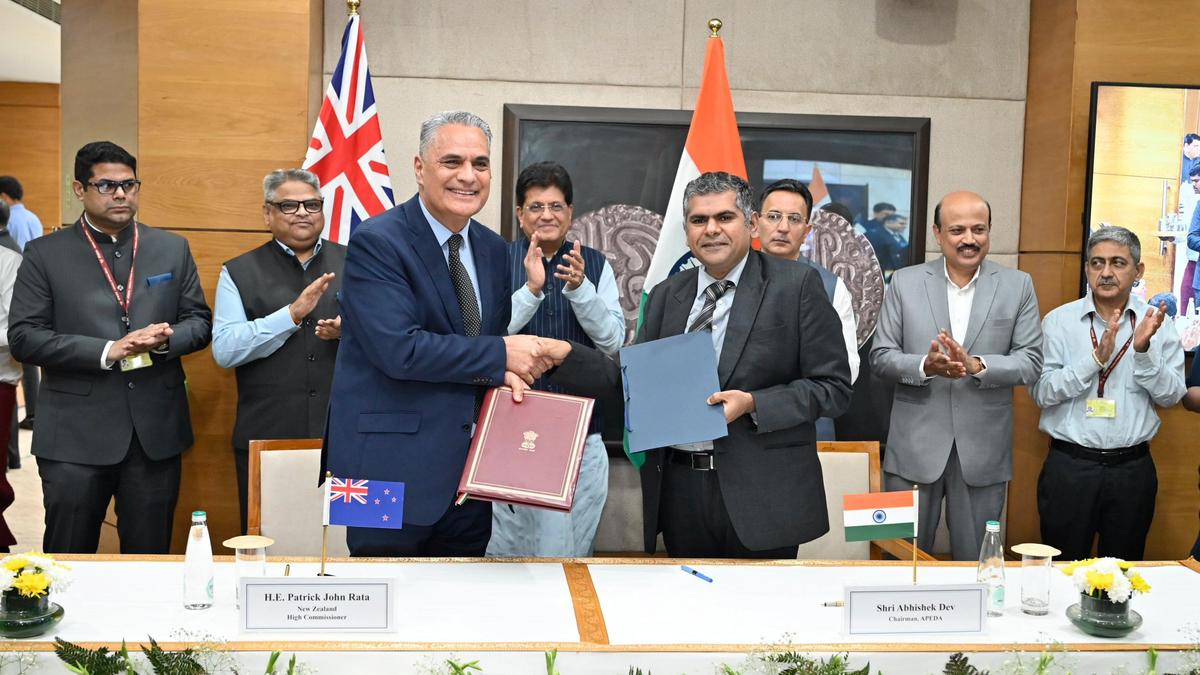
India–New Zealand trade: tariff access, rules of origin and temporary employment pathways.
Image: The Hindu
Why in news
The FTA has become operational following its signing and ratification. New Zealand’s immigration authorities have also announced employment and student-related commitments under the agreement.
100%
New Zealand tariff lines offering duty-free access
70%
Indian tariff lines receiving concessions
95%
New Zealand exports covered by Indian concessions
29.97%
Indian tariff lines on exclusion list
5,000
TEE visa holders permitted at any one time
$20 billion
FDI component reported as part of the deal
Background
A free trade agreement provides preferential market access between participating economies while allowing each to retain its own external tariffs towards non-members. Unlike a customs union, it therefore requires rules of origin to identify goods eligible for preferences and prevent simple transshipment from third countries. Trade agreements may also address services, investment and temporary movement of people. Under the WTO framework, preferential agreements operate within disciplines relating to trade in goods and services; tariff preferences do not automatically remove product standards, licensing requirements or immigration conditions.
Tariff liberalisation: comprehensive access with asymmetric commitments
New Zealand is providing duty-free access across all tariff lines from the agreement’s entry into force, covering all of India’s current exports to that market. The report describes this as India’s first FTA offering full duty-free access across all tariff lines from the outset. It removes pre-FTA tariff disadvantages of up to 10% faced by Indian exporters.
India’s offer is more calibrated: concessions cover 70% of tariff lines and about 95% of the current trade value of New Zealand’s exports to India. These concessions include tariff elimination or sharp reductions; they should not be interpreted as universal zero-duty access. The reported exclusion share is 29.97%, while the concession share is expressed in rounded terms.
For apples, kiwifruit, manuka honey and albumins, the source reports duty-based quotas, minimum import price provisions and other safeguards. Their detailed thresholds and operating conditions are not provided.
- Potential beneficiaries include textiles and clothing, leather and footwear, pharmaceuticals, engineering goods and marine products.
- Agricultural and food export opportunities include fruits and vegetables, cereals, processed foods, coffee, tea, cocoa and spices.
- Tariff-line coverage measures product categories, whereas trade-value coverage reflects the value of existing trade.
Infographic
Tariff access
Full New Zealand duty-free coverage; calibrated Indian concessions.
Origin compliance
Preferences depend on qualifying goods and verifiable origin.
Sensitive sectors
Exclusions, quotas and safeguards seek to manage adjustment.
Employment mobility
New temporary pathways with a concurrent presence ceiling.
Strategic outcomes
Diversification and deeper ties depend on effective implementation.
AI-assisted infographic by Pragnya IAS Academy, based on the cited sources.
Rules of origin: the bridge between tariff promises and usable preferences
Duty-free access is not determined solely by the port from which a product is shipped. Rules of origin establish whether a good qualifies as originating in an FTA partner, helping prevent third-country goods from obtaining preferences through simple rerouting.
Common approaches include wholly obtained criteria for goods such as crops, and substantial transformation criteria for manufactured products. The latter may involve changes in tariff classification, value-content requirements or specified processing. These are general trade-policy concepts: the supplied report does not disclose this agreement’s product-specific origin rules, certification procedures or cumulation provisions.
For Indian exporters using imported inputs, commercially workable origin rules and predictable verification are crucial. Excessively burdensome documentation can reduce preference utilisation, while weak verification can enable circumvention and undermine domestic confidence in the agreement.
- Exporters should verify the applicable product-specific origin rule before promising preferential prices to buyers.
- Origin compliance must be distinguished from sanitary, phytosanitary and technical compliance.
- The report does not establish any agreement-specific local-content threshold.
Temporary employment mobility: opportunities within defined limits
The agreement introduces two Temporary Employment Entry visa categories for Indian nationals: one for highly skilled occupations and another for a small number of professions described as iconic to India. Most places are allocated to skilled occupations already identified on New Zealand’s Green List.
The pathways permit up to 5,000 TEE visa holders in New Zealand at any one time. This is a concurrent presence ceiling, not a stated annual admissions quota. The agreement also includes expanded post-study work rights for some Indian graduates, commitments around in-study work rights and a new working holiday scheme.
These provisions can strengthen professional and educational links, but temporary employment access is not equivalent to permanent residence or unrestricted labour-market access. The source does not specify eligible professions in full, visa duration or detailed qualification requirements.
- Transparent eligibility and qualification requirements will determine how widely Indian professionals can use these pathways.
- Recruitment integrity, workplace protections and accessible grievance redressal are essential to meaningful mobility.
- Temporary movement of natural persons is relevant to services trade, but treaty-specific classifications require the agreement’s legal text.
Export diversification and strategic engagement: potential beyond tariff cuts
The FTA can support market diversification by improving the relative competitiveness of Indian goods in New Zealand. The opportunity spans labour-intensive manufacturing, agricultural products and higher-value exports, but tariff removal alone cannot create demand or overcome logistics, standards and distribution constraints.
The report identifies a $20 billion FDI component as part of the deal. It does not provide a disbursement schedule or implementation conditions; this figure should not be presented as investment already received by India.
Strategically, stronger commercial, educational and professional links can give greater substance to bilateral engagement in the wider Indo-Pacific. An FTA is an economic agreement, however, and should not be equated with a security alliance or assumed strategic alignment on every issue.
- Export diversification should be measured through new products, new exporters and sustained market presence, not tariff coverage alone.
- Investment outcomes should be tracked through realised projects and their productive linkages.
- Regular implementation dialogue can convert market access commitments into durable economic cooperation.
| Component | Reported provision | Interpretive caution |
|---|---|---|
| New Zealand’s goods offer | Duty-free access across all tariff lines from entry into force | Origin rules and applicable product standards still matter. |
| India’s goods offer | Concessions on 70% of tariff lines, covering about 95% of New Zealand’s current exports to India | Concessions include reductions as well as elimination of tariffs. |
| Sensitive imports | Exclusions and duty-based quotas with minimum import price provisions and safeguards | Detailed thresholds and administration are not supplied. |
| Employment mobility | Two TEE categories with up to 5,000 holders present at any one time | The ceiling is not described as an annual quota. |
| Investment | $20 billion FDI component reported as part of the deal | Actual inflows and the implementation schedule are not established by the report. |
- 1. Identify the product’s tariff classification and applicable concession.
- 2. Check the agreement’s product-specific rule of origin.
- 3. Maintain the origin evidence required under the applicable procedures.
- 4. Meet destination-market product standards and import requirements.
- 5. Claim preferential treatment through the prescribed customs process.
April 27, 2026
The FTA was signed in New Delhi.
September 16, 2026
New Zealand’s Parliament passed legislation to implement the agreement.
September 21, 2026
The agreement was ratified, according to the report.
October 20, 2026
The FTA entered into force and the new TEE pathways became available.
Significance, challenges & way forward
Significance
- Comprehensive duty-free access can improve Indian exporters’ price competitiveness in New Zealand.
- Coverage across diverse sectors creates opportunities to broaden India’s export basket and market reach.
- Temporary employment pathways connect trade policy with professional and educational opportunities.
- India’s exclusions and calibrated agricultural access seek to balance liberalisation with domestic sensitivities.
- Trade, investment and people-to-people links can deepen the economic foundations of bilateral strategic engagement.
Challenges
- Tariff advantages may remain underutilised if firms face high origin-documentation and certification costs.
- Sanitary, phytosanitary and technical requirements can constrain effective access despite zero customs duty.
- Sensitive agricultural imports require transparent quota administration and monitoring of domestic market effects.
- Employment opportunities depend on eligibility, qualification requirements and employer demand, not visa ceilings alone.
- The investment component requires implementation clarity before its contribution to productive capacity can be assessed.
Way forward
- Provide product-wise guidance covering tariff schedules, origin rules, documentation and destination-market standards.
- Support smaller exporters through testing facilities, compliance assistance and buyer connections.
- Publish clear procedures for agricultural quotas, minimum import prices and safeguard administration.
- Ensure transparent recruitment, worker-rights information and grievance channels for temporary employment entrants.
- Track preference utilisation, export diversification, investment realisation and mobility outcomes separately.
- Use bilateral consultations to resolve implementation bottlenecks without diluting legitimate health, safety or origin controls.
Key terms
- Tariff line
- A product category in a customs tariff schedule to which a particular duty treatment applies.
- Rules of origin
- Criteria used to determine the economic nationality of goods and eligibility for trade preferences.
- Preference utilisation
- The extent to which eligible trade actually claims the preferential treatment available under an agreement.
- Tariff-rate quota
- An arrangement allowing a specified import quantity at a lower tariff, with a different tariff applying beyond that quantity.
- Minimum import price
- A prescribed minimum price condition for specified imports, subject to the governing policy rules.
- Temporary Employment Entry
- The temporary employment visa pathways for Indian nationals announced under this agreement.
- SPS measures
- Sanitary and phytosanitary measures that protect human, animal or plant life or health from specified risks.
- GATS Mode 4
- Supply of services through the temporary presence of natural persons, distinct from permanent migration.
Link with static syllabus
Prelims practice MCQs
Q1. With reference to the India–New Zealand FTA, consider the following statements: 1. New Zealand provides duty-free access across all tariff lines from entry into force. 2. India provides duty-free access across all its tariff lines. 3. India’s concessions cover about 95% of the current trade value of New Zealand’s exports to India. Which of the statements given above are correct?
Q2. What is the principal purpose of preferential rules of origin in a free trade agreement?
Q3. With reference to the Temporary Employment Entry provisions reported under the India–New Zealand FTA, consider the following statements: 1. Two new categories are provided for Indian nationals. 2. The figure of 5,000 refers to visa holders permitted in New Zealand at any one time. 3. The provisions automatically grant permanent residence to eligible applicants. Which of the statements given above are correct?
Q4. Consider the following pairs: 1. Tariff line: A product category in a customs tariff schedule 2. Tariff-rate quota: A lower tariff for a specified import quantity, with a different tariff beyond it 3. Sanitary and phytosanitary measures: Rules whose sole purpose is to establish the economic nationality of goods Which of the pairs given above are correctly matched?
Mains practice questions
GS 2 · 15 marks · 250 words
The benefits of a free trade agreement depend on usable market access rather than tariff elimination alone. Examine with reference to the India–New Zealand FTA and its implications for export diversification and bilateral engagement.
Frequently asked questions
Does the FTA make all bilateral trade duty-free?
No. New Zealand provides duty-free access across all tariff lines, while India offers elimination or reductions on selected lines and retains exclusions.
Why do rules of origin matter when tariffs are zero?
They determine which goods qualify for zero-duty treatment and prevent simple rerouting of third-country goods. The supplied report does not provide the agreement’s detailed origin rules.
Does the agreement provide 5,000 work visas every year?
The reported provision allows up to 5,000 TEE visa holders in New Zealand at any one time. It is not described as an annual quota.
Has India already received the reported $20 billion investment?
The report identifies this amount as part of the deal but does not establish realised inflows or a disbursement schedule. It should not be treated as investment already received.
Sources
Analysis prepared by the Pragnya IAS Academy current-affairs desk with AI assistance from the cited reports. Verify figures with the original sources.
Turn current affairs into marks
Join Pragnya IAS Academy's mentorship for daily answer-writing evaluation on stories like this — classroom programmes from a trusted name in IAS coaching in Hyderabad.