
Wholesale Inflation at 12.3%: WPI–CPI Transmission and RBI’s Growth Trade-off
Revise the static topic: UPSC Economy notes
In short: India’s wholesale inflation rose to 12.3% in October 2026, marking a second consecutive month of double-digit inflation, according to the supplied report. Fuel-led cost pressures and rising manufactured-goods prices could push up retail inflation, complicating the RBI’s task of containing inflation without unnecessarily weakening growth.
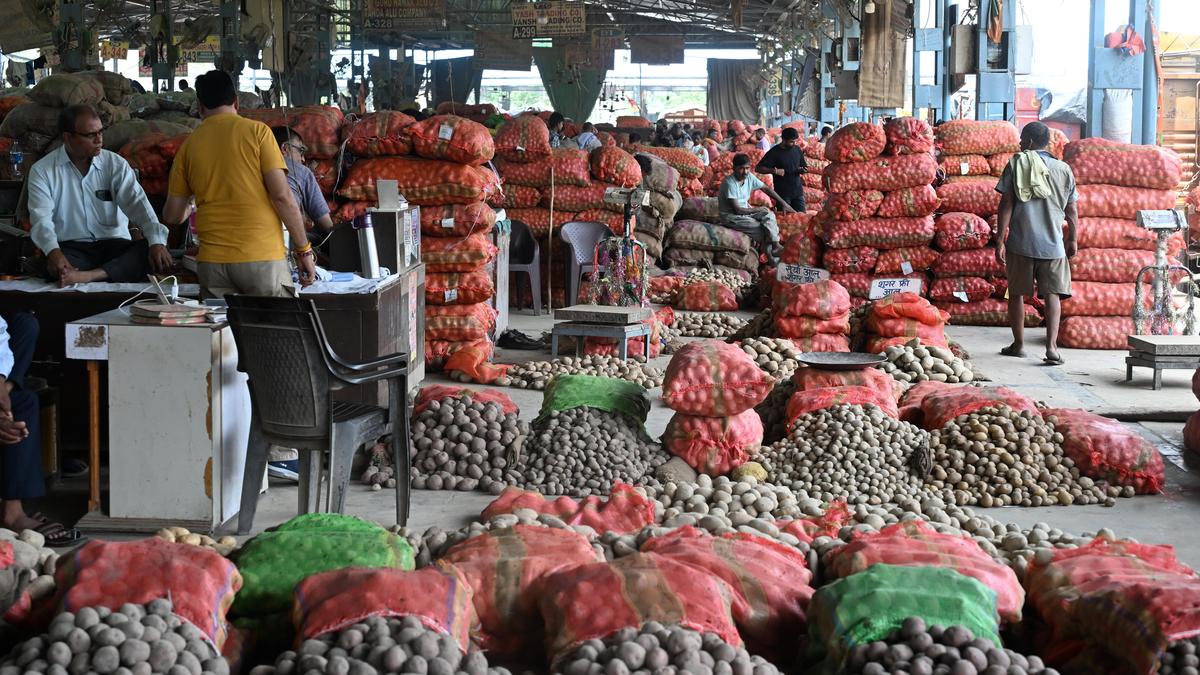
According to the supplied report, India’s wholesale inflation reached 12.3% in October 2026, its second consecutive month in double digits, raising concerns about cost pressures reaching consumers.
Image: The Hindu
Why in news
The Hindu reports that wholesale inflation data released on November 16, 2026 showed a sharp October increase, while retail inflation had also crossed the reported upper comfort mark of 6%. Economists quoted in the report anticipate further consumer-price pressures and a possible monetary-policy tightening.
12.3%
Headline WPI inflation
9.5%
Manufactured-goods inflation
8.3%
WPI food inflation
Nearly 33%
Fuel and power inflation
70.8%
Crude petroleum and natural gas inflation
57.3%
September crude petroleum and natural gas inflation
Background
Inflation is a sustained increase in the general price level, reducing the purchasing power of money. India uses different indices to track prices at different stages: the Wholesale Price Index measures wholesale prices of goods, while the Consumer Price Index measures retail prices of goods and services purchased by households. WPI is compiled by the Office of the Economic Adviser under the Ministry of Commerce and Industry, while CPI is compiled by the National Statistical Office under the Ministry of Statistics and Programme Implementation. Under the RBI Act, the primary objective of monetary policy is to maintain price stability while keeping in mind the objective of growth; the inflation-targeting framework uses CPI rather than WPI.
What the October inflation reading shows
The report identifies fuel as the principal driver of wholesale inflation. Fuel and power inflation increased to nearly 33% in October from about 26% in September, while crude petroleum and natural gas inflation rose to 70.8% from 57.3%.
Price pressures were not confined to energy. Manufactured-goods inflation reached 9.5%, with increases reported across textiles, tobacco products, chemicals, rubber products, metals and electrical equipment. WPI food inflation reached 8.3%, its highest level in 22 months according to the report.
- Energy inflation can raise production, freight and distribution costs across sectors.
- Manufactured-goods inflation indicates pressure beyond volatile food and energy prices.
- WPI food inflation must not be treated as the CPI food inflation rate because the underlying baskets differ.
Infographic
Headline pressure
WPI inflation reported at 12.3% in October 2026.
Energy shock
Fuel and power inflation reached nearly 33%.
Business response
Firms absorb costs or pass them into selling prices.
Consumer impact
Retail transmission is delayed and conditional, not one-to-one.
Policy balance
Contain persistent CPI inflation while limiting growth costs.
Data caution
Account for base effects and the new series’ limited history.
AI-assisted infographic by Pragnya IAS Academy, based on the cited sources.
Why WPI and CPI can move differently
WPI tracks goods at the wholesale stage; CPI tracks the prices households actually pay for goods and services. Differences in coverage, weights and pricing stages mean that an increase in WPI does not produce an identical increase in CPI.
WPI provides information about upstream price pressures but is not identical to a Producer Price Index, which measures prices received by producers. Nor is it a direct measure of household living costs. CPI is more relevant for assessing household purchasing power and is the reference index for India’s inflation-targeting framework.
- Services are included in CPI but excluded from WPI.
- Retail prices also reflect distribution costs, taxes and margins.
- A WPI–CPI gap can indicate delayed transmission, different sectoral movements or changes in business margins.
How wholesale costs reach consumers
Higher energy and material prices increase firms’ production costs. Firms may initially absorb these costs through lower margins, use existing inventories or improve efficiency. If pressures persist, they may raise selling prices, transmitting upstream inflation to consumers.
Pass-through depends on demand, competition, contracts, inventories and pricing power. The report quotes an economist warning that manufactured-goods price increases could feed into core CPI in coming months. This is a conditional assessment, not a fixed or automatic relationship.
- Strong demand and pricing power can make cost pass-through easier.
- Weak demand can constrain price increases and compress margins instead.
- Persistent price increases may influence wage demands and inflation expectations.
The RBI’s inflation–growth dilemma
A supply-driven energy shock raises prices while squeezing real incomes and business margins. Higher interest rates cannot directly increase fuel supply, but they can moderate demand, influence credit conditions and help prevent inflation expectations from becoming unanchored.
Tightening also raises financing costs and can weaken investment and consumption. Conversely, delaying action when inflation becomes broad-based can allow persistent price pressures to take hold, potentially requiring more disruptive tightening later.
The report quotes an economist describing a December rate hike as almost certain. This is a forecast, not an RBI announcement: the Monetary Policy Committee must assess CPI inflation, its outlook, expectations, growth and the transmission of earlier policy actions.
- WPI is an input into inflation analysis, not the monetary-policy target.
- The policy response should distinguish temporary relative-price shocks from persistent generalised inflation.
- Supply-side measures can complement monetary policy without requiring demand suppression alone.
Base effects and limits to interpretation
The report notes that fuel and power prices were in contraction for large parts of 2025. Crude petroleum and natural gas prices had contracted by 7.2% in October 2025. A weak comparison base can therefore magnify the current year-on-year inflation rate; it does not, by itself, establish the scale of the latest month-on-month price increase.
According to the report, the new WPI series has data only from April 2024. The October reading can therefore be described as the highest since at least that point within the reported series, not as an unrestricted historical record.
There is also an internal precision discrepancy: the headline and opening paragraph report 12.3%, while one quoted economist cites 12.39%. This analysis follows the headline figure; the exact figure should be checked against the official release.
- A fall in inflation means slower price increases, not necessarily falling prices.
- Long-run comparisons require a consistent or officially linked statistical series.
- The supplied report does not provide the exact October CPI inflation rate.
| Dimension | WPI | CPI |
|---|---|---|
| Pricing stage | Wholesale prices | Retail prices paid by households |
| Coverage | Goods | Goods and services |
| Compiling authority | Office of the Economic Adviser, Ministry of Commerce and Industry | National Statistical Office, Ministry of Statistics and Programme Implementation |
| Main analytical use | Tracking wholesale price movements and upstream pressures | Tracking consumer inflation and household purchasing-power pressures |
| Monetary-policy role | Supplementary indicator | Reference index for inflation targeting |
| Relationship with producer prices | Not identical to a Producer Price Index | Measures consumer prices, not producer realisations |
- 1. Energy and raw-material prices rise.
- 2. Production, transport and distribution costs increase.
- 3. Firms absorb costs, improve efficiency or draw down inventories.
- 4. Persistent pressures encourage price increases where demand and pricing power permit.
- 5. Retail goods prices rise, potentially adding to core CPI inflation.
- 6. The MPC assesses persistence, expectations and growth before deciding its response.
April 2024
Starting point of the new WPI series data described in the report.
October 2025
Crude petroleum and natural gas prices contracted by 7.2%, creating a weak comparison base.
September 2026
Fuel and power inflation was about 26%; crude petroleum and natural gas inflation was 57.3%.
October 2026
Headline wholesale inflation reached 12.3%, the second consecutive double-digit reading.
November 16, 2026
October wholesale inflation data were released, according to the report.
Significance, challenges & way forward
Significance
- Broadening wholesale price pressures can signal future consumer inflation even when pass-through is delayed.
- Higher consumer prices erode real purchasing power, particularly for households with limited savings.
- Rising input costs can weaken profitability and investment when firms cannot fully pass them on.
- The episode illustrates why inflation analysis must combine headline readings with sectoral composition and base effects.
Challenges
- Interest-rate policy cannot directly resolve fuel shortages or geopolitical supply disruptions.
- Excessive tightening can weaken consumption and investment while firms are already facing cost pressures.
- Insufficient action can allow inflation expectations and repeated price adjustments to become entrenched.
- Uncertain pass-through makes the timing and magnitude of future CPI inflation difficult to infer from WPI alone.
- The limited reported history of the new WPI series constrains long-run comparisons.
Way forward
- Base monetary-policy decisions on the CPI outlook, inflation expectations and growth conditions rather than mechanically responding to WPI.
- Monitor sectoral price momentum, business margins and retail pass-through to identify whether inflation is becoming persistent.
- Address food and logistics bottlenecks through better supply management and distribution.
- Evaluate targeted relief for vulnerable households while preserving fiscal space and avoiding broad demand stimulus.
- Strengthen energy diversification and efficiency to reduce exposure to external fuel-price shocks.
- Publish clear methodological notes and comparable historical data where feasible to improve interpretation of the new WPI series.
Key terms
- Cost-push inflation
- Inflation arising from higher production costs, such as energy, wages or raw materials.
- Price pass-through
- The extent and speed with which changes in input costs are reflected in selling prices.
- Core inflation
- An analytical measure commonly calculated by excluding food and fuel from headline consumer inflation.
- Base effect
- The influence of the comparison-period price level on the current measured inflation rate.
- Second-round effects
- Further inflation arising when an initial price shock influences wages, expectations and subsequent pricing decisions.
- Disinflation
- A decline in the inflation rate, which does not necessarily mean a decline in the price level.
- Producer Price Index
- An index measuring changes in prices received by producers, conceptually distinct from wholesale and consumer price indices.
Link with static syllabus
Prelims practice MCQs
Q1. With reference to price indices in India, consider the following statements: 1. WPI covers goods but excludes services. 2. CPI includes both goods and services. 3. WPI is the reference index for India’s inflation-targeting framework. Which of the statements given above are correct?
Q2. A high year-on-year fuel inflation rate partly attributed to a low base necessarily establishes which of the following?
Q3. Consider the following statements about wholesale-to-retail price transmission: 1. Firms may absorb higher input costs through lower profit margins. 2. Weak demand may constrain firms’ ability to raise selling prices. 3. Every increase in WPI must immediately produce an identical increase in CPI. Which of the statements given above are correct?
Q4. Which of the following best explains the role of monetary tightening during a supply-driven inflation episode?
Mains practice questions
GS 3 · 15 marks · 250 words
Explain how rising wholesale prices can influence consumer inflation. Discuss the monetary-policy trade-off posed by fuel-led inflation in India.
Frequently asked questions
Does WPI inflation of 12.3% mean household expenses rose by the same amount?
No. WPI measures wholesale goods prices, whereas household expenses depend on retail goods and services prices and individual spending patterns.
Does high wholesale inflation automatically require an RBI rate hike?
No. The MPC assesses the CPI outlook, inflation persistence, expectations and growth; WPI informs that assessment but does not mechanically determine the policy rate.
Why can wholesale inflation rise sharply because of a base effect?
A low price level in the corresponding period of the previous year can make the current year-on-year increase appear especially large. This does not necessarily indicate an equally sharp increase over the preceding month.
Can interest-rate increases solve fuel-led inflation?
They cannot directly increase fuel supply, but can restrain demand and limit second-round inflation. Supply-side and energy-security measures remain important.
Sources
- The Hindu: Wholesale inflation rises to 12.3% in October 2026, second straight month of double-digit inflation
Analysis prepared by the Pragnya IAS Academy current-affairs desk with AI assistance from the cited reports. Verify figures with the original sources.
Turn current affairs into marks
Join Pragnya IAS Academy's mentorship for daily answer-writing evaluation on stories like this — classroom programmes from a trusted name in IAS coaching in Hyderabad.