
Delhi-NCR Air Pollution: Airshed Governance, Coordinated Enforcement and Accountability
Revise the static topic: UPSC Environment notes
In short: The Centre has directed Delhi-NCR agencies to strengthen coordinated pollution enforcement through secretary-level oversight, weekly reporting to the Commission for Air Quality Management and technology-backed field inspections. The directions seek to address implementation failures, but sustained improvement requires year-round, airshed-based emission reduction rather than dependence on winter emergency restrictions.
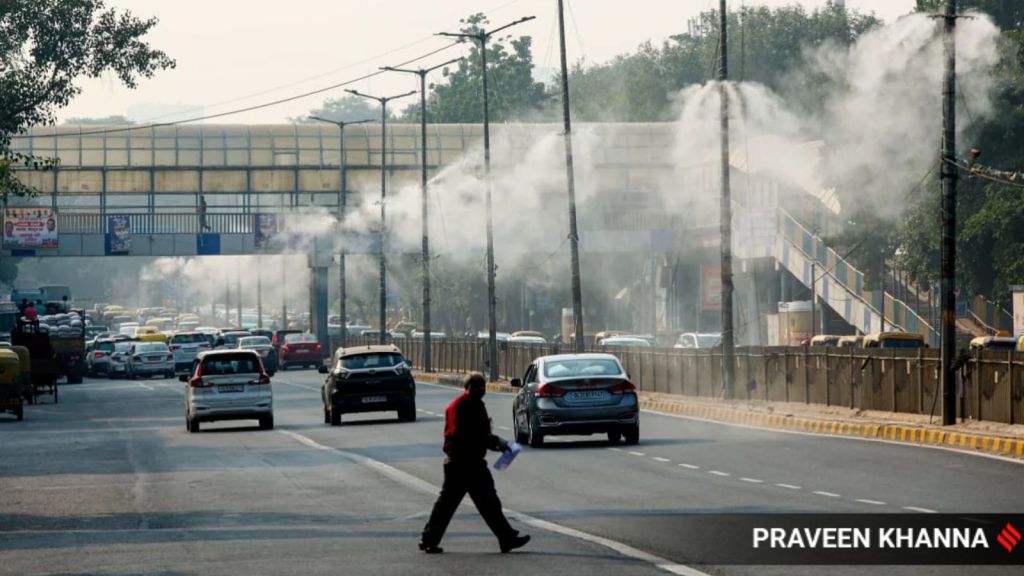
Reference view of water sprinklers at ITO in New Delhi for pollution control. Such local measures cannot substitute for sustained, airshed-wide emission reductions.
Image: Indian Express
Why in news
At a review meeting on November 14, 2026, Union Environment Minister Bhupender Yadav directed Delhi, Haryana, Uttar Pradesh and Rajasthan to ensure time-bound pollution enforcement. The measures include action against non-compliant industries and polluting vehicles, road-dust mitigation and direct accountability of implementing officials.
191
Non-compliant industries ordered to be sealed
3,221 km
Roads redeveloped
5,480 km
Road redevelopment target
233
Identified NCR congestion points
154
Delhi border entries targeted for free-flow systems
Over 3,000
Active construction and demolition sites requiring inspection
Background
Air pollution is a transboundary environmental externality: emissions generated in one jurisdiction can affect people elsewhere through atmospheric transport and chemical transformation. An airshed is a geographical area whose air quality is linked by shared meteorology and pollutant movement, rather than administrative boundaries. Delhi-NCR therefore requires coordination across transport, industry, construction, municipal services and agricultural residue management. The Commission for Air Quality Management in National Capital Region and Adjoining Areas provides a statutory platform for regional coordination, while the Central Pollution Control Board, State Pollution Control Boards, Delhi Pollution Control Committee and implementing agencies retain important regulatory and operational functions.
What the Centre has directed
State governments were directed to nominate secretary-level officials for seven cities in Haryana, four in Uttar Pradesh and four in Rajasthan. These officials are to undertake field visits and report weekly to CAQM; the Commission was also requested to issue notices to non-performing officers.
CPCB was directed to immediately seal 191 non-conforming polluting industries that had neither installed air pollution control devices nor placed orders despite repeated directions. These are reported enforcement directions, not confirmation that every unit has already been sealed.
The vehicle-related directions require Automatic Number-plate Recognition cameras at fuel stations, linked with VAHAN and Pollution Under Control Certificate databases. The report states that CAQM would initiate criminal prosecution against delinquent Transport Department officials after November 30 for failure to comply with the installation direction.
- Integrated Command and Control Centres are to support real-time monitoring using sensors, cameras and satellite inputs alongside physical inspections.
- Road-owning agencies must prioritise potholes, damaged footpaths, central verges and end-to-end paving under the CAQM framework.
- Immediate action was directed at identified congestion points, alongside fresh state-level assessments.
- The Municipal Corporation of Delhi was asked to complete multi-lane free-flow systems at specified Delhi border entry points by December 31.
- NCR States were asked to adopt Delhi's hotspot-focused winter action approach and strictly implement GRAP.
Infographic
Airshed planning
Match action to pollutant movement, not only administrative boundaries.
Shared responsibility
Coordinate States while assigning clear departmental and municipal duties.
Verified enforcement
Connect digital detection with inspections, lawful action and rechecks.
Structural source control
Sustain action on industry, transport, dust, waste and crop residues.
Emergency protection
Use GRAP as a backstop, not a substitute for year-round reform.
AI-assisted infographic by Pragnya IAS Academy, based on the cited sources.
Why the airshed, not the city boundary, is the appropriate unit
A city can strengthen local enforcement yet continue to experience pollution transported from outside its limits. Conversely, local emissions can impose costs on neighbouring jurisdictions. Winter conditions that restrict atmospheric dispersion can intensify the accumulated regional pollution burden.
Airshed management aligns emission inventories, monitoring, source assessment and sectoral action across connected territories. NCR-wide enforcement is therefore necessary, but a comprehensive approach must also account for relevant upwind sources beyond NCR where they affect its air quality.
The reported CAQM field visits to Punjab on crop-residue management illustrate the regional dimension. However, identifying regional sources must not become an excuse for neglecting local road dust, industrial emissions, traffic and open burning.
- Administrative boundaries determine responsibility, while atmospheric evidence should guide the geographical scope of action.
- Common monitoring protocols and shared data can reduce conflicting assessments across States.
- Coordinated standards can limit the incentive to shift polluting activities into less strictly regulated neighbouring jurisdictions.
- Joint regional goals should be translated into clearly assigned state, municipal and departmental duties.
Accountability must combine enforcement with institutional capacity
The secretary-level oversight model seeks to close the gap between issuing plans and delivering results. The reported Gurugram case, involving inspections, an engineer's suspension and steps towards prosecution, shows that official non-performance is being treated as an enforcement concern rather than merely an administrative delay.
Accountability is credible only when an officer's legal duty, authority, resources and specific failure are demonstrable. A direction to initiate prosecution is not a finding of guilt; applicable statutory requirements, approvals and judicial processes must be followed.
Technology can improve detection and traceability, but a dashboard is not proof of compliance. Camera records, database matches and citizen complaints should lead to verified inspections, legally sound action and confirmation that the violation has actually been remedied.
- Articles 48A and 51A(g) provide constitutional foundations for environmental protection by the State and citizens.
- Judicial interpretation of Article 21 links environmental quality with the right to life.
- The Air (Prevention and Control of Pollution) Act and the CAQM Act provide important statutory foundations for air-quality regulation.
- Responsibility should extend across the implementation chain rather than falling only on the lowest-level field officer.
- Performance assessment should distinguish delayed works, defective maintenance, persistent violations and verified emission reductions.

An explainer on how the Central Pollution Control Board calculates the Air Quality Index (AQI). Air-quality reporting complements, but does not replace, monitoring of emissions and enforcement performance.
Image: Times of India
Why emergency curbs cannot substitute for structural reform
GRAP is a graded emergency-response framework for worsening air quality. Restrictions on construction, traffic-related measures and work-from-home arrangements can reduce some immediate pressures, but they do not replace sustained reductions in emissions from transport, industry, waste burning, road dust and crop-residue burning.
The incomplete road redevelopment programme demonstrates why infrastructure and maintenance matter alongside prohibitions. Dust suppression without timely waste removal, road repairs and effective management of construction material can leave the underlying source largely intact.
The supplied Times of India material provides only a headline referring to odd-even restrictions and cloud seeding, not substantive evidence about their outcomes. Any such intervention should therefore be assessed through transparent evidence of feasibility, exposure reduction, costs and unintended effects rather than treated as a proven substitute for source control.
- Retain emergency measures as a protective backstop while reducing baseline emissions throughout the year.
- Evaluate traffic interventions alongside public transport availability and effects on congestion and travel demand.
- Support industrial compliance through reliable monitoring, appropriate control equipment and verified operation.
- Make crop-residue management operationally viable through machinery access and dependable residue-use arrangements.
- Judge success by sustained reductions in pollution and exposure, not merely the number of restrictions announced.
| Dimension | Short-term emergency response | Year-round airshed management |
|---|---|---|
| Primary purpose | Limit deterioration during pollution episodes | Reduce the underlying regional emissions burden |
| Trigger | Worsening air quality and applicable GRAP provisions | Persistent source contributions and planned compliance obligations |
| Typical tools | Temporary restrictions, hotspot enforcement and work-from-home measures | Cleaner production, transport reform, dust control and residue management |
| Geographical approach | Immediate operational action in affected areas | Coordination across linked upwind and downwind jurisdictions |
| Accountability | Timely activation and implementation of curbs | Verified compliance, infrastructure delivery and sustained emission reduction |
| Principal limitation | Cannot permanently remove structural pollution sources | Requires durable coordination, finance, capacity and credible monitoring |
- 1. Combine sensor, camera, satellite and citizen inputs through command-and-control systems.
- 2. Identify the suspected source and assign the competent implementing agency.
- 3. Verify the violation through field inspection and relevant records.
- 4. Undertake corrective or coercive action under applicable law.
- 5. Report progress through designated officials to CAQM.
- 6. Reinspect and assess whether compliance and pollution reduction are sustained.
October 30, 2026
CPCB directed the relevant State Pollution Control Boards and Delhi Pollution Control Committee to act against industries that had neither installed air pollution control devices nor placed orders.
November 3, 2026
Following a hearing, CAQM directed the Municipal Corporation of Gurugram Commissioner to file a complaint against an engineer over implementation lapses.
November 4, 2026
Haryana's Department of Urban Local Bodies suspended the engineer.
November 12, 2026
The Gurugram municipal commissioner sought examination of applicable provisions and appropriate prosecution proceedings after necessary approvals.
November 14, 2026
The Union Environment Minister reviewed Delhi-NCR pollution control and directed coordinated enforcement and secretary-level accountability.
After November 30, 2026
The reported direction envisages prosecution against delinquent Transport Department officials for failure to comply with the ANPR installation requirement.
December 31, 2026
Deadline set for the Municipal Corporation of Delhi to complete multi-lane free-flow systems at the specified border entry points.
Significance, challenges & way forward
Significance
- Regional coordination recognises that effective pollution control must follow atmospheric linkages rather than stop at state boundaries.
- Named senior officials and weekly reporting can make implementation responsibilities more visible and traceable.
- Integrated monitoring can strengthen enforcement against dispersed and recurring sources of pollution.
- Road repairs, congestion management and waste tracking connect clean-air policy with the quality of everyday urban governance.
- Verified compliance can protect public health while reducing the competitive disadvantage faced by law-abiding enterprises.
Challenges
- Overlapping responsibilities among regulators, municipalities, transport departments and road-owning agencies can obscure ownership of failures.
- Staffing, equipment, finance and procurement constraints can prevent directions from translating into timely field action.
- Punitive oversight without clear duties and due process can encourage defensive reporting rather than genuine problem-solving.
- Database errors and incomplete monitoring coverage can weaken technology-led enforcement unless findings are independently verified.
- Emergency restrictions can impose disproportionate burdens on workers and small enterprises without addressing persistent emission sources.
- Weather-related changes in pollution complicate assessment of how much improvement is attributable to enforcement.
Way forward
- Prepare a shared airshed strategy linking regional emission sources with clearly assigned state and sectoral responsibilities.
- Pair weekly compliance reporting with public disclosure of pending violations, corrective action and verified closure.
- Provide implementing agencies with adequate staff, equipment and funds while making persistent, demonstrable negligence accountable under law.
- Prioritise year-round industrial compliance, public transport, road maintenance, waste processing and practical crop-residue management.
- Use interoperable digital systems with data-quality checks, access safeguards and channels to contest erroneous enforcement.
- Assess outcomes through sustained air-quality and exposure trends, interpreted alongside meteorological conditions and source evidence.
- Retain GRAP as an emergency safeguard while reducing the frequency and severity of episodes that require its activation.
Key terms
- Airshed
- A geographical area with interconnected air quality because of shared atmospheric circulation, pollutant transport and transformation.
- Transboundary externality
- A cost or benefit generated in one jurisdiction that affects people or activities in another.
- CAQM
- The statutory Commission for Air Quality Management in National Capital Region and Adjoining Areas, established for coordinated regional air-quality management.
- GRAP
- The Graded Response Action Plan, which provides escalating measures to respond to deteriorating air quality in Delhi-NCR.
- ANPR
- Automatic Number-plate Recognition technology that reads vehicle registration plates for identification and database-linked checks.
- PUCC
- A Pollution Under Control Certificate recording a vehicle's compliance with prescribed emission-testing requirements.
- APCD
- An air pollution control device used to capture or reduce pollutants from an emission source.
- Source apportionment
- Scientific assessment of the contributions made by different sources to observed air pollution.
Link with static syllabus
Prelims practice MCQs
Q1. With reference to airshed-based pollution management, consider the following statements: 1. An airshed must coincide with the administrative boundary of a State. 2. Pollutant transport can make coordination between upwind and downwind jurisdictions necessary. 3. Regional coordination eliminates the need for local enforcement. Which of the statements given above is/are correct?
Q2. Consider the following pairs: 1. Article 48A: Environmental protection as a Directive Principle of State Policy 2. Article 51A(g): A citizen's fundamental duty relating to the natural environment 3. Article 21: A provision directly establishing the Commission for Air Quality Management Which of the pairs given above are correctly matched?
Q3. With reference to the pollution-control technologies mentioned in the Centre's review, consider the following statements: 1. ANPR cameras can support vehicle identification through registration plates. 2. Linking ANPR with VAHAN and PUCC databases can support compliance checks. 3. Installing ANPR cameras itself physically removes pollutants from vehicle exhaust. Which of the statements given above is/are correct?
Q4. Which of the following best describes the relationship between GRAP and long-term air-quality management?
Mains practice questions
GS 3 · 15 marks · 250 words
Air pollution governance must follow airsheds rather than administrative boundaries. Evaluate the role of inter-state coordination and enforcement accountability in Delhi-NCR, highlighting the limitations of emergency measures.
Frequently asked questions
Why is Delhi's air pollution not solely a Delhi government issue?
Pollutants can travel across state boundaries, making Delhi's air quality partly dependent on regional emissions and atmospheric conditions. Delhi nevertheless remains responsible for controlling sources within its own jurisdiction.
Have all the identified industries already been sealed?
The supplied reports state that CPCB was directed to immediately seal 191 non-compliant industries. They do not establish that sealing of every identified unit had been completed.
Can technology replace field inspections?
No. Sensors, cameras and database integration can flag suspected violations, but inspections and record verification remain necessary for credible enforcement and confirmation of compliance.
Is GRAP sufficient to deliver lasting clean air?
No. GRAP addresses worsening pollution through graded responses, while lasting improvement requires year-round reductions in emissions and better infrastructure, maintenance and regional coordination.
Sources
- The Hindu: Air pollution does not recognise State boundaries, coordinated action required: Union Minister
- Indian Express: Centre asks states to fix officers to track pollution curbs, seals 191 units
- Times of India: From odd-even to cloud seeding: Why Delhi's pollution battle remains unfinished
Analysis prepared by the Pragnya IAS Academy current-affairs desk with AI assistance from the cited reports. Verify figures with the original sources.
Turn current affairs into marks
Join Pragnya IAS Academy's mentorship for daily answer-writing evaluation on stories like this — classroom programmes from a trusted name in IAS coaching in Hyderabad.