
Starship’s Orbital Return and Tower Catch: Reusability, Re-entry and Launch Economics
Revise the static topic: UPSC Science & Technology notes
In short: According to The Hindu, SpaceX’s Starship upper-stage spacecraft returned from orbit and was caught by its launch-tower arms at Starbase, Texas, on November 14, 2026. However, the Super Heavy booster was lost, making this a spacecraft-recovery milestone rather than a successful recovery of the entire launch system. Its economic significance depends on whether recovered vehicles can be inspected, refurbished and reflown reliably at low cost.
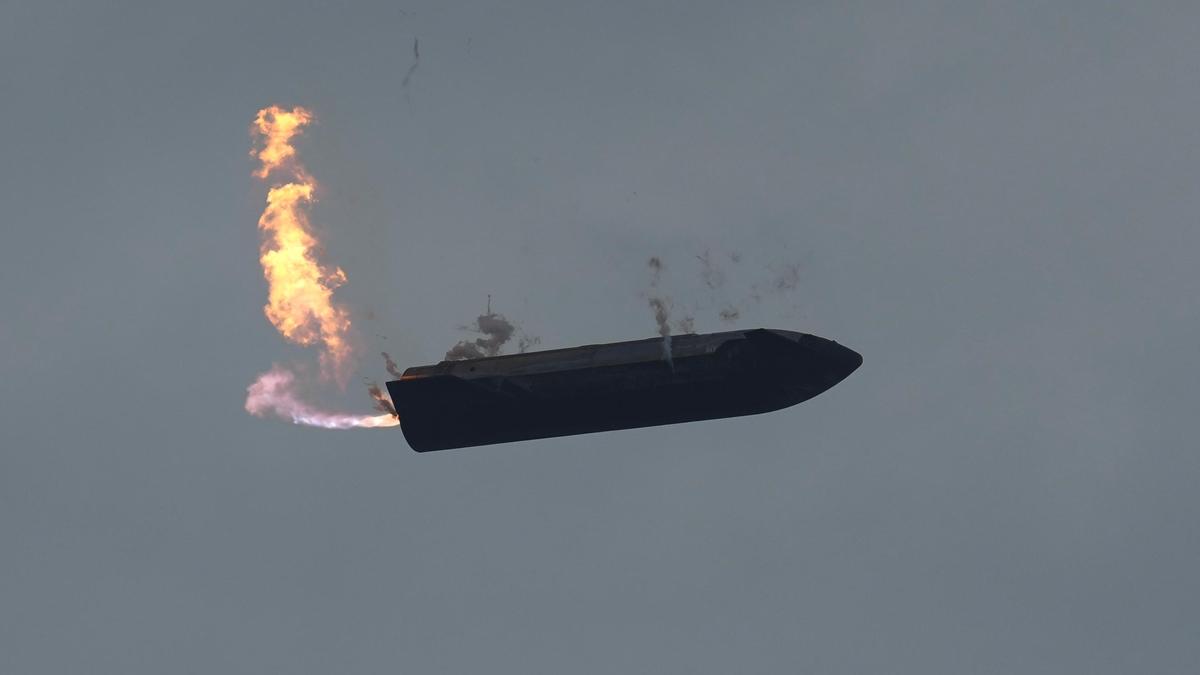
The Hindu reports Starship’s upper-stage return and capture by launch-tower arms at Starbase, Texas. The Super Heavy booster was lost, so this was not a recovery of the complete launch system.
Image: The Hindu
Why in news
The reported flight achieved Starship’s first tower catch after an orbital mission, following satellite deployment and an extended orbital flight. The planned recovery of both stages failed because the Super Heavy booster was diverted over the Gulf of Mexico and destroyed.
22 hours
Reported launch-to-return duration
14
Orbits completed
26
Starlink satellites deployed
265 kilometres
Reported orbital altitude
15th
Full-scale Starship test flight
3
Previous Super Heavy tower catches
Background
A conventional expendable launch vehicle discards major hardware after use. Reusable launch systems seek to recover valuable stages or spacecraft and fly them again, spreading manufacturing costs across multiple missions. SpaceX’s Starship system comprises the Super Heavy first-stage booster and the Starship upper-stage spacecraft, which also carries payloads. Recovering an orbital upper stage is particularly demanding because it must dissipate orbital energy, survive atmospheric heating and retain sufficient control for landing. Reuse itself is not new; the reported novelty is Starship’s own return from orbit to a launch-tower catch.
What succeeded—and what did not
The Hindu reports that the upper-stage Starship reached orbit, deployed Starlink satellites and returned to Starbase for an upright, engine-controlled descent into the tower’s mechanical arms. SpaceX said the spacecraft’s systems, including its heat shield, appeared to function well; this remains an initial company assessment rather than evidence of completed post-flight inspection.
The Super Heavy booster had a different outcome. According to SpaceX’s account cited in the report, its engines stopped firing too early during descent. Its guidance system detected an unsuitable position, diverted it over the Gulf of Mexico and initiated destruction. Engineers were still investigating the underlying cause.
SpaceX described the spacecraft catch as demonstrating full reusability. The more precise assessment is that it demonstrated a critical recovery capability for the upper stage. This flight neither recovered both stages nor demonstrated the subsequent reuse of the recovered spacecraft.
- Starship can refer to the complete launch system or its upper-stage spacecraft; distinguish these meanings in an examination answer.
- Earlier Super Heavy catches establish prior booster-recovery experience, not success of the booster on this flight.
- Recovery, refurbishment, reflight and routine rapid reuse are separate technological and operational milestones.
Infographic
Reported achievement
Upper-stage orbital return and launch-tower catch.
Critical distinction
Super Heavy was lost; both stages were not recovered.
Engineering chain
Thermal protection, guidance and precise powered descent.
Next proof
Inspect, refurbish and repeatedly refly recovered hardware.
Economic test
Lower lifecycle cost with reliable payload delivery.
India’s lesson
Pursue incremental capability matched to demand and safety.
AI-assisted infographic by Pragnya IAS Academy, based on the cited sources.
How orbital re-entry and precision recovery work
An orbiting spacecraft remains in continuous free fall around Earth because of its horizontal velocity. A controlled deorbit manoeuvre changes its trajectory so that it encounters denser atmosphere. Aerodynamic drag removes energy, while compression and shock heating of the surrounding gas create severe thermal loads; describing re-entry heating as friction alone is incomplete.
Thermal protection must limit heat reaching the vehicle’s structure and internal systems. Guidance and aerodynamic control manage orientation and trajectory through atmospheric descent. For a tower catch, the spacecraft must then achieve a precisely controlled powered descent, with acceptable position, speed and attitude relative to the catch mechanism.
The tower arms support the vehicle after engines have reduced its descent speed sufficiently. They do not replace atmospheric braking, heat shielding or powered landing control. A return from orbital flight generally presents a more demanding energy-management and thermal-protection problem than recovery of a booster that has separated before reaching orbital velocity.
- Thermal protection addresses heat exposure; guidance, navigation and control address trajectory and orientation.
- Recovery requires the launch vehicle and ground infrastructure to function as an integrated system.
- Abort and diversion capability is essential when a safe approach to the tower cannot be maintained.
Launch economics: why recovery is necessary but insufficient
Reusability can reduce the need to manufacture expensive flight hardware for every mission. However, the relevant economic measure is the total cost of reliably delivering payloads, not merely whether a vehicle returns intact. Inspection, refurbishment, propellant, ground operations, infrastructure maintenance and vehicle losses all affect the result.
Recovery also imposes trade-offs. Thermal protection and recovery hardware add mass, while manoeuvres and landing require propellant that might otherwise support payload delivery. A tower-catch architecture can shift part of the recovery function to ground infrastructure, but it also places valuable launch facilities close to a returning vehicle.
The mission combined operational satellite deployment with a recovery test. This shows how a launch programme can serve payload demand while gathering development data, but the supplied reports do not establish a verified cost per launch or cost per unit of payload. Projected launch frequency should therefore be treated as an ambition, not demonstrated capacity.
- Higher flight frequency can spread fixed costs, provided demand, reliability and infrastructure capacity support it.
- A recovered vehicle delivers savings only if making it flight-ready costs less than the hardware and operations it replaces.
- Booster loss and potential damage to launch infrastructure can offset savings from successful spacecraft recovery.
- The durability and maintenance burden of the heat shield are central to upper-stage reuse economics.
Strategic implications: lunar missions and lessons for India
NASA has selected Starship for a lunar-landing role under Artemis. Nevertheless, an Earth-return catch does not demonstrate lunar-mission readiness. The source identifies orbital propellant transfer as a major outstanding objective; docking, mission integration and human-spaceflight safety also require distinct validation.
For India, the relevant lesson is to develop reusable-launch capabilities through staged testing rather than equating a dramatic recovery with an operational transport system. ISRO’s reusable-launch technology work provides a static syllabus connection, particularly in autonomous guidance, thermal protection and landing technologies.
India’s approach should be driven by mission requirements, achievable launch demand and lifecycle costs. Reusability is an engineering and economic choice, not a universal substitute for expendable launchers or a reason to copy a particular recovery architecture.
- Strengthen domestic capabilities in reusable thermal protection, propulsion and autonomous flight control.
- Assess recovery architectures against geography, safety corridors, infrastructure and payload requirements.
- Treat lunar landing, orbital refuelling and rapid Earth-launch reuse as related but distinct capabilities.
| Aspect | Super Heavy booster | Starship upper-stage spacecraft |
|---|---|---|
| Primary role | Provides initial ascent thrust before separation | Reaches orbit and carries the mission payload |
| Recovery challenge | Return and controlled descent after early separation | Orbital energy dissipation, thermal protection and precision descent |
| Reported outcome | Diverted over the Gulf of Mexico and destroyed | Returned from orbit and caught by launch-tower arms |
| What the evidence establishes | Booster recovery failed on this flight despite earlier successful catches | An orbital-return and tower-catch capability was demonstrated |
| What remains unproven by this flight | Reliable recovery on every attempted mission | Low-cost refurbishment and routine rapid reflight |
- 1. Complete the orbital mission and establish a safe return opportunity.
- 2. Perform a deorbit manoeuvre to intersect the atmosphere.
- 3. Use thermal protection and controlled orientation to withstand atmospheric entry.
- 4. Manage trajectory and reduce speed through aerodynamic descent.
- 5. Use propulsion for precise terminal descent towards the recovery point.
- 6. Capture and secure the vehicle, then inspect it before any proposed reflight.
2021
NASA selected Starship for a lunar-lander role under Artemis, according to the source.
2023
The full-scale Starship flight-test series began.
March 2025
The launch report identifies this as the most recent of the three previous Super Heavy tower catches.
September 2026
According to the launch report, Starship first carried satellites to orbit; the upper stage later splashed down in the Pacific and caught fire.
November 13, 2026
The reported test flight launched from Starbase, deployed satellites and lost its booster during the attempted return.
November 14, 2026
The upper-stage spacecraft reportedly returned from orbit and was caught by the launch tower.
Significance, challenges & way forward
Significance
- The reported catch extends demonstrated Starship recovery capability to the orbital upper stage.
- Upper-stage recovery addresses a major obstacle to reusing the complete launch system.
- Combining payload deployment with recovery testing links technology development to operational demand.
- Reliable reuse could support more frequent satellite deployment and space exploration by reducing hardware replacement.
- The mission highlights the importance of autonomous navigation, thermal protection and integrated ground systems.
Challenges
- The booster failure shows that success in one stage does not establish reliability of the complete system.
- A heat shield that survives one entry may still require substantial inspection or replacement before reuse.
- Recovery propellant and protective hardware can reduce payload available for a given mission.
- Tower-based recovery exposes launch infrastructure to the consequences of landing errors.
- High flight frequency requires sustained demand, rapid maintenance, range availability and regulatory clearance.
- Orbital propellant transfer and other lunar-mission objectives remain separate from Earth-return recovery.
Way forward
- Complete the booster-failure investigation and validate corrective measures through subsequent testing.
- Demonstrate repeated recoveries and reflights of both stages before claiming routine full-system reuse.
- Measure inspection effort, component replacement and turnaround time to assess practical reusability.
- Evaluate launch economics using lifecycle costs and delivered payload rather than recovery success alone.
- Maintain robust exclusion zones, diversion procedures and environmental safeguards for failed recoveries.
- For India, pursue incremental reusable-launch demonstrations aligned with indigenous capabilities and mission demand.
Key terms
- Reusable launch system
- A launch architecture designed to recover and fly again some or all of its major flight hardware.
- Orbital re-entry
- The return of an orbiting vehicle into the atmosphere, requiring control of high energy, heating and aerodynamic loads.
- Thermal protection system
- Materials and structures that protect a spacecraft from damaging heat during atmospheric entry.
- Guidance, navigation and control
- The integrated functions that determine vehicle state, select a flight path and command motion along it.
- Tower catch
- Recovery in which ground-mounted mechanical arms support a returning vehicle after its descent is precisely controlled.
- Rapid reusability
- The ability to return recovered hardware to flight with limited maintenance and short turnaround.
- Orbital propellant transfer
- The transfer of propellant between spacecraft in orbit to enable refuelling or extend mission capability.
- Launch cadence
- The frequency at which a launch system conducts missions.
Link with static syllabus
Prelims practice MCQs
Q1. With reference to the Starship flight reported in November 2026, consider the following statements: 1. The upper-stage spacecraft returned from orbit and was caught by launch-tower arms. 2. Both the upper stage and the Super Heavy booster were successfully recovered on this flight. 3. Successful recovery alone establishes that the recovered spacecraft can be reflown economically. Which of the statements given above is/are correct?
Q2. Consider the following statements about atmospheric re-entry: 1. Compression and shock heating of the surrounding gas contribute to severe thermal loads. 2. A thermal protection system removes the need for guidance and attitude control. 3. Recovery of an orbital upper stage generally requires managing greater entry energy than recovery of a booster separating before orbital velocity. Which of the statements given above are correct?
Q3. With reference to reusable launch economics, consider the following statements: 1. Recovery-related propellant requirements can reduce payload capability. 2. Inspection and refurbishment expenditure affects the savings from reuse. 3. Launch frequency influences how fixed infrastructure costs are distributed across missions. Which of the statements given above are correct?
Q4. Which one of the following best explains the role of mechanical arms in a launch-tower catch?
Mains practice questions
GS 3 · 15 marks · 250 words
Recovery is a technological milestone, while rapid reusability is an operational and economic capability. Discuss in the context of Starship’s reported orbital return and tower catch. What lessons does it offer India?
Frequently asked questions
Did the entire Starship launch system return successfully?
No. The source reports a successful catch of the upper-stage spacecraft, while the Super Heavy booster was diverted over the Gulf of Mexico and destroyed.
Why is an orbital spacecraft catch more than a landing demonstration?
It requires successful orbital return, thermal protection, atmospheric control and precise powered descent before the tower can capture the vehicle. Each is a distinct part of the recovery chain.
Does the catch prove that Starship launches are now cheaper?
No verified launch-cost reduction is established by the supplied reports. Savings depend on repeated reuse, refurbishment needs, payload capability, reliability and launch frequency.
Does this establish readiness for a crewed lunar landing?
No. Lunar operations require additional demonstrations, including orbital propellant transfer, docking and mission-specific safety validation.
Sources
- The Hindu: SpaceX’s Starship returns from orbit and is captured by launch pad arms in a dramatic first
- The Hindu: SpaceX launches 15th Starship flight with hopes of achieving first round trip
Analysis prepared by the Pragnya IAS Academy current-affairs desk with AI assistance from the cited reports. Verify figures with the original sources.
Turn current affairs into marks
Join Pragnya IAS Academy's mentorship for daily answer-writing evaluation on stories like this — classroom programmes from a trusted name in IAS coaching in Hyderabad.