
Electoral Roll Integrity: Duplicate EPICs, Form 6 and Safeguards Against Exclusion
Revise the static topic: UPSC Polity notes · UPSC Governance notes
In short: The Hindu has reported duplicate electoral-roll entries and multiple voter IDs linked to individuals in Karnataka’s Mahadevapura constituency after Special Intensive Revision. A separate Times of India headline reports that the Election Commission permits Form 6 for re-inclusion in electoral rolls. Together, these developments highlight the need to remove duplicate enrolment without excluding eligible voters or treating identifier discrepancies as proof of fraudulent voting.
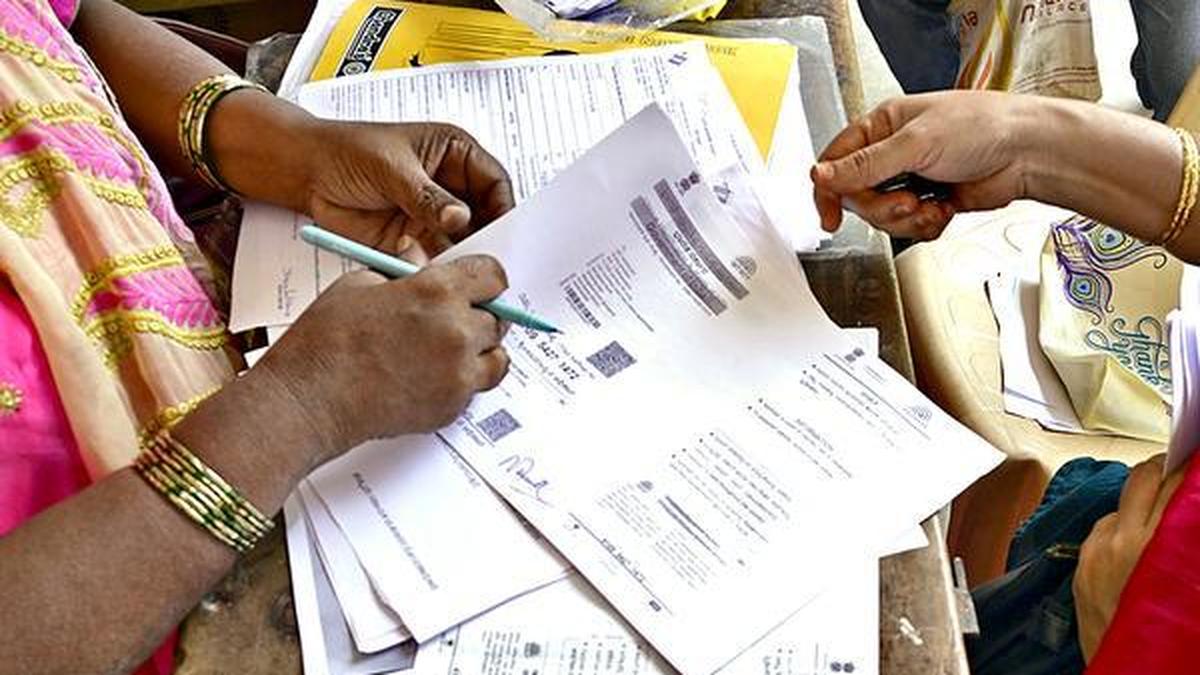
Photo from the source report: Electoral Roll Integrity: Duplicate EPICs, Form 6 and Safeguards Against Exclusion
Image: The Hindu
Why in news
The Hindu reported 803 voter IDs linked to 397 people in Mahadevapura after Special Intensive Revision, including entries across constituencies. Karnataka’s Chief Electoral Officer’s office said the flagged cases would be verified and that it had received no formal complaints about duplicate entries.
803
Voter IDs linked to 397 people, as reported
397
People linked to the reported voter IDs
7
Reported cross-constituency same-EPIC cases
14
Roll entries associated with those seven EPIC numbers
Background
The Election Commission of India exercises constitutional supervision over the preparation of electoral rolls under Article 324. Article 326 establishes adult suffrage for elections to the Lok Sabha and State Legislative Assemblies, subject to constitutional and legal qualifications. The Representation of the People Act, 1950 governs electoral registration, including ordinary residence, inclusion, correction and deletion. Electoral Registration Officers decide registration matters within this framework. An Elector’s Photo Identity Card is an identification document; possession of the card alone does not establish a current entitlement to vote, which depends on enrolment in the relevant electoral roll and applicable legal conditions.
What the reporting establishes—and what it does not
The Hindu identified two types of anomalies after the revision: the same EPIC number appearing in electoral-roll entries across constituencies, and individuals appearing with multiple EPIC numbers. Matching particulars such as relatives’ names, age and address strengthen the need for verification, but an official determination is still required.
The report also describes a voter whose name was deleted from the draft roll and who subsequently appeared twice in the final rolls after making two Form 6 applications. This illustrates how a corrective inclusion process can itself generate duplication if applications and existing records are not reconciled.
These findings concern registration records. They do not, by themselves, establish impersonation, multiple voting or manipulation of an election result. Political allegations mentioned in the report must remain distinct from verified administrative findings.
- The CEO’s office acknowledged the need to verify flagged cases rather than confirming every reported entry as a proven duplicate.
- The absence of a formal complaint does not establish that the electoral roll is error-free.
- The report’s different counts should not be added together because their units and possible overlap are not sufficiently clear.
Infographic
Identify correctly
Separate identifier collisions from duplicate enrolment.
Verify eligibility
Check identity, ordinary residence and existing records.
Protect due process
Use applicable notice, hearing and reasoned decisions.
Reconcile re-inclusion
Link Form 6 applications with earlier and pending records.
Ensure accountability
Maintain audit trails, accessible remedies and privacy safeguards.
AI-assisted infographic by Pragnya IAS Academy, based on the cited sources.
Duplicate identifiers are not the same as duplicate enrolment
An EPIC number is an identifier attached to an electoral record. Duplicate identifiers may reflect an identifier-management error, including the possibility that distinct eligible people share a number. Duplicate enrolment arises when the same person is registered more than once, whether under the same EPIC number or different numbers.
The legal issue is therefore the identity and eligibility of the elector, not merely the uniqueness of the EPIC number. Correcting a number cannot, by itself, remove duplicate enrolment; deleting an entry solely because its number matches another can wrongly exclude a distinct eligible voter.
- The same EPIC number across records should trigger identity verification, not automatic deletion.
- Different EPIC numbers do not prove that the underlying electors are different people.
- Similar names alone are insufficient to establish duplication.
- Multiple cards or entries do not establish that multiple votes were actually cast.
Form 6 re-inclusion: A remedy requiring record reconciliation
The supplied Times of India material contains a headline reporting the Election Commission’s acceptance of Form 6 for re-inclusion. It does not provide the underlying clarification, detailed conditions or procedural directions. The supported conclusion is limited to the reported availability of Form 6 as a re-inclusion route.
Form 6 is used to seek inclusion in the electoral roll. Its acceptance for re-inclusion provides a route for an eligible person whose name is missing to seek registration again, but an application is not automatic restoration. The Electoral Registration Officer must examine eligibility and the relevant records.
The Mahadevapura example demonstrates why repeat applications should be linked to a common case history. Re-inclusion should restore an eligible voter’s effective access to the franchise without creating additional active entries. It should also be distinguished from shifting residence, for which Form 8 is the prescribed application.
- A previously deleted voter should disclose relevant earlier registration details to support reconciliation.
- Repeat applications should be checked against pending applications and existing electoral-roll entries.
- Re-inclusion and an appeal against a deletion order are distinct procedural routes.
- Accessible remedies must accompany efforts to prevent duplicate registration.
Constitutional and statutory responsibilities
Article 324 places electoral-roll preparation under the Election Commission’s superintendence, direction and control, operating within the statutory framework. The Representation of the People Act, 1950 prohibits registration in more than one constituency under Section 17 and repeated registration in the same constituency under Section 18.
Sections 19 and 20 address registration eligibility and ordinary residence. Section 21 governs preparation and revision of rolls; Section 22 deals with correction and deletion; Section 23 addresses inclusion; and Section 24 provides statutory appeals. Where deletion is proposed on residence or entitlement grounds, the applicable safeguards include proper verification and a reasonable opportunity to be heard.
The institutional responsibility is two-sided: prevent multiple registration and protect eligible electors against wrongful exclusion. A duplicate-detection system is therefore an administrative aid, not a substitute for the Electoral Registration Officer’s statutory decision.
- Ordinary residence must be assessed under the law rather than inferred solely from a failed household visit.
- Temporary absence does not, by itself, terminate ordinary residence.
- Adverse decisions should be reasoned, communicated and supported by accessible remedies.
- The right to vote is governed by statute within the constitutional framework of adult suffrage.
Why revision quality depends on both accuracy and inclusion
A revision exercise cannot be judged only by the number of deletions or additions. It must also be assessed by whether eligible electors remain registered, duplicate entries are correctly resolved and grievances receive timely decisions.
Technology can identify suspicious combinations of names, relatives’ names, addresses and identifiers across constituencies. However, common names, transliteration differences, migration and incomplete addresses can produce false matches. Field verification, human adjudication and accountable data handling remain essential.
- Cross-constituency coordination is necessary where apparently linked records fall under different registration authorities.
- Deletion and re-inclusion records should remain traceable through an auditable case history.
- Transparency should reveal procedures and outcomes without unnecessarily exposing personal information.
| Situation | What it establishes | Appropriate response |
|---|---|---|
| Same EPIC number attached to distinct eligible people | An identifier collision, not necessarily duplicate enrolment | Verify identities and correct identifiers while preserving valid enrolment |
| Same person registered in different constituencies | Duplicate enrolment if identity is established | Determine ordinary residence and resolve duplicate registration through lawful procedure |
| Same person registered repeatedly within a constituency | Repeated registration if identity is established | Reconcile records and remove duplicate entries with applicable safeguards |
| One person possesses multiple EPIC cards | Card possession alone does not establish multiple active entries or multiple voting | Check current rolls and issuance history |
| Eligible voter omitted from the roll | A possible inclusion error requiring examination | Facilitate the applicable inclusion or appeal process and verify eligibility |
- 1. Flag potentially linked records through complaints, roll scrutiny or database checks.
- 2. Compare identity particulars, earlier registration details and application histories.
- 3. Verify ordinary residence and coordinate across the relevant registration authorities.
- 4. Provide notice and an opportunity to respond where required before an adverse decision.
- 5. Issue a reasoned decision preserving valid enrolment and correcting identifiers or duplicate entries as appropriate.
- 6. Update linked records, communicate the outcome and explain available remedies.
Draft-roll stage
The Hindu’s reported example concerns a voter whose name was deleted after being marked as permanently shifted.
August 14 and September 18, as reported
The Form 9 report cited by The Hindu recorded two Form 6 inclusion applications by that voter.
Final-roll stage
The voter appeared in two parts of the final roll, illustrating a failure to reconcile repeat inclusion applications.
After anomalies were flagged
The CEO’s office said it was monitoring complaints raised on social media and by political parties and would verify the cases.
Significance, challenges & way forward
Significance
- Accurate electoral rolls protect political equality by preventing multiple registration while retaining eligible electors.
- Accessible re-inclusion procedures can remedy omission without forcing voters to bear the consequences of administrative errors indefinitely.
- Clear distinctions between record anomalies and proven electoral offences improve the quality of public debate.
- Transparent verification and reasoned decisions strengthen confidence in the Election Commission’s neutrality and competence.
Challenges
- Common names, inconsistent spellings and incomplete addresses can cause automated systems to wrongly match different people.
- Multiple applications and poorly linked case histories can recreate duplication during corrective inclusion.
- Migration and temporary absence complicate ordinary-residence verification and can expose mobile voters to exclusion.
- Cross-constituency anomalies require coordination beyond a single polling station or Electoral Registration Officer.
- Unverified allegations and opaque official responses can both deepen distrust.
- Excessive disclosure of personal particulars during public scrutiny can create privacy risks.
Way forward
- Audit identifier collisions separately from duplicate enrolment so that each receives the correct remedy.
- Link inclusion applications, deletion orders and earlier records through an auditable case-management system.
- Use automated matching only to flag cases, with verification and statutory adjudication determining the outcome.
- Require cross-constituency reconciliation before closing cases involving apparently linked registrations.
- Provide accessible notices, assisted application facilities, reasoned decisions and clear appeal information.
- Publish anonymised information on verified errors, corrections and unresolved grievances rather than relying only on aggregate deletion figures.
- Explain publicly that holding an EPIC does not replace the requirement of being enrolled in the relevant electoral roll.
Key terms
- EPIC
- Elector’s Photo Identity Card, an electoral identification document whose possession alone does not establish current enrolment.
- Duplicate identifier
- The same identifier appearing in multiple records, which does not necessarily mean that those records concern the same person.
- Duplicate enrolment
- Registration of the same person more than once in a constituency or in more than one constituency.
- Special Intensive Revision
- An intensive electoral-roll revision exercise involving verification of entries and processing of necessary changes.
- Ordinary residence
- The statutory residence connection used to determine the constituency in which a person is entitled to be registered.
- Electoral Registration Officer
- The statutory authority responsible for preparing and revising electoral rolls and deciding registration matters.
- Form 6
- The application for inclusion in an electoral roll, also reported in the supplied material as permissible for re-inclusion.
- Form 9
- The prescribed list of claims for inclusion, referred to in the source as the report consolidating Form 6 applications.
Link with static syllabus
Prelims practice MCQs
Q1. Consider the following statements: 1. The same EPIC number appearing in two records necessarily proves that one person is enrolled twice. 2. Different EPIC numbers can be associated with duplicate enrolment of the same person. 3. Possession of an EPIC alone establishes a current entitlement to vote even if the holder’s name is absent from the relevant electoral roll. Which of the statements given above is/are correct?
Q2. Consider the following pairs: 1. Article 324 — Superintendence, direction and control of electoral-roll preparation 2. Article 326 — Elections to the Lok Sabha and State Legislative Assemblies on the basis of adult suffrage 3. Representation of the People Act, 1950 — Electoral registration framework Which of the pairs given above are correctly matched?
Q3. With reference to the Representation of the People Act, 1950, consider the following statements: 1. A person cannot be entitled to registration in more than one constituency. 2. A person cannot be entitled to repeated registration in the same constituency. 3. Temporary absence from a place necessarily ends a person’s ordinary residence there. Which of the statements given above are correct?
Q4. An eligible voter previously omitted from an electoral roll submits a Form 6 application for re-inclusion. Which of the following is the most appropriate administrative approach?
Mains practice questions
GS 2 · 15 marks · 250 words
Electoral-roll integrity requires preventing duplicate enrolment without causing wrongful exclusion. Discuss the Election Commission’s responsibilities, with reference to EPIC anomalies and re-inclusion through Form 6.
Frequently asked questions
Does the same EPIC number in two places prove electoral fraud?
No. It is a record anomaly requiring verification; authorities must establish whether the entries concern the same person, and evidence of duplicate registration is distinct from evidence of fraudulent voting.
Can Form 6 be used to seek re-inclusion after deletion?
The supplied Times of India headline reports that the Election Commission permits this. Re-inclusion remains subject to verification and a decision by the competent registration authority, not automatic restoration.
Can a person vote merely by producing an EPIC?
No. The person must be enrolled in the relevant electoral roll and satisfy the applicable legal conditions; the card alone does not establish current voting entitlement.
What is the principal safeguard against wrongful deletion?
Proper verification, compliance with applicable notice and hearing requirements, a reasoned decision and accessible remedies are central safeguards. A database match or temporary absence should not be treated as conclusive proof of ineligibility.
Sources
- The Hindu: In Karnataka seat where ‘vote chori’ claims first surfaced, over 800 voter IDs linked to 397 names after SIR
- Times of India: EC: Okay to use Form 6 for re-inclusion in rolls
Analysis prepared by the Pragnya IAS Academy current-affairs desk with AI assistance from the cited reports. Verify figures with the original sources.
Turn current affairs into marks
Join Pragnya IAS Academy's mentorship for daily answer-writing evaluation on stories like this — classroom programmes from a trusted name in IAS coaching in Hyderabad.