
India–ASEAN Summit: Centrality, Connectivity and the Act East–Indo-Pacific Link
Revise the static topic: UPSC International Relations notes
In short: At the India–ASEAN Summit in Manila on November 17, 2026, Prime Minister Narendra Modi reaffirmed India’s commitment to ASEAN unity and centrality, calling for a future shaped by cooperation rather than competition. The message places Southeast Asian regional cohesion at the centre of India’s Act East Policy and its vision of a secure, inclusive and prosperous Indo-Pacific.
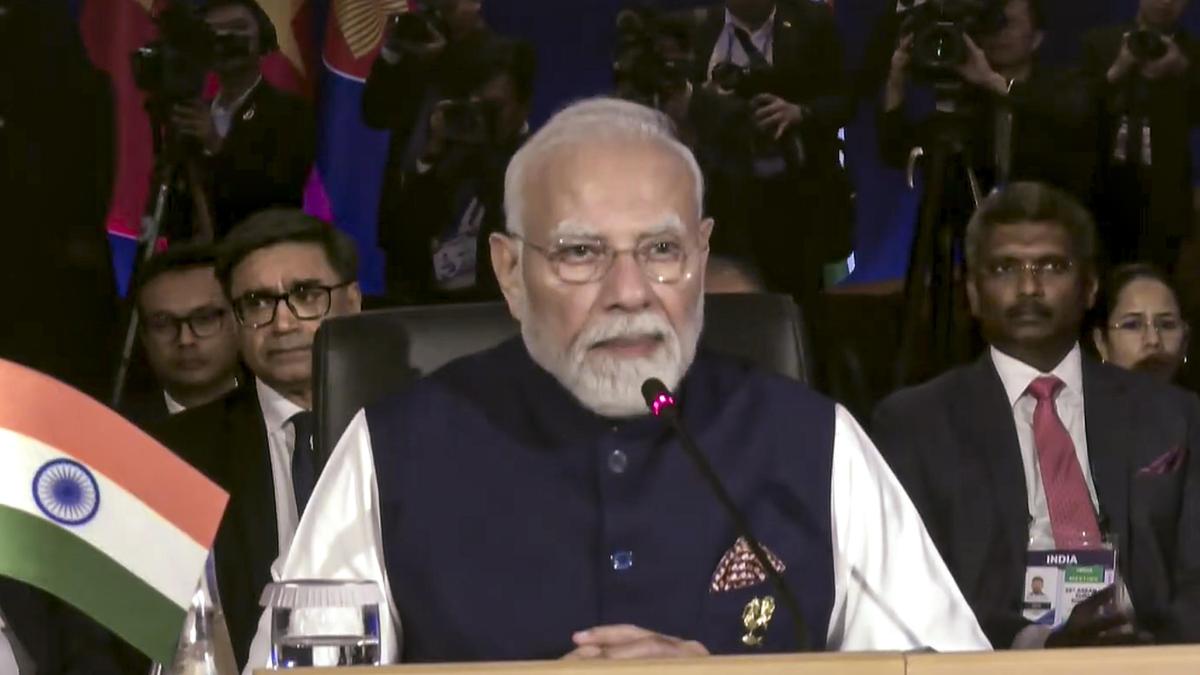
Reference image accompanying reporting on Prime Minister Narendra Modi’s message of cooperation to ASEAN leaders; not a verified view of the stated November 17, 2026 summit in Manila.
Image: The Hindu
Why in news
Addressing the 23rd ASEAN–India Summit, the Prime Minister linked ASEAN Community Vision 2045 with Developed India 2047 and emphasised peace, stability and predictability. The supplied reporting records strategic assurances, but does not specify new binding agreements, funding commitments or project deadlines.
23rd
ASEAN–India Summit
11
ASEAN members in the report
Nearly a quarter
Combined share of world population
2045
ASEAN Community Vision horizon
2047
Developed India horizon
Background
The Association of Southeast Asian Nations, founded in 1967, promotes regional economic growth, political stability, security and cultural cooperation. The supplied report lists Brunei, Cambodia, Indonesia, Laos, Malaysia, Myanmar, the Philippines, Singapore, Thailand, Timor-Leste and Vietnam as its members. India is an ASEAN dialogue partner and has a Comprehensive Strategic Partnership with the grouping. ASEAN occupies a pivotal position in India’s Act East Policy because Southeast Asia connects India’s northeastern neighbourhood and eastern maritime approaches with wider Asian economic networks. ASEAN-led institutions also provide inclusive platforms for dialogue among major powers.
What the summit message establishes—and what it does not
The Prime Minister’s central proposition was that India’s development and ASEAN’s prosperity are intertwined. His assurance of steadfast support for ASEAN unity and centrality positions the partnership as a source of regional stability rather than an instrument of exclusive geopolitical alignment.
The reference to ASEAN Community Vision 2045 and Developed India 2047 provides a long-term political frame for cooperation. However, aligning these aspirations requires sector-specific implementation; the statements themselves do not establish a joint development programme.
- The summit theme, “Navigating Our Future, Together”, emphasised a shared response to uncertainty.
- Peace, stability and predictability were presented as prerequisites for regional prosperity.
- The reporting does not establish that new trade concessions, connectivity financing or security obligations were adopted.
Infographic
Centrality
Strengthen ASEAN-led dialogue and regional agency.
Cohesion
Respect diverse interests without weakening collective cooperation.
Connectivity
Combine transport links with transit rules and local opportunity.
Commerce
Improve market access, standards and production linkages.
Implementation
Convert strategic assurances into jointly monitored outcomes.
AI-assisted infographic by Pragnya IAS Academy, based on the cited sources.
ASEAN centrality: Regional agency, not merely diplomatic etiquette
ASEAN centrality means retaining ASEAN’s leading convening and agenda-shaping role in the regional architecture. Platforms such as the East Asia Summit, ASEAN Regional Forum and ASEAN Defence Ministers’ Meeting-Plus enable engagement among countries with competing interests without requiring a common military alignment.
For India, supporting centrality helps reconcile cooperation with major powers and respect for Southeast Asian strategic autonomy. It also signals that India’s Indo-Pacific approach should complement, rather than displace, ASEAN-led institutions.
Centrality depends on cohesion. ASEAN’s consensus-based functioning accommodates diverse national interests, but can make common positions difficult when members assess security and economic risks differently. India must therefore engage individual members without weakening the collective framework.
- ASEAN centrality is a principle of regional leadership, not a claim that ASEAN controls every regional initiative.
- Regional cohesion requires meaningful consultation and sensitivity to differences among member states.
- Support for ASEAN should translate into sustained participation and practical cooperation through ASEAN-led mechanisms.
Connectivity: Converting Act East from geography into opportunity
Act East provides the practical bridge between India and Southeast Asia through diplomacy, commerce, connectivity and people-to-people engagement. India’s Northeast is especially important because Myanmar provides the land interface with mainland Southeast Asia, while the Bay of Bengal connects India to regional maritime networks.
Established initiatives such as the India–Myanmar–Thailand Trilateral Highway and the Kaladan Multi-Modal Transit Transport Project illustrate this connectivity logic. They are background examples, not new announcements reported from this summit.
Infrastructure alone cannot generate integration. Border procedures, transit arrangements, logistics services, local enterprise participation and environmental safeguards determine whether a transport corridor becomes an economic corridor.
- Physical connectivity must be accompanied by efficient customs and interoperable documentation.
- Local communities and northeastern enterprises should gain market access, not merely bear transit-related costs.
- Land and maritime routes should be developed as complementary channels rather than competing alternatives.
Economic cooperation and an inclusive Indo-Pacific
India–ASEAN economic cooperation can connect complementary production capabilities, consumer markets and services. The ASEAN–India Trade in Goods Agreement provides an existing framework, but deeper integration also depends on trade facilitation, workable standards, credible rules of origin and business-level participation.
The combined population share cited at the summit indicates scale, not an automatic integrated market. Purchasing power, logistics costs, regulatory compatibility and firm competitiveness determine how much of that potential becomes actual trade and investment.
An inclusive Indo-Pacific approach should combine maritime stability with development outcomes. Disaster response, maritime domain awareness, sustainable connectivity, digital cooperation and skills partnerships are potential areas for practical collaboration; the source does not identify them as newly agreed summit deliverables.
- Economic resilience should diversify commercial options without demanding exclusive geopolitical choices.
- Trade cooperation must address market access and adjustment concerns alongside the expansion of commerce.
- Minilateral arrangements can support regional public goods while remaining complementary to ASEAN-led institutions.
| Dimension | ASEAN’s role | Implementation test |
|---|---|---|
| Act East Policy | Principal regional partner for engagement with Southeast Asia | Whether diplomacy produces usable connectivity and stronger commercial links |
| Indo-Pacific approach | Inclusive platform for regional dialogue and cooperation | Whether India strengthens ASEAN-led mechanisms and respects regional agency |
| Northeast development | Gateway to neighbouring Southeast Asian markets | Whether local producers benefit from transport, logistics and border facilitation |
| Economic cooperation | Partner for trade, investment and production networks | Whether regulatory and logistical barriers are reduced |
| Regional cohesion | Collective forum accommodating diverse member interests | Whether bilateral engagement reinforces rather than fragments ASEAN cooperation |
- 1. Identify jointly agreed corridors and local development needs.
- 2. Develop reliable transport links with social and environmental safeguards.
- 3. Enable transit through customs coordination and compatible documentation.
- 4. Connect local enterprises to logistics, finance and regional buyers.
- 5. Expand trade, employment and production linkages.
- 6. Use shared economic gains to strengthen confidence in regional cooperation.
1967
ASEAN was founded as a regional organisation in Southeast Asia.
November 17, 2026
At the 23rd ASEAN–India Summit in Manila, the Prime Minister reaffirmed support for ASEAN unity and centrality and stressed cooperation over competition.
Significance, challenges & way forward
Significance
- Support for ASEAN centrality strengthens an inclusive regional order in which Southeast Asian countries retain agency.
- The partnership connects India’s Act East Policy with its broader Indo-Pacific approach.
- Improved regional connectivity can support northeastern development when local production and logistics capabilities are strengthened.
- Economic cooperation can broaden supply-chain options and reduce excessive dependence on individual routes or markets.
- Linking long-term development visions creates a basis for sustained cooperation beyond individual summit cycles.
Challenges
- Different strategic priorities among ASEAN members can complicate collective positions and implementation.
- Major-power competition can pressure regional countries to make choices that undermine inclusive cooperation.
- Land connectivity through Myanmar is exposed to political and security risks, making route resilience important.
- Transport infrastructure may remain underused if customs, transit rules and logistics services do not improve.
- Uneven competitiveness and market-access concerns can limit domestic support for deeper economic integration.
- Broad strategic assurances risk remaining symbolic without accountable institutions and clearly defined deliverables.
Way forward
- Translate summit assurances into jointly identified sectoral priorities with transparent milestones and implementation reviews.
- Strengthen participation in ASEAN-led institutions while consulting members on complementary bilateral and minilateral initiatives.
- Treat connectivity as a package of infrastructure, transit arrangements, customs reform and local enterprise development.
- Pursue balanced trade facilitation, stronger rules-of-origin administration and regulatory cooperation.
- Diversify land and maritime connectivity to improve resilience against disruptions.
- Build development-oriented partnerships in disaster response, skills, digital systems and sustainable infrastructure according to partner priorities.
- Assess success through operational links, enterprise participation and local benefits rather than announcements alone.
Key terms
- ASEAN centrality
- ASEAN’s leading convening and agenda-shaping role in the regional institutional architecture.
- Act East Policy
- India’s policy of deepening strategic, economic, connectivity and cultural engagement with Southeast Asia and the wider eastern region.
- Indo-Pacific
- A strategic conception linking the Indian and Pacific Ocean regions through maritime, economic and security interactions.
- Comprehensive Strategic Partnership
- A diplomatic framework for broad cooperation across strategic, economic and other sectors, without automatically creating alliance obligations.
- Rules of origin
- Criteria used to determine a product’s national origin, including its eligibility for preferential tariff treatment.
- Economic corridor
- A transport-linked development network that connects production centres, markets, services and communities.
- Minilateralism
- Cooperation among a limited group of countries on specific shared objectives.
Link with static syllabus
Prelims practice MCQs
Q1. With reference to ASEAN centrality, consider the following statements: 1. It concerns ASEAN’s leading role in convening and shaping regional cooperation. 2. It requires ASEAN members to join a common military alliance. 3. It can coexist with ASEAN members maintaining partnerships with different major powers. Which of the statements given above are correct?
Q2. Which of the following are ASEAN-led platforms? 1. East Asia Summit 2. ASEAN Regional Forum 3. ASEAN Defence Ministers’ Meeting-Plus Select the correct answer using the code below.
Q3. Consider the following pairs: 1. India–Myanmar–Thailand Trilateral Highway: Overland connectivity with mainland Southeast Asia 2. Kaladan Multi-Modal Transit Transport Project: Connectivity involving India and Myanmar 3. Rules of origin: Criteria determining a product’s national origin Which of the pairs given above are correctly matched?
Q4. With reference to the India–ASEAN Summit described in the supplied report, consider the following statements: 1. India reaffirmed its commitment to ASEAN unity and centrality. 2. The Prime Minister linked ASEAN Community Vision 2045 with Developed India 2047. 3. The report specifies a newly adopted binding defence alliance between India and ASEAN. Which of the statements given above are correct?
Mains practice questions
GS 2 · 15 marks · 250 words
ASEAN centrality is the institutional bridge between India’s Act East Policy and its Indo-Pacific approach. Discuss, with particular reference to regional cohesion, connectivity and economic cooperation.
Frequently asked questions
Why is ASEAN important to India’s Act East Policy?
ASEAN is India’s principal regional partner for engagement with Southeast Asia, linking diplomacy, trade, connectivity and cultural relations. It also connects northeastern development with wider regional economic opportunities.
What does India’s support for ASEAN centrality mean?
It means supporting ASEAN’s leading role in regional dialogue and institutions while respecting Southeast Asian countries’ agency. It does not imply that every regional initiative must be exclusively ASEAN-run.
Did the summit announce new binding agreements?
The supplied reporting does not specify new binding agreements, funding commitments or project deadlines. It primarily records political assurances and a shared strategic direction.
How are Act East and the Indo-Pacific approach different?
Act East focuses on deepening India’s engagement with Southeast Asia and the wider eastern region. The Indo-Pacific approach provides a broader maritime and strategic frame, with ASEAN serving as an important connecting institution.
Sources
- The Hindu: Our future must be shaped by ‘cooperation, not competition’: PM Modi to ASEAN leaders
- Times of India: Cooperation, not competition is the future: Modi at India-Asean summit
Analysis prepared by the Pragnya IAS Academy current-affairs desk with AI assistance from the cited reports. Verify figures with the original sources.
Turn current affairs into marks
Join Pragnya IAS Academy's mentorship for daily answer-writing evaluation on stories like this — classroom programmes from a trusted name in IAS coaching in Hyderabad.