
COP31: Climate Finance, the 1.5°C Pathway and India’s Island Diplomacy
Revise the static topic: UPSC Environment notes
In short: The COP31 draft negotiations in Antalya, Turkiye, reveal disagreements over emissions cuts, climate finance, electrification and the distribution of responsibilities between developed and developing countries. For India, the challenge is to defend equity and development space while advancing credible mitigation and practical resilience partnerships with vulnerable small island nations.
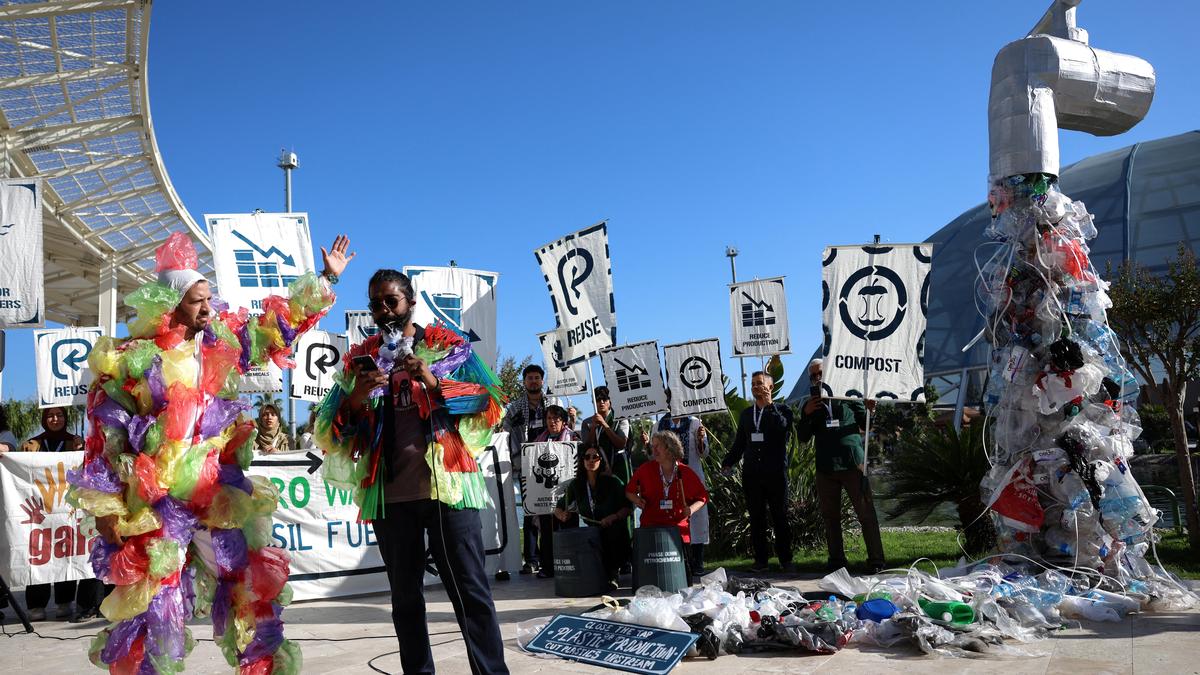
Photo from the source report: COP31: Climate Finance, the 1.5°C Pathway and India’s Island Diplomacy
Image: The Hindu
Why in news
Draft proposals at COP31 seek stronger developed-country mitigation leadership and faster climate finance, but remain contested rather than agreed outcomes. India has also offered small island nations scientific and technological cooperation in renewable energy, coastal resilience and disaster preparedness.
1.5°C
Paris temperature ambition
$300 billion annually
Finance goal by 2035
$1.3 trillion annually
All-source finance goal by 2035
$840 billion
Projected shortfall against larger goal
23
Active IRIS projects reported
25
Island countries covered by projects
Background
The United Nations Framework Convention on Climate Change anchors climate cooperation in equity and common but differentiated responsibilities and respective capabilities. The Paris Agreement combines nationally determined contributions with the objective of holding warming well below 2°C above pre-industrial levels and pursuing efforts to limit it to 1.5°C. It requires participation by all parties while recognising different national circumstances, developed-country leadership and support for developing countries. Mitigation addresses the causes of warming, adaptation reduces vulnerability to its impacts, and loss and damage concerns adverse consequences that are not avoided through mitigation and adaptation.
What is contested in the COP31 draft?
The draft cover text brings together competing proposals; their inclusion does not establish consensus or create an adopted obligation. Developing-country proposals call for developed countries to reach net-zero emissions by 2030 and net-negative emissions by 2045, substantially earlier than the 2050 net-zero targets adopted by several developed countries.
Other disputed elements include voluntary climate finance contributions from developing countries, a presidency proposal to source 35% of energy use from electricity by 2035, and calls to eliminate measures such as the European Union’s Carbon Border Adjustment Mechanism by the end of 2027. Some countries oppose making the electrification proposal obligatory.
These disputes concern the allocation of transition costs as much as aggregate ambition. Earlier emissions cuts, access to technology, trade competitiveness and affordable finance determine whether countries view a transition pathway as feasible and fair.
- A developing-country demand for earlier developed-country net zero is not an agreed global deadline.
- The proposed electrification share concerns energy use supplied through electricity, not the renewable share of electricity generation.
- A call to eliminate CBAM does not mean that the mechanism has been withdrawn.
Infographic
Ambition
Strengthen mitigation towards the Paris temperature objective.
Equity
Differentiate leadership and support by responsibility and capability.
Finance
Make funding predictable, accessible and appropriate to vulnerability.
Resilience
Protect coasts, ecosystems, infrastructure and livelihoods.
India–SIDS partnership
Combine technology, local knowledge and country-led implementation.
AI-assisted infographic by Pragnya IAS Academy, based on the cited sources.
Equity and the 1.5°C pathway must reinforce each other
The supplied draft-agreement headline places renewed pursuit of the 1.5°C objective on the agenda, but does not establish a final negotiated pathway. Analytically, the central question is how stronger global mitigation can be reconciled with historical responsibility, unequal capabilities and development needs.
Common but differentiated responsibilities and respective capabilities does not exempt developing countries from climate action. It requires differentiation in leadership, effort and support: developed countries should undertake ambitious reductions and provide finance and technology, while developing countries pursue progressively stronger action consistent with national circumstances.
Small island states and larger developing economies share concerns about inadequate support, but their immediate priorities need not be identical. Island states face acute threats from sea-level rise, coastal damage and ocean warming, making rapid global mitigation indispensable alongside adaptation assistance.
- Equity without stronger aggregate mitigation cannot adequately protect climate-vulnerable countries.
- Ambition without finance and technology can shift disproportionate adjustment costs onto poorer economies.
- Electrification supports decarbonisation most effectively when accompanied by cleaner power, stronger grids and affordable access.
Climate finance: delivery and quality matter as much as targets
The sources report a climate finance goal of $300 billion annually by 2035 and a wider mobilisation goal of $1.3 trillion annually by the same year from public and private sources. These should not be presented as equivalent commitments: the wider figure includes a broader financing pool, not solely developed-country public budget transfers.
A Brazil-led analysis cited in the reporting estimates that $137 billion was mobilised in 2024 and projects an $840 billion shortfall against the larger goal under current trends. This is a conditional projection, not a realised shortfall in 2035. Fiscal pressures, competing security expenditure, high capital costs and reduced international funding complicate delivery.
Finance quality is equally consequential. Loans can deepen debt burdens in countries repeatedly rebuilding after disasters, while complicated application procedures can overwhelm small administrations. The reported move by multilateral funds to rely more on one another’s assessments in co-financed operations could reduce duplication.
- Article 9 of the Paris Agreement requires developed-country financial support and encourages voluntary support from other parties.
- Voluntary South–South contributions should supplement, not substitute for, developed-country obligations.
- Adaptation and loss-and-damage needs require public support where commercial returns are weak or uncertain.
- Private finance can expand investment, but cannot be assumed to meet every resilience need.
India and island nations: translating solidarity into resilience
At a COP31 roundtable organised by The Energy and Resources Institute, Environment Minister Bhupender Yadav offered cooperation in renewable energy, disaster preparedness, resilient infrastructure and locally appropriate adaptation. India also recognised that island communities’ traditional ocean knowledge offers lessons for its own coastal management.
This engagement builds on the Forum for India-Pacific Islands Cooperation and the Infrastructure for Resilient Island States programme under the Coalition for Disaster Resilient Infrastructure. The reporting identifies 23 active IRIS projects covering 25 small island countries, with cooperation including satellite data and early-warning capacity.
India can connect its equity-based negotiating position with practical assistance, while acknowledging island states’ demand for urgent mitigation. Such partnerships should be country-driven and community-centred rather than treated as substitutes for developed-country climate finance.
- Coastal risk assessment and monitoring can improve preparedness and infrastructure siting.
- Mangrove conservation can support coastal protection, biodiversity and livelihoods.
- Energy technology partnerships can advance locally appropriate renewable deployment.
- Institutional exchanges can combine scientific information with traditional knowledge and local capacity.
Just transition and trade: implementation without burden shifting
India has called for the global just transition agenda to move beyond dialogue towards practical, country-driven implementation. A just transition includes workers, affected communities, livelihood diversification, social protection and affordable energy; it is broader than shifting employment from fossil-fuel industries to renewable energy.
Developing-country opposition to CBAM highlights the tension between carbon-related trade measures and unequal production capabilities. The EU mechanism links charges on covered imports to embedded emissions. Developing countries argue that such measures disadvantage their industries; this negotiating objection does not by itself establish a legal finding that CBAM violates trade rules.
A workable settlement should combine credible domestic decarbonisation with technology access, support for cleaner industrial production and transparent treatment of carbon-related trade measures. Uniform deadlines unsupported by finance risk undermining both implementation and political consent.
- Worker reskilling should be linked to actual employment opportunities and regional economic diversification.
- Climate-related industrial adjustment should account for smaller firms’ financing and technical constraints.
- International cooperation should reduce transition costs rather than merely relocate them.
| Pillar | Purpose | COP31 equity concern |
|---|---|---|
| Mitigation | Reduce emissions or enhance removals | Distribute effort according to responsibility, capability and development needs. |
| Adaptation | Reduce vulnerability to actual or expected climate impacts | Provide accessible support for countries with limited fiscal and administrative capacity. |
| Loss and damage | Address adverse climate consequences not avoided through mitigation and adaptation | Support vulnerable countries without compounding disaster-related debt. |
| Just transition | Make the low-emission transition socially inclusive | Protect workers, communities, livelihoods and affordable energy access. |
- 1. Identify country-led priorities through climate risk assessments and community consultation.
- 2. Match needs with grants, concessional finance, technology and capacity support.
- 3. Simplify access through coordinated assessments and proportionate application requirements.
- 4. Implement resilient infrastructure, early-warning systems and ecosystem protection.
- 5. Track disbursement, maintenance capacity and measurable resilience outcomes.
2014
The Forum for India-Pacific Islands Cooperation began, providing a platform that includes climate cooperation.
2021
India announced the IRIS programme at the Glasgow climate conference, COP26, under CDRI.
2024
Climate talks established the finance goals for 2035 reported in the supplied material.
November 2026
COP31 negotiations in Antalya exposed divisions over mitigation leadership, finance, electrification and carbon-related trade measures.
November 2026
India’s COP31 roundtable with small island nations reviewed resilience partnerships and identified areas for deeper cooperation.
Significance, challenges & way forward
Significance
- COP31 tests whether differentiation can enable stronger collective climate action rather than become a source of deadlock.
- Predictable finance can make low-emission development and adaptation more feasible for resource-constrained countries.
- India’s island partnerships can demonstrate that South–South solidarity includes practical delivery and mutual learning.
- Accessible adaptation support can protect livelihoods and reduce the fiscal disruption caused by repeated disasters.
- Country-driven just transition measures can strengthen public acceptance of structural economic change.
Challenges
- Developed-country fiscal and political pressures can delay support despite vulnerable countries’ urgent needs.
- Loan-heavy financing can worsen debt stress in economies already spending heavily on disaster recovery.
- Overlapping procedures and limited administrative capacity can prevent available finance from reaching projects promptly.
- Private investors’ return requirements may leave essential but commercially unattractive adaptation projects underfunded.
- Different priorities within the developing world complicate a common position on mitigation speed and burden sharing.
- Trade-related carbon measures can intensify mistrust if cleaner production alternatives remain unaffordable.
Way forward
- Pair stronger mitigation ambition with differentiated leadership, technology access and predictable financial support.
- Prioritise grants and highly concessional support for vulnerable countries’ adaptation and loss-and-damage needs.
- Report finance transparently by instrument, source, disbursement and grant-equivalent value to distinguish headline mobilisation from usable support.
- Simplify fund access and strengthen national project-preparation capacity without weakening environmental and social safeguards.
- Use public risk-sharing selectively to attract private investment while protecting recipient countries from excessive liabilities.
- Deepen India–SIDS cooperation through locally designed projects, maintenance support, institutional partnerships and community participation.
- Link just transition plans to employment, social protection, regional diversification and affordable clean energy.
Key terms
- CBDR-RC
- Common but differentiated responsibilities and respective capabilities recognises shared climate duties but differentiated effort and support.
- Nationally determined contribution
- A party’s national climate contribution communicated under the Paris Agreement.
- Net zero
- A balance between emissions and removals of the specified gas or gases over a defined period.
- Net-negative emissions
- A condition in which removals exceed emissions of the specified gas or gases.
- SIDS
- Small Island Developing States are a recognised group facing distinctive sustainable development and climate vulnerabilities.
- IRIS
- Infrastructure for Resilient Island States is a CDRI programme supporting infrastructure resilience in small island states.
- CBAM
- The European Union’s Carbon Border Adjustment Mechanism links charges on covered imports to embedded emissions.
- Fiscal space
- A government’s capacity to finance expenditure without undermining fiscal sustainability.
Link with static syllabus
Prelims practice MCQs
Q1. With reference to differentiation under the Paris Agreement, consider the following statements: 1. Developing countries are exempt from communicating nationally determined contributions. 2. Developed-country parties shall provide financial resources to assist developing-country parties with mitigation and adaptation. 3. Other parties are encouraged to provide financial support voluntarily. Which of the statements given above are correct?
Q2. Consider the following pairs: 1. Mitigation — Reducing greenhouse gas emissions 2. Adaptation — Reducing vulnerability to climate impacts 3. Net-negative emissions — Emissions exceeding removals How many of the pairs given above are correctly matched?
Q3. With reference to Infrastructure for Resilient Island States, consider the following statements: 1. It is a programme under the Coalition for Disaster Resilient Infrastructure. 2. Its cooperation includes satellite data support for early-warning capacity. 3. Its assistance replaces developed-country climate finance obligations under the Paris Agreement. Which of the statements given above are correct?
Q4. Regarding the COP31 proposals described in the supplied reporting, consider the following statements: 1. Inclusion of a proposal in the draft cover text establishes its adoption by the parties. 2. The proposed electricity share in energy use is identical to the renewable share of electricity generation. Which of the statements given above is/are correct?
Mains practice questions
GS 3 · 15 marks · 250 words
Climate ambition and climate equity must be mutually reinforcing. Discuss in the context of COP31 disagreements over mitigation and finance, highlighting India’s engagement with small island developing states.
Frequently asked questions
Has COP31 adopted a 2030 net-zero deadline for developed countries?
No adopted deadline is established by the supplied reporting. It describes a developing-country proposal in a contested draft cover text.
Does CBDR-RC mean that developing countries need not cut emissions?
No. It supports differentiated responsibilities and assistance, while the Paris Agreement requires climate contributions from all parties.
Why do small island states seek grants and simpler finance procedures?
Repeated disasters can erode fiscal space, and additional loans can worsen debt pressures. Complex procedures can also exceed the administrative capacity of small states.
How is India strengthening climate cooperation with island nations?
India has offered scientific and technological cooperation in renewable energy, coastal risk monitoring, disaster preparedness and ecosystem protection. IRIS under CDRI provides an existing platform for resilient infrastructure cooperation.
Sources
- The Hindu: Divergent positions mark draft text of COP31 under way in Turkiye
- The Hindu: Urgent climate finance pleas at COP31 face a non-urgent response
- Indian Express: COP31: India seeks to strengthen climate engagement with small island nations
- Indian Express: Let’s work to get back to 1.5° C target: COP31 draft agreement
Analysis prepared by the Pragnya IAS Academy current-affairs desk with AI assistance from the cited reports. Verify figures with the original sources.
Turn current affairs into marks
Join Pragnya IAS Academy's mentorship for daily answer-writing evaluation on stories like this — classroom programmes from a trusted name in IAS coaching in Hyderabad.