
Manila Quad Summit: Maritime Security, AI and India’s Strategic Autonomy
Revise the static topic: UPSC International Relations notes
In short: At the Manila summit on November 17, 2026, Quad leaders announced maritime surveillance cooperation, cybersecurity initiatives and a business forum, while affirming an AI Accelerator for the Indo-Pacific. The outcomes link maritime security with technological and economic resilience, raising important questions about ASEAN centrality and India’s strategic autonomy.
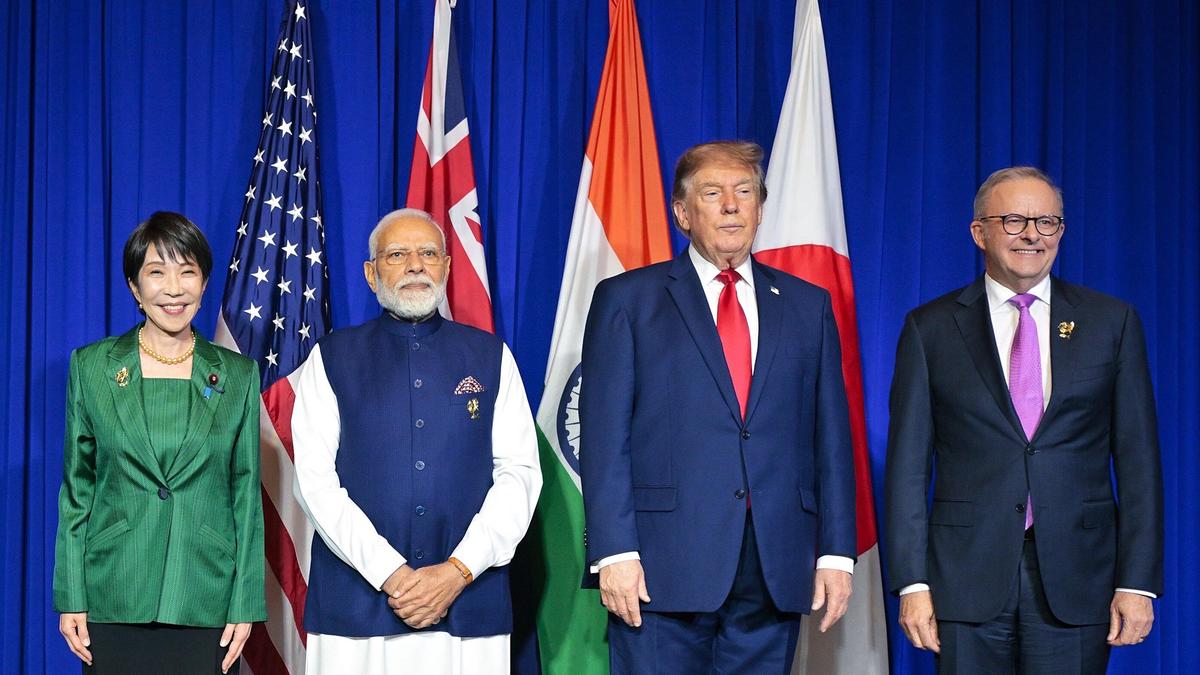
Photo from the source report: Manila Quad Summit: Maritime Security, AI and India’s Strategic Autonomy
Image: The Hindu
Why in news
India, Australia, Japan and the United States held their first leaders’ meeting since September 2024 on the sidelines of ASEAN-related summits in Manila. Announced deliverables include a maritime patrol aircraft exercise and the inaugural Quad Business Leaders’ Forum in Mumbai in 2027.
4
Quad member countries
7th
Quad Leaders’ Summit at Manila
2027
Planned maritime aircraft exercise
2027
Inaugural Mumbai business forum
Background
The Quadrilateral Security Dialogue brings together India, Australia, Japan and the United States. Its origins lie in coordinated relief after the 2004 Indian Ocean tsunami; the dialogue began in 2007, was revived in 2017 and reached the leaders’ level in 2021. The Quad is not a collective-defence treaty alliance: its practical agenda spans maritime awareness, technology, infrastructure, health security and humanitarian assistance. For India, it complements the Act East Policy and engagement with ASEAN, while strategic autonomy means retaining independent judgement rather than avoiding partnerships.
Manila outcomes: Distinguishing commitments from implementation
The summit’s central security outcome was the Indo-Pacific Maritime Surveillance Collaboration, intended to enhance information sharing and maritime domain awareness. The joint statement scheduled an exercise involving the members’ respective P-8 and P-3C patrol aircraft in 2027, for the first time in a Quad context.
Leaders affirmed the AI Accelerator previously announced by their foreign ministers in Atlanta, alongside enhanced cybersecurity cooperation. India announced that Mumbai would host the inaugural Quad Business Leaders’ Forum in 2027. The reporting also records a cable connectivity framework and stronger counterterrorism cooperation.
These are announcements and prospective activities, not evidence of completed implementation. The supplied reporting uses differing AI labels in leaders’ remarks; the joint press release describes an AI Accelerator for trusted AI access, deployment and technical assistance, which should anchor interpretation of the initiative.
- The leaders opposed destabilising unilateral changes to the status quo through force or coercion.
- They expressed concern about economic coercion, including arbitrary export restrictions.
- They committed to open, safe and resilient maritime transit corridors.
- The supplied material does not establish detailed operating rules for cybersecurity sharing or the cable connectivity framework.
Infographic
Maritime
Shared awareness and a planned patrol aircraft exercise
Technology
Trusted AI access and stronger cyber cooperation
Business
Mumbai forum to connect industry with regional priorities
ASEAN
Consultation and demand-driven regional projects
India
Greater capabilities without automatic strategic alignment
AI-assisted infographic by Pragnya IAS Academy, based on the cited sources.
Maritime security: From shared awareness to operational coordination
Maritime domain awareness converts observations about vessels and maritime activity into information that can support surveillance, safer navigation and timely responses. The planned patrol aircraft exercise adds a practical coordination element to the Quad’s information-sharing agenda.
For India, secure sea lanes matter for trade, energy supplies and seafarer safety. However, surveillance improves awareness; it does not automatically guarantee protection of shipping or create a collective military response obligation. Malabar involves the same four countries, but it should not be treated as proof that the Quad is a military alliance.
The United Nations Convention on the Law of the Sea provides the principal legal framework for maritime rights and jurisdiction. Cooperation must respect the distinction between coastal-state sovereignty in territorial waters and sovereign rights over resources in exclusive economic zones. Not all Quad members are parties to UNCLOS: the United States is not.
- Information-sharing arrangements should specify access, permissible uses and protection of sensitive data.
- Interoperability can improve coordination without requiring a unified command.
- Maritime capacity-building should address regional priorities such as illegal fishing, disaster response and safe navigation.
Technology and business: Economic resilience becomes a security priority
The AI Accelerator is intended to coordinate and fund trusted AI access, deployment and technical assistance across the Indo-Pacific. Combined with cybersecurity and cable connectivity cooperation, this broadens the Quad’s agenda from maritime security to the resilience of digital infrastructure and technology ecosystems.
The Mumbai business forum could connect diplomatic priorities with private investment, technology partnerships and supply-chain diversification. Critical minerals are relevant because concentrated supply and processing can expose economies to disruption or coercion; however, the supplied reporting does not establish a detailed common Quad minerals agreement.
India could benefit through stronger technology partnerships and diversified sourcing. These gains are conditional: trusted technology arrangements should not merely replace one dependency with another, while AI deployment requires safeguards for privacy, accountability and local capacity.
- The AI Accelerator is a cooperation mechanism, not evidence that superintelligent AI has been achieved.
- A business forum can facilitate investment but does not itself create a trade agreement.
- Diversification should complement domestic manufacturing, research and skills rather than substitute for them.
ASEAN centrality: Complementarity must be demonstrated
Manila was the first Quad leaders’ summit held in a non-Quad country, alongside ASEAN-related meetings. This places Southeast Asia visibly within the grouping’s regional outreach, but the venue alone does not establish ASEAN endorsement of every Quad initiative.
ASEAN centrality refers to ASEAN’s leading convening role in the regional institutional architecture, including ASEAN-led forums such as the East Asia Summit. It does not mean that ASEAN must approve every partnership, nor does the Quad’s small-group format automatically undermine it.
The real test is whether Quad projects reinforce regional institutions and respond to recipient priorities. Maritime surveillance or digital cooperation could strengthen local capacity; equally, bloc-style messaging or externally imposed technology choices could increase pressure on Southeast Asian states to choose sides.
- Consult ASEAN members during project design rather than only after announcements.
- Keep assistance demand-driven and respect participating countries’ policy choices.
- Use ASEAN-led forums for wider dialogue while pursuing practical delivery through smaller partnerships.
India’s strategic autonomy: Partnership without automatic alignment
For India, the Quad offers access to capabilities, investment and diplomatic coordination without a collective-defence obligation. Maritime cooperation and resilient supply chains can expand India’s room for manoeuvre by reducing vulnerability to coercion.
The corresponding risk is excessive dependence on partners for sensitive technologies, intelligence or critical inputs. Differences among members’ global priorities can also affect continuity. India therefore needs issue-based cooperation, independent decisions on security commitments and sustained engagement with ASEAN and other partners.
Strategic autonomy should be assessed through practical freedom of choice, not diplomatic distance from every major power. The appropriate balance is deeper cooperation where interests converge, alongside clear limits on data sharing, operational commitments and technological dependence.
- India should distinguish shared principles from automatic support for every partner’s policy.
- Domestic technological and maritime capabilities are essential foundations of external autonomy.
- The Quad’s credibility should rest on regional public goods as well as strategic signalling.
| Initiative | Reported commitment | What should not be assumed |
|---|---|---|
| Maritime surveillance collaboration | Information sharing and a patrol aircraft exercise scheduled for 2027 | A standing joint command or collective-defence guarantee |
| AI Accelerator | Support for trusted AI access, deployment and technical assistance | A completed deployment programme or achieved superintelligence |
| Quad Business Leaders’ Forum | Inaugural meeting in Mumbai in 2027 | A free trade agreement or guaranteed investment flows |
| Cybersecurity cooperation | Enhanced cooperation and information sharing | Unrestricted access to members’ sensitive data |
| Cable connectivity framework | Framework reported among summit initiatives | Detailed financing and operating arrangements absent from the supplied material |
- 1. Collect observations through maritime surveillance capabilities.
- 2. Share relevant information under agreed access and security rules.
- 3. Develop a clearer understanding of vessel activity and emerging risks.
- 4. Support national decisions and coordinated responses where agreed.
- 5. Improve maritime safety while preserving national command and legal responsibilities.
2004
The four countries coordinated relief following the Indian Ocean tsunami, providing the foundations for later cooperation.
2007
The Quadrilateral Security Dialogue began.
2017
Quad cooperation was revived in Manila.
2021
The grouping was elevated to the leaders’ level.
September 2024
Quad leaders met in Wilmington, United States.
November 17, 2026
The Manila summit announced maritime, cybersecurity and business initiatives and affirmed the AI Accelerator.
2027, planned
A maritime patrol aircraft exercise and the inaugural Quad Business Leaders’ Forum in Mumbai are scheduled.
Significance, challenges & way forward
Significance
- The summit connects maritime security, digital infrastructure and economic resilience within a common Indo-Pacific agenda.
- Practical exercises could improve coordination beyond diplomatic declarations.
- The Mumbai business forum gives India an opportunity to link regional diplomacy with industry participation.
- AI assistance could help regional partners access technology and develop deployment capabilities.
- Opposition to coercion reinforces the importance of countries retaining independent development and foreign-policy choices.
Challenges
- Announcements may outpace delivery unless responsibilities, financing and review mechanisms are clarified.
- Sensitive maritime and cyber information creates difficult questions about sovereignty, confidentiality and permissible use.
- Technology partnerships can generate new dependencies if domestic capabilities and alternative suppliers remain weak.
- ASEAN members may resist initiatives perceived as compelling alignment within major-power rivalry.
- Different threat perceptions and political priorities among Quad members can complicate sustained cooperation.
- Security-oriented cooperation may lose regional legitimacy if it neglects development needs and public goods.
Way forward
- Publish initiative-specific implementation plans with designated responsibilities and transparent progress reviews.
- Co-design projects with interested ASEAN members and connect them with ASEAN-led regional dialogue.
- Establish clear data-sharing safeguards, including access controls, purpose limitations and procedures for handling breaches.
- Prioritise affordable AI access, local skills, accountable deployment and interoperability.
- Use the Mumbai forum to develop viable partnerships in resilient supply chains and critical technologies without overstating expected investment.
- Preserve India’s independent decision-making while strengthening domestic industrial, technological and maritime capabilities.
- Assess success through useful regional outcomes rather than the number of summit announcements.
Key terms
- Minilateralism
- Cooperation among a small group of countries on selected shared interests.
- ASEAN centrality
- ASEAN’s leading convening role in the regional institutional architecture.
- Strategic autonomy
- The capacity to make independent policy choices while engaging in partnerships.
- Maritime domain awareness
- Understanding maritime activities and conditions relevant to security, safety, the economy and the environment.
- Interoperability
- The ability of different systems or organisations to communicate and operate together effectively.
- Economic coercion
- The use of economic pressure to influence another country’s policy choices.
- Critical minerals
- Minerals important to economic or strategic activities whose supply disruption can create significant risks.
- Regional public goods
- Shared benefits, such as safer sea lanes and disaster preparedness, that serve countries across a region.
Link with static syllabus
Prelims practice MCQs
Q1. With reference to the Quad, consider the following statements: 1. Its members are India, Australia, Japan and the United States. 2. Its origins are linked to cooperation after the Indian Ocean tsunami. 3. It is a collective-defence treaty alliance. Which of the statements given above are correct?
Q2. Regarding the Manila Quad Summit outcomes, consider the following pairs: 1. Quad Business Leaders’ Forum — Inaugural meeting planned in Mumbai 2. AI Accelerator — Support for trusted AI access and technical assistance 3. Maritime patrol aircraft exercise — Scheduled for 2027 How many of the pairs given above are correctly matched?
Q3. Which of the following best describes ASEAN centrality?
Q4. With reference to maritime law and cooperation, consider the following statements: 1. Every Quad member is a party to UNCLOS. 2. A coastal state’s sovereign rights over resources in its exclusive economic zone are distinct from sovereignty over its territorial sea. 3. Maritime information sharing necessarily establishes a unified military command. Which of the statements given above is/are correct?
Mains practice questions
GS 2 · 15 marks · 250 words
The Quad’s expanding maritime and technology agenda can strengthen India’s strategic autonomy only if it complements ASEAN centrality. Discuss in the context of the Manila summit.
Frequently asked questions
What were the main outcomes of the Manila Quad Summit?
The summit announced maritime surveillance collaboration, enhanced cybersecurity cooperation and a business forum in Mumbai, while affirming the AI Accelerator. A maritime patrol aircraft exercise and the inaugural business forum are planned for 2027.
Does the planned maritime exercise turn the Quad into a military alliance?
No. Practical security cooperation does not by itself create a collective-defence treaty, automatic military obligations or a unified command.
How can the Quad support ASEAN centrality?
It can consult ASEAN members, support their priorities and complement ASEAN-led dialogue with practical capacity-building. Holding a summit in an ASEAN country alone does not demonstrate substantive centrality.
Why does the Quad matter for India’s strategic autonomy?
It can expand India’s capabilities and diversify partnerships, increasing freedom of choice. India must nevertheless retain independent decisions and avoid excessive technological or operational dependence.
Sources
- The Hindu: ASEAN, Quad Summit updates on November 17, 2026
- The Hindu: What is Quad, what is on the Manila agenda, and why does the 2026 summit matter?
- Indian Express: Quad unveils security, business, AI plans; Trump says ‘phone, office open’
- Indian Express: PM Modi by his side, Trump calls him ‘very tough' at Quad Summit in Manila
Analysis prepared by the Pragnya IAS Academy current-affairs desk with AI assistance from the cited reports. Verify figures with the original sources.
Turn current affairs into marks
Join Pragnya IAS Academy's mentorship for daily answer-writing evaluation on stories like this — classroom programmes from a trusted name in IAS coaching in Hyderabad.