
India–China LAC Talks: Border Management Is Not Boundary Settlement
Revise the static topic: UPSC Internal Security notes
In short: India has confirmed senior military commanders’ talks with China in the eastern sector, focused on improving border management and addressing outstanding issues along the Line of Actual Control. Dialogue can reduce troop friction and prevent escalation, but maintaining tranquillity does not amount to resolving the boundary dispute.
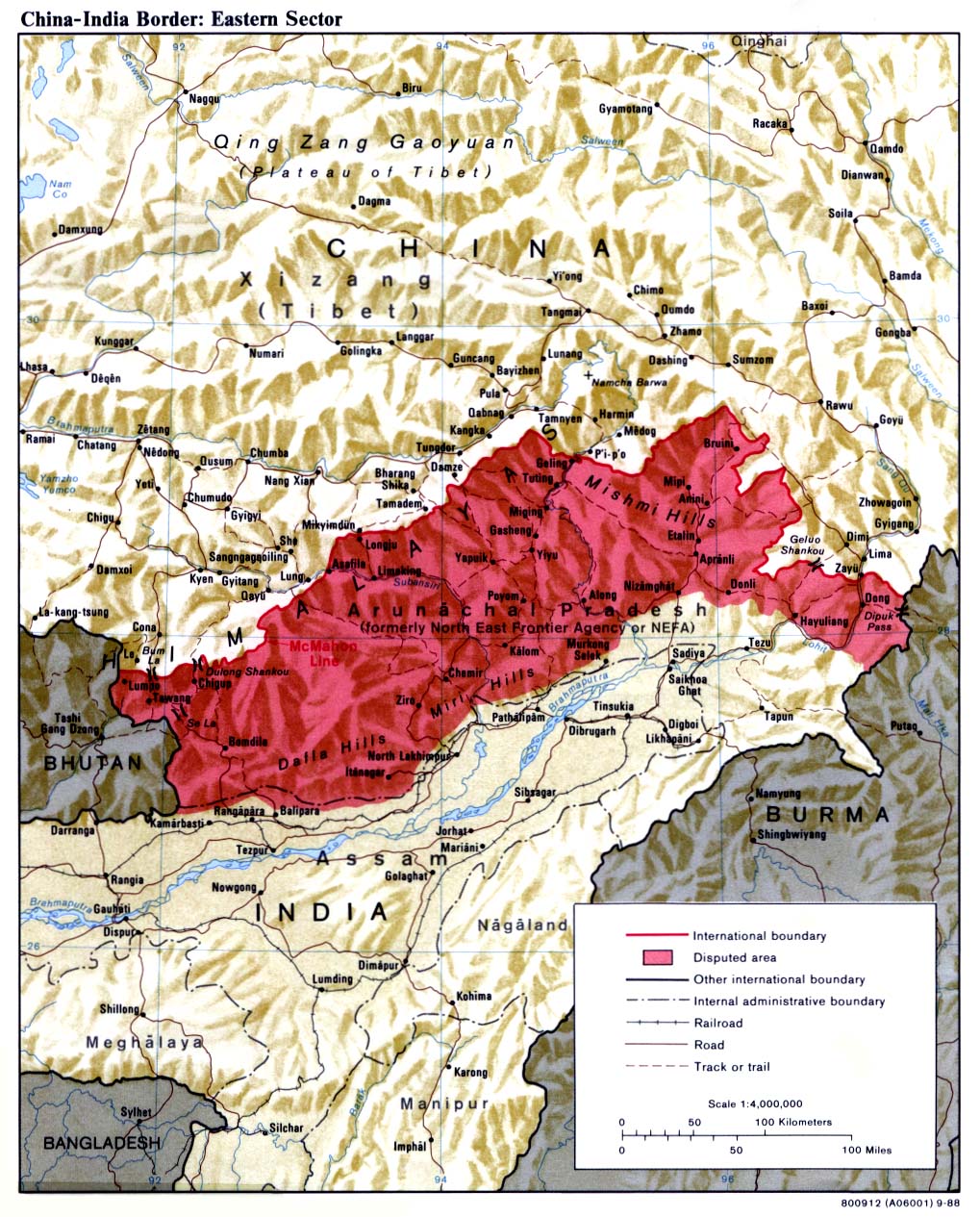
Reference map of the India–China eastern border showing disputed areas and the historical NEFA designation. Managing friction along the Line of Actual Control is distinct from settling the boundary dispute.
Image: Central Intelligence Agency · Public domain
Why in news
The Ministry of External Affairs confirmed recent eastern-sector military talks following an Indian Express report on another round of Corps Commander-level engagement in Arunachal Pradesh. The report described discussions on engagement rules, communication and reducing tensions.
Second round
Reported eastern-sector Corps Commander-level talks
Nearly 10 days
Reported duration, including a short break
Background
The India–China boundary remains unsettled, and the Line of Actual Control is not a mutually settled international boundary. In the eastern sector, the dispute concerns Arunachal Pradesh and China’s rejection of the McMahon Line, agreed between British India and Tibet in 1914. Arunachal Pradesh is an integral part of India. Military and diplomatic mechanisms seek to manage incidents and preserve peace while negotiations on the boundary continue; operational arrangements do not themselves determine sovereignty.
What is confirmed, and what remains unannounced?
The Ministry of External Affairs confirmed that senior military commanders met recently in the eastern sector. It identified improving border management, addressing outstanding LAC issues, maintaining peace and preventing escalation as the purposes of such engagement.
The Indian Express reported that the second eastern-sector Corps Commander-level round began after Diwali on November 8 and continued for nearly ten days, with a short break. According to the report, Lt General Girish Kalia, General Officer Commanding of III Corps, participated alongside other officers, with an MEA official also present.
The supplied account does not announce a signed agreement, verified disengagement, troop reductions or a boundary settlement. Discussions on engagement rules must therefore be distinguished from rules actually agreed and implemented.
- Official confirmation establishes that dialogue occurred, not that every outstanding issue was resolved.
- The reported objectives included avoiding troop friction, keeping communication lines open and lowering tensions.
- The presence of an MEA official indicates diplomatic participation in the military engagement.
Infographic
Communicate
Keep military and diplomatic channels functioning.
Prevent friction
Develop clear, reciprocal encounter procedures.
Review conduct
Judge progress by implementation and ground behaviour.
Preserve sovereignty
Keep local arrangements without prejudice to territorial positions.
Negotiate the boundary
Pursue political settlement separately from tactical management.
AI-assisted infographic by Pragnya IAS Academy, based on the cited sources.
Why military dialogue matters for escalation control
Where opposing troops operate close to one another, differing perceptions of the LAC and changes in patrolling behaviour can produce face-offs. The source reports substantial troop presence in the area and earlier tensions in Arunachal Pradesh.
Military dialogue can translate broader political directions into practical instructions for formations on the ground. Predictable conduct and timely communication reduce the risk that a local encounter becomes a wider confrontation, but their effectiveness depends on reciprocal compliance.
- Clear encounter procedures can reduce ambiguity over how patrols should respond during face-offs.
- Reliable commander-to-commander communication can enable rapid clarification of incidents.
- Regular meetings can help distinguish isolated encounters from recurring patterns of friction.
- Mutual review of incidents can test whether agreed arrangements are working.
Tranquillity, disengagement and boundary settlement are different
Maintenance of tranquillity concerns behaviour along the frontier: avoiding clashes, managing patrol encounters and preventing escalation. Disengagement concerns separating troops at a particular friction point, while de-escalation involves a broader reduction in military tensions or posture. None should be inferred merely from the holding of talks.
Boundary settlement is a separate political and diplomatic task involving agreement on the territorial boundary and its implementation. The Special Representatives mechanism addresses boundary negotiations; military commanders principally address operational conditions.
Consequently, a quieter LAC can coexist with an unresolved boundary dispute. Local arrangements should explicitly preserve India’s territorial position and should not be treated as recognition of the other side’s claims.
- Assess dialogue by reduced friction and implementation, not only by the frequency of meetings.
- Do not equate an operational patrol arrangement with a final territorial settlement.
- Do not automatically transfer assumptions about arrangements in one sector to another.
Eastern-sector geography and the bilateral relationship
The first reported eastern-sector Corps Commander-level talks took place on September 6–7 at the Wacha–Damai border, following reports of tension in the Taksing area of Upper Subansiri district. Wacha, in the Kibithoo sector, is India’s easternmost border personnel meeting point, according to the source.
China does not recognise the McMahon Line, disputing Tibet’s authority to conclude the agreement with British India. This underlying disagreement makes tactical management necessary but insufficient for a lasting settlement.
The MEA has reiterated that peace and tranquillity in border areas are essential for the overall development of bilateral relations. Border stability is therefore not merely a local military concern: it influences political trust and the wider relationship.
- The current engagement concerns the eastern sector in Arunachal Pradesh.
- III Corps, also called the Spear Corps, is headquartered at Rangapahar near Dimapur in Nagaland.
- The ITBP is a Central Armed Police Force under the Ministry of Home Affairs, not a formation of the Indian Army.
| Concept | Meaning | What it does not establish |
|---|---|---|
| Border management | Managing patrols, communication and incidents along the frontier | Agreement on the international boundary |
| Confidence-building measures | Reciprocal practices intended to improve predictability and reduce accidental escalation | An end to strategic distrust |
| Disengagement | Separation of opposing troops at a friction point | A broader reduction in military deployments |
| De-escalation | Reduction in military tensions and the wider confrontational posture | Resolution of competing territorial claims |
| Boundary settlement | Political and legal agreement on the territorial boundary | An outcome established by the latest reported talks |
- 1. Identify and report a patrol encounter or local friction.
- 2. Activate designated military communication channels.
- 3. Clarify the incident and exercise reciprocal restraint.
- 4. Use commanders’ meetings to address unresolved operational issues.
- 5. Communicate agreed procedures to deployed units.
- 6. Review compliance and refer wider disputes to diplomatic mechanisms.
1914
The McMahon Line was agreed between British India and Tibet; China does not recognise it.
August, as reported
Special Representatives Ajit Doval and Wang Yi met in Beijing before the first eastern-sector military round.
September 6–7, as reported
The first eastern-sector Corps Commander-level talks were held at Wacha–Damai following reports of tension around Taksing.
October, as reported
The ITBP Director General referred to face-offs at multiple locations in Arunachal Pradesh; the MEA reiterated the importance of border tranquillity.
November 8 onwards, as reported
The next round of eastern-sector military talks began and continued for nearly ten days, including a short break.
November 22, as reported
The Indian Express reported the second round of Corps Commander-level talks.
Subsequent official confirmation
The MEA confirmed senior commanders’ talks focused on border management and outstanding LAC issues.
Significance, challenges & way forward
Significance
- Sustained military contact provides a channel for preventing local incidents from escalating.
- Clear operational procedures can improve troop safety without prejudicing territorial claims.
- Diplomatic participation can strengthen coherence between local arrangements and national policy.
- A more predictable frontier can create space for wider bilateral engagement while boundary negotiations continue.
Challenges
- Differing perceptions of the LAC can generate recurring patrol encounters even when dialogue continues.
- China’s rejection of the McMahon Line sustains a fundamental disagreement beyond the authority of local commanders to settle.
- Substantial troop presence can shorten decision-making time during incidents and heighten miscalculation risks.
- Confidence-building measures remain vulnerable to inconsistent implementation and deviations from established patrolling patterns.
- Limited public detail makes it difficult to independently assess whether discussions have produced durable operational changes.
Way forward
- Translate dialogue into mutually understood encounter procedures and reliable communication arrangements.
- Review recurring friction points through military and diplomatic channels without prejudicing India’s territorial position.
- Maintain defensive preparedness alongside dialogue so that restraint is supported by credible capability.
- Strengthen coordination among the Army, ITBP and diplomatic authorities for consistent reporting and implementation.
- Assess progress through observable changes in incidents, adherence to procedures and reciprocal conduct.
- Continue boundary negotiations separately from tactical management and communicate this distinction clearly to the public.
Key terms
- Line of Actual Control
- The line separating areas under Indian and Chinese control, whose alignment is not mutually clarified throughout.
- McMahon Line
- The line agreed between British India and Tibet in 1914 that forms the basis of India’s eastern-sector boundary position and is rejected by China.
- Confidence-building measures
- Reciprocal procedures or commitments intended to reduce uncertainty, mistrust and the risk of unintended conflict.
- Corps Commander-level talks
- Senior military engagement intended to address operational tensions and border-management issues.
- Special Representatives mechanism
- A high-level India–China mechanism for addressing the boundary question through political and diplomatic negotiations.
- Disengagement
- Separation of opposing troops at a specific friction point, distinct from wider de-escalation or boundary settlement.
Link with static syllabus
Prelims practice MCQs
Q1. With reference to the reported India–China military talks in the eastern sector, consider the following statements: 1. The MEA confirmed discussions on improving border management and addressing outstanding LAC issues. 2. The official confirmation announced a final boundary settlement. 3. Avoiding escalation was identified as a purpose of such interactions. Which of the statements given above are correct?
Q2. Consider the following pairs: 1. Wacha — Kibithoo sector 2. Taksing — Upper Subansiri district 3. III Corps headquarters — Rangapahar near Dimapur Which of the pairs given above are correctly matched?
Q3. Which of the following best describes military disengagement in the context of border management?
Q4. With reference to the McMahon Line, consider the following statements: 1. It was agreed between British India and Tibet in 1914. 2. China recognises it as the settled boundary in Arunachal Pradesh. Which of the statements given above is/are correct?
Mains practice questions
GS 2 · 15 marks · 250 words
Military dialogue can maintain tranquillity along the India–China frontier without resolving the boundary dispute. Discuss its utility and limitations, with reference to confidence-building measures.
Frequently asked questions
What did India officially confirm?
The MEA confirmed a recent meeting of senior military commanders in the eastern sector focused on border management and outstanding LAC issues. It did not announce a final boundary settlement.
Are the LAC and the McMahon Line interchangeable?
No. The LAC concerns actual control along the India–China frontier, whereas the McMahon Line is the historical line underlying India’s eastern-sector boundary position.
Can military talks resolve the boundary dispute?
Military talks can manage operational tensions and support a favourable environment for negotiations. A final boundary settlement requires political and diplomatic agreement.
Were new engagement rules agreed?
The report says the talks aimed to establish engagement rules and avoid friction. The supplied material does not provide an announced text or confirm completed implementation.
Sources
Analysis prepared by the Pragnya IAS Academy current-affairs desk with AI assistance from the cited reports. Verify figures with the original sources.
Turn current affairs into marks
Join Pragnya IAS Academy's mentorship for daily answer-writing evaluation on stories like this — classroom programmes from a trusted name in IAS coaching in Hyderabad.