
India–Nepal Joint Vision: Connectivity, IIT Campus and Neighbourhood First
Revise the static topic: UPSC International Relations notes
In short: India and Nepal agreed on a joint vision for modernising their partnership during Prime Minister Balendra Shah’s visit to India in November 2026. A ₹15,000-crore development package, the inauguration of the Ayodhya–Janakpur rail service and a proposed offshore IIT campus seek to connect infrastructure development with economic opportunity, while dialogue and implementation mechanisms will determine their lasting impact.
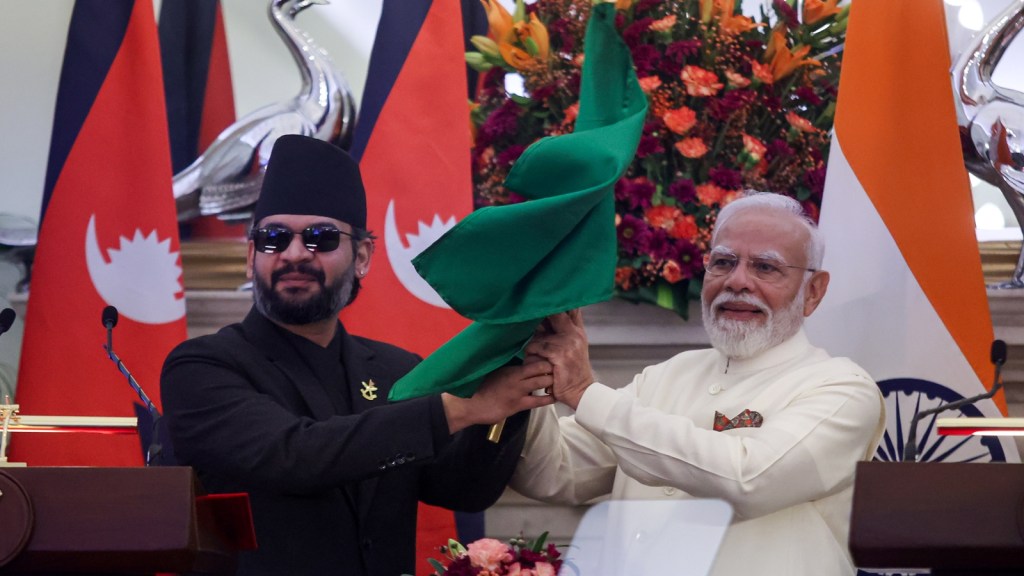
India and Nepal agree on a joint vision document to deepen their bilateral partnership.
Image: Indian Express
Why in news
On November 23, 2026, Prime Ministers Narendra Modi and Balendra Shah agreed on the document ‘Viksit Bharat and Samunnat Nepal: Re-imagining the Partnership’. The visit combined infrastructure inaugurations with announcements on development assistance, education, innovation and economic cooperation.
₹15,000 crore
Development package announced
10
Joint vision pillars
604 km
Ayodhya–Janakpur rail distance
Around 19 hours
Reported rail journey duration
Once a week
Train frequency in each direction
At least once in six mon
Monitoring group meeting frequency
Background
India and Nepal share an open border, extensive family and cultural ties, and interconnected economic interests. Nepal is a landlocked Himalayan country bordering India and China; access through India is important for its overseas trade and essential supplies. The Treaty of Peace and Friendship forms part of the institutional foundation of bilateral relations, alongside arrangements governing trade, transit and sectoral cooperation. India’s Neighbourhood First policy prioritises engagement with neighbouring countries through development partnerships, connectivity and people-to-people ties. Nepal’s sovereign choices and concerns about unequal dependence make mutual respect central to this relationship.
What the joint vision changes
The joint vision seeks to move the relationship beyond individual projects towards a broader partnership covering economic development, health, sports, technology and agriculture. It calls for an updated legal framework and allows existing bilateral agreements to be reviewed with mutual consent.
The leaders agreed that outstanding matters relating to water resources, energy, trade and commerce, and the boundary should be addressed through discussion and dialogue. This is a commitment to a method of dispute resolution, not evidence that the disputes have been settled.
- The development package signals political commitment, but its announcement must be distinguished from actual disbursement and project completion.
- Proposed cross-border special economic zones and IT parks could connect infrastructure investment with production and employment.
- The supplied reports do not specify the package’s grant–loan composition, sector-wise allocation or disbursement schedule.
Infographic
Development
₹15,000-crore package announced; delivery details remain crucial.
Connectivity
Rail, road and petroleum infrastructure deepen practical links.
Transit
Better routes and procedures can improve overseas market access.
Human capital
Proposed IIT campus, scholarships and innovation support.
Trust and delivery
Mutual consent, dialogue and regular implementation monitoring.
AI-assisted infographic by Pragnya IAS Academy, based on the cited sources.
Connectivity: from cultural travel to economic integration
The inaugurated Saryu-Kamala Express connects Ayodhya with Janakpur through Jaynagar, linking centres associated with the Ramayana tradition. Its direct service can support pilgrimage tourism, family visits, education and business travel, although the weekly frequency limits flexibility.
The Dharchula road bridge was also inaugurated. The dedication of Phase II of the Motihari–Amlekhgunj petroleum pipeline and the foundation stone laying for the Jhapa petroleum terminal extend cooperation into essential-supply infrastructure. These initiatives can strengthen reliability, but passenger rail, road access and petroleum logistics serve distinct functions.
- A direct train removes the need for passengers to change trains between the two destinations.
- The reported route connects towns in Uttar Pradesh and Bihar with Janakpur in Nepal.
- Border procedures remain relevant: an open border does not eliminate customs and security checks.
- Regular passenger services were expected to begin later in November; inauguration should not be equated with an already established regular service.
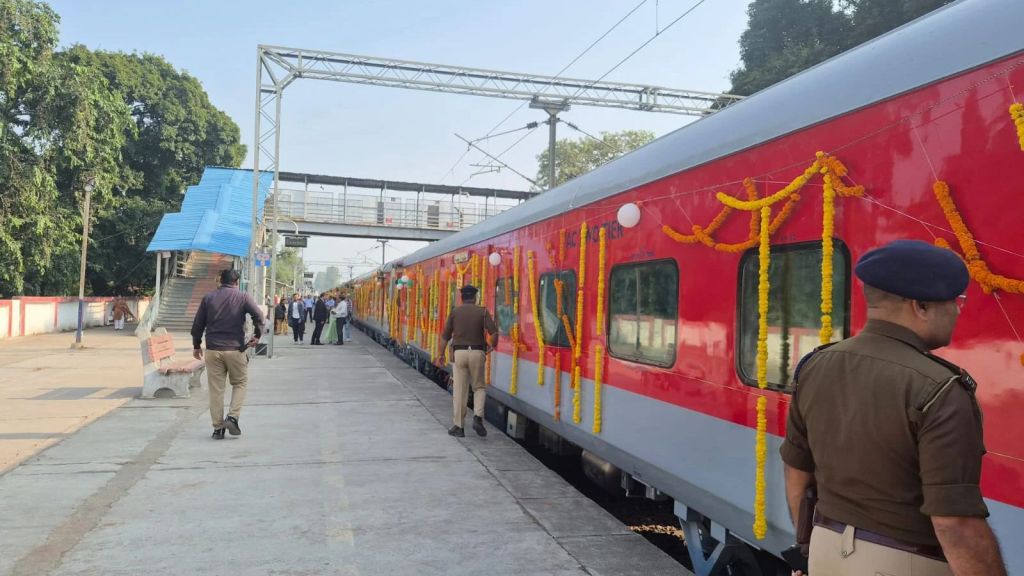
The Saryu Kamala Express on its inaugural run, illustrating the rail connectivity dimension of India–Nepal cooperation. Photo: Anish Mondal/Express.
Image: Indian Express
Transit and port access: strategic relevance, limited reported detail
For landlocked Nepal, transit through India connects domestic producers and consumers with maritime trade. Better access to Indian ports can reduce logistical uncertainty when supported by efficient customs, reliable inland transport and predictable transit rules.
The joint vision envisages reviewing enabling agreements and opening new transit connectivity and air routes. However, the supplied material does not identify a newly granted port-access concession, name an additional port or provide revised port-use terms. Port access should therefore be analysed as an important dimension of transit cooperation, not presented as a verified new decision of this visit.
- Physical access to a port is insufficient without efficient last-mile links, cargo handling and documentation.
- Improved transit can support Nepal’s export diversification while generating opportunities for Indian logistics and border economies.
- Dependable access and mutually agreed rules are essential to prevent interdependence from becoming a source of political insecurity.
Education and innovation: broadening the development partnership
India announced an offshore IIT campus in Nepal, a startup incubator and an innovation hub, alongside expanded scholarship opportunities in law and technology for Nepali students in India. Together, these proposals extend cooperation from physical assets to human capital and innovation capacity.
A locally accessible technology institution could help retain talent and connect research with Nepal’s development priorities. Its effectiveness would depend on academic quality, faculty availability, affordability and industry linkages rather than the institutional brand alone. The supplied sources do not identify the parent IIT, campus location or operational timeline.
- Scholarships can deepen professional networks and people-to-people connections.
- An incubator can complement education by helping translate ideas into enterprises.
- Research partnerships could focus on locally relevant challenges such as resilient infrastructure, agriculture and disaster preparedness.
Neighbourhood First: credibility through delivery and respect
The package advances Neighbourhood First by combining development finance, essential supplies, connectivity and youth-oriented cooperation. Nepal also acknowledged India’s humanitarian and search-and-rescue assistance following the August 2026 floods and debris flows, reinforcing the importance of disaster-response cooperation.
The central strategic test is whether unequal economic capabilities can produce mutually beneficial interdependence. India gains from a stable and prosperous neighbour, while Nepal gains infrastructure, skills and market access. These benefits will endure only if cooperation respects Nepal’s agency and produces visible local gains.
The leaders decided to activate the High-Level Monitoring Group, led by Nepal’s Foreign Secretary and India’s Ambassador. Its scheduled meetings provide an accountability mechanism, but success requires project-level milestones, timely decisions and follow-through.
- Consultation and mutual consent are essential when reviewing sensitive bilateral agreements.
- Boundary and water-related differences require sustained institutional dialogue.
- Transparent delivery can build more durable trust than announcements alone.
| Initiative | Reported status | Significance |
|---|---|---|
| Development package | ₹15,000 crore announced; detailed financing terms not supplied | Potential support for development, subject to allocation and execution |
| Ayodhya–Janakpur rail service | Inaugurated; regular services expected later in November | Direct cultural, family and tourism connectivity |
| Dharchula road bridge | Inaugurated | Improved cross-border road connectivity |
| Petroleum infrastructure | Pipeline Phase II dedicated; Jhapa terminal foundation stone laid | Stronger infrastructure for essential-supply logistics |
| IIT campus and innovation institutions | Announced; operational details not reported | Human-capital development and innovation cooperation |
| Transit and port access | New transit connectivity envisaged; no specific new port concession reported | Potential improvement in Nepal’s access to overseas markets |
| High-Level Monitoring Group | Activation decided; meetings at least once in six months | Institutional follow-up on implementation |
- 1. Identify projects jointly around Nepal’s priorities and shared bilateral benefits.
- 2. Clarify financing, legal arrangements and implementing responsibilities.
- 3. Complete safeguards, technical preparation and cross-border coordination.
- 4. Deliver infrastructure, academic programmes and enterprise support.
- 5. Use the High-Level Monitoring Group to address bottlenecks.
- 6. Assess outcomes in access, reliability, employment and local economic opportunity.
August 2026
Floods and debris flows affected the Rasuwa–Trishuli basin and other areas of Nepal; India provided humanitarian and search-and-rescue assistance.
November 22, 2026
Prime Minister Balendra Shah arrived in New Delhi for his first official visit to India.
November 23, 2026
The leaders agreed on the joint vision, inaugurated connectivity projects and announced development and education initiatives.
Later in November 2026
Regular passenger services on the Ayodhya–Janakpur Saryu-Kamala Express were expected to begin.
Significance, challenges & way forward
Significance
- The joint vision broadens Neighbourhood First from assistance-led engagement towards an integrated development partnership.
- Direct rail connectivity can convert shared cultural heritage into tourism and local livelihood opportunities.
- Transit cooperation can reduce disadvantages arising from Nepal’s landlocked geography and support regional value chains.
- The proposed IIT campus and innovation institutions place youth, skills and entrepreneurship within the bilateral agenda.
- Petroleum infrastructure and disaster-response cooperation strengthen the practical foundations of mutual trust.
- Agreement review by mutual consent offers a route to modernise relations without disregarding sovereignty.
Challenges
- The supplied reports leave financing terms, project allocations and several operational timelines unspecified.
- Different stages of implementation create a risk of treating announcements, foundation stones and completed facilities as equivalent achievements.
- Weekly rail frequency and border procedures may limit the convenience of the new passenger service.
- Landlocked dependence and unequal economic capabilities can generate concerns about autonomy and reliability.
- Boundary, water-resource and trade differences can complicate cooperation unless dialogue remains sustained.
- Himalayan infrastructure requires careful environmental assessment and resilience to floods, landslides and other hazards.
- The proposed IIT campus will need credible governance, faculty, funding and affordable access.
Way forward
- Publish a jointly agreed implementation matrix specifying financing instruments, responsible agencies and project milestones.
- Use the High-Level Monitoring Group to resolve bottlenecks and issue mutually agreed progress updates.
- Pair physical connectivity with simpler customs procedures, coordinated border operations and reliable logistics.
- Clarify proposed transit improvements, including any port-related arrangements, through negotiated and publicly explained terms.
- Develop the IIT campus and innovation institutions around Nepal’s educational priorities, quality assurance and industry demand.
- Build disaster resilience, environmental safeguards and local consultation into infrastructure design.
- Sustain dialogue on outstanding disputes while protecting practical cooperation from avoidable disruption.
Key terms
- Neighbourhood First
- India’s policy approach prioritising relations with neighbouring countries through cooperation, connectivity and development partnerships.
- Transit access
- Arrangements allowing goods to pass through another country’s territory to reach external markets or ports.
- Bilateral interdependence
- A relationship in which both countries derive benefits from, and face costs from disruption of, their economic and social links.
- Offshore IIT campus
- A campus of an Indian Institute of Technology established outside India under applicable institutional and host-country arrangements.
- Special economic zone
- A designated area with a special regulatory or incentive framework intended to encourage investment, production and exports.
- Development partnership
- Cooperation supporting another country’s development through infrastructure, finance, training, technology or institutional capacity.
- High-Level Monitoring Group
- The bilateral mechanism led by Nepal’s Foreign Secretary and India’s Ambassador to follow up on implementation.
Link with static syllabus
Prelims practice MCQs
Q1. With reference to the India–Nepal joint vision agreed in November 2026, consider the following statements: 1. Existing bilateral agreements may be reviewed with mutual consent. 2. Outstanding boundary matters are to be resolved through mutual discussion and dialogue. 3. The joint vision itself constitutes a final settlement of the bilateral boundary. Which of the statements given above are correct?
Q2. Consider the following pairs concerning initiatives reported during the Nepal Prime Minister’s visit: 1. Saryu-Kamala Express — Ayodhya–Janakpur connection 2. Jhapa petroleum terminal — Foundation stone laying 3. Offshore IIT campus in Nepal — Confirmed commencement of classes Which of the pairs given above are correctly matched?
Q3. With reference to India–Nepal transit cooperation, consider the following statements: 1. Nepal is a landlocked country bordering India and China. 2. Access to maritime trade depends on inland transport and transit procedures as well as port facilities. 3. The supplied reports identify a specific additional Indian port newly opened to Nepal during the visit. Which of the statements given above are correct?
Q4. The High-Level Monitoring Group mentioned in the India–Nepal joint vision is to be led by:
Mains practice questions
GS 2 · 15 marks · 250 words
Assess how the India–Nepal joint vision can advance India’s Neighbourhood First policy through connectivity, development and education cooperation. What conditions are necessary for mutually beneficial interdependence?
Frequently asked questions
What is the central purpose of the India–Nepal joint vision?
It seeks to modernise the partnership across development, connectivity, technology and other sectors. It also provides for reviewing agreements with mutual consent and addressing outstanding matters through dialogue.
Has the proposed IIT campus in Nepal started functioning?
The supplied reports establish an announcement, not operational commencement. They do not specify the parent IIT, location or opening timeline.
Did the visit provide Nepal with new access to a named Indian port?
The supplied material does not identify a specific new port-access concession. It reports a broader intention to review enabling agreements and expand transit connectivity.
Why does the Ayodhya–Janakpur rail link matter?
It provides a direct connection supporting pilgrimage, tourism and family travel. Its wider benefits depend on service reliability, frequency and efficient border procedures.
Sources
- The Hindu: Nepal PM India visit highlights: PM Modi announces offshore campus of IIT in Nepal
- Indian Express: India, Nepal agree on comprehensive joint vision document to strengthen partnership
- Indian Express: India-Nepal rail link will boost cultural ties, say passengers on inaugural journey
- Indian Express: ‘Ties built on trust’: India announces Rs 15,000 crore package for Nepal
Analysis prepared by the Pragnya IAS Academy current-affairs desk with AI assistance from the cited reports. Verify figures with the original sources.
Turn current affairs into marks
Join Pragnya IAS Academy's mentorship for daily answer-writing evaluation on stories like this — classroom programmes from a trusted name in IAS coaching in Hyderabad.