
India–U.S. Trade Deal: Legal Status, Tariff Risks and Competitive Advantage
Revise the static topic: UPSC International Relations notes
In short: Commerce Minister Piyush Goyal said the first tranche of the India–U.S. trade agreement had been finalised, while acknowledging that legal drafting and final contours remained unfinished. Implementation is linked to clarity on India’s competitive advantage over peer countries, so the announcement should not be treated as evidence of a signed, legally effective or operational agreement.
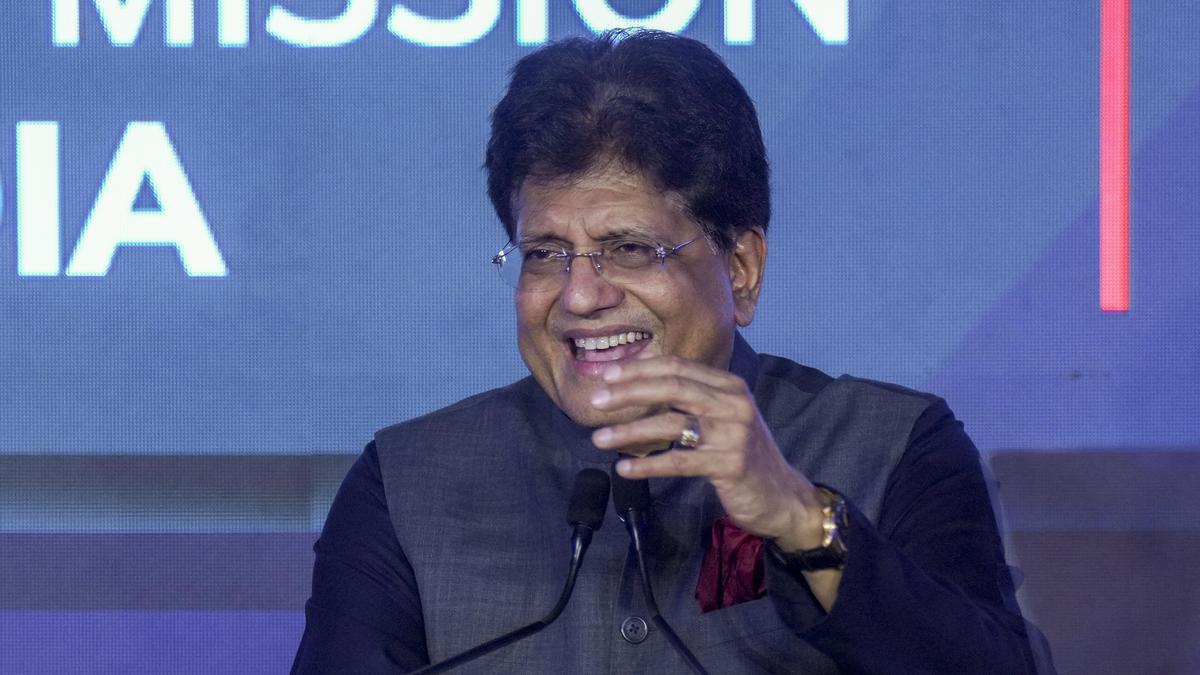
Piyush Goyal said the first tranche of the India–U.S. trade agreement had been finalised, but legal drafting remained unfinished and implementation depended on clarity about India’s competitive advantage. The announcement does not establish a signed or operational agreement.
Image: The Hindu
Why in news
On October 15, 2026, Piyush Goyal described the first tranche as finalised despite recent Indian and American statements indicating negotiating constraints. The reported U.S. tariff measures and pending investigations make the agreement’s effective market-access benefits uncertain.
10%
Reported U.S. tariff on imports from India
Up to 100%
Potential tariff ceiling under reported Russian-energy law
Background
Trade agreements seek to improve market access through negotiated commitments that may cover tariffs, customs procedures, standards and other trade barriers. Their economic value depends on product coverage, implementation schedules and the interaction between concessions and other regulatory measures. Under the WTO framework, most-favoured-nation treatment is a foundational principle, while preferential agreements must satisfy applicable legal conditions. In India, treaty-making generally falls within the Union executive’s sphere; Parliament has power under Article 253 to enact legislation implementing international agreements.
What has been announced—and what remains unproven
Goyal’s statement indicates claimed progress on the first tranche, not demonstrated completion of every legal and operational stage. His accompanying references to final contours, legal drafting and conditional operationalisation qualify the description of the deal as finalised.
Finance Minister Nirmala Sitharaman had described negotiations as having plateaued, while U.S. Trade Representative Jamieson Greer had said an agreement was not imminent. These statements may reflect different assessments of unresolved issues; the supplied report does not establish their reconciliation.
Commerce Secretary Rajesh Agrawal’s expectation of signing at the earliest possible time also indicates that signature was still prospective. The supplied material does not provide an authenticated agreement text, final tariff schedules or a confirmed entry-into-force date.
- Treat ministerial announcements as evidence of the stated negotiating position, not as substitutes for the legal instrument.
- Distinguish the first tranche from the larger Bilateral Trade Agreement and the previously announced interim agreement.
- Do not infer sector-specific concessions, exclusions or safeguards that the source does not disclose.
Infographic
Legal certainty
Verify text, signature, entry into force and implementation.
Relative access
Compare India’s treatment with competing suppliers.
Tariff clarity
Resolve the interaction of concessions and separate duties.
Usable benefits
Address origin rules, standards and exporter capacity.
Strategic balance
Deepen cooperation while preserving policy autonomy.
AI-assisted infographic by Pragnya IAS Academy, based on the cited sources.
Market access: The relevant test is relative competitiveness
A tariff concession benefits Indian exporters only to the extent that it improves commercially usable access. The relevant comparison is the final treatment of Indian products against competing suppliers in the same product categories, rather than the headline concession alone.
Rules of origin, product standards, customs delays and compliance costs can reduce the value of nominal tariff preferences. Exchange rates, logistics, productivity and delivery reliability also influence whether exporters can convert improved access into orders.
Competitive advantage in this negotiation should not be confused with comparative advantage in economic theory. The former concerns India’s actual position against rival suppliers; the latter refers to producing goods at a lower opportunity cost.
- Compare final product-wise tariff treatment with that available to peer exporters.
- Assess market-access gains alongside the domestic adjustment costs of reciprocal concessions.
- Evaluate whether smaller exporters can satisfy origin and compliance requirements without disproportionate costs.
Tariff uncertainty could dilute negotiated concessions
The Hindu report states that the U.S. imposed a 10% tariff on imports from India following a Section 301 investigation concerning prevention of imports of goods made using forced labour. It also reports a separate excess-capacity investigation that could produce further tariffs.
The report describes a law signed in September 2026 that could permit tariffs of up to 100% on countries such as India importing substantial Russian oil and gas. This is a reported potential ceiling, not an established final tariff on India; the report says the final tariffs were awaited.
The source does not establish whether these measures would overlap, be exempted, be modified or apply differently across products. Consequently, the reported rates must not be added together or presented as India’s final effective tariff burden.
- Section 301 is a U.S. domestic trade-law mechanism, not a WTO dispute-settlement ruling.
- A bilateral concession does not by itself establish exemption from a separate tariff measure.
- Legal clarity on the interaction of tariff instruments is essential for pricing and investment decisions.
Legal implementation and strategic implications
Legal drafting translates negotiating understandings into precise obligations: coverage, definitions, exceptions, timelines and procedures. Whether signature itself creates operative obligations or further steps are required depends on the instrument’s terms and applicable domestic law.
In India, Article 73 concerns the extent of Union executive power, including rights, authority and jurisdiction exercisable by virtue of treaties or agreements. Article 253 empowers Parliament to legislate for treaty implementation. Not every agreement requires parliamentary ratification, but implementing obligations that change existing law may require legislation; measures within delegated statutory powers may be taken through notifications.
A credible agreement could strengthen economic confidence within India–U.S. strategic relations. However, the reported connection between tariffs and Russian energy purchases shows how commercial negotiations can intersect with wider geopolitical choices. Strategic cooperation should therefore support, rather than replace, scrutiny of enforceable economic benefits.
- Verify the legal text, signature status, entry-into-force provisions and implementing measures separately.
- Preserve policy space through carefully drafted exceptions and review arrangements where negotiated.
- Avoid equating strategic convergence with automatic alignment on tariffs or energy policy.
| Stage or issue | Evidence in the supplied report | Correct interpretation |
|---|---|---|
| Negotiating announcement | Goyal described the first tranche as finalised. | A ministerial claim of progress, qualified by pending work. |
| Legal drafting | Final contours and legal drafting remained underway. | The report does not establish completion of the legal instrument. |
| Signature | The Commerce Secretary anticipated signing at a mutually agreed time. | Signature was prospective in the report. |
| Operationalisation | Goyal linked implementation to competitive advantage over peers. | No confirmed operational date is established. |
| Final market access | Tariff restructuring and further tariff outcomes remained relevant. | Net benefits cannot be quantified from the supplied material. |
- 1. Identify precisely what negotiating outcome has been announced.
- 2. Examine the final legal text, product schedules and exceptions when available.
- 3. Verify signature and the instrument’s entry-into-force requirements.
- 4. Confirm necessary domestic legislation or implementing notifications.
- 5. Determine how concessions interact with other applicable tariffs and regulations.
- 6. Compare effective access with peer exporters and monitor actual utilisation.
October–November 2025
The report identifies this as the original target window for concluding the larger Bilateral Trade Agreement.
February 2026
An interim trade agreement was announced, according to the report.
March–April 2026
The announced interim agreement was expected to be implemented in this period.
September 2026
The report says the U.S. President signed legislation permitting potentially high tariffs linked to Russian oil and gas purchases.
Earlier in October 2026
Sitharaman described negotiations as having plateaued; Greer had earlier indicated that a deal was not imminent.
October 15, 2026
Goyal said the first tranche was finalised while acknowledging pending drafting and conditional implementation; Agrawal anticipated a future signing.
Significance, challenges & way forward
Significance
- Predictable market access could help Indian exporters plan contracts, production and investment.
- A genuine advantage over competing suppliers could improve India’s position in international supply chains.
- Legal certainty would reduce the gap between diplomatic announcements and commercial expectations.
- A workable agreement could strengthen the economic foundation of India–U.S. strategic cooperation.
Challenges
- The absence of a final text and product schedules in the supplied material prevents a reliable assessment of sectoral gains and losses.
- Pending U.S. tariff outcomes could alter the value of negotiated concessions.
- Different public assessments of negotiating progress complicate expectations about closure.
- Reciprocal concessions may impose adjustment costs on exposed domestic producers.
- Energy-linked trade pressure could create tensions between market access and India’s strategic autonomy.
- Complex origin and compliance requirements could limit preference utilisation by smaller firms.
Way forward
- Publish the final agreement and accessible explanatory schedules once legally cleared, distinguishing commitments from negotiating intentions.
- Clarify the legal interaction between negotiated concessions and separate U.S. tariff measures.
- Benchmark product-wise access against competing suppliers rather than relying on headline tariff reductions.
- Consult affected industries, workers and other stakeholders on implementation and adjustment needs.
- Strengthen testing, traceability, logistics and exporter assistance to make market access commercially usable.
- Seek clear consultation, review and dispute-management provisions while maintaining export-market diversification.
Key terms
- Bilateral Trade Agreement
- An agreement between two trading partners establishing negotiated trade-related rights and obligations.
- Tranche
- A distinct part or instalment of a broader negotiated package.
- Market access
- The conditions under which goods or services can enter and compete in another market.
- Competitive advantage
- An ability to compete more effectively than rivals because of costs, quality, market treatment or other commercial strengths.
- Comparative advantage
- The ability to produce a good or service at a lower opportunity cost than another producer.
- Rules of origin
- Criteria used to determine a product’s country of origin, including eligibility for preferential treatment.
- Section 301
- A provision of the U.S. Trade Act of 1974 authorising action concerning specified foreign practices affecting U.S. commerce.
- Entry into force
- The point at which an agreement becomes legally effective under its specified conditions.
Link with static syllabus
Prelims practice MCQs
Q1. With reference to the reported India–U.S. trade negotiations, consider the following statements: 1. The first tranche was described by the Commerce Minister as finalised. 2. The supplied report establishes that the agreement had been signed and had entered into force. 3. Implementation was linked to clarity on India’s competitive advantage over peer countries. Which of the statements given above are correct?
Q2. Consider the following statements about international agreements in India: 1. Article 253 empowers Parliament to legislate for implementing international agreements. 2. Every international trade agreement must undergo parliamentary ratification before signature. Which of the statements given above is/are correct?
Q3. Which of the following best describes Section 301 referred to in the supplied report?
Q4. Consider the following statements: 1. Comparative advantage concerns relative opportunity costs. 2. A nominal tariff reduction necessarily gives exporters an advantage over all competing suppliers. 3. Rules of origin can affect utilisation of preferential tariffs. Which of the statements given above are correct?
Mains practice questions
GS 2 · 15 marks · 250 words
A trade agreement must be assessed by enforceable and commercially usable market access, not merely by its announcement. Discuss in the context of the proposed India–U.S. trade agreement.
Frequently asked questions
Has the India–U.S. trade agreement become operational?
The supplied report does not establish operationalisation. It records a ministerial claim that the first tranche was finalised, alongside pending legal drafting, prospective signing and conditional implementation.
Why does India’s advantage over peer exporters matter?
A concession may offer limited benefit if competing suppliers receive equal or better treatment. India must compare final product-wise access, including other applicable duties and compliance costs.
Does the reported tariff ceiling mean India already faces a 100% tariff?
No. The report describes a potential ceiling under a law linked to Russian energy purchases and says final tariffs on India were awaited.
Must Parliament ratify every Indian trade agreement?
There is no universal constitutional requirement for parliamentary ratification of every agreement. Parliament may need to legislate where implementation requires changes to existing law, with Article 253 providing the relevant legislative power.
Sources
Analysis prepared by the Pragnya IAS Academy current-affairs desk with AI assistance from the cited reports. Verify figures with the original sources.
Turn current affairs into marks
Join Pragnya IAS Academy's mentorship for daily answer-writing evaluation on stories like this — classroom programmes from a trusted name in IAS coaching in Hyderabad.