
Biodiversity COP17 in Yerevan: Finance, Accountability and Equitable Conservation
Revise the static topic: UPSC Environment notes
In short: Biodiversity COP17 opens in Yerevan, Armenia, to review implementation of the Kunming-Montreal Global Biodiversity Framework and accelerate action towards its 2030 targets. With fewer than half of assessed national targets on track, the central challenge is to translate commitments into adequately financed, measurable and equitable conservation.

Reference panorama of Yerevan, Armenia, with Mount Ararat in the background. The city is the host location for biodiversity COP17; this is not a photograph of the talks.
Image: UN News
Why in news
The UN Biodiversity Conference, scheduled from 19 to 30 October 2026, is taking stock of global progress towards halting and reversing biodiversity loss. The supplied UN News reports highlight uneven implementation, inadequate resources and gaps in monitoring and accountability.
30%
Land and sea conservation ambition by 2030
23
Framework targets for 2030
4
Long-term goals for 2050
Nearly 90%
CBD parties with national biodiversity targets
Close to 60%
CBD parties with national strategies and action plans
Fewer than half
Assessed national targets on track
Background
The Convention on Biological Diversity is an international treaty whose objectives are the conservation of biological diversity, sustainable use of its components, and fair and equitable sharing of benefits arising from the utilisation of genetic resources. Its Conference of the Parties reviews implementation and guides collective action. Adopted in 2022, the Kunming-Montreal Global Biodiversity Framework provides a global roadmap for biodiversity action; it is not a separate treaty. National Biodiversity Strategies and Action Plans translate international commitments into domestic priorities. In India, the Biological Diversity Act provides an institutional framework involving the National Biodiversity Authority, State Biodiversity Boards and local Biodiversity Management Committees.
What COP17 is expected to deliver
Yerevan is being presented as both a review COP and an implementation COP. Its task is to establish where countries stand, identify what is working and determine how implementation can be accelerated before 2030.
The framework extends beyond protected areas. It addresses the drivers of biodiversity loss, conservation finance, harmful incentives, sustainable production and consumption, and business impacts and dependencies on nature. The supplied reports describe the opening agenda and expectations, not final negotiated outcomes.
- Align national biodiversity targets and action plans with global commitments.
- Mobilise resources and strengthen implementation capacity.
- Improve monitoring, reporting and accountability for results.
- Enable meaningful participation by Indigenous Peoples, local communities, women and youth.
Infographic
Aligned plans
Translate global goals into actionable national priorities.
Adequate finance
Fund implementation and reform harmful incentives.
Measurable outcomes
Track ecosystem health, not just designated area.
Equitable participation
Include communities, women and youth in decisions.
Accountability
Use transparent reviews to correct implementation gaps.
AI-assisted infographic by Pragnya IAS Academy, based on the cited sources.
The implementation gap: Plans are necessary, but outcomes matter
Nearly 90 per cent of the Convention's 196 parties have established national biodiversity targets, close to 60 per cent have developed national biodiversity strategies and action plans, and more than 70 per cent have submitted national reports. Yet fewer than half of the national targets assessed by parties are on track. These figures distinguish procedural progress from ecological achievement.
According to the UN Secretary-General, an additional 1.3 million square kilometres of land and six million square kilometres of ocean have received formal protection since 2022. This is meaningful progress, but formal designation alone cannot establish whether habitats are healthy, species are recovering or conservation is equitably governed.
- Assess national ambition as well as implementation: meeting a weak target may still fall short of global needs.
- Track ecosystem condition, species trends and management effectiveness alongside conserved area.
- Strengthen baselines, comparable indicators and data systems to make progress verifiable.
Conservation finance: Mobilisation must be matched by policy coherence
The UN reports identify finance, capacity and cooperation as major implementation gaps. Conservation requires reliable support for ecological restoration, long-term management, monitoring and the participation of communities whose livelihoods depend on biodiversity.
Mobilising additional resources is only part of the solution. The framework also addresses harmful incentives and unsustainable production and consumption. Conservation spending can be undermined when other policies continue to encourage habitat conversion, excessive extraction or pollution.
- Link biodiversity plans to public budgets, responsible agencies and implementation responsibilities.
- Reform biodiversity-harming incentives while protecting vulnerable livelihoods through transition support.
- Use private finance as a complement to public responsibility, with transparent environmental claims and safeguards.
- Assess expenditure by ecological and social outcomes rather than announcements or disbursement alone.
Equitable participation: Communities as decision-makers
The CBD leadership has called for greater contributions from Indigenous Peoples and local communities, women and youth, alongside cities, businesses and financial institutions. Participation matters because biodiversity loss directly affects food, water, livelihoods and cultural practices, while conservation decisions can alter access to land and resources.
Conservation that excludes resource-dependent communities can create conflict and weaken legitimacy. A rights-sensitive approach should combine scientific evidence with community knowledge, meaningful participation, fair benefit-sharing and accessible grievance mechanisms.
- Involve communities in planning, implementation and monitoring rather than consulting them only after decisions are made.
- Recognise conservation contributions beyond formally designated protected areas where relevant criteria are met.
- Assess who bears conservation costs and who receives its benefits.
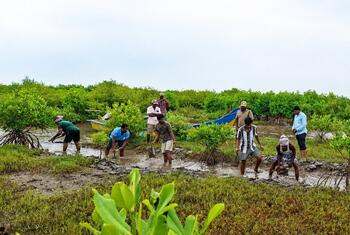
Reference image of community members restoring mangroves under the GCF ECRICC Project in Andhra Pradesh, India. It illustrates community involvement in conservation, while the article examines the further need for equitable decision-making.
Image: UN News
India's policy relevance: Connect biodiversity governance with development
For India, implementation is a cross-sectoral governance challenge rather than an environment-department task alone. Agriculture, fisheries, forestry, infrastructure, urban development and pollution control all influence biodiversity outcomes.
India's biodiversity institutions offer channels for national, State and local coordination. Biodiversity Management Committees and People's Biodiversity Registers can support locally grounded knowledge and planning, while implementation must respect applicable forest rights and environmental laws.
- Use landscape and seascape planning to connect protected habitats with wider production systems.
- Integrate biodiversity considerations into development planning and environmental appraisal.
- Strengthen local institutions with technical support, accessible finance and feedback on monitoring results.
- Revise Article 48A, Article 51A(g), the Biological Diversity Act and the Forest Rights Act for the constitutional and legal context.

Reference photograph of a tiger at Bandhavgarh National Park, India. Protected wildlife habitats provide a concrete setting for the article’s discussion of connecting biodiversity governance with development policy.
Image: UN News
| Dimension | Present signal from the sources | Implementation priority |
|---|---|---|
| National planning | Target-setting is more widespread than completed strategies and action plans. | Translate targets into funded, institutionally assigned actions. |
| Conservation coverage | Formal land and ocean protection has expanded since 2022. | Verify ecological effectiveness, connectivity and equitable governance. |
| Finance | Major resource gaps persist. | Improve predictable funding and reform harmful incentives. |
| Monitoring | Reporting has advanced, but data gaps remain. | Track comparable outcomes against credible baselines. |
| Participation | UN leadership seeks greater engagement by communities, women and youth. | Enable meaningful roles in decisions, benefits and monitoring. |
- 1. Translate global commitments into nationally relevant biodiversity targets.
- 2. Prepare action plans with responsibilities, baselines and indicators.
- 3. Align budgets, incentives and sectoral policies with biodiversity objectives.
- 4. Implement conservation and sustainable-use measures with community participation.
- 5. Monitor ecological outcomes, social impacts and expenditure.
- 6. Report progress and use review findings to revise plans and close gaps.
2022
The Kunming-Montreal Global Biodiversity Framework was adopted at COP15.
COP16
According to the supplied UN account, the conference advanced mechanisms for implementing the framework.
19–30 October 2026
COP17 in Yerevan is scheduled to review progress and consider measures to accelerate implementation.
2030
Deadline for the framework's 23 targets, including its 30-by-30 conservation ambition.
2050
Horizon for the framework's four longer-term goals.
Significance, challenges & way forward
Significance
- COP17 can shift international attention from adopting commitments to demonstrating results before 2030.
- Biodiversity protection supports food security, water security, livelihoods and resilience to environmental shocks.
- Better monitoring can distinguish formal protection and administrative compliance from genuine ecological recovery.
- Equitable participation can strengthen conservation legitimacy, local knowledge and long-term stewardship.
- Coordinated action can address the interconnected crises of biodiversity loss, climate change and pollution.
Challenges
- Fewer than half of assessed national targets are on track, while national ambition also remains insufficient.
- Finance and capacity gaps can prevent national plans from becoming operational programmes.
- Incomplete data and uneven monitoring capacity limit reliable assessment and comparison.
- Sectoral incentives may continue to promote habitat conversion, overexploitation and pollution.
- Area-based conservation pursued without safeguards can marginalise biodiversity-dependent communities.
- Formal protection may fail to deliver ecological gains where management, connectivity and enforcement are weak.
Way forward
- Convert national biodiversity strategies into costed implementation plans with clear institutional responsibility.
- Prioritise predictable finance for long-term management, restoration, local institutions and monitoring.
- Reform harmful incentives through transparent assessments and socially just transition measures.
- Combine area-based indicators with measures of ecosystem condition, species recovery and equitable governance.
- Give communities meaningful decision-making roles, fair benefits and accessible grievance mechanisms.
- Integrate biodiversity into agriculture, fisheries, infrastructure and urban policies rather than treating conservation as an isolated sector.
- Use periodic review to correct implementation failures and strengthen insufficient ambition.
Key terms
- Convention on Biological Diversity
- The international treaty addressing biodiversity conservation, sustainable use and equitable benefit-sharing from genetic resources.
- Kunming-Montreal Global Biodiversity Framework
- The global biodiversity roadmap adopted in 2022, with targets for 2030 and longer-term goals for 2050.
- 30 by 30
- The framework's ambition to conserve 30 per cent of land and sea by 2030.
- NBSAP
- A National Biodiversity Strategy and Action Plan translating biodiversity commitments into domestic priorities and actions.
- Other effective area-based conservation measures
- Geographically defined areas outside protected areas that deliver sustained, long-term in-situ biodiversity conservation.
- Access and benefit-sharing
- Arrangements governing access to genetic resources and fair and equitable sharing of benefits from their utilisation.
- Harmful incentives
- Policies or economic inducements that encourage activities damaging biodiversity.
- Triple planetary crisis
- The interconnected crises of climate change, biodiversity loss and pollution.
Link with static syllabus
Prelims practice MCQs
Q1. With reference to the Kunming-Montreal Global Biodiversity Framework, consider the following statements: 1. It was adopted in 2022. 2. It contains 23 targets for 2030 and four longer-term goals for 2050. 3. It is confined to expanding formally designated protected areas. Which of the statements given above are correct?
Q2. Which of the following is not an objective of the Convention on Biological Diversity?
Q3. Consider the following pairs: 1. National Biodiversity Strategy and Action Plan — Domestic planning for biodiversity commitments 2. Biodiversity Management Committee — Local-level institution under India's biodiversity framework 3. Article 51A(g) — Fundamental Duty relating to protection and improvement of the natural environment How many of the above pairs are correctly matched?
Q4. With reference to biodiversity conservation, consider the following statements: 1. An increase in formally protected area necessarily proves improvement in ecosystem condition. 2. Other effective area-based conservation measures can contribute to in-situ conservation outside protected areas. 3. Community participation is irrelevant once a conservation area has legal protection. Which of the statements given above is/are correct?
Mains practice questions
GS 3 · 15 marks · 250 words
Global biodiversity conservation faces an implementation deficit rather than merely a commitment deficit. Discuss with reference to COP17, highlighting conservation finance, monitoring and equitable community participation.
Frequently asked questions
What is the main purpose of Biodiversity COP17 in Yerevan?
It is reviewing progress under the Kunming-Montreal Global Biodiversity Framework and considering how to accelerate implementation towards 2030. Finance, monitoring, accountability and inclusive participation are central concerns.
Is Biodiversity COP17 the same as a climate COP?
No. Biodiversity COP17 is a meeting of parties to the Convention on Biological Diversity, whereas climate COPs operate under the UN Framework Convention on Climate Change.
Does 30 by 30 mean that declaring more protected areas is sufficient?
No. Conserved areas must deliver effective biodiversity outcomes and equitable governance; formal designation alone does not establish ecological recovery.
Have the supplied reports announced final COP17 decisions?
No. They describe the conference's opening context, progress assessments and priorities, not final negotiated decisions.
Sources
- UN News: Protecting Earth’s fragile biodiversity takes spotlight at Armenia talks
- UN News: COP17: The world has a plan to save nature. Is it working?
Analysis prepared by the Pragnya IAS Academy current-affairs desk with AI assistance from the cited reports. Verify figures with the original sources.
Turn current affairs into marks
Join Pragnya IAS Academy's mentorship for daily answer-writing evaluation on stories like this — classroom programmes from a trusted name in IAS coaching in Hyderabad.