
Quad’s Economic-Security Agenda: Critical Minerals, AI Access and India’s Strategic Choices
Revise the static topic: UPSC International Relations notes
In short: Quad Foreign Ministers meeting in Atlanta on October 31, 2026 expressed concern over economic coercion and outlined cooperation on critical minerals, AI access, supply chains and maritime security. The agenda included a US commitment of $10 million for critical-mineral recovery facilities in India and ASEAN countries, alongside an intention to provide over $85 million in technical and financial assistance linked to AI initiatives. For India, these measures offer opportunities to diversify strategic dependencies, strengthen technological capabilities and shape a more resilient Indo-Pacific.
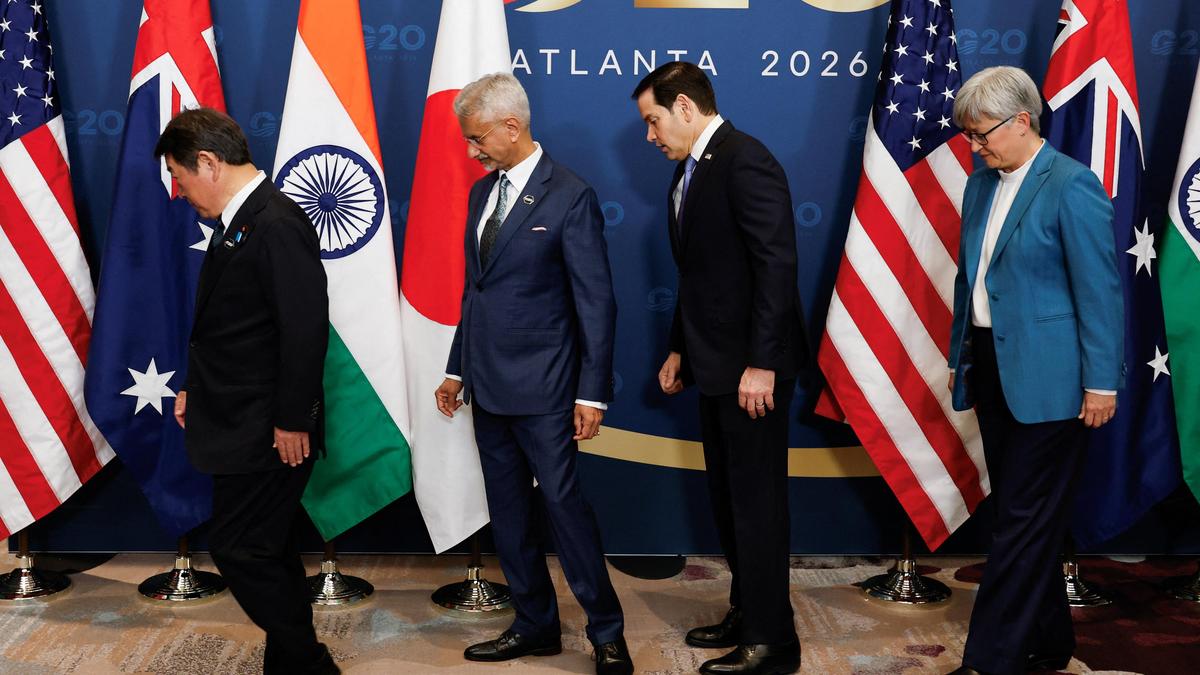
Photo from the source report: Quad’s Economic-Security Agenda: Critical Minerals, AI Access and India’s Strategic Choices
Image: The Hindu
Why in news
The Atlanta meeting was the third Quad Foreign Ministers’ Meeting of the year, following meetings in New Delhi and Manila. It reviewed practical cooperation ahead of a proposed leaders’ summit in the Philippines in November.
$10 million
US commitment for mineral recovery
Over $85 million
Intended AI-linked assistance
3
Quad ministerial meetings in 2026
Background
The Quadrilateral Security Dialogue brings together India, the United States, Japan and Australia. It is a diplomatic partnership rather than a treaty-based collective-defence alliance. Its Indo-Pacific cooperation spans maritime security and practical public goods, increasingly connecting economic resilience with strategic stability. Critical minerals are inputs essential to important economic and technological activities whose supplies may be vulnerable to disruption; their designation varies across countries. For India, Quad cooperation operates within a broader approach of strategic autonomy, diversified partnerships and support for ASEAN centrality.
What the Atlanta meeting established
The ministers placed economic security at the centre of global stability and prosperity. They reaffirmed support for reliable and open supply chains, trusted and resilient infrastructure, and cooperation in next-generation technologies.
The outcomes combined political positions, funding commitments, intended assistance and institutional initiatives. These categories must be distinguished: an announcement or expression of intent does not establish that funds have been disbursed or that projects are operational.
- The United States committed $10 million to promote facilities in India and ASEAN countries that recover critical minerals from waste.
- The ministers highlighted AI and initiatives such as Pax Silica, expressing an intention to provide over $85 million in technical and financial assistance; the reporting links the package to expanding AI access.
- They announced the first-ever Quad Business Leaders’ Forum to strengthen public-private ties.
- They noted the first-ever Quad Fuel Security Forum held in September and discussed strengthening strategic petroleum reserves and stockholdings.
- They committed to tackling online and cyber scams and holding transnational criminal groups and their leaders accountable.
Infographic
Diversified supply chains
Reduce concentrated exposure while retaining openness.
Critical-mineral recovery
$10 million US commitment for facilities in India and ASEAN countries.
AI access
Over $85 million in intended technical and financial assistance.
Maritime and fuel security
Protect navigational rights and strengthen disruption preparedness.
India’s strategic choices
Build capabilities, preserve autonomy and support regional priorities.
AI-assisted infographic by Pragnya IAS Academy, based on the cited sources.
Economic coercion: resilience without indiscriminate decoupling
The statement expressed grave concern over economic coercion, including arbitrary export restrictions, and non-market policies that create overcapacity and disrupt critical supply chains. It did not name a country. The reports interpret this language as an indirect criticism of China, including its rare-earth export controls; that interpretation should not be presented as an explicit country-specific finding by the Quad.
Economic coercion involves using economic leverage to influence another state’s choices. Concentrated supply chains can make export restrictions strategically consequential, while policy-driven overcapacity can weaken competing producers and increase longer-term dependence. However, neither every export restriction nor every instance of surplus production automatically constitutes coercion or a violation of trade rules.
For India, the appropriate objective is risk reduction through diversification, domestic capabilities and predictable trading arrangements. Blanket decoupling could raise input costs and constrain industrial competitiveness, whereas the Quad’s stated emphasis on open supply chains provides space for a more selective approach.
- Assess vulnerabilities across extraction, processing, transport and final manufacturing rather than focusing only on mineral reserves.
- Separate evidence-based trade concerns from broad geopolitical labelling.
- Avoid replacing dependence on a single supplier with dependence on an exclusive supplier bloc.
Critical minerals and AI: complementary foundations of economic security
Recovering critical minerals from waste links supply security with the circular economy. It can supplement primary mining, improve material efficiency and create domestic processing capabilities. Its contribution depends on reliable waste collection, suitable recovery technology, commercial viability and environmental safeguards.
The AI-related assistance signals an effort to broaden access to emerging technologies. Access, however, requires more than software: affordable computing, dependable electricity, connectivity, skills, suitable datasets and governance safeguards are also necessary. The supplied reports do not specify the detailed allocation, eligibility criteria or delivery arrangements for the intended assistance.
For India, the strategic opportunity lies in connecting external finance and technology partnerships with domestic research, firms and public-interest applications. Participation should build local capabilities rather than merely expand dependence on imported technology or proprietary platforms.
- Mineral recovery should complement responsible mining and refining, not be treated as a complete substitute.
- AI partnerships should support Indian-language applications, skills and locally relevant problem-solving.
- Pax Silica is mentioned in the reporting, but its detailed institutional design and obligations are not provided.
Maritime and fuel security connect the Indo-Pacific with western sea lanes
The ministers called for uninterrupted commerce, energy security and the safety of maritime crews and vessels. They specifically highlighted navigational rights and freedoms in the Strait of Hormuz, the Red Sea and the Bab el-Mandeb Strait, in accordance with international law as reflected in UNCLOS.
These references underline the interdependence of Indo-Pacific production networks and sea routes linking the Indian Ocean with West Asia and Europe. Hormuz connects the Persian Gulf with the Gulf of Oman; Bab el-Mandeb connects the Red Sea with the Gulf of Aden. Disruptions along these routes can affect energy availability, freight costs and delivery schedules.
Strategic petroleum reserves provide a buffer against temporary supply shocks, while diversified sourcing and maritime cooperation address other aspects of vulnerability. The reported call for unhindered passage without tolls should be understood within applicable international law, not as a blanket prohibition on every lawful maritime service charge.
- UNCLOS supplies the principal legal framework for ocean uses and navigational rights.
- The United States is not a party to UNCLOS; invoking the Convention does not imply that all Quad members have ratified it.
- The meeting did not announce a collective-defence obligation or a new joint military enforcement mechanism.
India’s strategic partnerships: capability gains with policy space
The agenda allows India to combine diplomatic engagement with tangible economic outcomes: diversified mineral access, recovery technologies, AI capabilities and stronger commercial networks. It also expands the practical content of partnerships with the United States, Japan and Australia beyond security consultations.
India must nevertheless retain flexibility over trade, technology regulation and relations with other partners. The Quad will be more attractive to regional countries if its initiatives respond to their development priorities rather than require exclusive geopolitical alignment.
The proposed leaders’ summit remained a plan in the supplied reports. The immediate test is therefore implementation: whether ministerial commitments generate accessible finance, viable projects, institutional continuity and measurable regional benefits.
- Preserve strategic autonomy through issue-based cooperation rather than automatic alignment.
- Work with ASEAN countries as partners in project design and implementation.
- Use business engagement to identify investible projects while maintaining transparent public oversight.
| Area | Reported outcome | Implementation test |
|---|---|---|
| Critical minerals | US commitment of $10 million for mineral recovery facilities in India and ASEAN countries | Viable recovery processes, dependable waste streams and environmental compliance |
| AI access | Intention to provide over $85 million in technical and financial assistance linked to AI initiatives | Clear allocation, affordable access, skills and local capability creation |
| Economic security | Concern over arbitrary export restrictions and non-market overcapacity | Diversification without unnecessary trade fragmentation |
| Fuel security | September Fuel Security Forum and discussion of reserves and stockholdings | Preparedness for supply disruptions and sustainable reserve management |
| Commercial diplomacy | Announcement of a Quad Business Leaders’ Forum | Conversion of dialogue into transparent, commercially viable projects |
| Maritime security | Support for navigational rights in specified sea lanes | Lawful cooperation that protects commerce and avoids escalation |
- 1. Identify concentrated dependencies and vulnerable maritime routes.
- 2. Diversify suppliers and develop mineral-recovery capabilities.
- 3. Mobilise finance, technology and public-private partnerships.
- 4. Build domestic skills, infrastructure and emergency buffers.
- 5. Measure reduced disruption risks and wider regional access.
May 2026
Quad Foreign Ministers met in New Delhi.
July 2026
Quad Foreign Ministers met in Manila.
September 2026
The first-ever Quad Fuel Security Forum was convened.
October 31, 2026
The Atlanta ministerial meeting reviewed cooperation and highlighted economic coercion, critical minerals, AI and maritime security.
Mid-November 2026, proposed
Plans were underway for a Quad leaders’ summit in the Philippines on the sidelines of the ASEAN-East Asian Summits.
Significance, challenges & way forward
Significance
- The agenda recognises that industrial inputs, technology access and maritime connectivity are integral to national security.
- Critical-mineral recovery can connect resource security with circular-economy objectives.
- AI cooperation could broaden access to productivity-enhancing technologies if finance is accompanied by infrastructure and skills.
- India can strengthen strategic partnerships while developing capabilities relevant to domestic industrial priorities.
- Practical benefits for ASEAN countries can improve the Quad’s credibility as a provider of regional public goods.
Challenges
- Funding commitments and expressions of intent do not by themselves establish disbursement, project viability or successful delivery.
- Mineral recycling faces collection, technological, commercial and environmental constraints.
- AI partnerships may reproduce dependence if access remains tied to costly proprietary platforms and external computing infrastructure.
- Differences among members over trade, export controls and regulation could complicate implementation.
- An exclusively anti-China framing could deter regional partners seeking diversified external relationships.
- Maritime security cooperation must reconcile operational needs with international law and escalation risks.
Way forward
- Publish project-level objectives, eligibility rules and implementation responsibilities for announced assistance.
- Prioritise supply-chain mapping across mining, processing, recycling and transport to identify genuine bottlenecks.
- Integrate mineral-recovery projects with safe waste collection, traceability and worker protection.
- Link AI assistance to affordable computing, local skills, Indian-language applications and responsible data governance.
- Develop reserve-management dialogue and disruption preparedness while respecting national decision-making.
- Align regional projects with ASEAN priorities and offer participation without exclusive geopolitical conditions.
- Evaluate success through operational projects, diversified sourcing and durable domestic capabilities rather than meeting frequency.
Key terms
- Economic coercion
- Use of economic pressure or dependence to influence another state’s policy choices.
- Critical minerals
- Minerals important to economic or strategic activities whose supply disruption could create significant vulnerabilities.
- Urban mining
- Recovery of useful materials from discarded products, infrastructure and other waste streams.
- Overcapacity
- A situation in which production capacity exceeds demand; its causes and trade effects require case-specific assessment.
- De-risking
- Reducing concentrated vulnerabilities without necessarily severing wider economic relationships.
- Strategic petroleum reserves
- Emergency petroleum stocks maintained to cushion significant supply disruptions.
- UNCLOS
- The United Nations Convention on the Law of the Sea, which establishes a broad legal framework for ocean uses.
- Strategic autonomy
- The capacity to make foreign-policy and security choices independently while cooperating with multiple partners.
Link with static syllabus
Prelims practice MCQs
Q1. With reference to the Quad, consider the following statements: 1. India, Japan, Australia and the United States are its members. 2. It is a treaty-based collective-defence alliance. 3. Its cooperation includes economic security and emerging technologies. Which of the statements given above are correct?
Q2. Consider the following pairs: 1. Strait of Hormuz — Persian Gulf and Gulf of Oman 2. Bab el-Mandeb — Red Sea and Gulf of Aden 3. Strait of Malacca — Red Sea and Mediterranean Sea Which of the pairs given above are correctly matched?
Q3. Regarding the outcomes reported from the October 2026 Quad ministerial meeting, consider the following statements: 1. The US commitment of $10 million concerned recovery of critical minerals from waste in India and ASEAN countries. 2. The ministers confirmed that over $85 million in AI-related assistance had already been disbursed. 3. The statement explicitly named China as the country responsible for economic coercion. Which of the statements given above is/are correct?
Q4. With reference to critical-mineral security, consider the following statements: 1. Supply vulnerability can arise at the processing stage even when mineral deposits occur in several countries. 2. Recovering minerals from waste can complement primary extraction. 3. Critical minerals and rare-earth elements are necessarily identical categories. Which of the statements given above are correct?
Mains practice questions
GS 2 · 15 marks · 250 words
The Quad’s expanding economic-security agenda offers India opportunities for resilience but also creates new strategic trade-offs. Discuss with reference to critical minerals, artificial intelligence and maritime security.
Frequently asked questions
Did the Quad explicitly accuse China of economic coercion?
No. The statement did not name a country; the reports interpreted its language on export restrictions and overcapacity as an indirect criticism of China.
What did the Quad announce on critical minerals and AI?
The ministers welcomed a US commitment of $10 million for mineral-recovery facilities in India and ASEAN countries. They also expressed an intention to provide over $85 million in technical and financial assistance linked to AI initiatives.
Why does mineral recycling matter for India?
Recovering minerals from waste can diversify supplies, improve resource efficiency and develop domestic processing capabilities. It complements, rather than eliminates the need for, other sources of mineral supply.
Does Quad cooperation compromise India’s strategic autonomy?
Not inherently: the Quad is not a collective-defence alliance. The key is whether India uses cooperation to expand capabilities and choices while retaining independent policy judgement.
Sources
- The Hindu: Quad delivering results for people in Indo-Pacific: Rubio
- The Hindu: Quad ministers express ‘grave concerns’ over economic coercion
- Indian Express: Quad building reliable, open supply chains and securing critical minerals, says Marco Rubio
- Times of India: Quad flags economic coercion, announces $85 million to expand AI access
Analysis prepared by the Pragnya IAS Academy current-affairs desk with AI assistance from the cited reports. Verify figures with the original sources.
Turn current affairs into marks
Join Pragnya IAS Academy's mentorship for daily answer-writing evaluation on stories like this — classroom programmes from a trusted name in IAS coaching in Hyderabad.