
BPaL Patent Rejection: TB Treatment Access, Generic Competition and Innovation
Revise the static topic: UPSC Social Justice notes · UPSC Science & Technology notes
In short: The Indian Patent Office has rejected TB Alliance’s patent application for the BPaL combination of bedaquiline, pretomanid and linezolid, removing one potential barrier to generic competition in India. The decision could improve procurement affordability for drug-resistant tuberculosis treatment, but wider access still requires regulatory compliance, quality-assured suppliers and effective programme delivery.
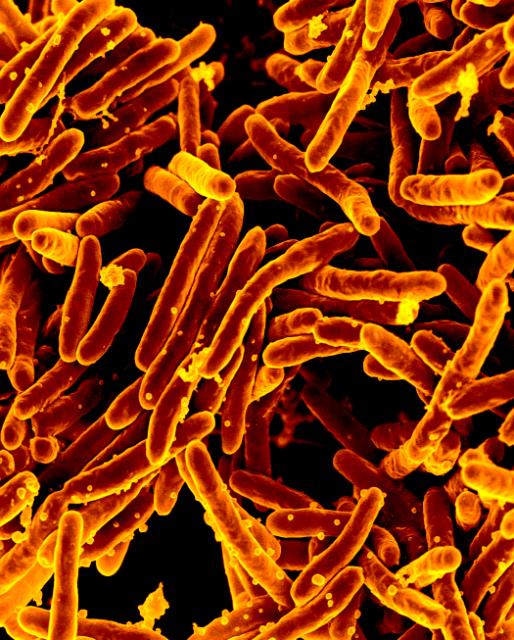
Reference scanning electron micrograph of Mycobacterium tuberculosis, the bacterium that causes TB. BPaL combines bedaquiline, pretomanid and linezolid to treat eligible patients with drug-resistant tuberculosis. Credit: NIAID.
Image: NIAID on Flickr. · Public domain
Why in news
The rejection followed pre-grant oppositions filed in 2020 by patient advocates and civil society organisations. It has renewed debate on secondary pharmaceutical patents, affordable medicines and the distinction between patent clearance and actual treatment access.
6 months
BPaL treatment duration
187 per 100,000
India’s TB incidence in 2024
89%
Reported BPaLM treatment success
52–75%
Reported standard-regimen success
More than 15,000
Patients started on BPaLM under NTEP
$284
Reported six-month BPaLM course cost
Background
Tuberculosis is an infectious disease caused by Mycobacterium tuberculosis, primarily affecting the lungs and spreading through the air. Drug-resistant TB requires treatment selected according to resistance patterns and clinical eligibility. Patents provide time-limited exclusive rights over qualifying inventions, while generic competition can improve affordability after relevant legal barriers are absent. India’s Patents Act balances innovation incentives with patentability safeguards and public-interest mechanisms. The National Tuberculosis Elimination Programme provides the institutional framework for public-sector TB diagnosis and treatment.
What the patent rejection changes
The rejected application was filed by the US-based Global Alliance for TB Drug Development, known as TB Alliance, for the combination of bedaquiline, pretomanid and linezolid. The applicant cannot use this particular application to claim exclusive patent rights over the combination in India.
The decision followed separate pre-grant oppositions by Eldred Tellis and Ganesh Acharya, and by the Delhi Network of Positive People, with support from access-to-medicines organisations. It illustrates how patient groups can scrutinise pharmaceutical patent applications before exclusive rights are granted.
The immediate effect is legal rather than clinical: a potential obstacle to competition has been removed. It is not a drug approval, a change in treatment guidelines or proof that prices have already fallen because of this decision.
- The source also reports earlier refusals of challenged bedaquiline-related applications, including the salt form and paediatric formulation.
- The rejection of one application should not be treated as a substitute for examining other applicable patents, licences and regulatory requirements.
- Manufacturing and export opportunities remain subject to relevant regulatory permissions and destination-country rules.
Infographic
Rigorous patent examination
Protect genuine inventions; reject non-qualifying claims.
Generic competition
Enable qualified suppliers and competitive procurement.
Regulatory assurance
Maintain quality, safety and efficacy requirements.
Programme readiness
Ensure diagnosis, eligibility assessment and uninterrupted supply.
Patient-centred care
Combine shorter treatment with monitoring and socioeconomic support.
AI-assisted infographic by Pragnya IAS Academy, based on the cited sources.
Why BPaL-based treatment matters
BPaL is a six-month, all-oral regimen recommended by WHO for eligible patients with drug-resistant TB. BPaLM adds moxifloxacin to the same three medicines. The source reports a treatment success rate of 89 per cent for BPaLM, compared with 52–75 per cent for standard regimens; these figures should not be presented as results for BPaL alone.
Shorter, oral treatment can reduce the burden associated with prolonged antibiotic courses and painful injections. It can also help patients resume work and family responsibilities, although clinical monitoring and adherence support remain essential.
India accounts for nearly a quarter of global TB cases, according to the source. More than 15,000 patients have already started BPaLM under the national programme, making equitable expansion to medically eligible patients a central implementation priority.
- Regimen selection must follow drug-resistance testing, clinical eligibility and programme treatment standards.
- A shorter course does not eliminate the need for monitoring adverse effects and treatment response.
- WHO recommendations do not imply that every TB patient should receive the same regimen.
Patentability safeguards: preventing evergreening without rejecting innovation
Under the Patents Act, an invention must satisfy requirements such as novelty, inventive step and industrial applicability, and must not fall within statutory exclusions. Section 25(1) permits any person to file a pre-grant opposition after publication of an application and before grant, on specified grounds.
Section 3(d) is relevant to debates on secondary pharmaceutical patents: a new form of a known substance must demonstrate enhanced efficacy to avoid the exclusion. For medicines, the Supreme Court’s Novartis ruling interprets efficacy as therapeutic efficacy. Section 3(e) excludes a mere admixture resulting only in the aggregation of the properties of its components.
These provisions are relevant analytical safeguards, but the supplied report does not reproduce the Patent Office’s detailed reasoning. It would therefore be incorrect to assert that this application was rejected specifically under either provision. A combination or improved formulation is not automatically unpatentable merely because it uses known medicines.
- Evergreening refers to attempts to prolong exclusivity through additional patents on changes to existing medicines without commensurate innovation.
- Secondary patents must be assessed claim by claim; they are not inherently invalid.
- The objective is to reward qualifying innovation while preventing unjustified restrictions on competition.
- The TRIPS framework and the Doha Declaration recognise the importance of protecting public health and promoting access to medicines.
Affordability depends on procurement, not patent status alone
Patients receiving drug-resistant TB treatment through the public health system already obtain their medicines free of cost. Consequently, lower procurement prices would initially benefit the government purchaser, potentially allowing a given budget to support more treatment courses.
The source quotes an access advocate reporting that a six-month BPaLM course costs $284, down from $588 in 2022, and links earlier price reductions to generic competition following the bedaquiline salt patent rejection. This price movement must not be attributed to the present combination-patent decision.
Patent rejection creates an opportunity, not a guaranteed price reduction. Actual gains depend on supplier entry, manufacturing capacity, quality assurance, tender design and uninterrupted delivery. Patients may still face travel expenses, nutritional needs, investigations outside the programme and lost income.
- Track actual procurement prices before estimating savings attributable to the latest ruling.
- Use competition to improve supply resilience as well as affordability.
- Distinguish free medicines from genuinely affordable completion of treatment.
Patent rights and medicine regulation are separate
The Patent Office determines whether an applicant can obtain exclusive rights over an invention. CDSCO and the applicable drug regulatory framework determine whether medicines may be marketed and used under specified conditions. The source states that bedaquiline and pretomanid have been approved for use under NTEP.
WHO prequalification assesses whether a medicine meets international standards of quality, safety and efficacy; it does not replace permissions required from Indian regulators. Expanding access therefore requires alignment between legal freedom to compete, regulatory compliance and national treatment standards.
- Patent rejection does not authorise unrestricted sale or clinical use.
- Eligible patients require timely diagnosis, resistance testing and linkage to treatment.
- Quality-assured procurement and pharmacovigilance must accompany treatment expansion.
| Instrument or institution | What it determines | What it does not ensure |
|---|---|---|
| Patent Office examination | Whether an invention qualifies for patent protection | Marketing approval or clinical suitability |
| Pre-grant opposition | Whether objections to a pending application warrant refusal or amendment | Automatic rejection merely because an objection is filed |
| Indian drug regulatory approval | Permitted marketing or use under applicable conditions | Absence of patent barriers or affordable procurement |
| WHO prequalification | Compliance with assessed international quality, safety and efficacy standards | Replacement of Indian regulatory permissions |
| NTEP procurement and delivery | Purchase and provision of treatment through the programme | Removal of all patient expenses or treatment barriers |
- 1. Rejection removes the exclusivity barrier sought through the particular patent application.
- 2. Prospective suppliers assess remaining legal requirements and obtain applicable regulatory permissions.
- 3. Quality-assured suppliers enter or expand production.
- 4. Competitive procurement can lower prices and diversify supply.
- 5. NTEP links eligible patients to uninterrupted treatment and clinical monitoring.
- 6. Patient support helps convert medicine availability into treatment completion.
2020
Two pre-grant oppositions were filed against the BPaL combination patent application.
2022
The source cites $588 as the earlier cost of a six-month BPaLM course.
2023
The challenged bedaquiline salt-form patent application was refused.
2024
The challenged bedaquiline paediatric-formulation patent application was refused.
Latest reported development; decision date unspecified
The Indian Patent Office rejected TB Alliance’s BPaL combination patent application.
Significance, challenges & way forward
Significance
- The decision demonstrates the role of pre-grant opposition in bringing patient interests and technical scrutiny into patent examination.
- Greater generic competition could increase the purchasing power of public TB expenditure.
- A diversified supplier base could reduce dependence on a limited number of manufacturers.
- Shorter, all-oral treatment can reduce the physical and socioeconomic burden of drug-resistant TB.
- The case connects intellectual property policy with the right-to-health dimension of Article 21 and the public-health responsibility under Article 47.
Challenges
- Supplier entry and price reductions are not automatic consequences of patent rejection.
- The supplied report does not establish the precise statutory grounds of rejection or quantify savings caused by this ruling.
- Diagnostic delays and inadequate linkage to care can prevent eligible patients from benefiting from available medicines.
- Supply interruptions, weak monitoring and inadequate adherence support can undermine treatment outcomes.
- Travel, nutrition and income losses remain substantial barriers even when programme medicines are free.
- Patent policy must discourage unjustified exclusivity without weakening incentives for genuinely valuable TB research.
Way forward
- Publish accessible, reasoned patent decisions so that applicants, patients and manufacturers can understand the legal basis and scope of refusal.
- Apply patentability standards consistently while ensuring technically robust and timely examination of opposition submissions.
- Expand BPaL-based treatment according to clinical eligibility and national guidelines, supported by resistance testing and trained providers.
- Use transparent, quality-assured procurement and supplier diversification to translate competition into dependable availability.
- Monitor procurement prices, stock-outs, treatment initiation and completion before claiming access gains from the ruling.
- Provide nutritional, transport and livelihood-related support alongside free medicines.
- Support genuine TB innovation through public research funding, partnerships, access-oriented licensing and predictable protection for qualifying inventions.
Key terms
- BPaL
- A regimen combining bedaquiline, pretomanid and linezolid for eligible patients with drug-resistant TB.
- BPaLM
- A regimen that adds moxifloxacin to bedaquiline, pretomanid and linezolid.
- Multidrug-resistant TB
- TB resistant to at least isoniazid and rifampicin.
- Rifampicin-resistant TB
- TB resistant to rifampicin, with or without resistance to other anti-TB medicines.
- Pre-grant opposition
- A statutory process allowing any person to challenge a published patent application on specified grounds before grant.
- Evergreening
- Attempts to prolong exclusivity through additional patents on changes to an existing medicine without commensurate innovation.
- Generic competition
- Competition from alternative manufacturers supplying equivalent medicines in compliance with applicable legal and regulatory requirements.
- Pharmacovigilance
- Detection, assessment, understanding and prevention of adverse effects and other medicine-related problems.
Link with static syllabus
Prelims practice MCQs
Q1. With reference to BPaL and BPaLM, consider the following statements: 1. BPaL consists of bedaquiline, pretomanid and linezolid. 2. BPaLM adds moxifloxacin to BPaL. 3. BPaL is an injectable regimen intended for every patient with tuberculosis. Which of the statements given above are correct?
Q2. Consider the following statements regarding pharmaceutical patentability in India: 1. Section 3(d) is relevant to the assessment of new forms of known substances. 2. Section 3(e) excludes a mere admixture resulting only in aggregation of the properties of its components. 3. Any combination containing known medicines is automatically excluded from patent protection. Which of the statements given above are correct?
Q3. Which one of the following correctly describes pre-grant opposition under the Indian Patents Act?
Q4. With reference to medicine access, consider the following statements: 1. Rejection of a pharmaceutical patent application automatically authorises marketing of the medicine in India. 2. WHO prequalification replaces Indian regulatory permissions. 3. Lower procurement prices can benefit a public programme even when medicines are already provided free to patients. Which of the statements given above is/are correct?
Mains practice questions
GS 2 · 15 marks · 250 words
India’s rejection of the BPaL combination patent application highlights both the potential and the limits of intellectual property safeguards in improving medicine access. Discuss with reference to affordable tuberculosis treatment and innovation incentives.
Frequently asked questions
Does the BPaL patent rejection immediately make TB treatment cheaper?
No. It removes one potential legal barrier, but price reductions depend on supplier entry, quality assurance and procurement; savings attributable to this ruling are not yet established in the source.
Can manufacturers sell BPaL without regulatory permission after the rejection?
No. Patent rights and drug regulatory approval are separate, and manufacturers must satisfy applicable permissions and treatment-use conditions.
Why do lower prices matter if public-sector TB medicines are free?
Lower procurement prices can help the government finance more treatment courses from the same budget. Patients still need support for non-medicine burdens such as travel, nutrition and lost income.
Does India prohibit patents on all improvements to existing medicines?
No. Improvements must satisfy the applicable patentability requirements and statutory exclusions; secondary patents are not automatically invalid.
Sources
Analysis prepared by the Pragnya IAS Academy current-affairs desk with AI assistance from the cited reports. Verify figures with the original sources.
Turn current affairs into marks
Join Pragnya IAS Academy's mentorship for daily answer-writing evaluation on stories like this — classroom programmes from a trusted name in IAS coaching in Hyderabad.