
SIR Electoral-Roll Revision: Supreme Court Scrutiny and Safeguards Against Voter Exclusion
Revise the static topic: UPSC Polity notes · UPSC Governance notes
In short: The Election Commission of India extended Special Intensive Revision timelines in five States and Delhi following requests from Chief Electoral Officers. Reported rejection of pre-SIR enrolment applications in Telangana over a subsequently required declaration highlights why additional time must be accompanied by clear rules, effective notice and accessible remedies against wrongful exclusion.
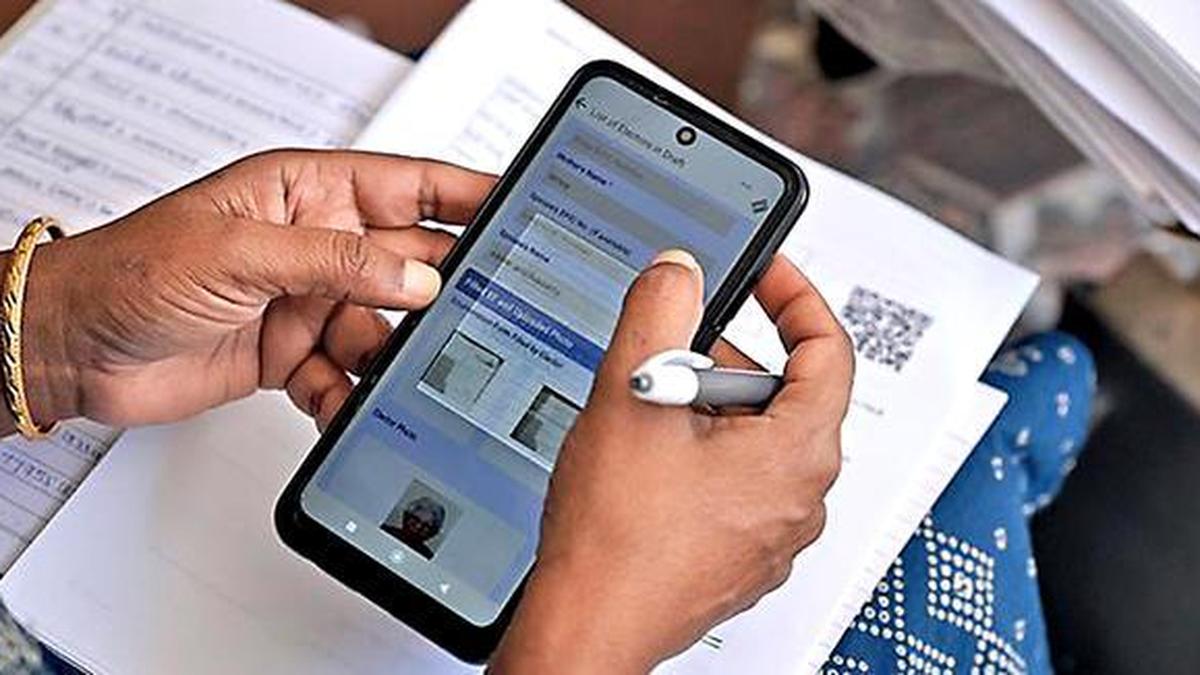
The Election Commission extended Special Intensive Revision timelines in Maharashtra, Delhi, Andhra Pradesh, Haryana, Telangana and Nagaland, raising questions about safeguards against wrongful voter exclusion.
Image: The Hindu
Why in news
On October 29, 2026, the ECI revised SIR schedules for Maharashtra, Delhi, Andhra Pradesh, Haryana, Telangana and Nagaland. A supplied editorial also flags Supreme Court scrutiny of SIR’s design, but its excerpt does not provide any specific judicial order or direction.
5,20,331
Telangana pre-SIR enrolment applications
3,22,785
Applications accepted by October 28
1,92,574
Applications rejected
37%
Reported pre-SIR rejection rate
4,972
Applications awaiting processing
73.39 lakh
Reported Telangana draft-roll removals
Background
Electoral rolls identify persons entitled to vote in a constituency. Article 324 places their preparation under the superintendence, direction and control of the Election Commission of India, while Articles 325 and 326 establish the principles of a general electoral roll and adult suffrage. The Representation of the People Act, 1950 and the Registration of Electors Rules, 1960 govern registration, revision, correction and related procedures. Electoral Registration Officers decide enrolment matters; Booth Level Officers support field verification and voter outreach. A revision must therefore pursue accurate rolls without turning administrative or documentation failures into barriers for eligible citizens.
What the ECI has changed
The ECI extended SIR schedules after requests from the Chief Electoral Officers concerned. The supplied reports provide detailed revised dates for Maharashtra, Delhi and Telangana, but not for Andhra Pradesh, Haryana or Nagaland.
These extensions create additional time for specified stages of revision. They do not, by themselves, establish that rejected applications will be reconsidered or that every omitted eligible elector will be restored.
- Maharashtra: claims and objections now close on November 13; the notice and disposal phase continues until November 25; final publication is scheduled for November 30.
- Delhi: claims and objections now close on November 25; disposal continues until December 15; final publication is scheduled for December 22.
- Telangana: notices and disposal of claims and objections continue until November 26; final publication has shifted from November 9 to November 30.
- The Telangana report does not specify a revised deadline for filing claims and objections; its final-publication extension should not be treated as an extension of every procedural stage.
Infographic
Clear requirements
Publish applicable rules and protect pending applicants through fair transitions.
Effective notice
Explain the precise issue, response deadline and available assistance.
Individual verification
Distinguish absence or documentation gaps from actual ineligibility.
Reasoned decisions
Keep statutory accountability with the competent registration authority.
Accessible remedies
Enable correction and appeal before exclusion harms participation.
AI-assisted infographic by Pragnya IAS Academy, based on the cited sources.
Telangana: the problem of changing documentary requirements
The report records 5,20,331 Form-6 applications submitted between January 1 and June 14, 2026, before SIR. By October 28, 3,22,785 had been accepted, 1,92,574 rejected and 4,972 remained pending. Officials attributed the rejections to the absence of a declaration that had not been mandatory when these applications were submitted.
The SIR-specific declaration sought details linking applicants or their parents or relatives to the 2002 SIR. Where those details were unavailable, the report says applicants were required to furnish one of the listed 12 documents as citizenship proof. Applying a later documentary requirement to pending applications raises questions of fair notice, transitional arrangements and a meaningful opportunity to cure deficiencies.
The report also records 73.39 lakh electors removed from Telangana’s draft rolls under Absent, Shifted, Dead and Duplicate categories. This is a separate issue from rejection of fresh enrolment applications. The figure does not establish that every removal was wrongful, nor does draft-roll omission necessarily mean irreversible exclusion.
- A missing declaration is a procedural deficiency; it is not, by itself, proof that the applicant lacks substantive eligibility.
- According to officials cited in the report, rejected applicants must apply afresh to secure inclusion, creating an additional procedural burden.
- Delayed processing can expose applicants to changed requirements that did not exist when they originally applied.
Constitutional responsibilities and the limits of discretion
Article 324 gives the ECI broad responsibility for electoral administration, but that authority operates within the Constitution and applicable legislation. Article 325 prohibits exclusion from electoral rolls only on grounds of religion, race, caste or sex. Article 326 anchors elections to the Lok Sabha and State Legislative Assemblies in adult suffrage, subject to constitutionally permitted disqualifications.
The Representation of the People Act, 1950 addresses revision under Section 21, correction and deletion under Section 22, inclusion under Section 23 and appeals under Section 24. Citizenship, qualifying age and ordinary residence are central eligibility considerations. Temporary absence does not, by itself, terminate ordinary residence.
Article 14 and principles of natural justice provide the framework for examining arbitrary treatment, inadequate notice and denial of a fair opportunity to respond. The supplied editorial characterises Supreme Court scrutiny as identifying design flaws, but no specific holding, prescribed document list or judicial remedy can be inferred from the excerpt.
- The constitutional basis of adult suffrage must be distinguished from the statutory framework governing registration and exercise of the vote.
- Administrative discretion should facilitate statutory objectives, not create unsupported grounds for disqualification.
- An allegation of procedural unfairness requires examination of the applicable rules, notices, evidence and individual decisions.
Why more time must be matched by better procedure
The Telangana report describes overloaded BLOs handling document collection, uploads and repeated household visits, alongside difficulty staffing enrolment camps. A deadline extension can ease pressure, but it cannot substitute for adequate staffing, clear allocation of responsibility and reliable service of notices.
A fair revision must distinguish genuine ineligibility from non-response, temporary absence, incomplete documentation and administrative failure. If an elector never receives a notice or cannot understand how to remedy a deficiency, formal availability of a claims window offers limited protection.
The central governance test is whether an eligible person can understand the issue, submit relevant evidence, obtain a reasoned decision and pursue an effective remedy before exclusion affects electoral participation.
- Verification must remain rigorous without treating every documentation gap as substantive ineligibility.
- Field reports should inform decisions, not replace the ERO’s statutory responsibility.
- Public communication must distinguish deadlines for filing claims, disposal and final publication.
- Reason-wise monitoring can identify systemic problems without exposing sensitive personal documents.
| State or Union Territory | Claims and objections deadline | Notices or disposal deadline | Final-roll publication |
|---|---|---|---|
| Maharashtra | November 13, earlier October 26 | November 25, earlier disposal deadline November 10 | November 30 |
| Delhi | November 25, earlier October 30 | December 15, earlier November 30 | December 22 |
| Telangana | Not specified in supplied report | November 26, earlier November 5 | November 30, earlier November 9 |
| Andhra Pradesh, Haryana and Nagaland | Extension reported; revised dates not supplied | Revised dates not supplied | Revised dates not supplied |
- 1. Identify the precise deficiency or eligibility issue through reliable verification.
- 2. Communicate the grounds, applicable requirements and response deadline through effective notice.
- 3. Provide an accessible opportunity to submit evidence, correct deficiencies and be heard where required.
- 4. Ensure the competent ERO assesses the evidence and records a reasoned decision.
- 5. Communicate the outcome and available statutory remedy to the affected person.
- 6. Implement corrections and verify that eligible applicants are accurately reflected in the roll.
January 1–June 14, 2026
Telangana received the pre-SIR Form-6 applications examined in the report.
August 31, 2026
Maharashtra’s draft electoral roll was published.
October 28, 2026
Telangana application data showed a reported rejection rate of 37% among pre-SIR fresh-enrolment applications.
October 29, 2026
The ECI revised SIR timelines following requests from the Chief Electoral Officers concerned.
November 30, 2026
Final-roll publication is scheduled for Maharashtra and Telangana.
December 22, 2026
Final-roll publication is scheduled for Delhi.
Significance, challenges & way forward
Significance
- Accurate and inclusive rolls protect both electoral integrity and equal political participation.
- The extensions provide administrative space for verification and disposal of claims, but their value depends on effective implementation.
- The Telangana experience highlights how transitional documentation rules can affect applications that were already pending.
- Judicial scrutiny can reinforce the requirement that electoral administration remain within constitutional and statutory limits.
Challenges
- Applying later documentary requirements without adequate transitional safeguards risks arbitrary treatment of similarly placed applicants.
- Failure to deliver notices or conduct effective field verification can convert administrative lapses into voter exclusion.
- Overloaded BLOs may be unable to combine household outreach, document collection, uploads and enrolment-camp duties effectively.
- Absent, shifted, dead and duplicate classifications require differentiated verification rather than a uniform presumption of ineligibility.
- Fresh-application requirements may disproportionately burden migrants, persons with disabilities and citizens with limited documentary or digital access.
- Aggregate rejection figures cannot establish individual eligibility or quantify wrongful exclusion without case-level scrutiny.
Way forward
- Issue clear transitional instructions for pre-SIR applications and provide a lawful opportunity to cure subsequently identified deficiencies.
- Review rejection grounds and facilitate reconsideration or fresh applications through lawful procedures, without treating previous rejection as conclusive evidence of ineligibility.
- Serve intelligible notices stating the precise issue, acceptable evidence, response channels and available remedies.
- Strengthen ERO supervision and BLO staffing while preserving the distinction between field assistance and statutory decision-making.
- Provide assisted offline access and targeted outreach for citizens facing mobility, literacy, documentation or digital barriers.
- Publish privacy-protective, reason-wise information on pending applications, rejections and corrections to enable scrutiny.
- Evaluate revision quality through both detection of ineligible entries and prevention of wrongful exclusion, rather than deletion totals alone.
Key terms
- Special Intensive Revision
- An intensive electoral-roll revision exercise undertaken under the ECI’s authority to verify and update entries.
- Form-6
- The prescribed application form for registration of new voters in electoral rolls.
- Electoral Registration Officer
- The statutory officer responsible for preparing and revising the electoral roll of the assigned constituency.
- Booth Level Officer
- A field-level functionary assisting electoral registration through local verification and voter outreach.
- Ordinary residence
- The residence-based connection relevant to constituency registration, which is not automatically lost through temporary absence.
- Claims and objections
- Procedural avenues for seeking inclusion and contesting entries during electoral-roll revision.
- Natural justice
- Principles of fair decision-making, including an effective opportunity to respond and impartial consideration.
- Reasoned decision
- A decision explaining its factual and legal basis so that the affected person can understand and challenge it.
Link with static syllabus
Prelims practice MCQs
Q1. With reference to electoral provisions of the Constitution, consider the following statements: 1. Article 324 covers the superintendence, direction and control of the preparation of electoral rolls. 2. Article 325 prohibits exclusion from electoral rolls only on grounds of religion, race, caste or sex. 3. Article 326 concerns adult suffrage for elections to the Lok Sabha and State Legislative Assemblies. Which of the statements given above are correct?
Q2. Consider the following pairs under the Representation of the People Act, 1950: 1. Section 21 — Preparation and revision of electoral rolls 2. Section 22 — Correction of entries in electoral rolls 3. Section 24 — Appeals Which of the pairs given above are correctly matched?
Q3. With reference to electoral registration, consider the following statements: 1. Temporary absence from a place necessarily terminates ordinary residence there. 2. A Booth Level Officer’s field report substitutes for the Electoral Registration Officer’s statutory decision. 3. Form-6 is used for registration of new voters. Which of the statements given above is/are correct?
Q4. Consider the following statements regarding electoral-roll revision: 1. Rejection of a fresh-enrolment application and removal of an existing elector from a draft roll are distinct administrative events. 2. Extending final-roll publication automatically reopens every rejected application. 3. A draft-roll removal figure alone establishes the number of eligible citizens wrongfully excluded. Which of the statements given above is/are correct?
Mains practice questions
GS 2 · 15 marks · 250 words
Electoral-roll integrity requires preventing both ineligible inclusion and wrongful exclusion. Examine this proposition in the context of Special Intensive Revision and suggest safeguards for procedural fairness.
Frequently asked questions
Does the SIR extension automatically restore rejected applicants?
No automatic restoration is established by the supplied reports. Affected applicants require action through the applicable inclusion, correction, reconsideration or appeal procedure.
Why are Telangana’s pre-SIR Form-6 rejections controversial?
Officials attributed the rejections to a missing declaration that was not mandatory when the applications were submitted. This raises questions about transitional rules, timely processing and opportunities to rectify deficiencies.
What exactly did the Supreme Court direct on SIR?
The supplied editorial excerpt flags Supreme Court scrutiny of SIR’s design but contains no specific order or direction. It cannot support a claim that the Court suspended SIR, invalidated a requirement or ordered restoration.
Can temporary absence alone justify loss of electoral registration?
Temporary absence does not, by itself, terminate ordinary residence. Eligibility must be assessed under the applicable law rather than inferred solely from absence during a field visit.
Sources
- The Hindu: ECI extends SIR timelines in Maharashtra, Delhi, Andhra, Haryana, Telangana, Nagaland
- The Hindu: SIR deadline for Telangana extended to November 30, 2026
- The Hindu: 37% of pre-SIR Form-6 applications rejected due to absence of declaration form
- The Hindu (Editorial): Deemed ineligible: On the Supreme Court and SIR
Analysis prepared by the Pragnya IAS Academy current-affairs desk with AI assistance from the cited reports. Verify figures with the original sources.
Turn current affairs into marks
Join Pragnya IAS Academy's mentorship for daily answer-writing evaluation on stories like this — classroom programmes from a trusted name in IAS coaching in Hyderabad.