
Andhra Pradesh Weighs Optional Father’s Name: Child Dignity and Inclusive Documentation
Revise the static topic: UPSC Social Justice notes
In short: A State-level consultation in Andhra Pradesh discussed making the father’s name optional in official documents to prevent exclusion arising from family circumstances. The proposal seeks to protect children’s access to education, identity documents and welfare, but the source reports consultation and recommendations, not an enacted policy.
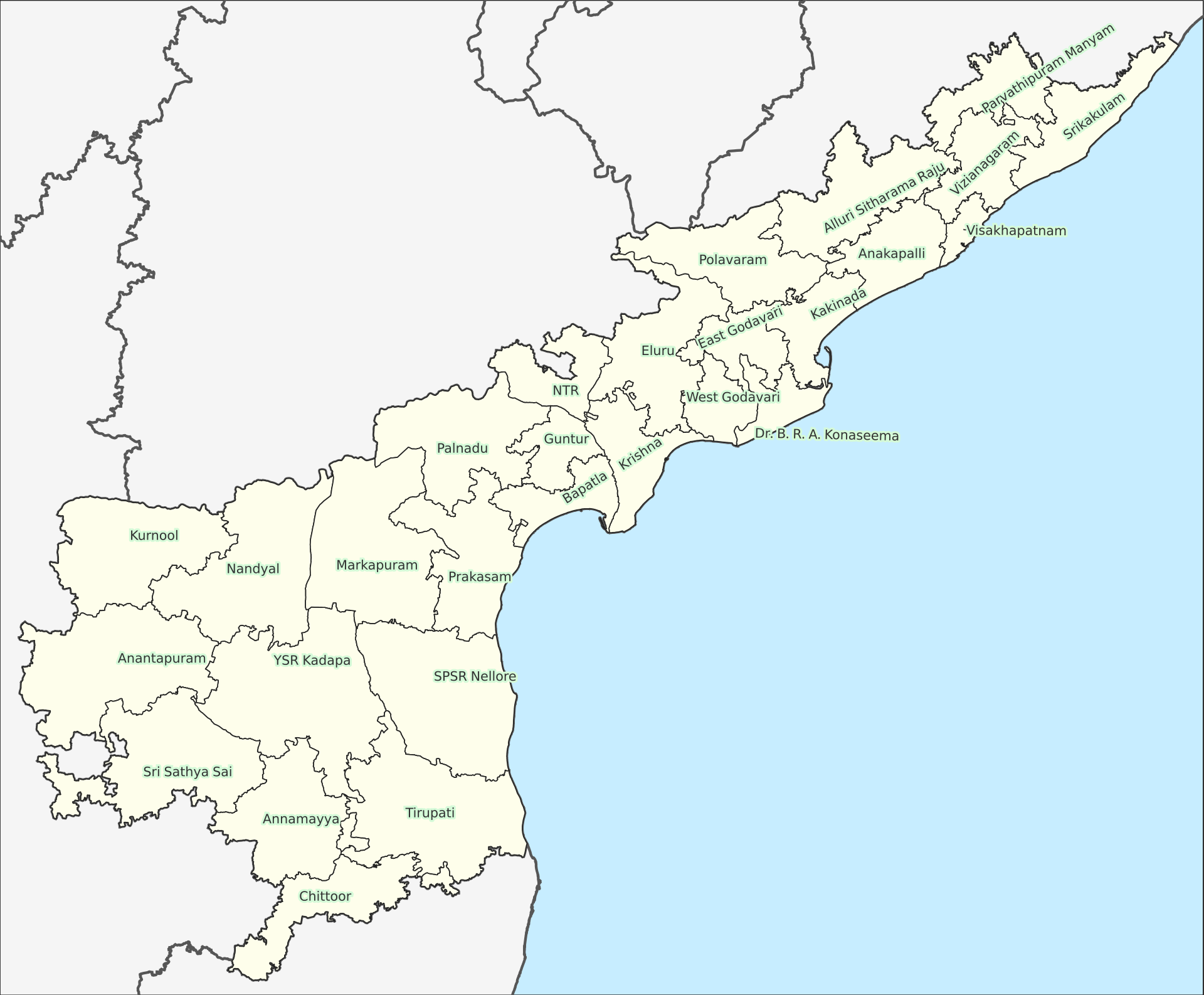
Reference map of Andhra Pradesh with districts labelled in English. The state-level consultation considered making the father’s name optional in official documents; the proposal is not an enacted policy.
Image: Arjunaraoc · CC BY-SA 4.0
Why in news
The Andhra Pradesh State Commission for Protection of Child Rights organised a consultation with Children India Foundation and HELP on making the father’s name non-mandatory in documents. Participants called for examination of legal implications and child-friendly rules, with recommendations to be submitted to the government.
Background
Official forms commonly collect parental particulars for identification and administrative purposes. However, a requirement centred on paternal identity can create difficulties where that information is unavailable or disclosure is unwanted. India’s constitutional framework protects equality and dignity, while the Right of Children to Free and Compulsory Education Act and the Juvenile Justice framework provide a child-centred foundation for education and protection. State child rights commissions are statutory bodies under the Commissions for Protection of Child Rights Act; their recommendations can guide reform but do not themselves amend every applicable documentation rule.
What the consultation proposed
The consultation examined making the father’s name optional in all official documents, particularly for children of single parents, sex workers, divorced couples and orphans, as well as applicants who do not wish to mention their fathers’ names. Its central concern was that family circumstances should not obstruct access to public services.
Representatives from government departments, child rights organisations, the Andhra Pradesh Mahila Commission and NGOs participated. Social Welfare and Women Development and Child Welfare officials stated that their departments were already not insisting on the father’s name in application forms.
Participants sought examination of legal implications before rules are framed. The reported departmental practices should not be mistaken for an existing, uniform exemption across all official documents.
- The reported measure remains a proposal under consideration, not a notified universal rule.
- Optional disclosure would preserve the ability to provide a father’s name without making it an unavoidable condition.
- Making a field optional need not eliminate verification of identity or scheme-specific eligibility.
Infographic
Dignity
Do not penalise children for family circumstances.
Inclusion
Provide legally valid alternatives to mandatory paternal details.
Privacy
Avoid unnecessary disclosure of family histories.
Verification
Retain proportionate identity and eligibility checks.
Implementation
Align rules, forms, portals and frontline practice.
Accountability
Provide reasons for rejection and accessible review.
AI-assisted infographic by Pragnya IAS Academy, based on the cited sources.
Why documentation is a social justice issue
A formally identical requirement can have unequal effects. Children whose paternal details are unavailable, disputed or difficult to disclose may face a barrier that other applicants do not encounter. An official at the consultation identified instances in which the requirement had obstructed education.
The issue extends beyond form design. Repeated demands for explanations about a parent’s absence can expose private family circumstances and invite stigma. The child should not bear an administrative penalty for circumstances beyond their control.
Inclusive documentation should therefore combine flexible identification with respectful treatment. Merely replacing a compulsory father’s-name field with a compulsory mother’s-name field would leave children without available parental details inadequately protected.
- Education should not be interrupted merely because paternal particulars are unavailable.
- Welfare administration should distinguish relevant eligibility evidence from unnecessary family information.
- Alternatives should accommodate parental, guardianship and other legally recognised care situations.
- Staff should not infer a child’s family circumstances or social background from an unfilled field.
Constitutional and institutional foundations
Article 14 provides the equality framework for examining arbitrary administrative barriers. Article 21 protects life and personal liberty, including dignity and privacy, while Article 21A establishes the right to elementary education. Together, these provisions support scrutiny of documentation requirements that unnecessarily obstruct children’s rights.
Article 15(3) enables special provisions for women and children. Article 39(f), a Directive Principle, calls for opportunities and facilities for children to develop in conditions of freedom and dignity and protection against exploitation and abandonment. The best-interests principle under the Juvenile Justice framework further supports child-sensitive administration.
These principles provide a basis for reform, but do not automatically displace every document-specific legal requirement. The State Commission can examine safeguards and recommend changes; competent authorities must identify and amend the relevant forms, rules or other legal instruments.
- A rights-based review should ask whether paternal information is necessary for the particular service.
- Removing a compulsory field does not itself determine parentage, custody, maintenance or inheritance.
- Documents governed by authorities outside the State’s competence require coordination rather than a unilateral State-level solution.
From optional fields to an enforceable service guarantee
Implementation would require an audit of forms, instructions, digital validation rules and verification practices. A paper form may permit a blank field while a portal or linked database rejects it. Reform must therefore cover the full service-delivery chain.
Alternative documentation should be proportionate to the purpose of the application and consistent with applicable law. Where an adult representative is necessary, systems should recognise legally valid parental, guardianship or care arrangements rather than presume a single family structure.
Privacy safeguards and grievance redress are equally important. Applicants should not routinely have to disclose sensitive family histories to justify non-disclosure, and rejected applications should receive clear reasons and an accessible review mechanism.
- Publish department-wise instructions distinguishing optional information from legally essential evidence.
- Align paper forms, portals and database interoperability requirements.
- Train frontline personnel to prevent intrusive questioning and informal insistence on paternal details.
- Monitor documentation-related refusals without creating unnecessary sensitive profiles of children.
| Administrative issue | Recommended approach | Safeguard |
|---|---|---|
| Father’s-name field | Permit non-disclosure wherever legally permissible | Do not automatically reject an application for leaving it blank |
| Alternative identification | Accept suitable evidence under the applicable framework | Retain verification relevant to identity and eligibility |
| Parental or representative details | Accommodate legally recognised family and care arrangements | Do not assume that every child has available parental particulars |
| Digital processing | Revise validation rules and linked workflows | Test whether applications without paternal details complete processing |
| Review of rejection | Provide reasons and accessible grievance redress | Avoid repeated disclosure of sensitive family circumstances |
- 1. Submit consultation recommendations to the State government
- 2. Audit document-specific legal requirements and departmental practices
- 3. Amend relevant rules, forms and instructions through competent authorities
- 4. Update portals, databases and verification workflows
- 5. Train staff and communicate alternatives to applicants
- 6. Review refusals and correct persistent exclusion
Significance, challenges & way forward
Significance
- The proposal places children’s dignity above assumptions about a uniform family structure.
- Inclusive documentation can remove an avoidable barrier to education and welfare access.
- Optional disclosure can reduce unnecessary exposure of sensitive family information.
- Recognising diverse care arrangements can make administration more responsive to vulnerable children.
- Uniform instructions can reduce discretionary and inconsistent treatment across offices.
Challenges
- Different documents are governed by different legal frameworks and competent authorities.
- Existing databases may require paternal details even after application forms are changed.
- Frontline officials may continue older practices unless instructions and accountability mechanisms are clear.
- Alternative evidence requirements could reproduce exclusion if they are costly, intrusive or difficult to obtain.
- Applicants may mistakenly understand an optional field as changing substantive parentage or family-law rights.
- Children without available parental details need arrangements beyond simply substituting the mother’s name.
Way forward
- Conduct a document-wise legal review rather than assume that a single instruction can amend every requirement.
- Adopt a clear non-exclusion principle so that missing paternal particulars alone do not block services where the law permits alternatives.
- Specify accessible alternative evidence proportionate to the purpose of the document or benefit.
- Synchronise forms, portals, verification manuals and database requirements before implementation.
- Protect privacy by limiting collection of reasons for non-disclosure and restricting access to sensitive information.
- Establish prompt grievance redress and use recurring complaints to identify systemic barriers.
- Consult affected children, caregivers and child rights organisations while designing and reviewing the policy.
Key terms
- Substantive equality
- An approach that examines the actual effects of rules on differently situated people rather than relying only on identical treatment.
- Best interests of the child
- A child-centred principle requiring decisions to prioritise the child’s rights, welfare and development.
- Administrative exclusion
- Denial or obstruction of access caused by procedures, documentation demands or implementation practices.
- Data minimisation
- Collecting only the personal information necessary for a specified and legitimate purpose.
- Optional disclosure
- Allowing an applicant to withhold a particular detail without automatic rejection, subject to applicable law.
- State Commission for Protection of Child Rights
- A statutory child rights body that examines safeguards, reviews concerns and makes recommendations within its mandate.
Link with static syllabus
Prelims practice MCQs
Q1. With reference to the consultation in Andhra Pradesh on making the father’s name optional in official documents, consider the following statements: 1. The source reports a proposal under consideration rather than an enacted universal policy. 2. Officials from Social Welfare and Women Development and Child Welfare stated that their departments were not insisting on the father’s name in application forms. 3. Recommendations of the State Commission automatically amend all documentation laws. Which of the statements given above are correct?
Q2. Which of the following constitutional provisions specifically enables the State to make special provisions for women and children?
Q3. Consider the following pairs: 1. Article 14 — Equality before law and equal protection of laws 2. Article 21A — Right to elementary education 3. Article 39(f) — Establishment of State child rights commissions Which of the pairs given above are correctly matched?
Q4. With reference to inclusive identity-document requirements, consider the following statements: 1. A formally uniform requirement may have unequal effects on children in different family circumstances. 2. Making the father’s name optional necessarily extinguishes rights relating to maintenance and inheritance. 3. Changing a paper form may be insufficient if digital validation still requires paternal details. Which of the statements given above are correct?
Mains practice questions
GS 2 · 15 marks · 250 words
Documentation requirements should verify eligibility without penalising children for their family circumstances. Discuss in the context of Andhra Pradesh’s proposal to make the father’s name optional in official documents.
Frequently asked questions
Has Andhra Pradesh already made the father’s name optional in all official documents?
The supplied report does not establish that such a policy has been enacted. It describes a consultation and recommendations intended for submission to the government.
Who could benefit from the proposal?
The consultation highlighted children of single parents, sex workers, divorced couples and orphans, alongside applicants who do not wish to mention their fathers’ names. The objective is to prevent family circumstances from obstructing education, documentation or welfare.
Would making the father’s name optional remove all verification requirements?
No. Identity and relevant eligibility checks may continue under applicable law; the reform would concern whether paternal particulars must invariably be supplied.
Would optional disclosure change inheritance or maintenance rights?
Making a field optional does not by itself alter substantive rights concerning parentage, inheritance or maintenance. Those questions remain governed by their applicable legal frameworks.
Sources
Analysis prepared by the Pragnya IAS Academy current-affairs desk with AI assistance from the cited reports. Verify figures with the original sources.
Turn current affairs into marks
Join Pragnya IAS Academy's mentorship for daily answer-writing evaluation on stories like this — classroom programmes from a trusted name in IAS coaching in Hyderabad.