
Armenia Biodiversity Talks: Finance, National Action and Equitable Benefit-Sharing
Revise the static topic: UPSC Environment notes
In short: The UN Biodiversity Conference, COP17, in Yerevan, Armenia, is assessing implementation of the Kunming-Montreal Global Biodiversity Framework. The central challenge is to translate commitments into measurable conservation through aligned national strategies, adequate finance and accountable, inclusive governance.

Reference view of Yerevan, Armenia’s capital, at dawn; the city is hosting the COP17 biodiversity talks.
Image: Սէրուժ Ուրիշեան (Serouj Ourishian) · CC BY-SA 3.0
Why in news
Governments meeting in Yerevan are reviewing progress towards global biodiversity goals, including conserving 30 per cent of land and sea by 2030. UN leaders have warned that progress remains uneven and too slow despite an expansion in formally protected areas.
196
Countries making commitments in 2022
30%
Land and sea conservation ambition
2030
Deadline for the conservation ambition
More than one million
Species facing extinction, according to the UN warning
1.3 million sq km
Additional land formally protected since 2022
6 million sq km
Additional ocean formally protected since 2022
Background
The Convention on Biological Diversity is the principal international treaty addressing biodiversity conservation, sustainable use of its components, and fair and equitable sharing of benefits arising from the utilisation of genetic resources. Its Conference of the Parties reviews implementation and develops collective policy direction. The Kunming-Montreal Global Biodiversity Framework, adopted in 2022, provides an agreed blueprint for biodiversity action. National Biodiversity Strategies and Action Plans translate international objectives into domestic priorities, while the Nagoya Protocol provides a specialised framework for access to genetic resources and benefit-sharing.
What the Yerevan talks are assessing
The conference is focused on implementation rather than merely restating ambition. The source identifies stronger national action, adequate resources, improved monitoring and accountability, and wider participation as priorities for turning commitments into measurable progress.
The UN Secretary-General cited additional formal protection for land and ocean since 2022, but warned that the world risks falling well short of its conservation ambition. These additions demonstrate policy action; they do not, by themselves, establish effective management, ecological recovery or equitable governance.
- The source reports ongoing talks and political appeals, not a final negotiated outcome.
- The principal drivers identified are land- and sea-use change, unsustainable exploitation, climate change, pollution and invasive species.
- A credible review must assess ecological outcomes alongside the geographical extent of conservation.
Infographic
National delivery
Translate global goals into financed, accountable NBSAPs.
Reliable finance
Match resources with needs and track actual disbursement.
Effective conservation
Measure ecosystem health, not coverage alone.
Equitable benefits
Respect knowledge holders and share utilisation benefits fairly.
Inclusive accountability
Enable community participation and publish verifiable outcomes.
AI-assisted infographic by Pragnya IAS Academy, based on the cited sources.
National strategies must become whole-of-government delivery plans
National Biodiversity Strategies and Action Plans, or NBSAPs, are the bridge between the global framework and domestic implementation. Alignment requires more than adopting similar language: national targets need responsible institutions, financing arrangements, implementation milestones and measurable indicators.
Biodiversity policy cannot remain confined to environment ministries. Agriculture, fisheries, infrastructure, urban development and industrial policy shape habitats and resource use. For India, implementation should connect national priorities with State Biodiversity Boards, local Biodiversity Management Committees and sectoral planning.
- Integrate biodiversity considerations into land-use planning and environmental assessment.
- Use locally grounded biodiversity information alongside scientific monitoring.
- Assess habitat condition, connectivity and pressures on species, not only administrative outputs.
- Assign clear responsibilities across national, state and local institutions.
Conservation finance: adequacy, access and accountability
The source explicitly calls for finance to match biodiversity needs, but provides no financing-gap estimate or newly agreed funding package. The analytical issue is therefore how to make conservation funding sufficient, predictable and accessible while ensuring that expenditure produces verifiable ecological benefits.
Public budgets and international support remain important for conservation activities that do not generate commercial returns. Private finance can supplement these resources, but safeguards are needed to prevent greenwashing, displacement of communities or claims that financial investments automatically compensate for irreversible ecosystem damage.
- Link national biodiversity priorities to budget allocations and sustained management costs.
- Improve access to funding for local institutions and community-led conservation.
- Review incentives that encourage overexploitation, pollution or habitat conversion.
- Disclose funding commitments, disbursements and outcomes separately.
Equitable benefit-sharing and community participation
Fair and equitable benefit-sharing is a core objective of the Convention on Biological Diversity. It concerns benefits arising from the utilisation of genetic resources and associated traditional knowledge, rather than merely the general distribution of conservation expenditure. Benefits can be monetary or non-monetary, including research cooperation, technology transfer and capacity-building.
The source calls for stronger participation by Indigenous Peoples and local communities, women and youth. It does not report a new benefit-sharing agreement at Yerevan. Nevertheless, equitable governance is central to implementation: conservation is more legitimate when knowledge holders participate in decisions and receive appropriate benefits rather than bearing disproportionate restrictions.
- Apply prior informed consent and mutually agreed terms where required under applicable access and benefit-sharing rules.
- Protect traditional knowledge and provide meaningful participation in decisions.
- Ensure transparent benefit distribution and accessible grievance mechanisms.
- Distinguish access and benefit-sharing obligations from broader livelihood safeguards in conservation.
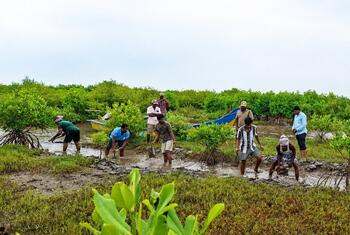
Community members participate in mangrove restoration under the GCF ECRICC Project in Andhra Pradesh, India, illustrating community participation in conservation implementation.
Image: UN News
India's implementation priorities
India's Biological Diversity Act provides an institutional architecture involving the National Biodiversity Authority, State Biodiversity Boards and local Biodiversity Management Committees. People's Biodiversity Registers can support documentation of local biological resources and associated knowledge, subject to appropriate safeguards.
The constitutional duties to protect the environment and the policy commitment to ecological security support a broader approach than protected-area expansion alone. India should connect habitat conservation with restoration, sustainable agriculture and fisheries, pollution control and landscape-level planning.
- Strengthen local institutions with technical capacity and usable financial support.
- Connect biodiversity planning with livelihoods and community rights.
- Improve coordination between biodiversity institutions and development departments.
- Measure whether conservation maintains ecosystem functions and reduces pressures on nature.

Reference view of a tiger resting on a mossy rock in Bandhavgarh National Park, India, illustrating the habitats and wildlife that national biodiversity action must protect.
Image: UN News
| Implementation pillar | Domestic action | Evidence of progress |
|---|---|---|
| National strategies | Align NBSAPs with global objectives and sectoral plans. | Clear responsibilities, financed priorities and public progress reports. |
| Conservation finance | Mobilise predictable resources and improve local access. | Disbursement records linked to independently assessed outcomes. |
| Area-based conservation | Combine coverage with effective and equitable management. | Habitat condition, connectivity and species trends. |
| Benefit-sharing | Implement applicable access rules and transparent benefit agreements. | Documented benefits reaching entitled providers and knowledge holders. |
| Participation | Include communities, women and youth in decisions. | Meaningful representation, grievance redress and responsive management. |
- 1. Translate the global framework into nationally appropriate biodiversity targets.
- 2. Embed targets in NBSAPs, sectoral policies and local plans.
- 3. Assign institutional responsibilities and secure predictable finance.
- 4. Implement conservation with community participation and applicable benefit-sharing safeguards.
- 5. Monitor ecological condition, social outcomes and expenditure.
- 6. Publish results and revise policies where implementation falls short.
2022
The Kunming-Montreal Global Biodiversity Framework was adopted, establishing an agreed blueprint for biodiversity action.
Since 2022
According to figures cited by the UN Secretary-General, additional land and ocean areas have received formal protection.
2026
COP17 in Yerevan assesses implementation and seeks stronger finance, monitoring, accountability and coordinated action.
2030
Target year for the framework's ambition of conserving 30 per cent of land and sea, alongside the Sustainable Development Goals deadline.
Significance, challenges & way forward
Significance
- Biodiversity conservation protects ecosystem services that underpin food production, fisheries, water security and livelihoods.
- The Yerevan review can shift attention from announced commitments to implementation quality and accountability.
- Coordinated biodiversity action can address interconnected pressures from climate change, pollution and resource overuse.
- Equitable benefit-sharing can strengthen trust between resource providers, knowledge holders and users.
- For India, stronger biodiversity governance can connect ecological security with decentralised planning and livelihood protection.
Challenges
- Expanding formally protected areas may not deliver recovery where management capacity, connectivity or enforcement remains weak.
- National biodiversity strategies can remain disconnected from budgets and economic-sector decisions.
- Unpredictable funding and difficult access procedures can undermine long-term and community-led conservation.
- Weak ecological baselines and inconsistent monitoring can obscure whether interventions are working.
- Exclusionary conservation can impose livelihood costs and weaken local legitimacy.
- Power and information asymmetries can prevent resource providers and traditional knowledge holders from obtaining fair benefits.
Way forward
- Convert NBSAPs into financed delivery plans with clear institutional responsibilities and publicly reviewable indicators.
- Assess conservation through ecological effectiveness and equity, rather than area coverage alone.
- Combine public funding, international cooperation and carefully regulated private participation without treating them as interchangeable.
- Improve direct and accountable access to conservation resources for capable local institutions.
- Make community participation, applicable consent requirements and transparent benefit-sharing integral to implementation.
- Reform policies and incentives that drive habitat loss, unsustainable extraction and pollution.
- Strengthen independent monitoring and use review findings to correct ineffective interventions.
Key terms
- Kunming-Montreal Global Biodiversity Framework
- The global biodiversity blueprint adopted in 2022 to guide conservation, sustainable use and related implementation efforts.
- NBSAP
- A National Biodiversity Strategy and Action Plan translating international biodiversity objectives into domestic priorities and actions.
- 30 by 30
- The ambition to conserve 30 per cent of land and sea by 2030.
- Access and benefit-sharing
- Arrangements governing access to genetic resources and fair sharing of benefits arising from their utilisation.
- Nagoya Protocol
- A protocol under the Convention on Biological Diversity addressing access to genetic resources and fair and equitable benefit-sharing.
- Ecosystem services
- Benefits people obtain from ecosystems, including pollination, water regulation and provisioning of food.
- Triple planetary crisis
- The interconnected crises of climate change, biodiversity loss and pollution.
- People's Biodiversity Register
- A locally prepared record of biological resources and associated knowledge under India's biodiversity governance framework.
Link with static syllabus
Prelims practice MCQs
Q1. Consider the following statements about the Kunming-Montreal Global Biodiversity Framework: 1. It was adopted in 2022. 2. Its conservation ambition includes conserving 30 per cent of land and sea by 2030. 3. Formal designation of an area for protection necessarily establishes its effective ecological management. Which of the statements given above are correct?
Q2. Which of the following best describes the principal role of National Biodiversity Strategies and Action Plans?
Q3. Consider the following pairs: 1. Nagoya Protocol — Access to genetic resources and benefit-sharing 2. Biodiversity Management Committees — Local biodiversity governance in India 3. People's Biodiversity Registers — International carbon-trading certificates Which of the pairs given above are correctly matched?
Q4. With reference to the Convention on Biological Diversity, consider the following: 1. Conservation of biological diversity 2. Sustainable use of biodiversity components 3. Fair and equitable sharing of benefits arising from the utilisation of genetic resources Which of the above are objectives of the Convention?
Mains practice questions
GS 3 · 15 marks · 250 words
Global biodiversity commitments will remain aspirational unless finance, national planning and equitable benefit-sharing reinforce one another. Discuss with reference to the Kunming-Montreal Global Biodiversity Framework and India's implementation priorities.
Frequently asked questions
What is the main focus of the Armenia biodiversity talks?
COP17 in Yerevan is assessing progress under the Kunming-Montreal Global Biodiversity Framework. The emphasis is on implementation, resources, monitoring, accountability and coordinated action.
Does conserving more area automatically mean biodiversity is recovering?
No. Formal protection must be accompanied by effective management, ecological connectivity, reduced threats and equitable governance.
Why is benefit-sharing important for biodiversity conservation?
Fair benefit-sharing recognises the interests of genetic-resource providers and traditional knowledge holders. It can strengthen trust and support cooperation in conservation and sustainable use.
Has Yerevan adopted a new conservation finance or benefit-sharing agreement?
The supplied source does not report such an agreement. It describes ongoing talks and calls for stronger implementation and adequate resources.
Sources
Analysis prepared by the Pragnya IAS Academy current-affairs desk with AI assistance from the cited reports. Verify figures with the original sources.
Turn current affairs into marks
Join Pragnya IAS Academy's mentorship for daily answer-writing evaluation on stories like this — classroom programmes from a trusted name in IAS coaching in Hyderabad.