
COP31 Draft: Fossil-Fuel Transition, Climate Finance and the CBAM Equity Debate
Revise the static topic: UPSC Environment notes
In short: The November 19 COP31 draft cover text dropped references to fossil-fuel phase-out, net-zero dates and a firm adaptation-finance target, while retaining proposals on electrification and a broad commitment to triple adaptation finance. The changes expose the central negotiating challenge: securing stronger climate action alongside credible developed-country finance and fair treatment of developing economies.
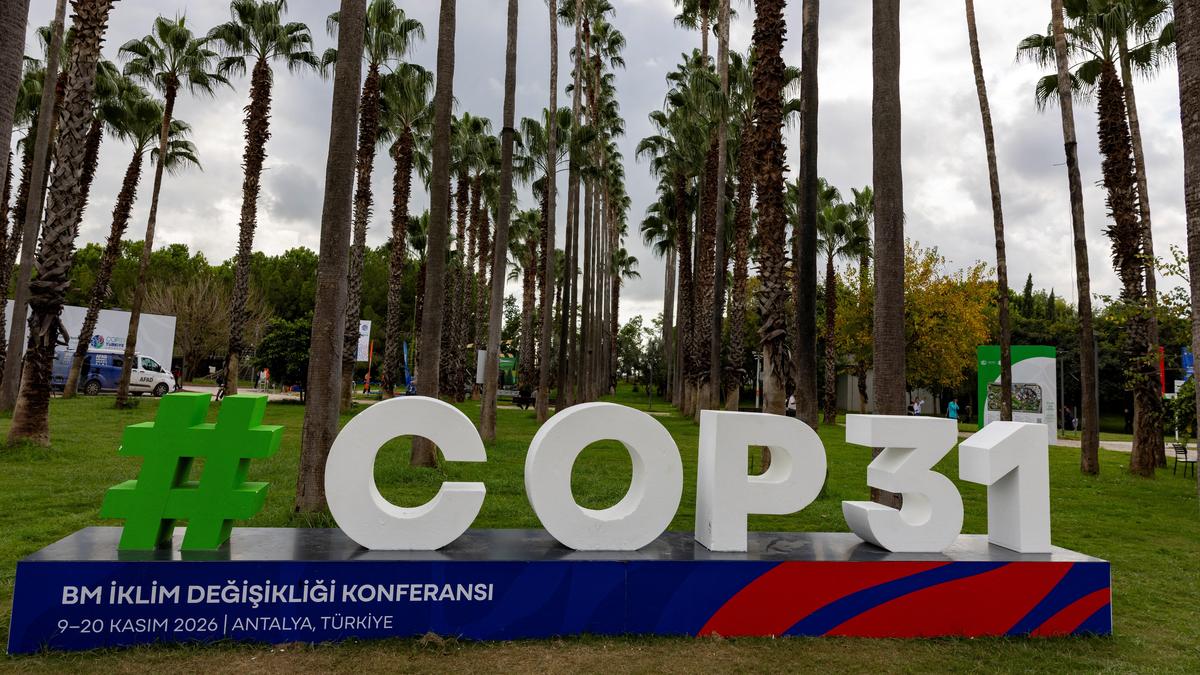
The November 19 COP31 draft dropped references to fossil-fuel phase-out and net-zero dates, highlighting divisions over climate ambition, finance and equity.
Image: The Hindu
Why in news
The Hindu reported these changes as COP31 in Antalya, Türkiye, approached its scheduled conclusion on November 20, 2026. The supplied reports describe negotiations and draft proposals, not a confirmed final agreement.
$120 billion annually by
Adaptation-finance demand reported
35% by 2035
Proposed electricity share in final energy
2027
Proposed universal early-warning deadline
1.5°C
Paris temperature ambition
2.6°C
Reported end-century warming projection
80 paragraphs
Revised draft, down from 144
Background
The United Nations Framework Convention on Climate Change provides the institutional framework for international climate negotiations. The Paris Agreement combines nationally determined contributions with collective temperature goals, adaptation, finance and transparency arrangements. It seeks to hold warming well below 2°C above pre-industrial levels while pursuing efforts to limit it to 1.5°C. Equity and common but differentiated responsibilities and respective capabilities recognise that countries have different historical contributions, capacities and development circumstances. These principles make the distribution of transition costs as important to negotiations as the scale of emissions reductions.
What changed in the COP31 draft?
The revised cover text removed explicit references to fossil-fuel phase-out and net-zero dates. It also omitted the firm adaptation-finance figure sought by developing countries and an earlier proposal to phase out unilateral trade measures such as the European Union’s Carbon Border Adjustment Mechanism by 2027.
A cover text is an overarching political decision framing a conference outcome. Its legal effect depends on its wording and treaty context; a draft is neither an adopted commitment nor evidence that existing treaty obligations have disappeared. The Presidency had clarified that earlier drafts did not represent consensus.
- The revised text retained a proposal to raise electricity’s share in final energy consumption to 35% by 2035.
- Scaling up carbon capture and utilisation and making early-warning systems universal by 2027 remained in the draft.
- A broad commitment to triple adaptation finance survived, but the firm monetary target was removed.
- Deletion of a proposal to phase out CBAM does not constitute a COP endorsement of CBAM.
Infographic
Transition
Address all fossil fuels while protecting energy access.
Clean electrification
Pair electricity targets with cleaner supply and stronger grids.
Finance
Specify baselines, delivery timelines and financing quality.
Equity
Reflect responsibility, capability and livelihood needs.
Fair trade
Address carbon leakage without ignoring unequal capacities.
AI-assisted infographic by Pragnya IAS Academy, based on the cited sources.
Why electrification cannot substitute for a fossil-fuel transition
Electrification shifts energy use in transport, buildings and industry towards electricity. It can enable decarbonisation when combined with cleaner generation and efficiency improvements. However, an electricity-share target does not itself require electricity to come from renewable or other low-emission sources.
The Hindu reported a Climate Action Tracker assessment projecting end-century warming of 2.6°C without drastic reductions beyond existing promises. This underscores the gap between aggregate energy targets and the emissions reductions needed to pursue the Paris temperature ambition.
- A credible transition must address coal, oil and gas rather than treating coal as the only fossil-fuel concern.
- Renewable expansion requires transmission, storage, grid flexibility and reliable electricity access.
- Carbon capture can address some emissions, but utilisation does not necessarily provide permanent carbon storage.
- Transition pathways must account for energy security, worker livelihoods and regional dependence on fossil-fuel revenues.
Climate finance: obligation, quantum and quality
Article 9 of the Paris Agreement requires developed-country Parties to provide financial resources to assist developing-country Parties with mitigation and adaptation. This existing obligation must be distinguished from the specific demand for at least $120 billion annually in adaptation finance by 2035, which the supplied reporting does not establish as an adopted, legally binding target.
A promise to triple adaptation finance remains difficult to assess without an agreed baseline, deadline, contributor responsibilities and accounting rules. The editorial concern about inherited climate debt also highlights why the form of finance matters: loans for disaster recovery can transfer repayment burdens to future generations.
- Adaptation finance supports resilience to climate impacts; it is not interchangeable with mitigation finance.
- Loss and damage concerns adverse impacts that are not avoided through mitigation and adaptation.
- Grants and highly concessional support are particularly important where resilience investments generate limited commercial returns.
- Clear reporting should distinguish public finance, mobilised private finance, loans and grants to limit double counting and inflated claims.
CBAM: carbon-leakage instrument or unequal transition burden?
The EU’s CBAM links covered imports to their embedded greenhouse-gas emissions, seeking to address carbon leakage and align carbon costs between imported and EU-produced goods. Carbon leakage occurs when production shifts to jurisdictions with weaker carbon constraints, undermining the environmental effect of domestic policy.
Developing-country concerns arise because exporters face different technological capabilities, electricity mixes and access to affordable transition finance. A border measure can therefore transmit decarbonisation costs through trade without directly accounting for historical responsibility. Nevertheless, neither its environmental rationale nor criticism of its fairness alone settles its compatibility with WTO rules.
- Indian exporters in covered sectors may face emissions-verification requirements, compliance costs and pressure to decarbonise production.
- Smaller firms may find product-level emissions measurement and certification especially demanding.
- The disappearance of anti-CBAM language from the draft leaves the underlying trade-equity dispute unresolved.
- A balanced response should examine non-discrimination, transparent methodologies and recognition of carbon prices effectively paid in the country of origin.
India’s negotiating balance: ambition with enabling support
For India, climate diplomacy must reconcile development needs, affordable energy and industrial competitiveness with the benefits of a lower-emission economy. Equity supports differentiated pathways and stronger developed-country leadership; it does not remove the need for progressively stronger domestic climate action.
A constructive approach is to link transition ambition with affordable finance, technology access, adaptation support and fair trade treatment. India can simultaneously strengthen domestic emissions accounting and clean industrial capacity while challenging discriminatory or inadequately justified trade practices through appropriate forums.
- Prioritise predictable adaptation support alongside mitigation investment.
- Protect workers and vulnerable consumers through planned, locally grounded transition policies.
- Build coalitions around transparent finance delivery and recognition of different national circumstances.
- Treat clean-energy competitiveness and climate equity as complementary objectives rather than opposing choices.
| Issue | Status in the revised draft | Why it matters |
|---|---|---|
| Fossil-fuel phase-out and net-zero dates | References removed | Weakens explicit directional language on the energy transition. |
| Firm adaptation-finance target | Specific monetary target removed | Reduces clarity on the scale of support sought by developing countries. |
| Tripling adaptation finance | Broad commitment retained | Needs a baseline, deadline and credible delivery arrangements. |
| Electrification | 35% share in final energy consumption by 2035 retained | Climate benefits depend on the emissions intensity of electricity supply. |
| Universal early-warning systems | 2027 proposal retained | Can strengthen preparedness but cannot replace wider resilience investment. |
| Unilateral trade measures | Earlier proposal for phase-out by 2027 removed | Leaves concerns over CBAM and development equity unresolved. |
- 1. An importing market applies carbon-related requirements to covered goods.
- 2. Exporters must establish and verify the emissions embedded in their products.
- 3. Applicable border costs depend on embedded emissions and the mechanism’s rules.
- 4. Carbon-intensive producers may face higher compliance costs and competitive pressure.
- 5. Access to clean electricity, technology and finance influences their ability to adjust.
2015
The Paris Agreement established a framework for collective temperature goals and nationally determined climate action.
November 16, 2026
An earlier COP31 cover-text draft contained 144 paragraphs and proposals subsequently omitted from the revised version.
November 19, 2026
The revised draft was reduced to 80 paragraphs, dropping fossil-fuel phase-out references, net-zero dates and the firm adaptation-finance target.
November 20, 2026
COP31 was scheduled to conclude; the supplied reporting described continuing negotiations rather than an adopted final outcome.
Significance, challenges & way forward
Significance
- The draft reveals that mitigation ambition and finance delivery are politically interdependent rather than separate negotiating tracks.
- Removing explicit fossil-fuel language can weaken investment signals, even though existing Paris Agreement commitments continue.
- Adaptation finance is central to protecting vulnerable populations and preventing climate shocks from deepening development deficits.
- The CBAM dispute demonstrates how climate governance increasingly intersects with trade rules and industrial competitiveness.
- Universal early-warning systems offer a practical resilience priority even when broader negotiations remain contested.
Challenges
- Consensus-based negotiations can favour language acceptable to all Parties but insufficiently precise to guide implementation.
- Electrification targets may deliver limited emissions benefits if additional demand is met through fossil-intensive generation.
- Unspecified finance baselines and inconsistent accounting make delivery difficult to verify.
- Debt-heavy climate support can aggravate fiscal vulnerability in countries already exposed to repeated disasters.
- Unequal access to clean technologies and emissions-verification capacity can magnify the burden of carbon border measures.
- Abrupt transition policies without livelihood protection can undermine domestic support for climate action.
Way forward
- Negotiate an equitable transition framework covering all fossil fuels, supported by transparent sectoral implementation plans.
- Translate broad adaptation-finance promises into clear baselines, timelines, reporting standards and delivery responsibilities.
- Prioritise grant-based and concessional public finance for vulnerable countries and essential resilience infrastructure.
- Integrate electrification with low-emission generation, efficiency, grid investment and affordable access.
- Address carbon border disputes through climate dialogue and WTO processes while supporting transparent emissions accounting.
- Help Indian enterprises, especially smaller exporters, access cleaner production technologies and credible verification systems.
- Embed worker protection, regional diversification and community participation in transition planning.
Key terms
- Cover text
- An overarching conference decision that frames political outcomes across negotiating issues.
- CBDR-RC
- Common but differentiated responsibilities and respective capabilities: a principle recognising shared obligations but differing responsibilities and capacities.
- Nationally determined contribution
- A country’s nationally determined climate commitment communicated under the Paris Agreement.
- Final energy consumption
- Energy consumed by end users, distinct from energy inputs used for conversion into electricity or other energy carriers.
- Adaptation finance
- Financial support for reducing vulnerability and strengthening resilience to climate impacts.
- Loss and damage
- Adverse climate impacts that are not avoided through mitigation and adaptation.
- Carbon leakage
- The shifting of production and associated emissions to jurisdictions with weaker carbon constraints.
- CBAM
- The EU’s Carbon Border Adjustment Mechanism, which applies carbon-related requirements to embedded emissions in covered imports.
Link with static syllabus
Prelims practice MCQs
Q1. With reference to the COP31 draft described in the reports, consider the following statements: 1. Removal of a proposed adaptation-finance target terminates existing finance obligations under the Paris Agreement. 2. A draft cover text is not equivalent to an adopted conference outcome. 3. Removal of a proposal to phase out CBAM amounts to a COP endorsement of that mechanism. Which of the statements given above is/are correct?
Q2. Consider the following statements about electrification: 1. A higher electricity share in final energy consumption necessarily means a higher renewable-energy share. 2. The emissions benefit of electrification depends partly on how electricity is generated. 3. Transmission and storage can support the integration of variable renewable energy. Which of the statements given above are correct?
Q3. Which of the following best describes carbon leakage?
Q4. With reference to international climate finance, consider the following statements: 1. Article 9 of the Paris Agreement requires developed-country Parties to provide financial resources to assist developing-country Parties with mitigation and adaptation. 2. Adaptation finance and loss-and-damage support are interchangeable concepts. 3. A commitment to triple finance can be fully evaluated without identifying its baseline. Which of the statements given above is/are correct?
Mains practice questions
GS 3 · 15 marks · 250 words
Climate ambition cannot be sustained without financial credibility and transition equity. Examine this statement in the context of the reported COP31 draft and unilateral carbon border measures.
Frequently asked questions
Did COP31 finally abandon a fossil-fuel transition?
The supplied reports establish only that explicit fossil-fuel phase-out references were removed from a revised draft. They do not establish the final adopted outcome or the termination of existing climate commitments.
Was the $120 billion adaptation-finance target legally binding?
The sources describe it as a demand, not an adopted binding target. Developed-country finance obligations under the Paris Agreement must be distinguished from this specific proposed amount.
Why does the proposed electricity-share target need scrutiny?
An increase in electricity use can still rely on coal, oil or gas. Its climate value depends on cleaner generation, efficiency and the fossil-fuel use it displaces.
Why is CBAM relevant to India’s climate diplomacy?
It can affect the costs and competitiveness of Indian exports in covered sectors through embedded-emissions requirements. India must therefore address both trade fairness and the domestic capacity to produce and verify lower-emission goods.
Sources
- The Hindu: COP 31: Nations still seeking deeper fossil fuel cuts as climate summit enters final day
- The Hindu: Draft of COP31 cover text drops references to fossil fuel phase-out, net zero dates
- The Hindu: COP31 must not leave the next generation with a climate bill
- Indian Express: COP31: Future of fossil fuels exposes sharp divides among countries, yet again
Analysis prepared by the Pragnya IAS Academy current-affairs desk with AI assistance from the cited reports. Verify figures with the original sources.
Turn current affairs into marks
Join Pragnya IAS Academy's mentorship for daily answer-writing evaluation on stories like this — classroom programmes from a trusted name in IAS coaching in Hyderabad.