
Gaganyaan Separation Tests: Safety Validation Before the First Uncrewed Mission
Revise the static topic: UPSC Science & Technology notes
In short: ISRO has completed Crew Module–Service Module separation tests ahead of Gaganyaan’s first uncrewed mission, G1. The tests validated the separation system’s design adequacy and demonstrated the shock-survivability of critical Crew Module subsystems, strengthening confidence in a safety-critical operation before atmospheric re-entry.
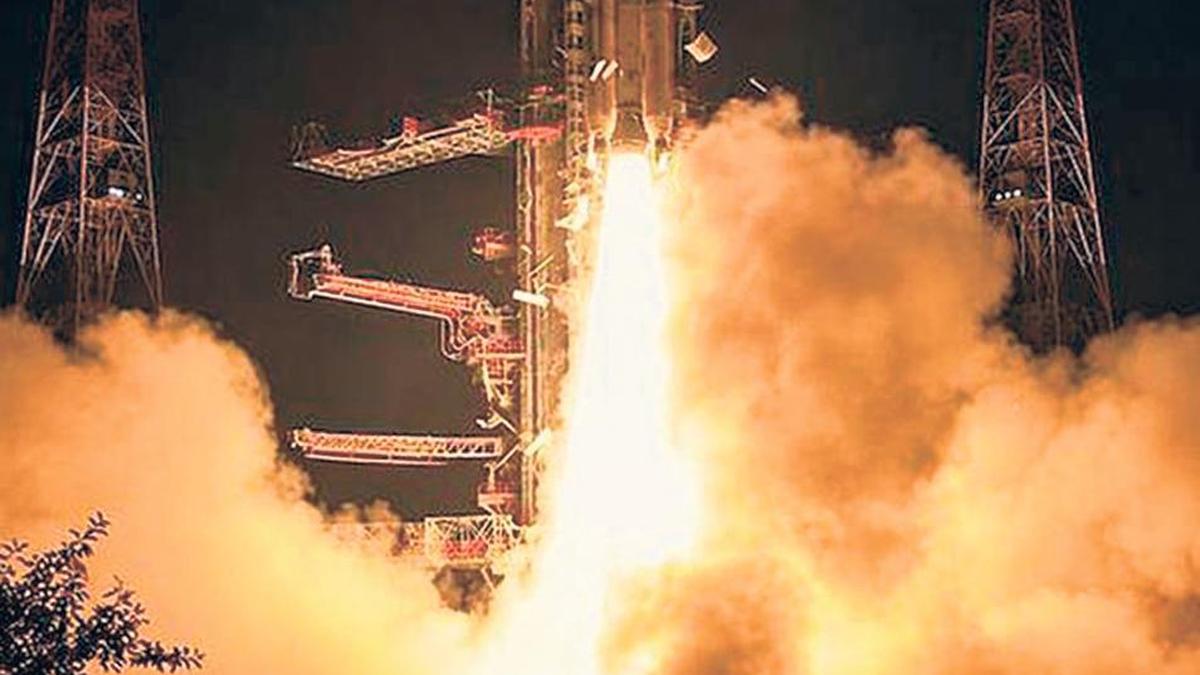
Photo from the source report: Gaganyaan Separation Tests: Safety Validation Before the First Uncrewed Mission
Image: The Hindu
Why in news
ISRO conducted the tests using an extensively instrumented setup at the Vikram Sarabhai Space Centre, Thiruvananthapuram. The supplied report describes G1 as targeted for launch this year; the tests are a readiness milestone, not confirmation that the mission has launched.
3 members
Envisaged crew
400 km
Envisaged orbital altitude
3 days
Envisaged crewed mission duration
Background
Gaganyaan seeks to demonstrate India’s human spaceflight capability through a crewed orbital mission followed by safe return to Indian sea waters. Its Orbital Module comprises a Crew Module and a Service Module, connected through a separation system and electrical and fluid umbilicals. The modules operate together from launch until completion of the on-orbit phase, but the Crew Module must separate before re-entry. Human spaceflight therefore requires not merely successful launch and orbital operations, but reliable performance across the entire mission, including separation, atmospheric return and recovery.
What has been tested?
The tests simulated Crew Module–Service Module separation, including severing several umbilical connections between the modules. Separation involves precisely sequenced events using pyrotechnic devices and jettisoning systems.
The instrumented setup at the Vikram Sarabhai Space Centre simulated the overall module assembly. ISRO reported validation of the separation system’s design adequacy and demonstration of the robustness and shock-survivability of critical Crew Module subsystems.
- The assessed subsystems included avionics and inertial navigation systems.
- The tests covered the thermal protection system in the aft and conical heat shield, and the Crew Module deployable umbilical shield.
- They also assessed pyrotechnic devices associated with the Crew Module uprighting system and the thermal and humidity control system.
Infographic
Integrated architecture
Crew and Service Modules operate together through the on-orbit phase.
Precise separation
Sequenced release events sever interfaces before re-entry.
Subsystem survival
Critical equipment must withstand separation-induced shocks.
Layered validation
Ground tests and uncrewed flights provide complementary evidence.
National capability
Systems integration and reliability expertise underpin technological self-reliance.
AI-assisted infographic by Pragnya IAS Academy, based on the cited sources.
Why separation is a safety-critical transition
The Orbital Module must transition from an integrated configuration used during launch and orbital operations to a separated Crew Module configuration before atmospheric re-entry. This requires coordinated release of structural connections and severing of electrical and fluid interfaces.
Successful separation is not simply the physical detachment of two modules. Critical systems must remain functional after the shocks generated by separation events; otherwise, an apparently successful release could still compromise subsequent operations.
- Sequencing matters because interconnected release events must occur in the intended order.
- Interface management matters because umbilicals must not obstruct clean separation.
- Shock-survivability matters because navigation, electronics and protective systems must withstand separation-induced mechanical loads.
How staged testing builds confidence
Human spaceflight uses layered verification: component testing, subsystem testing, integrated ground testing and uncrewed flight demonstrations provide different kinds of evidence. This progression helps identify faults before people are exposed to flight risks.
Ground tests permit controlled conditions and detailed instrumentation. Uncrewed flights subsequently assess interactions across the actual mission environment that cannot be reproduced completely on the ground.
The reported tests establish confidence in the implemented separation system under the tested conditions. They do not, by themselves, establish readiness of the entire human spaceflight mission or eliminate the need for further integrated validation.
- Testing should verify both intended operation and resilience to credible off-nominal conditions.
- Anomalies should feed back into design changes and repeat testing before progression.
- Flight-readiness decisions should rest on accumulated evidence rather than a single successful milestone.
Significance for India’s technological capabilities
Gaganyaan’s technological value lies in integrating multiple demanding capabilities into a system that can safely carry and return humans. The reported tests illustrate the importance of precision mechanisms, avionics, navigation, thermal protection and instrumented validation.
Such programmes can strengthen domestic engineering expertise, supplier quality practices and institutional capabilities in reliability assurance. Their broader benefits depend on translating mission-specific learning into reusable standards, testing infrastructure and industrial capabilities.
The appropriate measure of progress is therefore not launch symbolism alone, but demonstrated reliability across the mission lifecycle and the depth of technological capability retained in India.
- Human spaceflight raises the importance of traceability, configuration control and quality assurance.
- Integrated testing builds expertise in managing interactions among independently developed subsystems.
- Potential spillovers include better sensing, materials testing and safety-critical engineering practices.
| Testing stage | Primary contribution | Limit of the evidence |
|---|---|---|
| Component and subsystem tests | Assess individual devices and functional units | Do not establish the behaviour of the complete integrated system |
| Integrated ground tests | Assess interfaces, sequencing and responses under simulated conditions | Cannot reproduce every aspect of an actual flight environment |
| Uncrewed flight demonstrations | Assess mission operations and system interactions in flight without exposing a crew | Require detailed assessment before supporting crewed-flight readiness |
| Reported CM–SM separation tests | Validate separation design adequacy and critical subsystem shock-survivability | Do not independently establish readiness of the entire Gaganyaan mission |
- 1. Integrate the Crew Module and Service Module before launch, including electrical and fluid umbilicals.
- 2. Operate the modules as an integrated Orbital Module through launch and the on-orbit phase.
- 3. Initiate the precisely sequenced separation events before re-entry.
- 4. Sever umbilicals and release the Crew Module using the separation and jettisoning systems.
- 5. Proceed with Crew Module re-entry and the planned return to Indian sea waters.
Significance, challenges & way forward
Significance
- The tests strengthen confidence in a critical transition between orbital operations and atmospheric re-entry.
- Demonstrating shock-survivability addresses whether essential subsystems can remain functional after separation events.
- Integrated validation strengthens India’s systems-engineering capability beyond the development of individual space technologies.
- Staged testing allows major risks to be investigated before exposing astronauts to the mission environment.
Challenges
- Ground simulations cannot fully reproduce all combined environmental and operational conditions encountered during flight.
- Multiple release events and umbilical interfaces create interdependencies that demand precise sequencing.
- Separation-induced shocks can threaten sensitive equipment even when mechanical detachment succeeds.
- A successful subsystem milestone must not be mistaken for end-to-end mission readiness.
- Maintaining consistent hardware quality and incorporating test lessons across configurations are continuing engineering tasks.
Way forward
- Use evidence-based readiness gates so that progression depends on verified performance and closure of significant anomalies.
- Extend validation to credible off-nominal conditions, interface failures and interactions among critical subsystems.
- Correlate ground-test measurements with uncrewed-flight data to refine models and identify gaps in simulation.
- Maintain rigorous configuration control, supplier traceability and repeat testing after safety-relevant design changes.
- Preserve independent safety review and communicate milestone achievements without overstating overall readiness.
- Convert programme learning into reusable testing facilities, engineering standards and domestic industrial expertise.
Key terms
- Orbital Module
- The integrated assembly of Gaganyaan’s Crew Module and Service Module.
- Crew Module
- The part of the spacecraft intended to accommodate the crew and return safely to Earth.
- Service Module
- The module connected to the Crew Module during launch and orbital operations and separated before Crew Module re-entry.
- Umbilical connections
- Interfaces that provide electrical and fluid servicing between connected modules.
- Pyrotechnic devices
- Devices using controlled energetic reactions to perform functions such as release or separation.
- Shock-survivability
- The ability of equipment to withstand sudden mechanical loads without losing required functionality.
- Inertial navigation system
- A navigation system that uses measurements of acceleration and rotation to estimate motion and orientation.
- Thermal protection system
- Materials and structures that protect a spacecraft from severe heating, particularly during atmospheric re-entry.
Link with static syllabus
Prelims practice MCQs
Q1. With reference to Gaganyaan’s Orbital Module, consider the following statements: 1. It comprises the Crew Module and the Service Module. 2. Electrical and fluid servicing between the modules is ensured through umbilical connections. 3. The modules remain attached throughout the Crew Module’s atmospheric re-entry. Which of the statements given above are correct?
Q2. Which of the following best describes the significance of the reported Gaganyaan CM–SM separation tests?
Q3. Consider the following pairs: 1. Umbilical connections: Electrical and fluid servicing between modules 2. Inertial navigation system: Estimation of motion using acceleration and rotation measurements 3. Thermal protection system: Protection against severe heating during re-entry How many of the above pairs are correctly matched?
Q4. With reference to safety validation in human spaceflight, consider the following statements: 1. Integrated ground tests can help identify problems arising from interactions between subsystems. 2. Successful testing of one separation system conclusively establishes readiness of the entire mission. 3. Uncrewed flights can provide evidence about system behaviour in actual flight conditions. Which of the statements given above are correct?
Mains practice questions
GS 3 · 15 marks · 250 words
Staged testing, rather than a single successful launch, is the foundation of safe human spaceflight. Discuss with reference to Gaganyaan’s Crew Module–Service Module separation tests and their technological significance for India.
Frequently asked questions
What exactly did ISRO test before Gaganyaan’s G1 mission?
ISRO tested Crew Module–Service Module separation, including severing umbilical connections. The tests validated separation design adequacy and demonstrated the shock-survivability of critical Crew Module subsystems.
Why must the Crew Module separate from the Service Module?
The modules function together during launch and orbital operations, but the Crew Module must enter its return configuration before atmospheric re-entry. Separation is therefore a necessary transition in the mission sequence.
Does completion of these tests mean Gaganyaan is ready to carry astronauts?
No. It strengthens confidence in the separation system, while overall crewed-flight readiness requires broader system validation and assessment of uncrewed-flight results.
Will the first uncrewed mission carry the envisaged three-member crew?
No. G1 is an uncrewed mission; the three-member crew, 400 km orbit and three-day duration describe Gaganyaan’s envisaged crewed demonstration.
Sources
Analysis prepared by the Pragnya IAS Academy current-affairs desk with AI assistance from the cited reports. Verify figures with the original sources.
Turn current affairs into marks
Join Pragnya IAS Academy's mentorship for daily answer-writing evaluation on stories like this — classroom programmes from a trusted name in IAS coaching in Hyderabad.