
India’s Indigenous H5N1 Vaccine: Poultry Protection and the One Health Imperative
Revise the static topic: UPSC Social Justice notes · UPSC Science & Technology notes
In short: Scientists at ICAR-National Institute of High Security Animal Diseases, Bhopal, have developed what the Indian Express reports as India’s first indigenous H5N1 vaccine for protecting poultry. The development could strengthen affordable animal-disease prevention, but the source does not establish regulatory approval or field deployment; surveillance, biosecurity and coordinated human–animal health action remain essential.
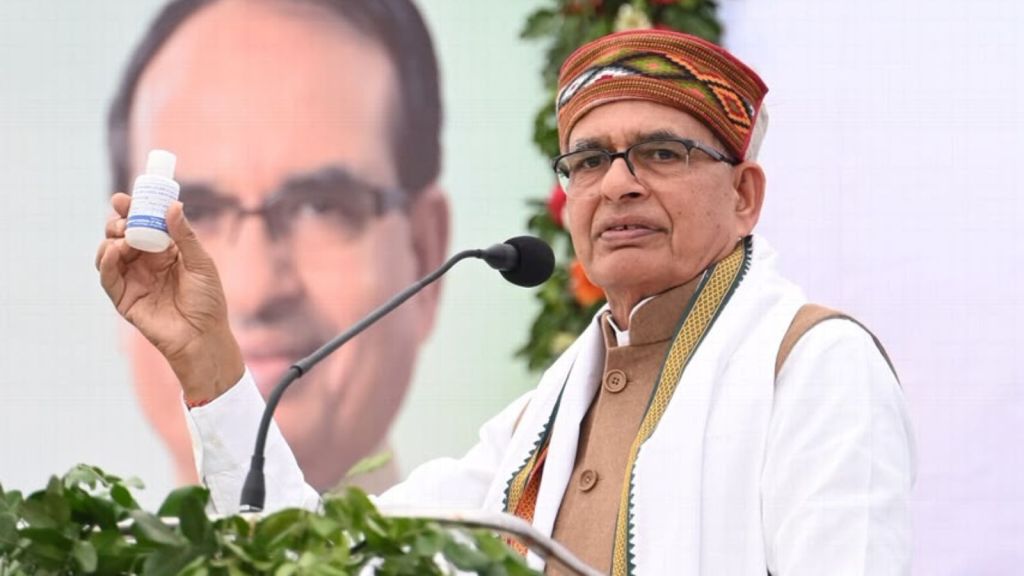
Union Minister Shivraj Singh Chouhan at the Bhopal ceremony dedicating the indigenous H5N1 poultry vaccine to the nation. The reported development does not establish regulatory approval or field deployment.
Image: Indian Express
Why in news
Union Agriculture Minister Shivraj Singh Chouhan dedicated the indigenous H5N1 vaccine to the nation in Bhopal and announced a proposed Rs 300-crore animal-disease research laboratory. The vaccine was reported to be priced at Rs 1–2 per dose.
Rs 1–2
Reported vaccine price per dose
Rs 300 crore
Proposed animal-disease research laboratory
Background
Avian influenza is caused by influenza A viruses, which are classified into subtypes according to their haemagglutinin and neuraminidase surface proteins. H5N1 is one such subtype, and highly pathogenic forms can cause severe disease and mortality in poultry. Wild aquatic birds are important natural reservoirs of avian influenza viruses, while contact between wild birds, domestic poultry and contaminated environments can enable transmission. Some avian influenza viruses can infect humans and other mammals. ICAR-NIHSAD, located in Bhopal, is an Indian Council of Agricultural Research institute working on high-risk animal diseases.
What has been developed, and what remains unverified
The source reports that ICAR-NIHSAD scientists developed India’s first indigenous vaccine against H5N1 to protect poultry. Its reported price suggests potential for affordable prevention, while domestic development could reduce dependence on external technologies.
Development and ceremonial dedication must not be treated as proof of regulatory approval, commercial availability or inclusion in an operational vaccination programme. The report does not provide the vaccine platform, trial results, duration of protection, dosing schedule or regulatory status.
The proposed research laboratory is an infrastructure announcement, not evidence that the facility is already operational. Its eventual contribution will depend on implementation, trained personnel and sustained biosafety oversight.
- This is an animal-health development, not an announcement of a human H5N1 vaccine.
- The reported per-dose price does not establish the full cost of vaccination, including administration, storage and monitoring.
- Claims about efficacy, prevention of infection or reduction in viral shedding require supporting data.
Infographic
Indigenous research
Domestic vaccine capability developed at ICAR-NIHSAD.
Evidence and approval
Verify quality, safety, efficacy and authorisation before deployment claims.
Surveillance
Track infections, circulating strains and field performance.
Biosecurity
Reduce farm exposure and strengthen safe outbreak response.
One Health
Connect animal, human and wildlife health with livelihood protection.
AI-assisted infographic by Pragnya IAS Academy, based on the cited sources.
Why avian influenza is both an agricultural and public-health concern
Highly pathogenic avian influenza can cause poultry mortality, disrupt production and undermine rural incomes. Outbreak-control measures can also impose losses on farmers and associated supply chains, making early detection and credible compensation important for timely reporting.
Human infection can occur through exposure to infected animals or contaminated environments. Poultry workers, veterinarians, laboratory personnel and outbreak-response teams therefore require appropriate protection and exposure monitoring. Animal infection does not, by itself, establish sustained human-to-human transmission.
Influenza A viruses evolve through mutation and can exchange genome segments through reassortment when different viruses infect the same cell. This makes integrated animal and human surveillance important, without implying that every poultry outbreak will become a human pandemic.
- The designation highly pathogenic primarily describes pathogenicity in poultry, not a direct measure of human transmissibility.
- Poultry vaccination may contribute to reducing infection pressure if effective, but it does not directly immunise people.
- Risk communication should explain exposure pathways without creating indiscriminate fear of poultry products.
Vaccination must complement surveillance and biosecurity
An effective vaccine could reduce disease burden and protect livelihoods. However, protection depends on the match between vaccine and circulating viruses, administration practices, coverage and duration of immunity. The supplied report does not establish these performance characteristics for the indigenous vaccine.
Vaccination cannot replace farm biosecurity or laboratory-based surveillance. If vaccination reduces visible illness without fully preventing infection, relying only on reported deaths could miss ongoing circulation. Monitoring must therefore assess infection and, where relevant, viral shedding rather than treating healthy-looking flocks as proof of freedom from disease.
- Farm biosecurity should reduce contact with wild birds and control the movement of birds, equipment and personnel.
- Prompt reporting, diagnostic testing, movement controls and safe carcass disposal remain central to outbreak management.
- Field evaluation should examine protection against circulating strains and performance under actual farm conditions.
- Where technically feasible, strategies to differentiate infected from vaccinated animals can support surveillance; the source does not establish this capability for the vaccine.
One Health and the institutional challenge
One Health treats human, animal and ecosystem health as interconnected. For avian influenza, this requires coordination among veterinary services, public-health authorities, wildlife agencies, laboratories and local administrations. Shared alerts should connect unusual bird mortality with animal testing and assessment of exposed people.
Indigenous research capacity is strategically valuable, but a laboratory breakthrough must be linked to manufacturing quality, regulatory scrutiny and accessible veterinary delivery. Commercial farms and backyard poultry keepers have different capacities to pay, report disease and maintain biosecurity.
High-containment research also requires biosafety and biosecurity. Biosafety addresses accidental exposure or release, while biosecurity addresses unauthorised access, loss or misuse of biological materials. Expanding infrastructure must be accompanied by reliable operational safeguards.
- Animal Husbandry is a State List subject, making State veterinary capacity central to implementation.
- The Prevention and Control of Infectious and Contagious Diseases in Animals Act, 2009 provides a statutory framework for animal-disease control.
- A source-supported conclusion is that vaccine development strengthens capacity; it does not establish that all regulatory and deployment requirements have been met.
| Stage | Meaning | Position in the supplied source |
|---|---|---|
| Development | Creation and scientific evaluation of a vaccine | Indigenous H5N1 vaccine development at ICAR-NIHSAD is reported; evaluation data are not supplied. |
| Regulatory approval | Authorisation following applicable scrutiny of quality, safety and efficacy | Approval status is not established. |
| Deployment | Manufacture, procurement, distribution and administration under a defined strategy | A field rollout or operational vaccination programme is not established. |
| Population-level impact | Demonstrated reduction in disease burden or transmission under field conditions | Field-effectiveness and transmission-impact data are not provided. |
- 1. Detect and report unusual illness or mortality in poultry or wild birds.
- 2. Collect samples safely and obtain laboratory confirmation and virus characterisation.
- 3. Share findings across veterinary, public-health and wildlife authorities.
- 4. Contain animal exposure through biosecurity, movement controls and applicable outbreak measures.
- 5. Assess exposed people and provide appropriate protection and clinical monitoring.
- 6. Use vaccination where authorised and justified, while maintaining surveillance for infection and vaccine performance.
Significance, challenges & way forward
Significance
- Indigenous development strengthens India’s ability to address high-risk animal diseases through domestic research.
- An affordable and effective vaccine could protect poultry livelihoods and support the continuity of food supply chains.
- Domestic capability could improve responsiveness to changing viral strains, provided research and manufacturing systems remain adaptable.
- The proposed laboratory could expand high-risk pathogen research capacity if implemented with adequate staffing and containment safeguards.
- The development creates an opportunity to integrate agricultural disease control with public-health preparedness.
Challenges
- The report does not provide evidence on regulatory approval, safety, efficacy, duration of immunity or field performance.
- Viral evolution can affect vaccine matching and requires continued characterisation of circulating strains.
- Fragmented poultry production and uneven veterinary access can complicate delivery and disease reporting.
- Fear of livelihood losses can discourage farmers from reporting suspected infection unless support mechanisms are credible.
- Vaccination without adequate surveillance can create false reassurance about continued virus circulation.
- A low reported dose price does not remove the costs of distribution, administration, diagnostics and monitoring.
Way forward
- Publish quality, safety and efficacy evidence and communicate regulatory status clearly before making deployment claims.
- Determine vaccine use through an evidence-based strategy that accounts for circulating strains and different poultry-production systems.
- Strengthen district-level veterinary diagnostics, sample transport and linked animal–human disease alerts.
- Pair any authorised vaccination programme with biosecurity, infection surveillance and field-effectiveness assessment.
- Support smallholders through accessible veterinary services, reporting incentives and timely compensation for applicable control measures.
- Build the proposed research capacity alongside trained staff, independent oversight and sustained biosafety and biosecurity systems.
Key terms
- H5N1
- An influenza A subtype identified by haemagglutinin type 5 and neuraminidase type 1 surface proteins.
- Highly pathogenic avian influenza
- An avian influenza classification associated with severe pathogenicity in poultry, not automatically with efficient human transmission.
- Zoonosis
- An infectious disease that can be transmitted naturally between vertebrate animals and humans.
- One Health
- An integrated approach recognising the interdependence of human, animal and ecosystem health.
- Biosecurity
- Measures to prevent pathogen introduction and spread on farms, or unauthorised access and misuse in laboratory settings.
- Biosafety
- Containment practices and safeguards that prevent accidental exposure to or release of biological agents.
- Reassortment
- Exchange of genome segments between compatible viruses infecting the same cell.
- DIVA
- Differentiating infected from vaccinated animals through a suitable combination of vaccine design and diagnostic tests.
Link with static syllabus
Prelims practice MCQs
Q1. With reference to H5N1 avian influenza, consider the following statements: 1. H and N denote haemagglutinin and neuraminidase surface proteins. 2. The designation highly pathogenic necessarily establishes efficient human-to-human transmission. 3. Some avian influenza viruses can infect mammals. Which of the statements given above are correct?
Q2. Regarding the indigenous H5N1 vaccine described in the supplied report, consider the following statements: 1. It was developed by ICAR-NIHSAD, Bhopal. 2. It is intended to protect poultry rather than directly immunise humans. 3. Its dedication to the nation conclusively establishes regulatory approval and nationwide rollout. Which of the statements given above are correct?
Q3. Which of the following best illustrates a One Health response to avian influenza?
Q4. Consider the following pairs: 1. Reassortment: Exchange of viral genome segments during co-infection of a cell 2. Biosafety: Prevention of accidental exposure to or release of biological agents 3. DIVA: Differentiation of infected from vaccinated animals Which of the pairs given above are correctly matched?
Mains practice questions
GS 3 · 15 marks · 250 words
India’s indigenous H5N1 vaccine development is an important scientific achievement, but vaccination alone cannot ensure avian influenza control. Discuss with reference to regulatory safeguards, rural livelihoods and One Health.
Frequently asked questions
Is India’s indigenous H5N1 vaccine meant for humans?
The supplied report describes a vaccine intended to protect poultry. It does not announce a human H5N1 vaccine.
Has the vaccine received regulatory approval?
The supplied source does not establish regulatory approval. Development and dedication to the nation should not be presented as proof of authorisation or rollout.
Why is surveillance needed after poultry vaccination?
Vaccination may not completely prevent infection or viral shedding, depending on the vaccine and circulating strain. Surveillance is needed to detect continuing circulation and evaluate protection.
What does One Health add to bird-flu control?
It links poultry and wildlife surveillance with human exposure assessment and environmental risk management. This enables coordinated action across agencies rather than isolated responses.
Sources
- Indian Express: India's bird flu fight gets a homegrown weapon: First indigenous vaccine against H5N1 developed
Analysis prepared by the Pragnya IAS Academy current-affairs desk with AI assistance from the cited reports. Verify figures with the original sources.
Turn current affairs into marks
Join Pragnya IAS Academy's mentorship for daily answer-writing evaluation on stories like this — classroom programmes from a trusted name in IAS coaching in Hyderabad.