
Riverbed Sand Mining: CEC’s Reservoir Sediment Alternative and Enforcement Challenge
Revise the static topic: UPSC Environment notes
In short: The Supreme Court’s Central Empowered Committee has proposed a three-year roadmap to phase out unsustainable sand mining and recover suitable construction material through scientific reservoir desiltation. The recommendations, which the Court is yet to examine in detail, seek to reduce damage to river ecosystems while addressing reservoir sedimentation, but their feasibility depends on material quality, environmental safeguards and effective enforcement.
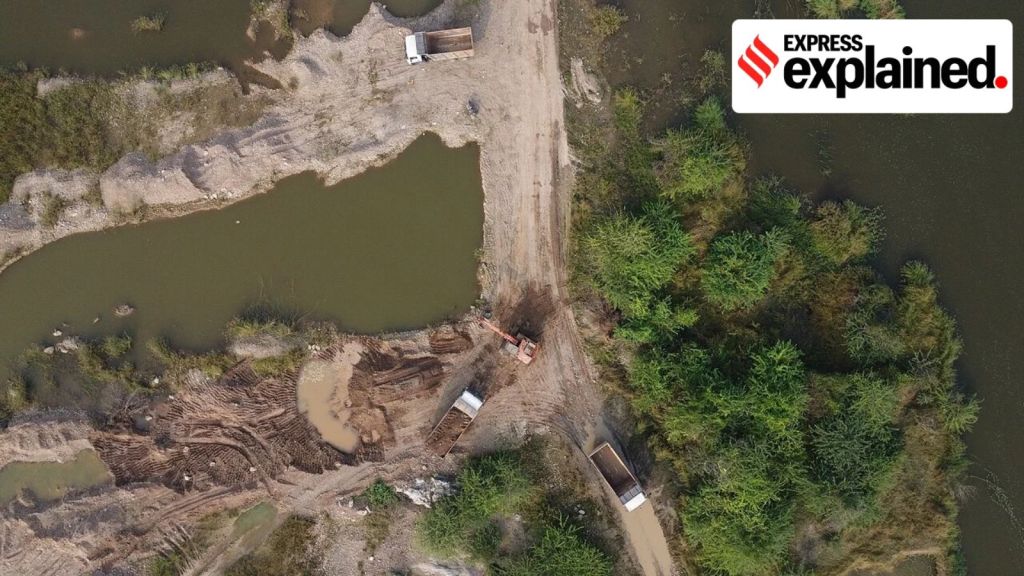
Reference image: An aerial view of sand mining in the Gundlakamma River near Vinukonda, Andhra Pradesh. Riverbed extraction is the focus of the CEC’s proposed transition toward more sustainable construction-material sources, including suitable reservoir sediment.
Image: Indian Express
Why in news
The CEC submitted its recommendations in a suo motu case concerning illegal sand mining in the National Chambal Sanctuary, whose scope the Supreme Court expanded to examine riverbed sand mining. It has proposed a national reservoir sediment management policy or programme as part of the transition.
3 years
Proposed transition roadmap
439 reservoirs
CWC-assessed reservoir sample
19.24%
Average original gross storage capacity lost
0.74%
Approximate average annual capacity loss
10 years
Proposed desiltation cycle
More than 15 years
Age threshold for assessing un-desilted storage dams
Background
River channels are shaped by the interaction of water discharge, sediment supply and erosion. Sand, gravel and silt are therefore functional components of river ecosystems rather than merely construction inputs. Sand is classified as a minor mineral under the Mines and Minerals (Development and Regulation) Act, 1957, with state governments empowered to frame rules governing concessions for minor minerals. Mineral permissions do not displace applicable environmental and wildlife safeguards. The Central Empowered Committee assists the Supreme Court in examining environmental matters, while the Central Water Commission is a technical institution concerned with water resources.
What the CEC has proposed: A transition, not an operative blanket ban
The CEC recommends progressively moving away from unsustainable extraction in active river channels through a three-year roadmap. It distinguishes scientific extraction, such as limited skimming of sandbars deposited after the monsoon, from indiscriminate excavation of deep pits.
Its alternative is a national policy or programme to recover suitable sediment from reservoirs. Proposed elements include a ten-year desiltation cycle, reservoir-wise assessments, material testing, environmental safeguards, dam safety requirements and beneficial use of recovered material.
These are recommendations, not a court-imposed nationwide prohibition. The Supreme Court is yet to examine them in detail; the proposal should not be presented as a ban on every form of riverbed sand extraction.
- Assess and prioritise storage dams more than 15 years old that have not undergone systematic desiltation.
- Determine sediment quantity and suitability before treating reservoir deposits as a construction resource.
- Link the transition away from unsustainable mining with credible alternative supplies.
Infographic
Protect river functions
Preserve sediment balance, groundwater interactions and habitats.
Recover suitable sediment
Link reservoir storage restoration with tested material recovery.
Verify actual extraction
Match physical operations and transport records with approved limits.
Diversify supply
Combine suitable reservoir material with quality-assured alternatives.
Apply ecological safeguards
Assess turbidity, residual sediment, aquatic habitats and dam safety.
AI-assisted infographic by Pragnya IAS Academy, based on the cited sources.
Why excessive extraction destabilises rivers
A river maintains a dynamic balance between water flow and sediment movement. Removing sediment faster than it is replenished can cause the channel to erode its own bed and banks, destabilising habitats and nearby infrastructure.
Deep excavation can disturb the natural subterranean barrier and allow surrounding groundwater to drain into the river channel. This can deplete aquifers and dry up wells. Excessive extraction also alters flow, velocity and discharge capacity, while damaging aquatic and riparian habitats.
The source illustrates infrastructure risks through the Bombay High Court’s 2010 prohibition on suction-pump sand mining in the Vaitarna riverbed, citing a railway bridge threat, and damage to the Kalwa-Nangal bridge over the Swan River in 2024 attributed to excessive extraction.
- Sediment removal affects channel stability as well as water availability.
- Riverbed lowering and bank erosion can undermine infrastructure safety.
- Habitat loss links sand regulation directly with biodiversity conservation.
Reservoir sediment: A useful alternative with ecological and commercial limits
Reservoirs trap sediment carried by rivers, progressively reducing storage available for irrigation, hydropower and drinking water supply. CWC assessments cited by the CEC found that 439 reservoirs had lost an average of 19.24% of their original gross storage capacity. Recovering suitable sand and gravel could therefore combine storage restoration with reduced pressure on active channels.
However, accumulated sediment is not synonymous with construction-grade sand. Grain-size, mineralogical and quality testing are necessary; fine silt and clay may be unsuitable for conventional construction. The CEC also requires attention to downstream turbidity, aquatic habitats, dam safety and ecological consequences.
Commercial feasibility must be assessed reservoir by reservoir. Recoverable material quality, dredging and processing requirements, transport to demand centres and management of unsuitable fractions will determine viability. Manufactured sand and recycled construction materials can complement suitable reservoir sediment where they meet applicable standards; no single alternative should be assumed to replace all river sand.
- Storage loss is not a direct estimate of saleable sand availability.
- Desiltation should follow reservoir-specific evidence rather than a uniform excavation target.
- Substitution must not shift environmental damage from rivers to reservoirs, quarries or disposal sites.
Enforcement and legal accountability: Permissions are only the starting point
The CEC identifies outdated District Survey Reports and replenishment studies, poorly demarcated boundaries, excessive extraction depths and quantities, night-time operations and forged transit permits as major enforcement failures. A lease or environmental clearance does not establish that actual mining remains within approved limits.
India lacks a consolidated national database of sand extraction, consumption and illegal extraction volumes. The Ministry of Mines figure of 95,306 illegal mining cases in 2021-22 covers major and minor minerals across reporting states; it is neither a sand-specific count nor a measure of the quantity extracted.
Section 15 of the MMDR Act empowers states to make rules for minor mineral concessions. This decentralised framework requires coordinated monitoring across mining, environmental, water resources and local authorities. Articles 48A and 51A(g), alongside environmental protection within the judicial interpretation of Article 21, provide the broader constitutional context.
- Verify physical extraction against approved location, depth, quantity and replenishment conditions.
- Separate mineral concession compliance from applicable environmental and wildlife compliance.
- Build interoperable records without misrepresenting case counts as extraction volumes.
| Source | Potential contribution | Essential limitation or safeguard |
|---|---|---|
| Limited scientific riverbed extraction | Uses replenished deposits, such as upper sandbar layers | Requires current replenishment studies, enforceable limits and site-specific ecological assessment |
| Reservoir sediment recovery | Can restore storage while supplying suitable sand and gravel | Requires quality testing, dam safety checks, habitat safeguards and management of unsuitable sediment |
| Manufactured sand | Provides processed crushed-rock material where suitable | Requires quality control and safeguards for quarrying, dust, energy use and transport |
| Recycled construction materials | Can reduce demand for virgin aggregates in suitable applications | Requires segregation, processing, testing and application-specific acceptance |
- 1. Survey reservoir sediment and identify storage-restoration priorities.
- 2. Test grain size, mineralogy and quality to distinguish usable material from unsuitable fractions.
- 3. Assess dam safety, aquatic habitats, downstream turbidity and operational constraints.
- 4. Determine economic feasibility and obtain applicable approvals.
- 5. Recover and process suitable material while managing residual sediment safely.
- 6. Trace material to end users and monitor storage gains and ecological outcomes.
2010
The Bombay High Court prohibited suction-pump sand mining in the Vaitarna riverbed, citing a threat to an important railway bridge.
2024
The Kalwa-Nangal bridge over the Swan River in Punjab was damaged due to excessive riverbed sand extraction, according to the source.
April 2026
The Bhakra Beas Management Board’s expression of interest explored desiltation and dredging proposals for the Bhakra and Pong reservoirs.
Significance, challenges & way forward
Significance
- The proposal treats sediment as an ecological asset rather than an unrestricted construction input.
- Reducing excessive riverbed extraction can protect groundwater systems, aquatic habitats, riverbanks and infrastructure.
- Scientifically justified sediment recovery can support reservoir storage restoration and alternative material supply.
- The debate connects environmental regulation with construction demand, water security and resource efficiency.
- The distinction between legal permission and verified compliance strengthens outcome-based environmental governance.
Challenges
- The absence of consolidated sand supply and consumption data makes transition planning and enforcement assessment difficult.
- Outdated surveys, unclear boundaries and forged transit documents weaken control over actual extraction.
- Reservoir deposits contain mixed materials, so total sediment accumulation cannot be treated as usable sand supply.
- Dredging can affect turbidity, habitats and dam operations if poorly designed or monitored.
- Processing and transport requirements may make reservoir sediment commercially unsuitable for some construction markets.
- Restrictions without reliable alternatives could create supply pressures and incentives for illegal extraction.
Way forward
- Adopt a phased national framework while retaining reservoir-specific ecological, technical and economic assessments.
- Update District Survey Reports and replenishment studies, and demarcate approved extraction areas with verifiable spatial records.
- Integrate electronic transit permits, weighbridge records and field inspections to check material movement against authorised extraction.
- Pilot reservoir sediment recovery and publish material-quality, storage-restoration, cost and ecological results before scaling up.
- Develop clear testing and procurement pathways for suitable reservoir material, manufactured sand and recycled construction materials.
- Manage fine silt, clay and other unusable fractions explicitly rather than treating their disposal as an afterthought.
- Create a consolidated sand information system that distinguishes legal production, consumption, violations and estimated extraction volumes.
Key terms
- Sediment budget
- The balance between sediment entering, leaving and being stored within a river reach or basin.
- Replenishment study
- An assessment of sediment deposited over time that helps determine whether extraction limits are sustainable.
- Desiltation
- Removal of accumulated silt, sand, clay and other sediment or debris from a water body.
- Dredging
- Excavation or removal of material from the bed of a water body.
- District Survey Report
- A district-level assessment used in planning and environmental appraisal of minor mineral extraction, including sand.
- Riparian habitat
- The ecological zone along riverbanks that connects terrestrial and aquatic systems.
- Minor mineral
- A statutory mineral category under the MMDR Act that includes sand and is subject to state rule-making for concessions.
- Turbidity
- Cloudiness of water caused by suspended particles, which can affect light penetration and aquatic life.
Link with static syllabus
Prelims practice MCQs
Q1. With reference to the CEC recommendations on sand mining described in the source, consider the following statements: 1. They constitute an operative Supreme Court ban on all riverbed sand extraction. 2. They propose a three-year roadmap to phase out unsustainable sand mining. 3. They require testing before reservoir sediment is treated as construction material. Which of the statements given above are correct?
Q2. Consider the following statements about excessive riverbed sand extraction: 1. It can cause erosion of the river’s bed and banks. 2. Deep extraction can allow surrounding groundwater to drain into the river channel. 3. It affects only aquatic habitats and has no bearing on infrastructure safety. Which of the statements given above are correct?
Q3. With reference to mineral regulation in India, consider the following statements: 1. Sand is classified as a minor mineral under the MMDR Act, 1957. 2. State governments are empowered to frame rules for minor mineral concessions under Section 15 of the Act. 3. Possession of a mining lease by itself proves compliance with permitted extraction depths and quantities. Which of the statements given above are correct?
Q4. Which one of the following is the most appropriate interpretation of the reservoir sedimentation and illegal mining data cited by the CEC?
Mains practice questions
GS 3 · 15 marks · 250 words
Excessive riverbed sand mining is a challenge of both ecological sustainability and regulatory governance. Examine whether reservoir desiltation can provide a viable alternative for meeting construction demand.
Frequently asked questions
Has the Supreme Court banned all riverbed sand mining through this proposal?
No. The source describes CEC recommendations that the Supreme Court is yet to examine in detail, including a phased transition away from unsustainable extraction.
Can all reservoir sediment replace construction sand?
No. Suitable sand and gravel must be identified through grain-size, mineralogical and quality testing; fine silt and clay may be unsuitable for conventional construction.
Why can riverbed sand mining affect wells?
Deep extraction can disturb the natural subterranean barrier and allow surrounding groundwater to drain into the river channel. This can deplete aquifers and dry up wells.
Why is a mining lease insufficient to demonstrate compliance?
A lease authorises extraction subject to conditions but does not prove that actual operations stay within approved boundaries, depths and quantities. Field verification and material traceability remain necessary.
Sources
- Indian Express: Why the Supreme Court’s environmental watchdog wants to curb riverbed sand mining, and what it proposes instead
Analysis prepared by the Pragnya IAS Academy current-affairs desk with AI assistance from the cited reports. Verify figures with the original sources.
Turn current affairs into marks
Join Pragnya IAS Academy's mentorship for daily answer-writing evaluation on stories like this — classroom programmes from a trusted name in IAS coaching in Hyderabad.