
U.S. AI-Chip and Cloud Controls: Compute Sovereignty and India’s Options
Revise the static topic: UPSC Science & Technology notes
In short: The U.S. Commerce Department has issued an interim final rule extending restrictions on advanced American AI chips to overseas data-centre arrangements that provide computing access to businesses headquartered in specified countries. The move targets access to AI computing power, not merely physical chip shipments, highlighting the strategic importance of secure and diversified compute infrastructure for India.
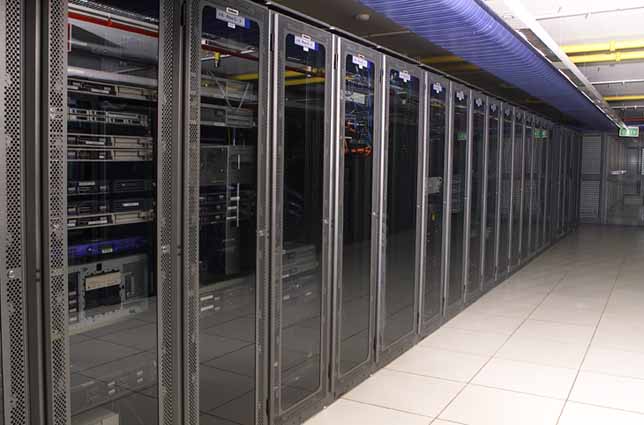
Reference view of managed server racks at a Macquarie Telecom data centre in Sydney, illustrating the infrastructure through which cloud providers deliver remote computing access.
Image: Lgate74 · CC BY 3.0
Why in news
The Hindu reports that the November 16 rule covers overseas cloud access involving businesses headquartered in two dozen countries, including China, Iran and Russia. It also requires explicit U.S. approval for high-end AI-chip shipments to five countries, including Indonesia, Malaysia and Singapore.
Two dozen
Countries covered by reported cloud-access restrictions
Five
Countries facing explicit approval for chip shipments
Background
Advanced AI systems depend on specialised semiconductor accelerators, memory, networking and data-centre infrastructure. Cloud computing allows users to access this infrastructure remotely without owning the underlying chips. Export controls regulate sensitive goods and technologies because of their commercial and military applications. The U.S. Export Control Reform Act, 2018 strengthened the legal framework for such controls, while the Bureau of Industry and Security administers export-control measures within the U.S. Commerce Department. Restrictions on cloud-mediated compute therefore connect semiconductor policy with national security, international trade and digital infrastructure.
What the reported rule changes
The source describes a licensing requirement for supplying advanced American AI chips to overseas data-centre operators providing substantial computing power to businesses headquartered in specified countries. Its central implication is that locating chips outside the U.S. does not, by itself, remove restrictions connected to their use.
The report also identifies a separate approval requirement for high-end AI-chip shipments to five countries, naming Indonesia, Malaysia and Singapore. These shipment controls should not be conflated with the wider country coverage of the reported cloud-access restrictions.
The supplied extract describes the measure both as a restriction on cloud services and as a licensing requirement affecting chip supply. It does not reproduce the operative legal text, technical thresholds, exceptions or implementation timetable; consequently, it should not be read as establishing a blanket ban on every cloud service.
- The regulatory focus extends beyond the location of hardware to the businesses accessing its computing capacity.
- The source does not provide the complete lists of countries covered by either restriction.
- India’s specific treatment under the rule cannot be established from the supplied extract.
Infographic
Secure access
Diversify lawful chip and cloud partnerships.
Build capabilities
Strengthen semiconductor and AI infrastructure ecosystems.
Share compute
Enable affordable research and start-up access.
Improve resilience
Support efficient models and portable workloads.
Ensure clarity
Assess actual licensing rules before investment decisions.
AI-assisted infographic by Pragnya IAS Academy, based on the cited sources.
Why cloud computing changes export-control logic
A business can train or run AI models using remotely rented accelerators without importing those chips. Controls centred only on physical shipments may therefore leave a route to the computing capability that policymakers seek to restrict.
Extending controls to overseas compute arrangements seeks to address this gap. It also increases the importance of identifying customers, their headquarters and the nature of the services supplied, although the extract does not specify the rule’s detailed verification obligations.
- Chip ownership and access to chip-generated computing power are distinct.
- A data centre’s host country and a customer’s headquarters can be different.
- Commercial cloud infrastructure can have dual-use implications because AI capabilities may support both civilian and military activities.
Geopolitics and technological sovereignty
The U.S. approach uses control over strategically important technology to constrain access to advanced capabilities. China has criticised the measure as an overextension of national security and interference in normal trade and technological cooperation.
Such restrictions can encourage countries and firms to seek alternative suppliers, develop domestic technologies and reassess cross-border infrastructure partnerships. They may also fragment technology markets and raise compliance uncertainty for legitimate users.
Technological sovereignty should therefore mean dependable access and meaningful control over critical capabilities, rather than complete technological isolation. Domestic infrastructure alone is insufficient if essential chips, software or servicing remain vulnerable to external restrictions.
- National-security objectives must be distinguished from the commercial effects of their implementation.
- Geographical diversification does not automatically eliminate dependence on a common technology supplier.
- Regulatory predictability becomes an important factor in data-centre investment decisions.
Implications for India’s AI and semiconductor ambitions
For India, the immediate lesson is to treat compute availability as a strategic input to research, enterprise development and public-service innovation. Any effect on Indian firms would depend on the rule’s actual coverage, their suppliers and customers, and applicable licensing conditions.
AI infrastructure policy and semiconductor policy require coordination but are not interchangeable. Expanding domestic data centres can improve access to compute, while chip design, fabrication, packaging, memory and equipment capabilities address different layers of dependence.
India can combine trusted international partnerships with domestic capability-building. The objective should be affordable access for researchers and smaller enterprises, continuity of critical workloads and a gradual reduction of concentrated technological dependencies.
- Assess exposure across imported accelerators, cloud contracts, software support and maintenance.
- Diversify suppliers and infrastructure locations without assuming that relocation removes export-control obligations.
- Support efficient AI models and shared research infrastructure alongside semiconductor capability-building.
- Avoid treating data localisation as equivalent to technological sovereignty.
| Dimension | Physical chip access | Cloud-mediated compute access |
|---|---|---|
| What the user obtains | Hardware for deployment | Remote access to computing capacity |
| Ownership | User or infrastructure operator acquires chips | Customer need not own the underlying chips |
| Relevant locations | Exporter and hardware destination | Hardware location and customer headquarters may differ |
| Reported control approach | Licensing or approval for specified chip supplies | Restrictions linked to overseas data-centre services for covered businesses |
| Lesson for India | Secure hardware supply and servicing | Secure lawful, affordable and continuous compute access |
- 1. Advanced American AI chips are supplied to an overseas data-centre operator.
- 2. The operator makes computing capacity available through cloud services.
- 3. A business accesses that capacity remotely without importing the chips.
- 4. The reported controls connect chip-supply permissions with access by businesses headquartered in covered countries.
- 5. Suppliers and operators must assess applicable restrictions before undertaking covered transactions.
2018
The U.S. enacted the Export Control Reform Act, strengthening its framework for controlling sensitive technology exports.
2019
The Bureau of Industry and Security placed Huawei and its affiliates on the Entity List, restricting access to controlled technology.
November 16, as reported
The U.S. Commerce Department issued an interim final rule addressing advanced AI-chip supply and overseas cloud-compute access involving specified countries.
Significance, challenges & way forward
Significance
- The measure highlights computing capacity, rather than hardware ownership alone, as a strategic resource.
- It shows how technology dependencies can transmit one country’s regulatory decisions across global infrastructure networks.
- It links India’s AI ambitions with semiconductor access, reliable cloud services and international technology partnerships.
- It strengthens the case for assessing resilience across the entire AI infrastructure stack.
Challenges
- The supplied extract does not establish precise technical thresholds, exemptions or India’s country-specific treatment.
- Overseas cloud arrangements can complicate the identification of customers and the assessment of restricted access.
- Regulatory uncertainty may increase compliance costs and discourage otherwise legitimate technological cooperation.
- Domestic data centres can remain dependent on foreign accelerators, software and technical support.
- Pursuing complete self-sufficiency could divert resources from more achievable priorities such as diversified access and targeted capability-building.
Way forward
- Examine the operative rule before advising Indian firms on coverage, licensing requirements or contractual changes.
- Map critical dependencies across accelerators, memory, networking, cloud services and software support.
- Use diplomatic and industry channels to seek predictable licensing and continuity of lawful technology access.
- Expand shared compute access for universities, start-ups and public-interest research with transparent allocation practices.
- Build semiconductor capabilities across design, manufacturing and packaging while recognising their distinct technological requirements.
- Promote energy-efficient infrastructure, model efficiency and workload portability to strengthen resilience without pursuing technological isolation.
Key terms
- AI accelerator
- A processor designed to perform computational tasks used in AI workloads efficiently.
- Compute
- The processing capacity used to train, run and evaluate computational models.
- Cloud computing
- On-demand remote access to computing resources such as processing, storage and software.
- Dual-use technology
- Technology capable of serving both civilian and military purposes.
- Export control
- A regulatory restriction on transfers of specified goods, software or technology.
- Entity List
- A BIS-administered list that imposes specified licensing requirements on transactions involving listed entities and items subject to U.S. export controls.
- Compute sovereignty
- The capacity to secure reliable access to, and meaningful control over, computing resources needed for strategic objectives.
Link with static syllabus
Prelims practice MCQs
Q1. With reference to AI infrastructure, consider the following statements: 1. A business can access advanced AI computing capacity without owning the underlying chips. 2. The headquarters of a cloud customer must be located in the same country as the data centre serving it. Which of the statements given above is/are correct?
Q2. Consider the following statements about U.S. technology export controls: 1. The Export Control Reform Act was enacted in 2018. 2. The Bureau of Industry and Security operates within the U.S. Commerce Department. 3. Dual-use technologies have exclusively military applications. Which of the statements given above are correct?
Q3. Which of the following best explains why restrictions on physical AI-chip exports may be extended to overseas cloud-computing arrangements?
Q4. Consider the following statements regarding technological sovereignty: 1. Hosting a data centre domestically necessarily eliminates dependence on foreign technology. 2. Data localisation and technological sovereignty are identical concepts. Which of the statements given above is/are correct?
Mains practice questions
GS 3 · 15 marks · 250 words
Restrictions on advanced AI chips increasingly target access to computing capability rather than hardware transfers alone. Analyse the implications for technological sovereignty and suggest a strategy for India.
Frequently asked questions
Does the reported rule ban all cloud services?
The supplied extract does not establish a universal cloud-service ban. It concerns advanced American AI chips and overseas compute arrangements involving businesses headquartered in specified countries.
Why can chip controls affect businesses that only rent cloud services?
Cloud customers use the computing capacity of chips owned by a provider. Controls can therefore target arrangements that enable restricted businesses to access advanced compute without importing hardware.
Is India directly covered by the new restrictions?
The extract does not provide complete country lists or establish India’s specific treatment. Direct implications require examination of the operative rule and the relevant business arrangement.
Will domestic data centres alone ensure India’s compute sovereignty?
No. Reliable access also depends on chips, software, servicing, energy and applicable regulatory permissions, alongside domestic technical capabilities.
Sources
Analysis prepared by the Pragnya IAS Academy current-affairs desk with AI assistance from the cited reports. Verify figures with the original sources.
Turn current affairs into marks
Join Pragnya IAS Academy's mentorship for daily answer-writing evaluation on stories like this — classroom programmes from a trusted name in IAS coaching in Hyderabad.