
Assam–Tamil Nadu Elephant Transfers: Ownership, Welfare and Enforcement Gaps
Revise the static topic: UPSC Environment notes
In short: The Hindu has reported the hurried transfer of five elephants from Assam to temples in Tamil Nadu, raising questions about ownership verification, transfer procedures and animal welfare. The central issue is whether regulatory approvals reliably establish lawful origin and suitable care, rather than merely authorise movement across State boundaries.
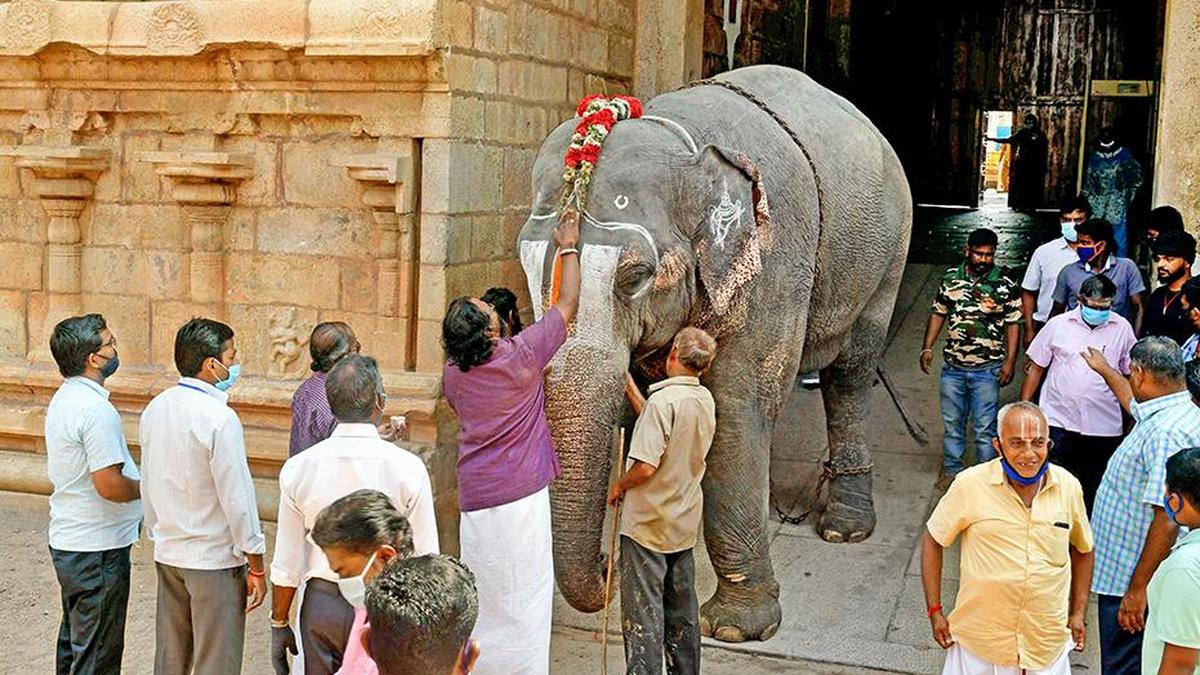
The Hindu’s report examines the transfer of five elephants from Assam to Tamil Nadu temples, raising questions about lawful ownership, transfer approvals and welfare after arrival.
Image: The Hindu
Why in news
The reported transfers have brought scrutiny to the safeguards governing the acquisition of captive elephants by temples. The supplied excerpt raises concerns about regulatory gaps but does not establish that these particular transfers were illegal.
5
Elephants reportedly moved from Assam to Tamil Nadu
Background
The Asian elephant is protected under Schedule I of the Wild Life (Protection) Act. Captive possession does not remove this protection: lawful ownership, transfer and transport remain regulated. The Act provides a specific route for transferring or transporting captive elephants with valid ownership certificates, subject to prescribed conditions. The Captive Elephant (Transfer or Transport) Rules govern this route, while the Prevention of Cruelty to Animals Act provides a complementary framework against unnecessary pain and suffering. Temple use is therefore a regulated custodial arrangement, not an exemption from wildlife or welfare law.
What the report establishes—and what remains unverified
The supplied report describes the movement of five elephants from Assam to temples in Tamil Nadu and questions the haste and robustness of the transfer process. It also explains that temple elephants may participate in rituals, processions, festivals and interactions with devotees.
The excerpt does not provide the ownership certificates, transfer orders, veterinary assessments or inspection reports for these elephants. Accordingly, it supports scrutiny of the regulatory process, but not a definitive finding of forged ownership, illegal capture, commercial dealing or cruelty.
- The immediate accountability question is whether authorities verified lawful possession and the proposed conditions of care before approving movement.
- The broader policy question is whether the system can detect illegal wildlife acquisition concealed within apparently valid paperwork.
Infographic
Lawful origin
Authenticate ownership and trace custody history.
Verified identity
Match records to the elephant actually being moved.
Valid authorisation
Apply statutory conditions to the proposed arrangement.
Humane care
Assess both transport risks and destination welfare.
Shared accountability
Coordinate States and monitor conditions after arrival.
AI-assisted infographic by Pragnya IAS Academy, based on the cited sources.
Legal framework: a conditional permission, not unrestricted trade
The Wild Life (Protection) Act generally restricts commercial transfers involving protected captive wildlife covered by ownership certificates. Its elephant-specific provision permits transfer or transport by a person holding a valid ownership certificate, subject to conditions prescribed by the Union government. This is not a blanket authorisation for unrestricted elephant commerce.
The Captive Elephant (Transfer or Transport) Rules address circumstances such as an owner's inability to maintain an elephant and the prospect of better upkeep under the proposed arrangement. They provide a regulatory framework involving wildlife authorities, verification and welfare-related assessment. Interstate movement requires coordination between the originating and receiving States.
Wildlife authorisation and animal-welfare compliance are distinct obligations. An approved transfer does not excuse unnecessary suffering during transport or subsequent custody, and religious use does not create a general exemption from these safeguards.
- An ownership certificate concerns lawful possession; it should not be treated as permission for every subsequent transaction.
- A transfer changes custody or ownership, whereas transport concerns movement; the regulatory questions are related but not identical.
- Chief Wildlife Wardens and State forest authorities have central administrative roles in regulating captive wildlife.
Ownership verification: trace the elephant, not merely the certificate
The principal enforcement risk is a mismatch between an elephant's actual history and the documents presented for approval. A robust inquiry should establish continuity between lawful acquisition, successive custodians and the identity of the animal being moved. This is an enforcement standard, not a finding that such a mismatch occurred in the reported case.
Certificates should be checked against issuing-authority records and available individual-identification data, including microchip records where maintained. Unexplained changes in identity, age, custody or movement history should trigger closer examination rather than automatic acceptance.
Authorities should also examine whether an arrangement described as a donation or welfare transfer conceals prohibited commercial dealing. The label attached to a transaction cannot substitute for verification of its substance.
- Cross-check the certificate with the issuing authority rather than relying only on a copy supplied by the applicant.
- Reconcile individual identification with previous custody, veterinary and movement records.
- Investigate suspicious provenance without presuming that every interstate transfer is illegal.
Welfare and interstate enforcement must continue after arrival
Elephants are socially complex animals whose welfare cannot be assessed solely through a fitness-to-travel certificate. Destination assessment should consider suitable space, water, shade, veterinary support, opportunities for movement and social needs. Ritual schedules, public contact and restraint practices also require scrutiny.
Interstate transfers can fragment responsibility: the source State may focus on dispatch, while the receiving State may rely on the source State's paperwork. A credible system must connect pre-transfer verification, transport monitoring, confirmation of arrival and subsequent inspections.
The Wildlife Crime Control Bureau can support coordination and intelligence concerning organised wildlife crime. Routine ownership and welfare supervision, however, must remain anchored in accountable State-level administration.
- Require a documented handover so that responsibility does not end at the State border.
- Assess the receiving institution's actual capacity rather than its religious or charitable status alone.
- Use follow-up inspections to test whether promised improvements in upkeep have materialised.
| Safeguard | Core question | Why it matters |
|---|---|---|
| Ownership verification | Does the certificate correspond to this elephant and a lawful custody history? | Helps detect undocumented acquisition and substitution. |
| Transfer authorisation | Does the proposed arrangement satisfy the applicable legal conditions? | Prevents a conditional permission from becoming an unrestricted trading route. |
| Transport assessment | Can the elephant undertake the journey without avoidable suffering? | Addresses risks arising during movement. |
| Destination assessment | Can the recipient provide appropriate long-term care? | Tests whether the proposed custody arrangement is welfare-compatible. |
| Post-transfer monitoring | Do actual conditions match the approved arrangement? | Prevents compliance from ending once movement is completed. |
- 1. Authenticate ownership records and establish the elephant's custody history.
- 2. Match the physical animal with available individual-identification records.
- 3. Assess the legal grounds for transfer and the recipient's care capacity.
- 4. Coordinate State-level scrutiny and document the required authorisations.
- 5. Arrange veterinary safeguards and humane transport.
- 6. Confirm arrival, update records and undertake follow-up welfare inspections.
Significance, challenges & way forward
Significance
- Reliable provenance checks help prevent illegally acquired elephants from entering apparently lawful captive arrangements.
- The case links species conservation with the welfare of individual captive animals, requiring both to be addressed.
- Interstate transfers test whether cooperative federalism works through shared records and clear administrative responsibility.
- Transparent scrutiny can distinguish genuine care-oriented transfers from arrangements that exploit regulatory exceptions.
- Temple custody brings public institutions, cultural practices and animal-care obligations into the same accountability framework.
Challenges
- Incomplete or inconsistent historical records can make lawful-origin verification difficult.
- Authentic paperwork may still be inadequate if it is not reliably linked to the elephant being transferred.
- Formal descriptions such as donation or improved upkeep may obscure the actual purpose of a transaction.
- A favourable pre-transfer inspection cannot guarantee sustained welfare at the destination.
- Fragmented responsibility between States can weaken follow-up and delay responses to suspected violations.
- The supplied report excerpt does not contain the administrative records needed to determine whether the particular transfers breached the law.
Way forward
- Develop interoperable captive-elephant records linking identity, ownership, custody changes, veterinary history and movement permissions.
- Require issuing-authority confirmation and reconciliation of identification records before accepting ownership claims.
- Publish reasoned transfer decisions and non-sensitive compliance findings to strengthen public accountability.
- Use documented veterinary and destination-care assessments, with additional independent scrutiny in disputed cases.
- Establish a joint interstate protocol covering departure, arrival confirmation, responsibility for inspection and responses to non-compliance.
- Investigate suspected document fraud or wildlife trafficking through coordinated forest-department action and Wildlife Crime Control Bureau support where appropriate.
- Make long-term welfare outcomes, rather than completion of paperwork, the principal test of successful regulatory supervision.
Key terms
- Ownership certificate
- A statutory document recognising lawful possession of specified captive wildlife, subject to the governing law.
- Provenance
- The documented origin and successive custody history of an animal.
- Captive-elephant transfer
- A regulated change in ownership or custody of an elephant held in captivity.
- Wildlife laundering
- Concealing the illegal origin of wildlife through apparently legitimate documents or transactions.
- Chief Wildlife Warden
- The principal State-level wildlife authority entrusted with statutory functions under the Wild Life (Protection) Act.
- Wildlife Crime Control Bureau
- A statutory body that supports intelligence gathering and coordination against organised wildlife crime.
- Animal welfare
- The physical and behavioural well-being of an animal, including protection from unnecessary pain and suffering.
Link with static syllabus
Prelims practice MCQs
Q1. With reference to captive elephants in India, consider the following statements: Statement I: Captivity removes an elephant from the protection of the Wild Life (Protection) Act. Statement II: The Act provides a conditional route for transferring or transporting a captive elephant held under a valid ownership certificate. Which of the statements given above is/are correct?
Q2. Consider the following pairs: Pair I: Chief Wildlife Warden — State-level administration of statutory wildlife functions. Pair II: Wildlife Crime Control Bureau — Coordination and intelligence support against organised wildlife crime. Pair III: CITES — Routine authorisation of domestic interstate transfers of temple elephants. Which of the pairs given above are correctly matched?
Q3. Which of the following most accurately describes the relationship between wildlife-transfer permission and animal-welfare obligations?
Q4. With reference to the verification of captive-elephant transfers, consider the following statements: Statement I: Provenance verification concerns the animal's origin and custody history. Statement II: A fitness-to-travel assessment by itself establishes that the destination can provide suitable long-term care. Statement III: Describing a transaction as a donation does not eliminate the need to examine its legality. Which of the statements given above are correct?
Mains practice questions
GS 3 · 15 marks · 250 words
Captive-elephant transfers reveal the limits of document-centred wildlife regulation. Discuss with reference to ownership verification, animal welfare and interstate enforcement.
Frequently asked questions
Were the Assam–Tamil Nadu elephant transfers proved illegal?
The supplied excerpt does not establish illegality. It reports the transfer of five elephants and raises questions about the speed and adequacy of regulatory scrutiny.
Can captive elephants legally be transferred between States?
Yes, subject to the applicable wildlife-law provisions, valid ownership documentation and prescribed transfer or transport conditions. Interstate movement is not automatically illegal, but it requires regulatory scrutiny.
Is an ownership certificate sufficient to establish full compliance?
No. It does not by itself establish that a particular transfer, journey or destination-care arrangement satisfies all applicable requirements.
Why do temple-elephant transfers raise conservation concerns?
Weak verification can create opportunities to conceal unlawful acquisition within apparently legitimate captive arrangements. Conservation safeguards must therefore operate alongside welfare oversight, without presuming wrongdoing in every transfer.
Sources
Analysis prepared by the Pragnya IAS Academy current-affairs desk with AI assistance from the cited reports. Verify figures with the original sources.
Turn current affairs into marks
Join Pragnya IAS Academy's mentorship for daily answer-writing evaluation on stories like this — classroom programmes from a trusted name in IAS coaching in Hyderabad.