
Delimitation Bills: Lok Sabha Expansion, State-Share Freeze and Women’s Reservation
Revise the static topic: UPSC Polity notes · UPSC Governance notes
In short: The Union Cabinet has approved proposals to expand Lok Sabha and Assembly seats, preserve existing inter-State Lok Sabha seat proportions until 2051 and enable women’s reservation through delimitation. The proposed framework seeks to reconcile gender inclusion with federal safeguards, but raises questions about population-based representation, Census choice and parliamentary scrutiny.
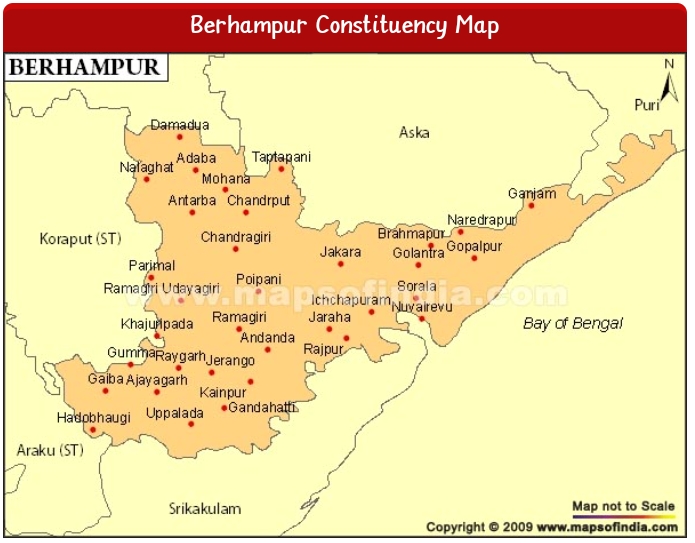
Reference map of Berhampur Lok Sabha constituency in Odisha. Constituency boundary revision is distinct from allocating Lok Sabha seats among States; this map does not depict the proposed changes.
Image: Maps of India · CC BY-SA 4.0
Why in news
On November 27, 2026, the Union Cabinet approved the proposed 132nd Constitutional Amendment Bill, accompanied by a fresh Delimitation Bill. Parliamentary consideration is proposed during special sittings from November 30 to December 3; the changes are not yet enacted.
50%
Proposed seat increase
850
Proposed Lok Sabha ceiling
550
Existing Lok Sabha ceiling
2051
Proposed State-share freeze endpoint
33%
Women’s reservation
2011
Census envisaged for boundary revision
Background
Delimitation involves allocating legislative seats and drawing territorial constituency boundaries. Article 81 governs the composition of the Lok Sabha and population-related representation, while Article 82 provides for readjustment after a Census through a law made by Parliament. The existing framework distinguishes inter-State seat allocation, anchored to the 1971 Census, from constituency readjustment within States, based on the 2001 Census. The freeze sought to avoid disadvantaging States that stabilised population. Women’s reservation, approved by Parliament in 2023, is linked through Article 334A to Census publication and a subsequent delimitation exercise.
What the proposed Bills would change
The constitutional proposal would increase Lok Sabha seats allocated to each State and Union territory by 50%, while raising the House’s constitutional maximum from 550 to 850. It also proposes a similar increase in the total seats of each State and Union territory Legislative Assembly.
The intended safeguard is proportional expansion rather than population-driven redistribution between States. Existing inter-State Lok Sabha seat proportions would be protected until 2051, while the enlarged House would provide the setting for implementing women’s reservation.
- The proposed ceiling of 850 is not a notified final seat total.
- Preserving State shares does not mean freezing constituency boundaries within States.
- A uniform percentage increase requires explicit whole-seat allocation rules wherever the calculation produces fractions.
- Cabinet approval does not itself amend the Constitution or activate the new electoral arrangements.
Infographic
Federal protection
Preserve existing State seat proportions until 2051.
Legislative expansion
Propose 50% seat growth and an 850-seat Lok Sabha ceiling.
Gender inclusion
Enable women’s reservation through the proposed delimitation route.
Census choice
Use published figures available at commencement for boundaries.
Democratic legitimacy
Combine constitutional procedure, State consultation and transparent boundary-setting.
AI-assisted infographic by Pragnya IAS Academy, based on the cited sources.
Federal balance versus population-based representation
Population-based representation seeks broadly comparable representative weight for citizens. However, redistributing seats strictly according to changed population shares could reduce the relative parliamentary influence of States that achieved population stabilisation.
Preserving State shares addresses this federal concern, but does not remove differences in population represented by an MP across States. Expanding all State delegations proportionately can reduce average constituency size without correcting the underlying inter-State representational imbalance.
The proposed compromise therefore prioritises continuity in the federal distribution of political power while expanding representation. Its legitimacy depends on transparent reasoning and broad consultation, not merely on securing enough votes for passage.
- Absolute seat growth and relative parliamentary influence are different measures.
- Equality of voting rights does not automatically ensure equality of constituency population.
- Protection for State shares must be assessed alongside representation of citizens in faster-growing States.
Census choice: allocation and boundary revision are separate
The proposal replaces the existing reference to publication of the first Census figures after 2026 with a freeze running until 2051. It removes the explicit 1971 Census linkage for inter-State allocation and instead refers to Article 334A.
For constituency boundaries, the reported Bill uses the latest published Census figures available on the date the constitutional amendment commences. The supplied editorial identifies the 2011 Census as the basis envisaged for the immediate exercise; the commencement-date rule is the more precise legal formulation.
Older Census data may not adequately capture subsequent migration, urban expansion and population shifts. Conversely, waiting for newer data would affect the timing of delimitation and the implementation of women’s reservation. This is a policy trade-off requiring explicit justification.
- Do not treat 2051 as an announced Census year; it is the proposed endpoint of the freeze.
- Do not assume the Bill permanently mandates the 2011 Census regardless of its commencement date.
- Boundary revision can improve representation within States without changing their relative Lok Sabha shares.
Women’s reservation and the changed rationale for the freeze
The proposed amendment places the guarantee of seat expansion within Article 334A and presents it as a measure for giving immediate effect to women’s reservation. If enacted and followed by the required delimitation and electoral implementation, the framework would enable the reservation approved in 2023.
This changes the stated basis of the seat-share freeze. The earlier justification centred on population stabilisation; the new proposal connects the continuation of existing proportions with women’s representation.
These objectives should nevertheless be evaluated separately. Gender inclusion concerns access to legislative office, while a State-share freeze concerns the territorial distribution of parliamentary power. Their inclusion in the same package does not make the constitutional connection between them self-evident.
- Women’s reservation need not logically depend on a particular inter-State allocation formula.
- Expansion can accommodate inclusion without reducing existing State delegations.
- Legal clarity is needed on how expansion, constituency delimitation and reservation will operate together.
Constitutional procedure and institutional safeguards
Under Article 368, a constitutional amendment requires a majority of the total membership of each House and a majority of not less than two-thirds of members present and voting. An amendment changing the representation of States in Parliament also requires ratification by at least half of the State legislatures before presidential assent.
A constitutional amendment and a delimitation law perform different functions: the former changes constitutional constraints, while the latter provides the operational framework for readjustment. Neither Cabinet approval nor announcement of special sittings substitutes for these legal requirements.
Federalism and democracy are elements of the Constitution’s basic structure. Their relevance calls for careful constitutional scrutiny, not a presumption that every departure from strict population proportionality is necessarily invalid. Parliamentary committee examination and meaningful State consultation would strengthen the reform’s legitimacy.
- The amendment procedure must be distinguished from the passage of ordinary legislation.
- Independent boundary-setting procedures and public objections can reduce partisan manipulation.
- A larger legislature also requires stronger committee capacity, research support and debating arrangements.
| Issue | Existing framework | Reported proposal |
|---|---|---|
| Lok Sabha constitutional ceiling | 550 seats | 850 seats; the ceiling is not the final allocation |
| Inter-State allocation | 1971 Census-based allocation protected by the existing freeze | Existing State proportions protected until 2051 through the proposed Article 334A linkage |
| Seat expansion | Existing allocation continues | 50% increase for each State and Union territory; similar Assembly expansion |
| Constituency boundaries | 2001 Census basis under the existing frozen framework | Latest published Census figures at commencement; 2011 Census envisaged in the supplied editorial |
| Freeze endpoint | Linked to publication of relevant figures of the first Census taken after 2026 | Fixed reference to 2051 |
| Women’s reservation | Approved in 2023, with implementation linked to Census and delimitation | Expansion and immediate delimitation proposed to enable implementation |
- 1. Complete parliamentary passage of the constitutional amendment with the Article 368 special majority.
- 2. Secure the required State ratification and presidential assent.
- 3. Enact and commence the accompanying delimitation framework in accordance with law.
- 4. Apply the seat-expansion formula while protecting the prescribed State shares.
- 5. Redraw constituencies using the Census basis specified at commencement and determine reserved constituencies under the applicable law.
- 6. Bring the revised electoral arrangements into operation according to the enacted provisions.
1971
Census population distribution became the basis for the inter-State seat allocation subsequently protected by the freeze.
1976
A constitutional freeze protected State seat allocations against population-driven redistribution.
2001
The constitutional freeze was extended, continuing protection for existing inter-State allocation.
2023
Parliament approved women’s reservation, with implementation linked to Census publication and delimitation.
April 2026
The reported 131st Constitutional Amendment Bill sought inter-State redistribution using the 2011 Census.
November 27, 2026
The Cabinet approved the new constitutional proposal protecting State shares until 2051, accompanied by a fresh Delimitation Bill.
November 30–December 3, 2026
Special parliamentary sittings are proposed for consideration of the Bills.
Significance, challenges & way forward
Significance
- Protecting State shares addresses concerns that population stabilisation could lead to diminished relative influence in Parliament.
- Seat expansion could reduce the population represented by an individual MP, although the actual effect depends on final allocations.
- Implementation of women’s reservation would widen access to legislative decision-making.
- Separating inter-State allocation from intra-State boundary revision allows distinct representational problems to be addressed differently.
- A negotiated settlement could strengthen confidence in the Union’s handling of demographic diversity.
Challenges
- A prolonged State-share freeze retains unequal population-to-seat ratios across States.
- Older Census data may inadequately reflect migration, urbanisation and changed settlement patterns.
- Fractional outcomes from uniform expansion require clear rounding rules consistent with the promised proportional safeguard.
- Linking gender reservation to the State-share freeze requires a clearer constitutional and policy justification.
- A larger House may strain debating time, legislative infrastructure and committee scrutiny.
- Compressed consideration risks weakening consultation on a reform with long-term federal consequences.
Way forward
- Refer the Bills to a parliamentary committee for clause-by-clause scrutiny and consultations with States, political parties and constitutional experts.
- Publish illustrative State-wise allocations and explain how rounding will affect the promise of preserving proportions.
- State clearly which Census figures will govern the exercise and explain the representational costs of the chosen data.
- Provide a legally coherent implementation sequence for expansion, delimitation and women’s reservation.
- Ensure transparent boundary criteria, accessible draft maps and meaningful opportunities for public objections.
- Plan legislative staffing, research facilities and committee reforms alongside physical expansion.
- Develop a consultative framework for reviewing representation before the proposed freeze expires.
Key terms
- Delimitation
- The process of determining legislative constituencies and adjusting their boundaries and seat arrangements under law.
- Inter-State apportionment
- The allocation of Lok Sabha seats among States.
- Intra-State delimitation
- The drawing or revision of constituency boundaries within a State.
- Seat-share freeze
- A safeguard maintaining existing relative State representation rather than reallocating seats according to changed population shares.
- Malapportionment
- Unequal population-to-seat ratios across territorial constituencies or representative units.
- Article 334A
- The constitutional provision governing the commencement and duration framework of women’s legislative reservation.
- Sunset clause
- A provision specifying when a legal arrangement is to end or cease to apply.
- Constitutional ceiling
- The maximum membership permitted by the Constitution, distinct from the actual number of allocated seats.
Link with static syllabus
Prelims practice MCQs
Q1. With reference to the delimitation proposals reported in November 2026, consider the following statements: 1. They seek to preserve existing inter-State Lok Sabha seat proportions until 2051. 2. They propose a maximum Lok Sabha strength of 850. 3. Cabinet approval itself brings the proposed women’s reservation arrangements into electoral operation. Which of the statements given above are correct?
Q2. Consider the following statements about delimitation: 1. Inter-State apportionment concerns the allocation of Lok Sabha seats among States. 2. Intra-State delimitation concerns constituency boundaries within a State. 3. A uniform proportional increase in State delegations necessarily equalises population-to-seat ratios across States. Which of the statements given above are correct?
Q3. An amendment changing the representation of States in Parliament requires which of the following under Article 368?
Q4. Regarding the Census basis in the reported constitutional proposal, consider the following statements: 1. Constituency boundaries would use the latest published Census figures available when the amendment commences. 2. The reference to 2051 establishes a mandatory Census in that year. 3. The supplied editorial identifies the 2011 Census as the basis envisaged for the immediate boundary exercise. Which of the statements given above are correct?
Mains practice questions
GS 2 · 15 marks · 250 words
The proposed delimitation framework seeks to reconcile population-based representation, federal balance and gender inclusion. Critically examine its design and suggest safeguards for legitimate implementation.
Frequently asked questions
Has the Lok Sabha already been expanded to 850 seats?
No. The supplied reports describe a Cabinet-approved proposal to raise the constitutional ceiling to 850; this is neither enactment nor a final allocation of seats.
Does freezing State shares prevent constituency boundaries from changing?
No. Inter-State seat allocation can remain proportionately protected while constituencies within each State are redrawn.
Which Census would guide the proposed delimitation?
The reported Bill specifies the latest published Census figures available when the amendment commences. The supplied editorial identifies the 2011 Census as the basis envisaged for the immediate exercise.
Would Cabinet approval immediately activate women’s reservation?
No. The proposal seeks to enable reservation through constitutional changes and delimitation, but the required enactment and electoral implementation steps must first be completed.
Sources
- The Hindu: Centre proposes freeze on Lok Sabha seat proportions for States until 2051
- The Hindu: Lok Sabha seat freeze is no longer linked to population stabilisation
- The Hindu (Editorial): Fair play: on a hurried delimitation of Lok Sabha constituencies
- Indian Express: Delimitation Bill full text: 850 Lok Sabha seats, women's quota, 25-year freeze
Analysis prepared by the Pragnya IAS Academy current-affairs desk with AI assistance from the cited reports. Verify figures with the original sources.
Turn current affairs into marks
Join Pragnya IAS Academy's mentorship for daily answer-writing evaluation on stories like this — classroom programmes from a trusted name in IAS coaching in Hyderabad.