
ICJ’s Myanmar Genocide Ruling: State Responsibility and the Enforcement Gap
Revise the static topic: UPSC International Relations notes
In short: According to the supplied reports, the International Court of Justice ruled on November 19, 2026 that Myanmar committed genocide against the Rohingya during its 2017 military operations. The judgment establishes state responsibility and orders remedies, but protecting survivors depends on implementation, humanitarian access and conditions for safe return. It may influence other genocide proceedings without predetermining their outcomes.

Reference view of the Peace Palace in The Hague, Netherlands, the seat of the International Court of Justice; photographed in 2006, not during the reported judgment.
Image: International Court of Justice ; originally uploaded by Yeu Ninje at en.wikipedia . · Public domain
Why in news
The supplied reports describe the verdict in The Gambia v. Myanmar as the ICJ’s first finding that a state was directly responsible for committing genocide. Its significance lies in the distinction between judicial accountability and the court’s limited ability to secure compliance.
9–6
Vote on commission of genocide
14–1
Vote rejecting direct and public incitement charge
More than 7,40,000
Rohingya who fled to Bangladesh in 2017
Nearly 1.2 million
Rohingya in Cox’s Bazar camps, as reported
Two years
Period for Myanmar to report back to the court
Background
The Rohingya are a predominantly Muslim ethnic minority associated with Myanmar’s Rakhine State, bordering Bangladesh. The supplied reports describe longstanding denial of citizenship, restrictions on movement and exclusion from essential services. The Genocide Convention obliges states to prevent and punish genocide, while the ICJ, the principal judicial organ of the United Nations, adjudicates legal disputes between states on the basis of jurisdictional consent. Its role differs from that of the International Criminal Court, which prosecutes individuals rather than states.
What the reported judgment decides
The court reportedly held Myanmar responsible for genocide during the military’s 2017 clearance operations in northern Rakhine State. It also found failures to prevent genocide by civilians accompanying its forces, punish perpetrators and enact legislation required by the Convention, alongside destruction of evidence contrary to its interim order.
The judgment concerns Myanmar’s international legal responsibility, not the criminal conviction of individual commanders or officials. The distinction also explains its historical significance: the earlier Bosnia judgment recognised genocide at Srebrenica and held Serbia responsible for failing to prevent it, but did not attribute its commission to Serbia.
- Myanmar was ordered to investigate and, where warranted, prosecute those responsible.
- The reported remedies include guarantees of non-recurrence, safe, voluntary and dignified return, restoration of property and compensation.
- The compensation amount remains to be determined after Myanmar reports back within two years.
- The court rejected the direct and public incitement allegation and declined to order citizenship for the Rohingya.
- The judgment is final and without appeal; limited procedures for interpretation or revision are distinct from an appeal.
Infographic
Legal threshold
Prohibited acts, specific intent and state attribution must be established.
State accountability
ICJ findings concern the state, not individual criminal convictions.
Victim remedies
Return, property restoration, compensation and non-recurrence require implementation.
Enforcement gap
Binding obligations coexist with limited coercive capacity and political constraints.
Protection first
Humanitarian access and rights-based, voluntary return determine practical impact.
Wider relevance
Persuasive legal reasoning does not predetermine other genocide cases.
AI-assisted infographic by Pragnya IAS Academy, based on the cited sources.
Genocide: prohibited acts, specific intent and state attribution
Genocide requires a prohibited act committed with intent to destroy, in whole or in part, a national, ethnical, racial or religious group as such. The prohibited acts include killing, serious bodily or mental harm, destructive conditions of life, measures intended to prevent births and forcible transfer of children. Mass displacement or civilian suffering is not, by itself, sufficient to establish the specific intent required for genocide.
Where genocidal intent is inferred from a pattern of conduct, the ICJ applies the demanding test that it must be the only reasonable inference available from the evidence. According to the supplied analysis, the Myanmar ruling met this threshold through the evidentiary record, including UN investigative material, rather than by lowering the legal standard.
A finding of state responsibility also requires legal attribution of the relevant conduct to the state. Conduct by state organs, including armed forces, is generally attributable to the state; responsibility for failing to prevent genocide is a separate question from attribution of its commission.
- Article I establishes the obligation to prevent and punish genocide.
- Article II defines genocide, while Article III identifies punishable acts including genocide, conspiracy, direct and public incitement, attempt and complicity.
- Article V requires necessary domestic legislation and effective penalties.
- A counter-insurgency objective does not necessarily exclude the simultaneous existence of genocidal intent.
- State responsibility and individual criminal responsibility can coexist without one being a substitute for the other.
ICJ jurisdiction and the limits of enforcement
Article IX of the Genocide Convention provides for submitting disputes over its interpretation, application or fulfilment, including state responsibility for genocide, to the ICJ. Jurisdiction remains consent-based: treaty participation, applicable reservations and the existence of a legal dispute matter. Membership of the United Nations alone does not give the ICJ compulsory jurisdiction over every dispute.
The Convention protects a common interest of its parties. Through obligations erga omnes partes, a state party may invoke another party’s responsibility without showing that its own nationals were the victims, subject to jurisdictional requirements. This explains the legal relevance of proceedings brought by The Gambia.
The ICJ has no independent police force or coercive enforcement machinery. Under Article 94 of the UN Charter, members undertake to comply with judgments in cases to which they are parties; if a party fails to perform its obligations, the other party may approach the Security Council. Council action is discretionary and may encounter veto politics.
- A binding judgment does not automatically produce sanctions, arrests or compliance.
- Security Council involvement is a possible enforcement route, not a guaranteed outcome.
- Diplomatic pressure, domestic implementation and international monitoring remain crucial to translating legal obligations into protection.
Implications for Rohingya protection and other genocide cases
The verdict provides legal recognition of the Rohingya’s persecution and a framework for restitution, compensation and non-recurrence. However, the supplied reports describe continued fighting between Myanmar’s military and the Arakan Army, restricted humanitarian access and insecurity in Rakhine. A return order cannot itself make return safe or voluntary.
For other proceedings, including South Africa v. Israel, the ruling’s potential influence lies in its treatment of evidence, attribution and specific intent. Article 59 of the ICJ Statute limits a judgment’s binding force to the parties and the particular case. Its reasoning can nevertheless carry persuasive authority; allegations in another dispute must still be independently proved.
For India, the issue connects neighbourhood stability, displacement, maritime protection and border management. A credible regional approach should combine lawful security screening with humanitarian access, protection against return to persecution and sustained engagement with Bangladesh and other affected countries.
- The reported refusal to order citizenship leaves a central source of Rohingya exclusion unresolved.
- Refugees’ informed consent and independent assessment of conditions must guide any repatriation.
- Evidence preservation supports both state-responsibility proceedings and legally competent individual prosecutions.
- The Myanmar outcome neither automatically establishes genocide elsewhere nor removes jurisdictional barriers in other cases.
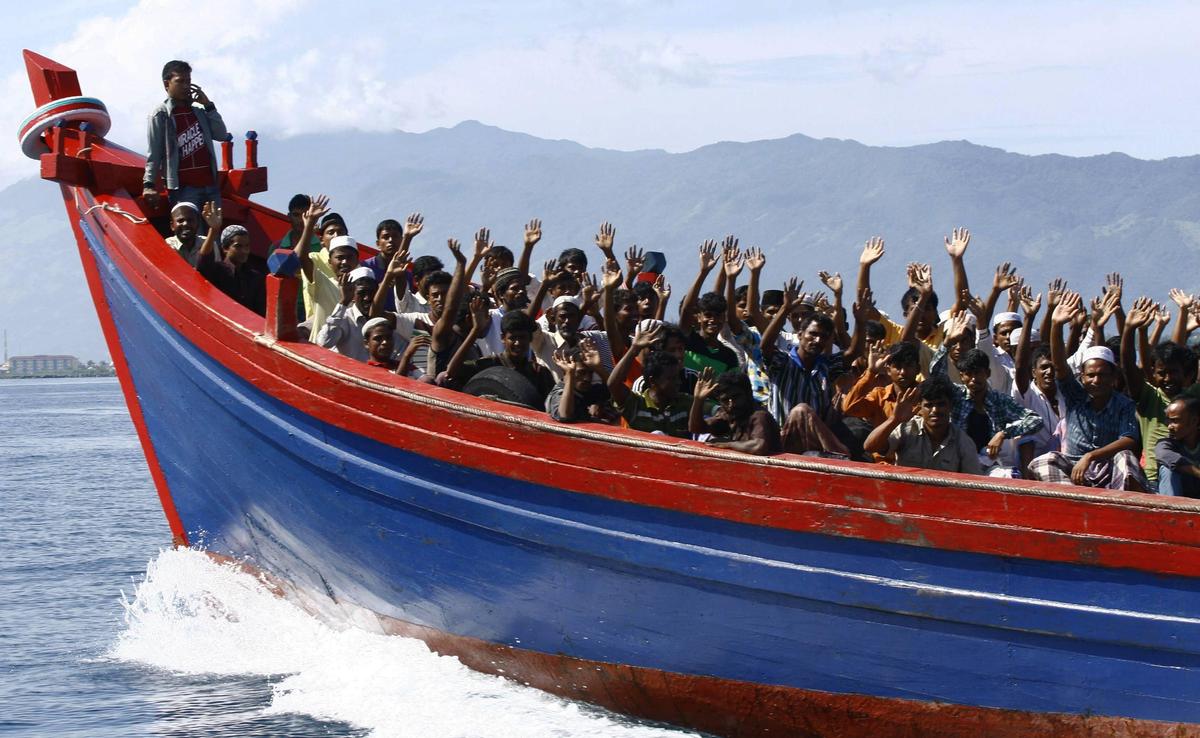
Historical reference photograph of refugees being transported by wooden boat to a temporary shelter in Krueng Raya, Aceh Besar, Indonesia, on April 8, 2013. This scene predates Myanmar’s 2017 military operations and illustrates the longer history of displacement and refuge.
Image: The Hindu
| Aspect | International Court of Justice | International Criminal Court |
|---|---|---|
| Institutional position | Principal judicial organ of the United Nations | Independent treaty-based criminal court |
| Subject of proceedings | States in contentious cases | Individuals accused of crimes within its jurisdiction |
| Jurisdictional basis | State consent, including applicable treaty clauses | Rome Statute jurisdictional conditions or a Security Council referral |
| Genocide-related role | Determines breaches of international obligations and state responsibility | Determines individual criminal responsibility |
| Possible outcomes | Declarations, cessation, reparation and appropriate guarantees of non-recurrence | Acquittal or conviction, criminal penalties and possible victim reparations |
| Implementation constraint | Depends on state compliance and available international enforcement mechanisms | Depends substantially on cooperation for arrests, evidence and enforcement |
- 1. A state invokes an applicable basis of ICJ jurisdiction over a legal dispute.
- 2. The court determines jurisdiction and admissibility; provisional protection may be ordered pending judgment.
- 3. Evidence is assessed for prohibited acts, specific intent, attribution and other Convention breaches.
- 4. A merits judgment determines state responsibility and appropriate remedies.
- 5. Domestic implementation, international monitoring and diplomatic engagement seek compliance.
- 6. If obligations remain unperformed, the other party may seek Security Council action under Article 94.
1948
The UN General Assembly adopted the Genocide Convention.
2007
In Bosnia and Herzegovina v. Serbia and Montenegro, the ICJ recognised the Srebrenica genocide and found Serbia in breach of its duty to prevent it, without attributing its commission to Serbia.
2015
In Croatia v. Serbia, the ICJ dismissed the claim and counterclaim after finding the necessary genocidal intent unestablished.
2017
Myanmar’s military operations in Rakhine triggered mass Rohingya displacement into Bangladesh.
2019
The Gambia brought proceedings against Myanmar under the Genocide Convention.
2020
The ICJ issued provisional measures, including obligations concerning preservation of evidence.
November 19, 2026
According to the supplied reports, the ICJ found Myanmar responsible for committing genocide and ordered remedies.
Significance, challenges & way forward
Significance
- The reported ruling distinguishes responsibility for committing genocide from responsibility for failing to prevent or punish it.
- It demonstrates the relevance of common-interest treaty obligations even when the applicant state is not directly injured.
- The remedies connect accountability with victims’ property, compensation, return and protection against renewed violations.
- Its treatment of investigative evidence may inform future litigation without creating an automatically binding precedent.
- It places refugee protection and neighbourhood instability within a wider framework of international legal responsibility.
Challenges
- The ICJ cannot independently compel compliance, while Security Council enforcement may be constrained by political divisions.
- Conflict and fragmented territorial control in Rakhine complicate humanitarian access, investigations and implementation.
- Unresolved citizenship and movement restrictions weaken the prospects for durable, rights-based return.
- Destruction of evidence and insecurity can obstruct individual accountability and verification of compliance.
- Overcrowded camps and uncertain legal status in host countries prolong displacement-related vulnerability.
- Premature repatriation could turn a judicial remedy into renewed exposure to persecution or violence.
Way forward
- Translate the judgment into independently verifiable benchmarks covering investigations, access, property restoration and non-recurrence.
- Preserve documentary, digital and testimonial evidence while protecting survivors and witnesses from retaliation.
- Prioritise humanitarian access and essential services irrespective of the pace of political negotiations.
- Make repatriation conditional on informed consent, independently assessed safety, dignity and effective rights protections.
- Address citizenship exclusion and freedom of movement through durable legal and administrative reforms.
- Support Bangladesh and other host countries through sustained assistance and responsibility-sharing rather than pressure for premature return.
- India should combine regional diplomacy and lawful security management with humane treatment and individualised protection assessment.
Key terms
- Genocide
- Specified acts committed with intent to destroy, wholly or partly, a protected national, ethnical, racial or religious group as such.
- Dolus specialis
- The specific intent to destroy a protected group that distinguishes genocide from other grave violations.
- Actus reus
- The prohibited conduct constituting the physical element of an offence.
- State responsibility
- International legal responsibility arising when conduct attributable to a state breaches its international obligations.
- Erga omnes partes
- Obligations owed to all parties to a treaty, each of which has a legal interest in their observance.
- Provisional measures
- Binding interim directions intended to preserve rights pending a final judicial decision.
- Non-refoulement
- The principle prohibiting return to persecution or specified serious harm, with its legal scope depending on the applicable regime.
- Guarantees of non-recurrence
- Measures intended to prevent repetition of internationally wrongful conduct.
Link with static syllabus
Prelims practice MCQs
Q1. With reference to genocide under international law, consider the following statements: 1. Genocide requires intent to destroy, in whole or in part, a protected group as such. 2. Forcibly transferring children of a protected group to another group can constitute genocide when accompanied by the requisite intent. 3. Every instance of large-scale forced displacement automatically constitutes genocide. Which of the statements given above are correct?
Q2. Consider the following statements about the International Court of Justice: 1. Only states may be parties in contentious cases before it. 2. It may impose prison sentences on military commanders for genocide. 3. Membership of the United Nations automatically establishes its compulsory jurisdiction over every dispute involving a member state. Which of the statements given above is/are correct?
Q3. With reference to the enforcement and effect of ICJ judgments, consider the following statements: 1. Under Article 59 of its Statute, a judgment has binding force only between the parties and in respect of the particular case. 2. Under Article 94 of the UN Charter, the other party may approach the Security Council when a party fails to perform obligations under a judgment. 3. Such an approach automatically requires the Security Council to impose sanctions. Which of the statements given above are correct?
Q4. The expression erga omnes partes, in the context of the Genocide Convention, most appropriately refers to:
Mains practice questions
GS 2 · 15 marks · 250 words
The recognition of state responsibility for genocide does not automatically ensure protection for its victims. Discuss with reference to the ICJ’s reported Myanmar judgment and its implications for other genocide proceedings.
Frequently asked questions
Does the ICJ ruling convict Myanmar’s military leaders?
No. It determines Myanmar’s state responsibility; criminal convictions of individuals require separate proceedings before a competent domestic or international criminal court.
Can the ICJ directly enforce its judgment?
The ICJ has no independent coercive enforcement machinery. Compliance depends on state action and international pressure, with possible recourse by the other party to the Security Council under Article 94.
Does the Myanmar ruling determine the outcome of the case against Israel?
No. Its reasoning may be persuasive, but each case requires an independent assessment of jurisdiction, evidence, attribution and genocidal intent.
Does the judgment mean Rohingya refugees can safely return now?
No. The supplied reports describe continuing insecurity and humanitarian restrictions; return requires verified safety, informed consent, dignity and effective protection of rights.
Sources
- The Hindu: News in Frames | Living with the wounds of displacement
- The Hindu: The Rohingya | Vindication for a persecuted people
- Indian Express: Why Myanmar’s genocide verdict matters, including for Israel’s case
Analysis prepared by the Pragnya IAS Academy current-affairs desk with AI assistance from the cited reports. Verify figures with the original sources.
Turn current affairs into marks
Join Pragnya IAS Academy's mentorship for daily answer-writing evaluation on stories like this — classroom programmes from a trusted name in IAS coaching in Hyderabad.