
India Crosses One Crore HPV Doses: Vaccination, Screening and Cervical-Cancer Prevention
Revise the static topic: UPSC Social Justice notes · UPSC Science & Technology notes
In short: India administered more than one crore HPV vaccine doses to 14-year-old girls by November 21, 2026, reaching nearly 87% of its identified annual target in less than nine months. The milestone strengthens cervical-cancer prevention, but sustained protection requires equitable vaccination, continued screening and timely treatment of precancerous lesions.
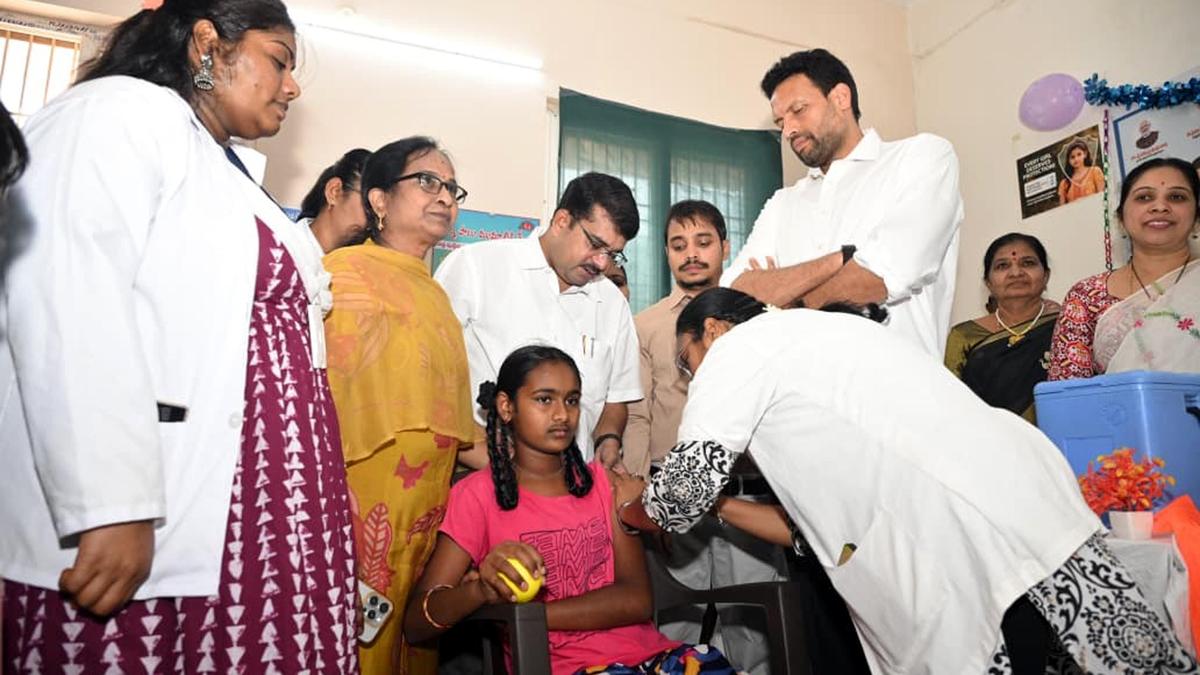
Photo from the source report: India Crosses One Crore HPV Doses: Vaccination, Screening and Cervical-Cancer Prevention
Image: The Hindu
Why in news
On November 23, 2026, Prime Minister Narendra Modi welcomed the national HPV vaccination milestone. The campaign provides free, voluntary, single-dose vaccination at designated government health facilities with parental consent.
More than one crore
HPV vaccine doses administered
Nearly 87%
Identified annual target reached
14 years
Campaign eligibility age for girls
1.2 crore
Estimated annual beneficiaries
6 states
Reported full target coverage
95.28%
Reported coverage in Telangana
Background
Human papillomavirus is a group of viruses, some of which can cause cancer. Persistent infection with high-risk HPV types can lead to cervical precancer and, over time, cervical cancer. Vaccination is most effective before exposure to the virus and constitutes primary prevention; screening identifies high-risk infection or precancerous changes so that appropriate follow-up and treatment can prevent progression. HPV vaccines prevent new infections but do not treat existing HPV infection or established cancer. Consequently, cervical-cancer control requires a continuum of vaccination, screening, diagnosis and treatment.
What the national campaign provides
Launched on February 28, 2026, the campaign targets every 14-year-old girl in the country, with an estimated annual cohort of 1.2 crore beneficiaries. Vaccination is free and voluntary, follows a single-dose schedule and requires parental consent at designated government health facilities.
The campaign uses Gardasil, a quadrivalent vaccine covering HPV types 16, 18, 6 and 11. Types 16 and 18 are high-risk cancer-associated types, while types 6 and 11 are primarily associated with genital warts; the four types should not be described as having identical cancer-causing potential.
- Public financing removes the vaccine price at the point of service, although travel and opportunity costs can still impede access.
- A single-dose schedule reduces repeat-visit requirements and simplifies delivery.
- The campaign's eligibility rules should not be confused with the broader clinical indications for HPV vaccination.
Infographic
Vaccination
Prevent new infections with covered HPV types.
Screening
Identify high-risk infection and precancerous changes.
Treatment
Ensure follow-up, precancer care and cancer referral.
Equity
Reach girls missed by routine identification and access.
Trust
Support informed consent and transparent safety communication.
Delivery
Maintain reliable supplies, trained staff and accurate records.
AI-assisted infographic by Pragnya IAS Academy, based on the cited sources.
Why vaccination must be combined with screening
Vaccination acts upstream by preventing infection with covered HPV types. Screening acts further along the disease pathway by identifying high-risk HPV infection or precancerous cervical changes that require assessment and management.
Vaccinated women still need screening according to applicable guidance because vaccination does not cover every cancer-causing HPV type or treat infection acquired earlier. Women outside the campaign's adolescent cohort also require access to prevention, diagnosis and treatment.
- Screening options include HPV testing, cytology and visual inspection with acetic acid, depending on programme protocols and resources.
- A positive screening result is not itself a diagnosis of cervical cancer and must trigger appropriate follow-up.
- Screening without accessible treatment and referral can leave the prevention pathway incomplete.
Coverage gains and the equity test
Government figures reported full target coverage in Gujarat, Uttar Pradesh, Andhra Pradesh, Mizoram, Madhya Pradesh and Bihar. Telangana reported 95.28% coverage, while several other states and a Union Territory remained below the national level.
These figures measure reported programme coverage against identified targets, not independently verified universal protection or an immediate reduction in cancer incidence. Aggregate success can conceal missed girls within districts, settlements and mobile populations.
- Out-of-school girls need identification and mobilisation beyond school-based communication.
- Migrant families, remote habitations and underserved urban settlements require tailored access arrangements.
- Target denominators should be checked for omissions, migration and duplicate records.
- Monitoring should track who remains unreached, rather than only cumulative doses.
Public trust and last-mile delivery
Because the campaign is voluntary and requires parental consent, clear communication is central to implementation. Families need understandable information on eligibility, benefits, limitations and possible adverse events, without stigma around HPV transmission.
Free availability at government facilities must be supported by reliable vaccine supply, cold-chain integrity, trained staff and convenient access. Community health workers, schools and local institutions can help eligible girls reach designated vaccination sites while preserving informed choice.
- Use local-language communication that presents HPV vaccination as cancer prevention.
- Explain that an adverse event following immunisation is not automatically caused by the vaccine and requires assessment.
- Maintain confidential records and accessible channels for questions and complaints.
- Connect adolescent vaccination outreach with broader awareness of adult cervical screening.
| Component | Principal role | Important limitation or requirement |
|---|---|---|
| HPV vaccination | Prevents new infection with vaccine-covered HPV types | Does not treat existing infection or replace screening |
| Cervical screening | Identifies high-risk infection or precancerous changes | Requires appropriate follow-up after a positive result |
| Treatment of precancer | Interrupts progression towards invasive cancer | Requires accessible services and patient follow-through |
| Cancer diagnosis and treatment | Manages established disease | Requires timely referral, specialist care and financial protection |
| Public awareness and outreach | Supports informed uptake and access | Must address stigma, misinformation and excluded populations |
- 1. Identify eligible girls, including those outside school and in mobile populations.
- 2. Provide clear information and obtain informed parental consent.
- 3. Facilitate access to designated government vaccination facilities.
- 4. Administer the vaccine with appropriate storage and safety procedures.
- 5. Record vaccination and monitor adverse events following immunisation.
- 6. Review coverage gaps and undertake targeted follow-up for missed girls.
2022
WHO's Strategic Advisory Group of Experts on Immunization supported a single-dose HPV vaccination option for girls and young women, citing strong efficacy evidence.
February 28, 2026
India launched its nationwide HPV vaccination campaign targeting 14-year-old girls.
November 21, 2026
The Health Ministry reported more than one crore doses administered and nearly 87% coverage of the identified annual target.
November 23, 2026
Prime Minister Narendra Modi welcomed the milestone as progress towards preventive healthcare.
Significance, challenges & way forward
Significance
- The campaign advances preventive healthcare by addressing an infection linked to cervical cancer before disease develops.
- Free vaccination can reduce financial barriers to an important preventive intervention for adolescent girls.
- A single-dose schedule simplifies logistics and reduces dependence on repeat attendance.
- The programme creates an opportunity to strengthen adolescent health outreach and awareness of women's cancer prevention.
- Successful prevention can reduce future treatment needs and associated household hardship.
Challenges
- National and state averages may conceal exclusion within districts and disadvantaged communities.
- Inaccurate target lists can overstate coverage or leave eligible girls unidentified.
- Parental concerns, misinformation and stigma can undermine informed vaccine uptake.
- Distance, inconvenient facility timings and indirect costs may persist despite free vaccination.
- Weak screening, referral and treatment services can limit the overall impact of cervical-cancer prevention.
- Dose totals are immediate delivery indicators, whereas cancer outcomes require sustained monitoring over time.
Way forward
- Validate beneficiary lists locally and use privacy-protecting district-level monitoring to identify missed populations.
- Coordinate health facilities, schools and community workers to reach both enrolled and out-of-school girls.
- Reduce travel and opportunity costs through locally appropriate access arrangements at designated facilities.
- Strengthen informed consent, local-language counselling and transparent vaccine-safety communication.
- Expand screening alongside reliable referral, treatment of precancerous lesions and support for patients with cancer.
- Evaluate programme success through equitable coverage and continuity of care, not dose counts alone.
Key terms
- Human papillomavirus
- A group of viruses that includes high-risk types capable of causing cervical and other cancers.
- Persistent HPV infection
- An HPV infection that does not clear and, when caused by a high-risk type, can lead to precancerous changes.
- Quadrivalent vaccine
- A vaccine designed to protect against four specified types of a pathogen.
- Primary prevention
- Action taken before disease develops, such as vaccination against a cancer-associated infection.
- Secondary prevention
- Early detection and intervention, such as screening and treatment of precancerous lesions.
- Administrative coverage
- Reported vaccination uptake measured against the programme's estimated or identified target population.
- Adverse event following immunisation
- A medical occurrence after vaccination that does not necessarily have a causal relationship with the vaccine.
Link with static syllabus
Prelims practice MCQs
Q1. With reference to India's HPV vaccination campaign reported in November 2026, consider the following statements: 1. It targets 14-year-old girls. 2. Vaccination is free and voluntary at designated government health facilities. 3. Parental consent is not required. Which of the statements given above are correct?
Q2. Consider the following statements about HPV vaccination and cervical screening: 1. HPV vaccines can treat an established HPV infection. 2. Vaccinated women should continue cervical screening according to applicable guidance. 3. A positive cervical screening result necessarily confirms invasive cancer. Which of the statements given above is/are correct?
Q3. With reference to the quadrivalent HPV vaccine used in the reported national campaign, consider the following pairs: 1. HPV types 16 and 18: High-risk cancer-associated types 2. HPV types 6 and 11: Primarily associated with genital warts Which of the pairs given above is/are correctly matched?
Q4. Which of the following best describes an adverse event following immunisation?
Mains practice questions
GS 2 · 15 marks · 250 words
India's HPV vaccination milestone is an important but insufficient condition for comprehensive cervical-cancer prevention. Discuss with reference to screening, equity, public awareness and last-mile delivery.
Frequently asked questions
Who is eligible under the reported national HPV vaccination campaign?
The campaign targets 14-year-old girls and provides free, voluntary, single-dose vaccination at designated government health facilities with parental consent.
Does HPV vaccination eliminate the need for cervical screening?
No. Vaccination does not cover every cancer-causing HPV type or treat existing infection, so screening should continue according to applicable guidance.
Does nearly 87% coverage mean cervical cancer has fallen by the same proportion?
No. The figure describes reported coverage of the identified annual vaccination target, not a reduction in cancer incidence; disease outcomes require longer-term monitoring.
Why does last-mile delivery matter when the vaccine is free?
Families may still face travel costs, lost work time, limited information or difficulty reaching designated facilities. Targeted outreach and convenient access are therefore necessary to convert free availability into equitable uptake.
Sources
- The Hindu: HPV vaccination campaign: Every dose is step towards protecting girls from cervical cancer, says PM Modi
- Indian Express: India crosses 1 crore HPV vaccinations in 9 months, 6 states hit 100% mark
Analysis prepared by the Pragnya IAS Academy current-affairs desk with AI assistance from the cited reports. Verify figures with the original sources.
Turn current affairs into marks
Join Pragnya IAS Academy's mentorship for daily answer-writing evaluation on stories like this — classroom programmes from a trusted name in IAS coaching in Hyderabad.