
India–EU FTA: Market Access, Competitiveness and the Road to Entry into Force
Revise the static topic: UPSC Economy notes
In short: India and the European Union are likely to sign their Free Trade Agreement on December 16, 2026, with entry into force expected in 2027, according to the supplied report. The pact promises duty-free access for 93% of Indian shipments, but actual gains will depend on implementation schedules, regulatory compliance and firms’ competitiveness; signing alone does not activate tariff concessions.
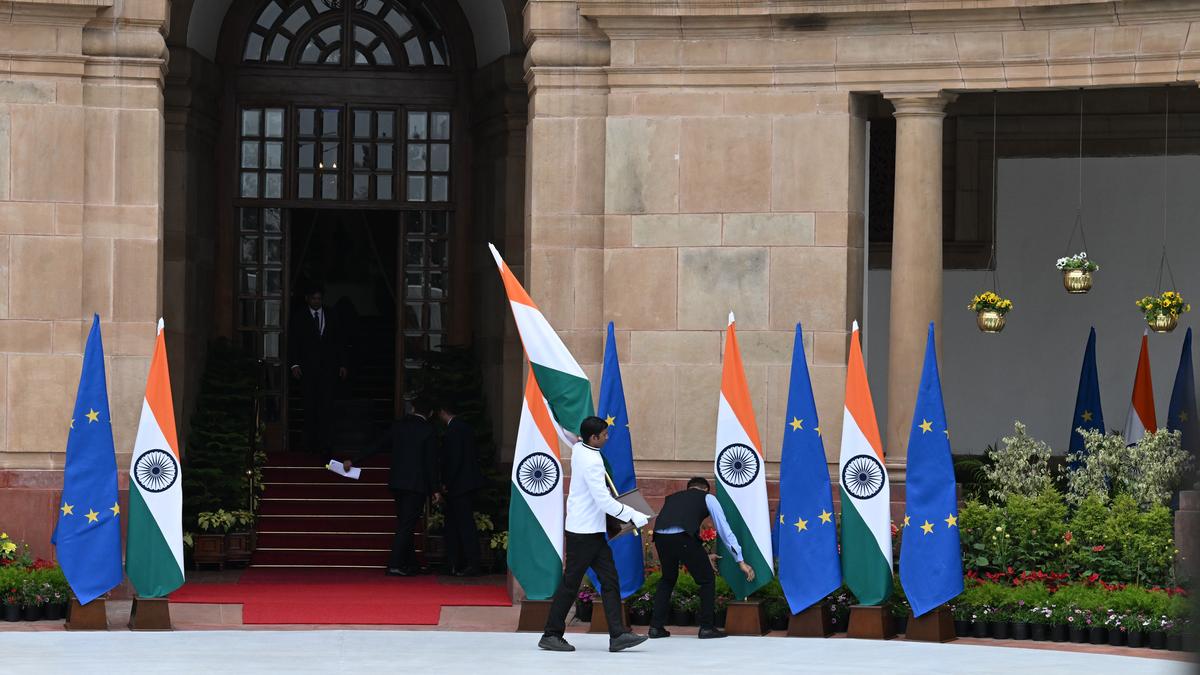
Reference image accompanying the India–EU FTA report, not confirmation of a signing ceremony. Tariff concessions would begin only after entry into force, subject to implementation schedules.
Image: The Hindu
Why in news
The Hindu reports that the India–EU FTA is likely to be signed during Prime Minister Narendra Modi’s proposed December visit to Brussels. The European Commission has submitted proposals to the Council of the European Union for authorisation to sign and conclude the agreement, alongside the final legal text and tariff schedules.
93%
Indian shipments promised duty-free access
27
EU member countries
About 2 billion
Combined market population
25%
Combined share of global GDP
About USD 11 trillion
Combined share of international trade by value
Background
A Free Trade Agreement provides preferential trading conditions among its parties, usually by reducing tariffs and addressing selected barriers to goods and services trade. Unlike a customs union, an FTA does not require a common external tariff; rules of origin determine which products qualify for preferences. The EU operates a common commercial policy, with the European Commission negotiating trade agreements under authorisation from the Council of the European Union. The supplied report identifies the EU as India’s largest goods-trading partner among individual blocs, making the agreement significant for India’s export diversification and integration into international production networks.
What is reported, and what remains unconfirmed
The two sides concluded negotiations on January 27, 2026. Signing is now reported as likely on December 16, while the EU Ambassador has indicated that the agreement is expected to come into force in 2027. These are prospective milestones, not evidence that the agreement is already operational.
The report states that 93% of Indian shipments will receive duty-free access and that imports of EU luxury cars and wines will become less expensive. It does not supply product-level tariff schedules, staging periods, exclusions or detailed services commitments. The shipment figure should not be reinterpreted as coverage of tariff lines or as immediate liberalisation across all exports.
- Treat the proposed signing date and expected commencement year as reported expectations.
- Distinguish headline coverage from the timing and conditions of individual concessions.
- Do not infer visa liberalisation, recognition of qualifications or regulatory exemptions from the available report.
Infographic
Market access
Reported duty-free access for 93% of Indian shipments.
Services
Assess actual commitments; do not assume mobility rights.
Standards
Tariff preferences do not waive regulatory compliance.
Competitiveness
Productivity, logistics and quality determine utilisation.
Legal commencement
Signing, entry into force and tariff staging are distinct.
AI-assisted infographic by Pragnya IAS Academy, based on the cited sources.
Goods market access: preference must become usable advantage
Duty-free access can improve the relative price competitiveness of eligible Indian products in the EU. A large destination market can support export diversification, investment and production at scale, but tariff removal does not guarantee orders or higher export earnings.
Realised gains will depend on rules of origin, documentation costs, logistics, product quality and exporters’ ability to meet delivery requirements. On the import side, lower duties can expand consumer choice and intensify competition for domestic producers; the report specifically anticipates cheaper EU luxury cars and wines.
- Trade creation occurs when lower barriers shift sourcing towards more efficient partner-country suppliers.
- Trade diversion can occur when preferences favour a partner over a more efficient non-member supplier.
- MSMEs may need shared testing facilities and practical origin-certification support to use preferences.
- Sectoral adjustment should be assessed against actual tariff schedules rather than headline liberalisation claims.
Services: commitments matter more than general promises
Services are central to assessing the agreement’s value for India. Commercial opportunities depend not only on formal market opening but also on licensing, recognition of professional qualifications, data-protection requirements and the temporary movement of service suppliers.
The supplied report does not establish what the FTA provides on these issues. Any claim of improved professional mobility or automatic recognition would therefore be premature. Temporary movement under services trade must also be distinguished from general immigration rights or unrestricted access to employment.
- Examine commitments separately for cross-border supply, consumption abroad, commercial presence and movement of natural persons.
- Assess whether regulatory procedures make scheduled services commitments commercially usable.
- Do not assume an FTA overrides EU data-protection rules or domestic professional licensing requirements.
Regulatory standards and Indian competitiveness
Tariff preferences do not remove the obligation to comply with applicable food-safety, technical, environmental and consumer-protection rules. Sanitary and phytosanitary measures and technical regulations can serve legitimate public purposes, while opaque or unnecessarily restrictive implementation can impede trade.
For Indian firms, the strategic response is to improve quality infrastructure, traceability, testing capacity and resource efficiency. Regulatory cooperation could reduce duplication where legally agreed, but the report does not establish any mutual-recognition arrangement or exemption from EU environmental requirements.
- Prioritise accredited laboratories, certification capacity and accessible compliance guidance.
- Improve productivity, logistics and reliable input supply alongside tariff negotiations.
- Seek transparent implementation and consultation without diluting legitimate health or environmental safeguards.
Signing is not entry into force
Signing is a formal treaty milestone; entry into force is governed by the agreement’s commencement provisions and completion of the necessary approval procedures. The Council’s authorisation to sign and its decision to conclude an agreement are distinct steps. For an EU FTA, European Parliament consent is required for conclusion; additional national procedures depend on whether the agreement includes matters requiring member-state participation.
In India, treaty-making falls within executive authority, while Article 253 empowers Parliament to legislate for implementing treaties and international agreements. Not every treaty requires a parliamentary ratification vote, but implementation must comply with domestic law and may require legislative or administrative changes. Provisional application is possible only where legally provided and authorised; the report does not establish that it is planned here.
- The Commission’s submission of proposals is not equivalent to completed EU approval.
- Even after entry into force, particular tariff reductions may follow phased schedules.
- Exporters should rely on official commencement notifications and applicable schedules, not the signing announcement alone.
| Stage | Meaning and implication |
|---|---|
| Conclusion of negotiations | The negotiated outcome is settled; this does not itself make concessions operational. |
| Signing | A formal treaty step following the required authorisation; it does not by itself establish that preferential tariffs apply. |
| Approval and conclusion | Relevant institutions complete the applicable procedures for consent to be bound. |
| Entry into force | The agreement becomes legally operative under its commencement provisions. |
| Implementation of concessions | Specific benefits apply according to tariff schedules, origin requirements and implementing measures. |
- 1. Confirm that the agreement or relevant provisions are legally operational.
- 2. Identify the product’s tariff classification and applicable concession schedule.
- 3. Verify compliance with the agreement’s rules of origin.
- 4. Meet applicable EU safety, technical and other regulatory requirements.
- 5. Provide the required origin and customs documentation to claim preferential treatment.
January 27, 2026
India and the EU concluded negotiations, according to the report.
Ahead of the proposed signing
The European Commission submitted proposals for signing and conclusion to the Council, with the final legal text and tariff schedules.
December 16, 2026 — proposed
The agreement is likely to be signed during the Prime Minister’s proposed Brussels visit.
2027 — expected
The EU Ambassador indicated expected entry into force; actual commencement depends on the required procedures and treaty provisions.
Significance, challenges & way forward
Significance
- Preferential access can strengthen India’s export diversification and participation in international production networks.
- More predictable trading conditions can support investment decisions and longer-term commercial partnerships.
- Import competition can encourage productivity improvements while expanding consumer choice.
- The agreement’s services value will depend on the depth and practical usability of commitments, not goods-market access alone.
- Closer economic engagement can broaden the strategic relationship between India and the EU.
Challenges
- Headline tariff coverage may conceal exclusions, phased reductions or difficult origin requirements.
- Compliance and certification costs can prevent smaller firms from using preferences effectively.
- Domestic producers exposed to stronger import competition may face uneven adjustment pressures.
- Services access can remain constrained by licensing, qualification recognition and mobility requirements.
- Approval procedures and domestic implementation create uncertainty between expected signing and actual commencement.
Way forward
- Publish accessible product-wise guidance on concessions, exclusions, staging and rules of origin once officially available.
- Build MSME readiness through shared laboratories, certification assistance and exporter helpdesks.
- Evaluate services commitments separately for market access, professional mobility, qualification recognition and regulatory procedures.
- Support affected producers through productivity enhancement, skills development and lawful adjustment measures.
- Track preference utilisation and sectoral outcomes rather than treating aggregate trade growth as the sole measure of success.
- Communicate signing, approval, entry into force and phased implementation as separate milestones.
Key terms
- Free Trade Agreement
- An agreement providing preferential trading conditions among parties without necessarily creating a common external tariff.
- Rules of origin
- Criteria used to determine whether a product qualifies as originating in a partner country for preferential treatment.
- Tariff staging
- The scheduled reduction or elimination of duties over an agreed implementation period.
- Sanitary and phytosanitary measures
- Measures addressing food safety and specified risks to human, animal or plant life or health.
- Technical barriers to trade
- Trade issues arising from technical regulations, standards and conformity-assessment procedures.
- Mode 4 services supply
- Supply of services through the presence of natural persons, distinct from general immigration or permanent employment rights.
- Entry into force
- The point at which an agreement becomes legally operative under its commencement provisions.
- Preference utilisation
- The extent to which eligible trade actually uses the preferential treatment available under an agreement.
Link with static syllabus
Prelims practice MCQs
Q1. With reference to the prospective India–EU FTA, consider the following statements: 1. Signing necessarily makes all tariff concessions operational immediately. 2. Entry into force depends on the agreement’s commencement provisions and applicable approval procedures. 3. Individual tariff concessions may be phased even after entry into force. Which of the statements given above are correct?
Q2. Consider the following statements about free trade agreements: 1. They necessarily require members to adopt a common external tariff. 2. Rules of origin help determine eligibility for preferential tariff treatment. 3. Duty-free access automatically exempts imported products from applicable safety standards. Which of the statements given above is/are correct?
Q3. Which of the following correctly describes Mode 4 under the General Agreement on Trade in Services?
Q4. With reference to treaty implementation in India, consider the following statements: 1. Article 253 empowers Parliament to make laws for implementing treaties and international agreements. 2. Every treaty must receive a parliamentary ratification vote before the executive can conclude it. Which of the statements given above is/are correct?
Mains practice questions
GS 3 · 15 marks · 250 words
The prospective India–EU Free Trade Agreement offers market access, but competitiveness will determine the gains. Evaluate with reference to goods, services and regulatory standards, distinguishing signing from entry into force.
Frequently asked questions
Has the India–EU FTA already entered into force?
Not according to the supplied report. Signing is expected in December 2026 and entry into force in 2027, subject to the applicable procedures and agreement provisions.
Does the 93% figure mean all covered exports become duty-free on signing?
No. The report states that 93% of Indian shipments will enjoy duty-free access, but does not establish immediate application, product-level coverage or staging periods.
Will the FTA automatically make it easier for Indians to work in the EU?
The supplied report does not establish any such commitment. Temporary movement of service suppliers, where agreed, is distinct from general employment or immigration rights.
Why do regulatory standards matter after tariffs are removed?
Products must still satisfy applicable safety, technical and other regulatory requirements. Testing, certification and traceability costs can determine whether exporters can actually use preferential access.
Sources
Analysis prepared by the Pragnya IAS Academy current-affairs desk with AI assistance from the cited reports. Verify figures with the original sources.
Turn current affairs into marks
Join Pragnya IAS Academy's mentorship for daily answer-writing evaluation on stories like this — classroom programmes from a trusted name in IAS coaching in Hyderabad.